
Two cheers for good personal hygiene, but do we really want mermaids and centaurs to share the same bathroom at the same time?

Hat tip: @AliceDreger (more creative restroom signs here)
Two cheers for good personal hygiene, but do we really want mermaids and centaurs to share the same bathroom at the same time?
Hat tip: @AliceDreger (more creative restroom signs here)
Say what? Is the apparent anomaly in this recent NPR/PBS poll (see screenshot below) evidence of a historic electoral paradigm shift or just evidence of too small a sample?

Hat tip: Tyler Cowen

Our Lady of Ocasio! Hat tip: @Vermeullarmine
Check out this fascinating report by Michael P. Regan (hat tip: Drudge) about the Jamaica Stock Exchange (JSE), the world’s best-performing stock market. Here is an excerpt: “Jamaican stocks have surged almost 300 percent [over the past five years], more than quadrupling the next-best-performing national benchmark and septupling the S&P 500’s advance…. What explains these gains? A Caribbean economic miracle the world has overlooked? Not exactly: Real growth in Jamaica has averaged less than 1 percent the past four years, and it’s expected to come in at 1.7 percent for 2018. The bull market is partly a matter of math. It doesn’t take much investment to make a tiny market boom, and the total value of the 37 stocks in the main Jamaica index is less than $11 billion, smaller than the valuation of Chipotle Mexican Grill Inc. But it’s also a story about Kingston’s nascent attempts to reinvent itself as a financial hub, even as it works to reduce the heavy debt load that brought the country to the brink of crisis a decade ago.”
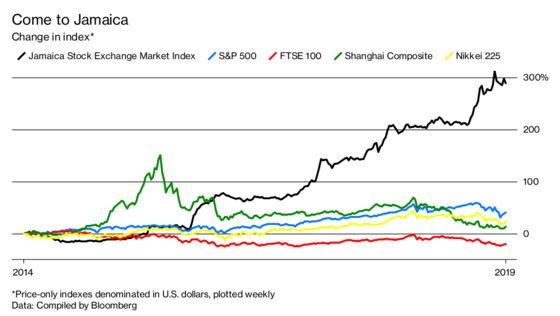
Source: Bloomberg|Quint
Happy Friday! Below are the first two paragraphs of my latest paper “Domestic Constitutional Violence,” which is now available here via SSRN (the footnotes are below the fold):
“We often associate violence with extra-legal behavior[1] or with the dark side of law enforcement.[2] But violence has also played a pivotal role in our nation’s history and in the development of constitutional law. Simply put, our government has often resorted to acts of “constitutional violence”[3] to effectuate major constitutional change. Consider the stain of slavery. From a practical perspective, it was not the formal enactment of the Thirteenth Amendment that eradicated this peculiar institution. Rather, it was the blood spilled in such costly battles as Bull Run, Chickamauga, and Gettysburg that settled the festering constitutional question of slavery once and for all.[4] The same logic applies to school desegregation and the Little Rock Crisis of 1957. From a practical perspective, it was not the Supreme Court’s landmark decision in Cooper v. Aaron[5] that diffused the crisis or that ended school desegregation. Rather, it was President Dwight D. Eisenhower’s reluctant decision to send paratroopers of the 101st “Screaming Eagles” Airborne Division into Arkansas in 1957, a full year before the Supreme Court’s decision in Cooper, that desegregated the iconic Central High School and changed the course of U.S. civil rights .[6]
“In short, momentous constitutional questions are often decided not through ordinary legal channels but by force. But the use of force to effectuate constitutional change poses a constitutional puzzle. In particular, what is the relation between violence and the overall legal system of government created by the Constitution? After all, the federal courts and the Congress do not have their own armies to enforce their decisions or laws. So, as a matter of constitutional first principles, one could argue that a president is acting “within” the law when he uses military force to enforce a law or court order, but at the same time, isn’t the use of military force totally antithetical to the idea of a republican constitution?[7] If so, is there any viable solution to this logical paradox? Eisenhower’s fateful decision to resort to military force during the Little Rock Crisis thus poses a constitutional paradox.[8] Was his use of force itself lawful, and if so, what are the outer limits to this power?”
According Ryan Struyk (via CNN), “the US has been in a perpetual state of declared national emergency for four decades, and the country is currently under 31 concurrent states of emergency ….” Do these multiple cries of alarm sound familiar?


What’s up, doc? The first edition of Book One of Miguel de Cervantes’s Don Quixote (El ingenioso hidalgo Don Quijote de la Mancha), the first modern novel according to Harold Bloom, was published on this day in 1605 in Madrid.

Update (1/17): The paper is now posted on SSRN.
That is the title of my most recent scholarly paper, which I am currently in the process of editing and which will be published in a symposium issue of the Arkansas Law Review this spring. I will be posting an open-access draft of my paper on SSRN (and on this blog) later this week, but in the meantime, here is my abstract:
My paper reframes the 1957 Little Rock Crisis as a paradigm case of domestic constitutional violence, i.e. the power and duty of the president to use military force to preserve, protect, and defend the Constitution. First, my paper revisits two obscure Little Rock cases that unsuccessfully attempted to challenge the legality of President Eisenhower’s decision to send paratroopers to Arkansas to desegregate Central High School. Although neither case reached the U.S. Supreme Court, they pose important questions about the legality of domestic constitutional violence in disputes over the meaning of the Constitution. Next, my article explores some potential sources of law authorizing the use of constitutional violence. In brief, there is an over 200-year body of law regulating the use of domestic constitutional violence. On the one hand, the Constitution itself anticipates the possibility of “domestic Violence”; on the other, the Congress has delegated a specific set of powers to the president to deal with certain classes of domestic dangers. Lastly, I conclude by proposing that we call this body of law “the laws of national necessity.”

Credit: Medi Berlortaja (h/t @pickover)










Welcome to the online home of the IASS
Hopefully It’s Interesting.
In Conversation with Legal and Moral Philosophers
dr hab. prof. UJ, Jagiellonian University
Books, papers, and other jurisprudential things
Ramblings of a retiree in France
BY GRACE THROUGH FAITH
Natalia's space
hoping we know we're living the dream
Lover of math. Bad at drawing.
We hike, bike, and discover Central Florida and beyond
Making it big in business after age 40
Reasoning about reasoning, mathematically.
I don't mean to sound critical, but I am; so that's how it comes across
remember the good old days...
"Let me live, love and say it well in good sentences." - Sylvia Plath
a personal view of the theory of computation
Logic at Columbia University
Just like the Thesis Whisperer - but with more money
the sky is no longer the limit
Technology, Culture, and Ethics
Just like the horse whisperer - but with more pages
Poetry, Other Words, and Cats


