Oh, the irony! Allen and Pardo’s relative plausibility view of proof is just as subjective as the Bayesian view

Note: This post is part 7 of our extended review of Allen & Pardo’s new paper on juridical proof “Relative plausibility and its critics.”

We replied to the pesky conjunction problem in our previous post. Today, we will discuss the irony of Allen and Pardo’s two most serious objections to the Bayesian or subjective view of juridical proof. In short, Allen and Pardo assert that subjective probability is subjective, and that being purely subjective, this account bears “no relationship to advancing accurate outcomes” in legal trials (p. 10). Say what? By definition, it’s true that subjective probability is subjective. In fact, all methods of decision-making under uncertainty are subjective! As such, the irony of Allen and Pardo’s bald assertions does not escape us, since the same could be said of their pet theory of relative plausibility! Think about it: just because explanation A is more plausible or persuasive than a competing explanation (explanation B) does not, by itself, make explanation A true, especially if the individual probabilities of A and B are each below 0.5 or don’t add up to 1. The question, then, is not whether judgments about evidence are subjective or not–all are–; the question is which view of proof generates less inaccuracy. Continue reading

Posted in Uncategorized | 1 Comment

The conjunction problem is not a problem for Bayesians

Note: This post is part 6 of our ongoing review of Allen & Pardo’s explanatory account of juridical proof.

We have been reviewing Ron Allen and Mike Pardo’s excellent paper, “Relative plausibility and its critics.” We agree with their critique of objective probability in law, so in the next few posts, we will restate and answer, point by point, their objections to subjective or Bayesian probability. (In the process, we hope to show why our Bayesian view of proof provides a better explanation of juridical proof than Allen and Pardo’s relative plausibility theory.) Here, we will turn our attention to the so-called conjunction problem. Continue reading

Posted in Uncategorized | Leave a comment

Levels of coercion

As the infographic below shows, there are various ways of using law to reduce a harm or “negative externality,” to use the lingo of economics. These methods include (1) flat out prohibition, (2) Pigovian taxes, (3) contracts, and (4) doing nothing, i.e letting the market determine what the optimal level of harm is. (In the case of plastic bags, it looks like method #4 is the dominant approach.) Which method is best?

https://i.redditmedia.com/LV0WAZAReM08Y9w9doewOWHJFPbkMDyNausQQrqQ8LQ.jpg?s=3410f614dbf5044f010f2925a6c77193

hat tip: u/ohzemartins, via Reddit

Posted in Uncategorized | Leave a comment

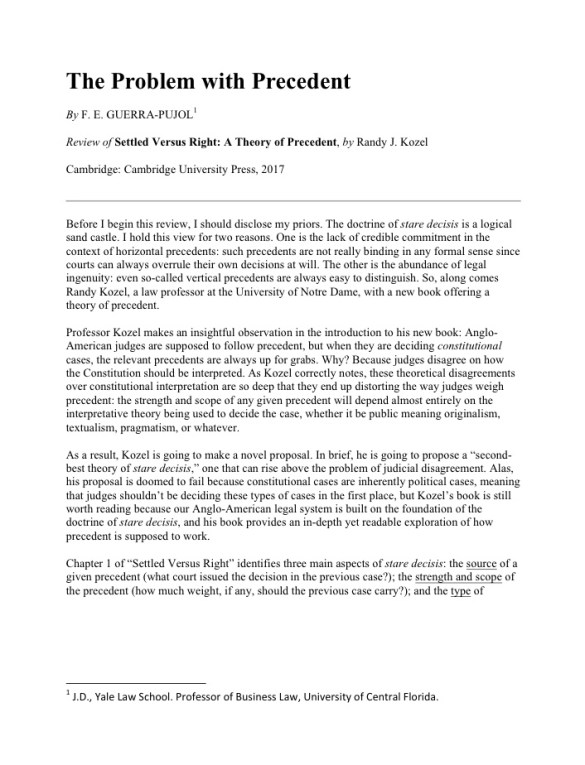
The problem with precedent

That is the title of my review of Randy Kozel’s excellent book “Settled Versus Right: A Theory of Precedent.” My essay is now posted on SSRN, the first page of which is included below:

Page 1 of 7

Posted in Uncategorized | Leave a comment

The problem with stories

We’ve been meaning to write up a scholarly critique of Richard Delgado’s law review article titled “A plea for narrative,” which was published in the pages of the Michigan Law Review, vol. 87 (1989), pp. 2411-2441. (Professor Delgado’s classic paper has been cited over 2600 times according to Google Scholar, and it was assigned reading for the first annual Margaret Montoya Legal Writing Retreat that we attended last month.) So, without further ado, here it goes: while we generally that lawyers are essentially storytellers and that stories are a forceful means of communicating ideas, there are three potential problem with storytelling. Professor Delgado identifies two of these perennial problems in footnote 87 of his paper (internal citations omitted):

There are dangers in storytelling …. The hearer of an unfamiliar [story] may reject it, precisely because the story unmasks hypocrisy and increases discomfort. *** Or, the hearer may consciously or unconsciously reinterpret the story, in light of the hearer’s own belief system and inventory of stock stories, so as to blunt, or even reverse [!], its meaning.

In other words, stories can actually strengthen the audience’s preexisting biases (the problem of confirmation bias) or produce an unintended polarizing effect (the problem of polarization). But these problems, in turn, are symptoms of a much deeper storytelling dilemma, one that Delgado does not address in his essay. I will dub this dilemma the “truth-value problem.” (This quandary is also referred to pejoratively as “just-so stories” in the philosophy of science literature. According to Wikipedia, a just-so story is “an unverifiable narrative explanation for a cultural practice, a biological trait, or behavior of humans or other animals.” As a further aside, Professor John Alcock writes in his 2003 book The Triumph of Sociobiology that the term just-so story is “one of the most successful derogatory labels ever invented.”) But as Professor Delgado correctly notes in his 1989 paper, storytelling is not just an indispensable feature of law practice; it is also a crucial part of human culture. So, how are we to respond to the “just-so story” label?

One response is to openly acknowledge the truth-value problem. Another response–one consistent with Professor Delgado’s scholarly project–is to tell better stories. (Exhibit A: Harper Lee’s “To Kill a Mockingbird.”) Yet another response is to change the incentive structure of scholarly work by rewarding “academic storytelling.” Most legal scholarship is either descriptive (telling us how what the law is; i.e. how the law plays out in the real world) or normative (telling us what the law ought to be; how the law should play out in an ideal world). There is no reason in principle why we can’t have a third category of “scholarly storytelling.” Even if most such stories in this third canon are unable to counteract or negate the polarization, confirmation bias, and truth-value problems we have identified in this post, all it takes is a few good stories to enrich our understanding of the world …

Image result for to kill a mockingbird
Posted in Uncategorized | Leave a comment

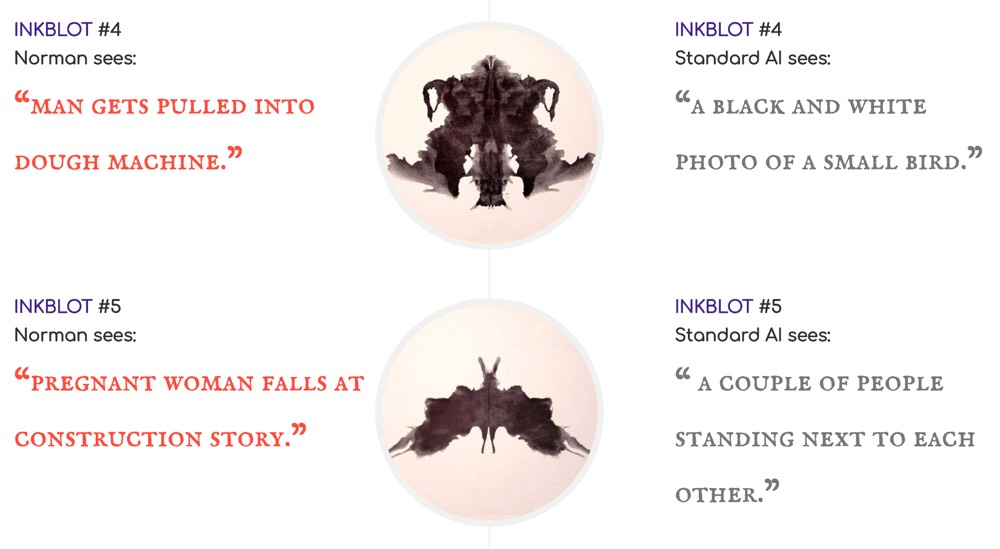
AI meets Rorschach inkblots

In case you’ve ever wondered what would happen if artificial intelligence were trained to perform image captions of Rorschach inkblots, this crazy website created by researchers at the MIT Media Lab is for you. Here are some sample Rorschach inkblots with AI generated captions:

Norman AI

Hat tip: kottke.

Posted in Uncategorized | Leave a comment

Arctic Circle Dispute

hat tip: u/nihilismdebunked, via Reddit

Posted in Uncategorized | Leave a comment

#DueProcess #PassiveVirtues

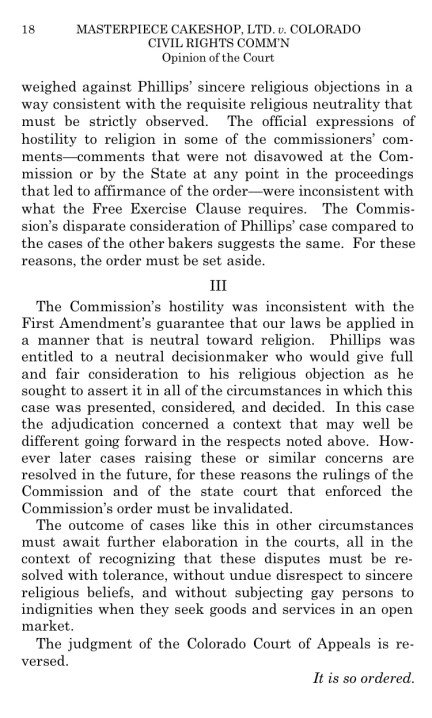
SCOTUS announced its decision in the Colorado gay wedding cake case yesterday (4 June). In brief, the Court side-stepped the main substantive issue (is baking a wedding cake a form of expression under the First Amendment?) and decided the case on procedural grounds instead: litigants are entitled to a neutral decision maker, even in administrative law cases! (See, in particular, Part III of the Court’s majority opinion, pictured below.) In other words, this is more of a Fourteenth Amendment case (procedural due process) and less of a First Amendment case (free exercise of religion).

#PassiveVirtues #AlexanderBickel

Posted in Uncategorized | Leave a comment

Probability in plain words (review of Allen and Pardo, part 5)

As we mentioned in a previous post (part 4 of our review of Allen and Pardo’s relative plausibility paper), “plausibility”, however defined, is just another word for “probability.” Yet, this notion of plausibility, though simple and intuitive, is a crude concept at best–not because it eschews the use of numerical values; but rather because it expresses only one shade of the probability continuum. It turns out there are many different words and phrases to describe many different levels of probability. [See chart below. More details are available here (via Wikipedia) and here too (via the CIA Library).] The main point (the one most relevant to the legal proof literature) is that we don’t always need to express our probabilities (or subjective degrees of belief) using numerical values. Words can work just fine, but we will need more than one word.

Image result for Words of estimative probability
Posted in Uncategorized | 2 Comments

Against relative plausibility (review of Allen and Pardo, part 4)

We have been reviewing Ron Allen and Mike Pardo’s excellent paper on “relative plausibility,” and as we mentioned in our previous post, we commend their relative plausibility theory of juridical proof for its simplicity. In brief, their theory is that jurors in civil and criminal cases compare and evaluate competing explanations of the evidence presented at trial. In civil cases, where the standard of proof is the preponderance of the evidence, the side with the most plausible explanation of the evidence, i.e. the side who offers the best explanation of the evidence, wins. In criminal cases, where the standard of proof is beyond a reasonable doubt, the defense wins if it offers any plausible explanation of the evidence consistent with the accused’s innocence. Continue reading

Posted in Uncategorized | 1 Comment