
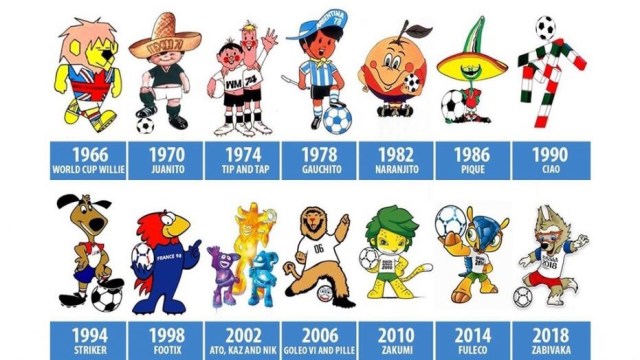
Which precursor to the Stars & Stripes do you like the best?

Happy Flag Day! (source: popchartlabs.com)
Which precursor to the Stars & Stripes do you like the best?
Happy Flag Day! (source: popchartlabs.com)
We’ve just read Frederick Schauer’s review of Randy Kozel’s excellent book “Settled Versus Right: A Theory of Precedent,” Cambridge University Press, 2017. (Schauer’s paper is provocatively titled “On treating unalike cases alike” and is posted on SSRN here. Hat tip: Larry Solum. As an aside, our own review of Kozel is available via SSRN here.) So, before we conclude our review of Ron Allen and Mike Pardo’s relative plausibility paper, we want to highlight one of our favorite passages from Professor Schauer’s review:
… precedential constraint … is not about treating like cases as alike. On the contrary, precedential constraint is about treating cases that are somewhat alike and somewhat different as being alike for purposes of precedential constraint. It is about treating the similarities as relevant and the differences as irrelevant, and about deciding which similarities matter and which do not. Thus, identifying what is a precedent for what is about attributing or ascribing likeness; and it is not about discovering, locating, or unearthing likeness. Determining precedential similarity … entails the question of what a decision-maker in the instant case deems to be similar, and not about what is actually similar in some deeper ontological sense.
Professor Schauer’s powerful critique of Aristotle’s axiom (see image below) is also worth noting. In fact, Schauer begins his review of Kozel thus: “Perhaps we should blame Aristotle. In his enduring discussion of justice in the Nicomachean Ethics, Aristotle offered the now-ubiquitous maxim that like cases should be treated alike” (footnote omitted). Despite the intuitive appeal of Aristotle’s axiom, Schauer frankly acknowledges “the almost complete emptiness of the ‘treat like cases alike’ maxim.” Why is this celebrated maxim empty, a mere tautology? Because as Schauer correctly notes, “Given that any two items in the world share some but not all of the properties of the respective items, any two items can be deemed alike in some respects and unalike in others, thus making the mere idea of likeness or unlikeness singularly unhelpful.” In short, we need some independent criterion of likeness “to make the maxim anything other than a largely useless tautology.”
So, what criterion (or criteria) should judges use when deciding whether two unalike cases are sufficiently similar to be treated alike? That is the $64 question, and your guess or theory is as good mine!

Credit: Shawn Copeland
Note: This is our penultimate post on Allen & Pardo’s paper “Relative plausibility and its critics.”
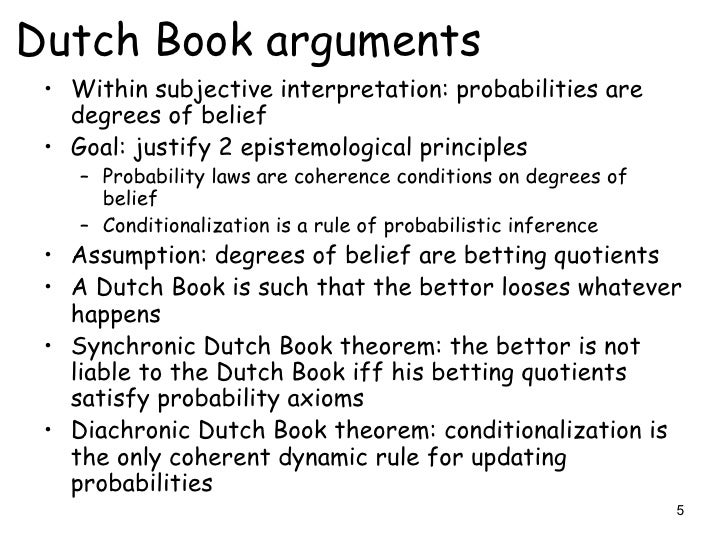
We defined subjective probability in terms of “degrees of belief” in our previous post. Here, we will consider Ron Allen and Mike Pardo’s relative plausibility theory in light of the Dutch book theorem, but first, let’s explore the connection between degrees of belief and betting behavior, for this connection is what subjective probability is all about and shows why subjective probability is more logical and mathematically rigorous than relative plausibility. (Like our previous post, we include a bibliography below.)
On the subjective probability view of proof, a juror’s decision is like a bet on which party is telling the truth about the facts of the case. So, let Pr(∏) be the probability that the plaintiff is presenting the truth about the facts of case A, and let  be the probability space containing all possible outcomes of case A, e.g. jury verdicts going 12-0, 11-1, 10-2, etc., or jury verdicts going 6-0, 5-1, 3-2, etc., depending on the composition of the jury. (Recall that most verdicts are collective decisions in Anglo-American trials with 12-man or 6-man juries.)
By a bet on ∏ ∈ Â we mean a contract between a bettor and a bookie whereby the bookie agrees to pay the bettor the amount $a if the plaintiff prevails and the bettor agrees to pay the bookie the amount $b if the defendant prevails. The stake of this bet is the sum $(a + b), and bettor’s odds is the ratio a ⁄ b. If Pr is the bettor’s subjective degree of belief function, the expected monetary value of the bet to him is [$a × Pr(∏)] − [$b × Pr(1 − ∏)].
The bet is a fair one if the expected value of the bet is zero. The bet is favorable (to the bettor) if the expected value of the bet is positive. And the bet is unfavorable to him if the expected value of the bet is negative. In algebraic notation, the condition for a fair bet, i.e. the bettor’s fair betting quotient, comes to Pr(∏) = b/(a + b ). If Pr(∏) = x is your degree of belief in ∏, then you should be willing to bet on ∏ as follows:
| EVENT | PAY TO BOOKIE | COLLECT FROM BOOKIE | NET |
| ∏ is true (plaintiff prevails) | xY | 0 | −xY |
| ∏ is false (defendant prevails) | xY | Y | (1 − x)Y |
According to the Dutch book theorem, if your degrees of belief fail to conform to the axioms of probability (i.e.: Pr(∏) + Pr(1 − ∏) = 1), then your net will always be negative. (For a formal proof of the Dutch Book Theorem, see Paris, 2001; Kemeny, 1955; Earman, 1992, p. 39.)
Why is the Dutch Book Theorem relevant to the literature on juridical proof? Because subjective beliefs that are logically coherent–i.e. that conform to the axioms of probability–are more likely to be accurate. (See Joyce, 2009; Williams, 2012.) The same, however, cannot be said for beliefs held under Allen and Pardo’s less demanding relative plausibility theory. Why not? Because the relative plausibility approach is susceptible the unknown probability space problem. Allen and Pardo not only “reject the assumption that the plaintiff’s explanation [in civil cases] must fill more than half of the possible probability space” (Allen & Pardo, 2018, p. 26); by their own admission, their theory of relative plausibility does not require the competing explanations of the evidence to add up to 1. Consider Allen & Pardo’s own preferred example, “where a [juror] concludes that a plaintiff’s explanation is 0.4 likely and a defendant’s explanation is 0.2 likely….” (Ibid.) Last we checked, 0.4 + 0.2 = 0.6, so what about the remaining 0.4 probability? It’s getting Dutch booked by creative trial lawyers!
To sum up, although numerical values are not needed to operationalize a subjective probability account of proof, one of the advantages of the subjective approach is that it is more logical and mathematically rigorous than Allen and Pardo’s relative plausibility theory. In addition, as we have mentioned in a previous post, the other major problem with Allen & Pardo’s approach is that they neglect the collective nature of jury voting. In our next post, our final one in this series, we will explain why the collective nature of jury voting lends itself to a subjective or Bayesian view of proof.
Bibliography
John Earman, Bayes or bust? A critical examination of Bayesian confirmation theory, MIT Press (1992).
James M. Joyce, “Accuracy and coherence: prospects for an alethic epistemology of partial belief,” in Franz Huber and Christoph Schmidt-Pierre, editors, Degrees of belief, Springer (2009), pp. 263-297.
Daniel Kahneman & Amos Tversky, “Subjective probability: a judgment of representativeness,” Cognitive Psychology, Vol. 3, no. 3 (1972), pp. 430-454.
G. Kemeny, “Fair bets and inductive probabilities,” Journal of Symbolic Logic, Vol. 20 (1955), pp. 263-273.
B. Paris, “A note on the Dutch book method,” in The Proceedings of the Second International Symposium on Imprecise Probabilities and Their Applications, Shaker Publishing (2001), pp. 301-306.
Abner Shimony, “Coherence and the axioms of confirmation,” Journal of Symbolic Logic, Vol. 20 (1955), pp. 1-28.
Robert G. Williams, “Money and truth: Dutch books and accuracy domination,” Journal of Philosophical Logic, Vol. 41, No. 5 (October 2012), pp. 811-840.
Credit: Frederica Russo
Note: This post is part 8 of our review of Ron Allen & Mike Pardo’s paper “Relative plausibility and its critics.” If you are already familiar with the subjectivist ideas of Frank Ramsey (1931) and Bruno de Finetti (1974), you can skip today’s post.
We have spent a significant amount of time and mental energy comparing and contrasting our Bayesian or “subjective probability” view of juridical proof with Ron Allen and Mike Pardo’s alternative theory of relative plausibility, but we just realized that we haven’t yet defined what we mean by subjective probability. So, before we address Allen and Pardo’s final objection to subjective probability, we thought we would take a moment to explain subjective probability, especially for those of you who may not be familiar with the work of our intellectual heroes Frank Ramsey or Bruno de Finetti. (Because this post is somewhat technical, we include a formal bibliography below.) Continue reading
Note: This post is part 7 of our extended review of Allen & Pardo’s new paper on juridical proof “Relative plausibility and its critics.”
We replied to the pesky conjunction problem in our previous post. Today, we will discuss the irony of Allen and Pardo’s two most serious objections to the Bayesian or subjective view of juridical proof. In short, Allen and Pardo assert that subjective probability is subjective, and that being purely subjective, this account bears “no relationship to advancing accurate outcomes” in legal trials (p. 10). Say what? By definition, it’s true that subjective probability is subjective. In fact, all methods of decision-making under uncertainty are subjective! As such, the irony of Allen and Pardo’s bald assertions does not escape us, since the same could be said of their pet theory of relative plausibility! Think about it: just because explanation A is more plausible or persuasive than a competing explanation (explanation B) does not, by itself, make explanation A true, especially if the individual probabilities of A and B are each below 0.5 or don’t add up to 1. The question, then, is not whether judgments about evidence are subjective or not–all are–; the question is which view of proof generates less inaccuracy. Continue reading
Note: This post is part 6 of our ongoing review of Allen & Pardo’s explanatory account of juridical proof.
We have been reviewing Ron Allen and Mike Pardo’s excellent paper, “Relative plausibility and its critics.” We agree with their critique of objective probability in law, so in the next few posts, we will restate and answer, point by point, their objections to subjective or Bayesian probability. (In the process, we hope to show why our Bayesian view of proof provides a better explanation of juridical proof than Allen and Pardo’s relative plausibility theory.) Here, we will turn our attention to the so-called conjunction problem. Continue reading
As the infographic below shows, there are various ways of using law to reduce a harm or “negative externality,” to use the lingo of economics. These methods include (1) flat out prohibition, (2) Pigovian taxes, (3) contracts, and (4) doing nothing, i.e letting the market determine what the optimal level of harm is. (In the case of plastic bags, it looks like method #4 is the dominant approach.) Which method is best?

hat tip: u/ohzemartins, via Reddit
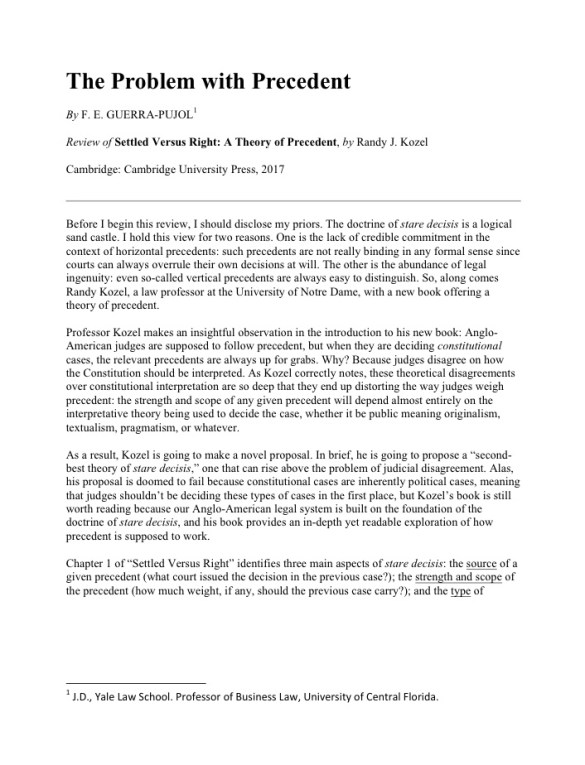
That is the title of my review of Randy Kozel’s excellent book “Settled Versus Right: A Theory of Precedent.” My essay is now posted on SSRN, the first page of which is included below:
Page 1 of 7







Welcome to the online home of the IASS
Hopefully It’s Interesting.
In Conversation with Legal and Moral Philosophers
Relitigating Our Favorite Disputes
PhD, Jagiellonian University
Inquiry and opinion
Life is all about being curious, asking questions, and discovering your passion. And it can be fun!
Books, papers, and other jurisprudential things
Ramblings of a retiree in France
BY GRACE THROUGH FAITH
Natalia's space
hoping we know we're living the dream
Lover of math. Bad at drawing.
We hike, bike, and discover Central Florida and beyond
Making it big in business after age 40
Reasoning about reasoning, mathematically.
I don't mean to sound critical, but I am; so that's how it comes across
remember the good old days...
"Let me live, love and say it well in good sentences." - Sylvia Plath
a personal view of the theory of computation
Submitted For Your Perusal is a weblog wherein Matt Thomas shares and writes about things he thinks are interesting.
Logic at Columbia University
Just like the Thesis Whisperer - but with more money
the sky is no longer the limit
Technology, Culture, and Ethics
Just like the horse whisperer - but with more pages
Poetry, Other Words, and Cats

 prior probability