Signaling theory (iPhone X edition)

Is iPhone X the new Blackberry? According to Square Trade, the iPhone X is not only the most breakable smartphone ever made; it’s also the most expensive to repair. So, can anyone explain to us why Apple addicts (like this one) still want (need?) to signal their fiendish devotion to Apple’s overrated and overpriced products?

Posted in Uncategorized | Leave a comment

Not again

Perhaps there is no way to prevent evil men from killing innocent people, but there is a way of making those who profit from these killings pay monetary damages to the victims. It’s called tort law. Unfortunately, however, the Protection of Lawful Commerce in Arms Act (PLCAA), signed into law on 26 October 2005, protects firearms manufacturers and dealers from being held liable when crimes have been committed with their products. Given that the U.S. now has a domestic terrorism problem, isn’t it time for the Congress to at least consider repealing this grotesque piece of special-interest legislation? In the alternative, couldn’t a State court simply declare the PLCAA unconstitutional? After all, tort law is by and large the domain of the States, so what constitutional authority does the Congress have under Article I to immunize an entire industry from legal liability under a State’s tort law? (Congress is not really regulating commerce under the PLCAA; it is shielding an entire industry from playing by the same rules of tort law as other industries.)

Related image
Posted in Uncategorized | 1 Comment

The Keepings Clause?

In our previous post, we shouted out Donald Kochan’s paper on the history of the Takings Clause, available here via SSRN. His work poses an intriguing and important question: From a consumer or marketing perspective, how should we label the various protections and rights set forth in the Constitution, with reference to the right being granted or with reference to the power being controlled? For example, according to Professor Kochan, the Takings Clause, which prohibits the government from taking private property without paying just compensation, was not actually called the “Takings Clause” by any court before 1955 nor did any justice of the U.S. Supreme Court use the moniker “Taking Clause” in any opinion before 1978. So, why don’t we refer to this protection of property rights as the Keepings Clause instead of the Takings Clause? Prof Kochan’s academic article applies interdisciplinary insights regarding the power of “framing”, including the study of consumer products labeling in marketing and advertising. Below the fold is an excerpt from the abstract of his paper:  Continue reading

Posted in Uncategorized | Leave a comment

Loyola Chicago

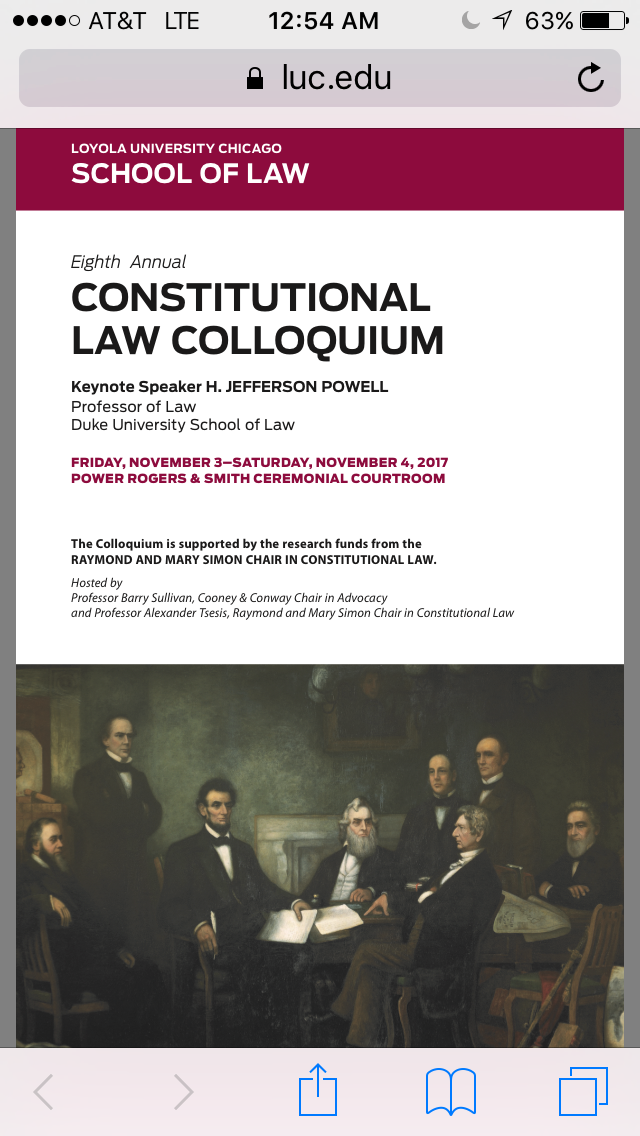
Updated 11/5 (9AM): We’re attending the eighth annual constitutional law colloquium at Loyola Law School in Chicago, where we are presenting our work-in-progress on “Bayesian voting.” So far, our favorite paper presented at the colloquium is Donald Kochan’s work on the “framing” or labeling of constitutional rights. (We are intrigued by his thesis and will be reading his paper on our return flight home tonight.) In addition, honorable mentions go to (1) Paul Gowder’s talk on constitutional collective action (“Beyond the arab spring: digital collective action and the rule of law”), (2) Eang Ngov’s talk on “Police ignorance and mistake of law,” and (3) Mihailis Diamantis’s talk on limiting the scope of the third party doctrine in Fourth Amendment cases. We will be posting more details about these talks soon.

Posted in Uncategorized | Leave a comment

Picbreeder

Picbreeder, created by University of Central Florida computer scientist Kenneth Stanley, is a computer algorithm that can create art. (More information here, via FiveThirtyEight. Hat tip: Cliff Pickover, via Twitter.)

Posted in Uncategorized | Leave a comment

Bayesian voting by judges (part 3)

In this post, we will explain what “Bayesian voting” and “probabilistic verdicts” are. Simply put, under Bayesian voting a judge would assign a numerical score reflecting his relative degree of belief in what the proper outcome of an issue or case should be. Ideally, the score would be anywhere in the range of 0 to 1:

Image result for number line 0 to 1

The higher the score, the greater the judge’s confidence level or degree of belief. A score below 0.5, for example, would mean that the party with the burden of persuasion is not expected to prevail. A score above 0.5, by contrast, indicates that the party is expected to prevail, while a score of 0.5 means the judge is undecided about which party should prevail. (For more information about Bayesian voting and probabilistic verdicts, check out my 2011 paper The Turing Test and the Legal Process.) In our next few posts, we will compare and contrast issue-voting versus outcome-voting and then consider the possibility of “herd behavior” and “strategic behavior” by judges.

Posted in Uncategorized | 1 Comment

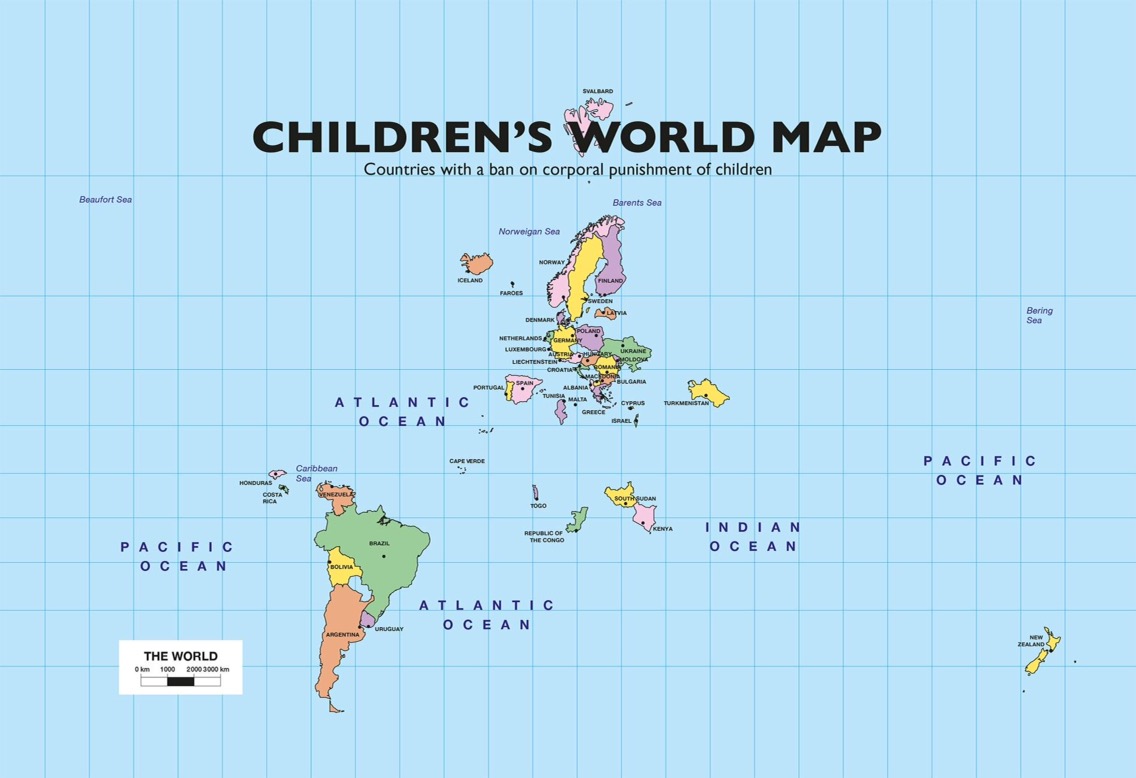
Map of countries that ban corporal punishment of children

According to Reddit user Wolfinton, Sweden was the very first country to introduce a ban on corporal punishment of children (1979). In recent years, many other countries have followed suit. (As of today, 52 countries have banned corporal punishment of children.) Question: Is the frequency of child abuse any lower in these 52 countries than elsewhere?

Source: “Save the Children” (h/t Wolfinton, via Reddit)

Posted in Uncategorized | Leave a comment

Bayesian updating by judges (part 2)

In a previous post, we introduced Eric Posner and Adrian Vermeule’s paper “The Votes of Other Judges,” which was published in volume 105 of the Georgetown Law Journal. To sum up, Posner and Vermeule present a theory of interdependent judicial voting, i.e. judges on multi-member panels should engage in Bayesian updating when they decide issues of law or questions of interpretation. Specifically, a judge sitting on a multi-member panel should do two things: (i) he should first take into account the way in which his fellow judges have voted, and (ii) he should be willing to change his vote accordingly. Although we agree with the spirit of Posner and Vermeule’s Bayesian approach to judging, their paper is short on specifics. After thirty dense, single-spaced pages devoted to peer disagreement and interdependent voting, their paper concludes with a timid whimper. Talk about an anti-climax! In particular, Posner and Vermeule propose a simple two-stage method of voting–“in the first stage, each judge votes; in the second stage, the judges may change their votes in light of what they learned from the first stage” (p. 189)–but they don’t formalize this two-step method any further. As a result, Posner and Vermeule’s approach to judging is too crude to be of any practical use. They offer a general exhortation–judges should be willing to change their votes (in light of the way their fellow judges have voted)–but they don’t specify the precise conditions under which a judge should actually change his vote.

Nevertheless, Posner and Vermeule are right that judges’ votes contain information (independent of whatever reasons judges may give to justify their votes) and that judges should always update their priors before casting their final and decisive votes, especially in close cases, but is there any way of operationalizing Posner and Vermeule’s theory of interdependent voting? In a word: yes! Let judges engage in Bayesian voting, i.e. let judges express their degrees of belief when voting. (As an aside, this is the main reason why Posner and Vermeule’s exhortation is too crude. In their model, judges are still emitting binary votes, i.e. judges must vote all or nothing: either “for” or “against” the moving party.) Ironically, Posner and Vermeule discuss the importance of degrees of belief (or “confidence levels”) in their paper, but their approach to judicial voting makes no use of confidence levels. In our next post, we will propose an alternative method of Bayesian voting by judges, one in which judges are allowed to disclose their degrees of belief instead of voting up or down.

Image result for bayesian updating

Credit: Lars P. Syll

Posted in Uncategorized | Leave a comment

#HappyHalloween

31 October 2017

Posted in Uncategorized | 1 Comment

Bayesian updating by judges

In their thought-provoking paper “The Votes of Other Judges,” Eric Posner and Adrian Vermeule present a compelling argument why judges on multi-member panels should engage in informal Bayesian updating when they decide issues of law or questions of interpretation. Consider, for example, the U.S. Supreme Court, which is composed of nine judges. The Supreme Court generally schedules an oral argument for each case on its docket, and each side is usually allotted 20 minutes to present their arguments to the Court. At the initial conference meeting after oral argument, the Justices meet in private and reveal to each other how they would decide the case. Suppose five of the Justices say that the ordinary meaning of the statute is clearly X, while four say that it is clearly Y. In the words of Eric Posner, “Shouldn’t all nine update their views and learn from the aggregate information contained in the votes of colleagues? Shouldn’t all entertain the possibility that the vote reveals the statute to be ambiguous?” In the alternative, what if five Justices say that the statute clearly means X, while four say that it is ambiguous as between X and Y. “Should the five obtain some information from the votes of the four, albeit not as much as in [the above case]? … And how about vice-versa–should the four update their own views, in light of the views of the five?” For our part, we think Posner and Vermeule are on the right track. The votes of each judge provide additional relevant information about the case under review. The problem, however, is not whether judges should engage in Bayesian voting, but rather how they should do so. After all, we don’t foresee judges doing formal probability calculations any time soon. (Here is a fun video tutorial explaining the finer points of Bayesian updating. Here is another.) We will address “the how question” in our next blog post.

Image result for bayesian updating

Hat tip: Kevin Binz, via Fewer Lacunae

Posted in Uncategorized | 1 Comment