
I discovered this catchy K-pop song (via Shazam) at my university campus Starbucks on Friday morning:
Creative Commons
Blogs I Follow





I discovered this catchy K-pop song (via Shazam) at my university campus Starbucks on Friday morning:
That is the title of this provocative op-ed by Harvard law professor Adrian Vermeule. Below is an excerpt:
The issue of defying court orders is still with us — but it has taken a twist. Now the defiance is coming from inside the judicial branch itself, in the form of a lower-court mutiny against the Supreme Court. District Court judges, and in some cases even appellate courts, have either defied orders of the court outright or engaged in malicious compliance and evasion of those orders, in transparent bad faith.
Wait, what?! Judges are playing politics? To quote Captain Renault, “I’m shocked, shocked to find that gambling is going on in here!” If the courts have the power to review the illegal or extra-constitutional acts of Congress and the president, who reviews the judges? File under: rule of law for thee but not for me!

A jury in Tallahassee, Florida, has found Donna Adelson, the Miami Beach mother of unindicted co-conspirator Wendi Adelson, guilty of first-degree murder, conspiracy, and solicitation in the murder-for-hire of FSU law professor Dan Markel.
Below is the epilogue to my forthcoming survey of open Adam Smith problems with Salim Rashid (footnotes are below the fold):
“We conclude our work with, perhaps, the most difficult and contested open questions of all: who was Adam Smith, really? How should he be remembered? What is his true legacy? Are his ideas and writings still relevant today? For our part, given Smith’s many foundational contributions to the fields of moral philosophy and political economy, we are tempted to see Smith as the world’s first (and perhaps only) moral economist.[1] But the deeper we dig into Smith’s life and work, the more surprises and contradictions we continue to find: college dropout (but why did he drop out?), freelance lecturer (but where are those lectures?), absent-minded college professor (was he really absent-minded or was it just an act?), competent university administrator (how did Smith juggle his teaching and administrative duties?), jurisprude and doctor of law (yet he never practiced law, did he? [*]), advisor to statesmen (yet his advice was never taken, was it?), tourist and tutor (but why give up his professorship?), solitary author (but how much of his Wealth of Nations did he borrow and how much did he steal?), and customs officer (cognitive dissonance, anyone?). Doctor Smith was and did many things (all of which pose many more questions than answers).
“At the same time, we have a nagging suspicion that none of these various pigeonholes or sundry labels truly capture the many-sidedness of Adam Smith. We therefore conclude with the following conjecture: what if we have been getting Smith and his legacy completely wrong all along? After all, although Adam Smith is credited with creating an entirely new discipline,[2] his writings extend far beyond political economy and moral philosophy, for he thought about and contributed fresh insights to such diverse fields as education, history, law, linguistics, logic, politics, religion, rhetoric, taxation, and the arts.[3] Given this multiplicity of intellectual pursuits, how did the flesh-and-blood Adam Smith see himself? Was it not, first and foremost, as a man of letters, a prose poet? For us, Smith’s love of language and les belles lettres is the golden thread that unifies the many-sidedness of Smith’s life and works. Perhaps we are wrong, but in the words of our colleague and friend Paul Sagar: ‘what is the point of any of this if we are not willing to debate things through?’”[4]

The penultimate part of my forthcoming survey of open Adam Smith problems with Salim Rashid (Chapter 12) contains a grab bag of additional sundry questions and miscellaneous Smith mysteries, all of which are deserving of further scrutiny. Below is an excerpt (footnotes are below the fold):
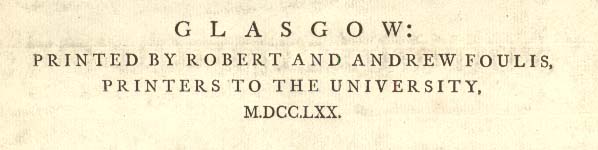
“In the very first letter that Adam Smith wrote to Charles Townshend (Corr. No. 39), Smith mentions that he ‘sent about a fortnight ago the books which you ordered for the Duke of Buccleugh [from] Mr. Campbell at Edinburgh.’[1] This letter is dated 17 September 1759, and according to Ernest Mossner and Ian Simpson Ross (1987, p. 57 n.2), the books Smith is referring to in his 17 September letter were supplied by Robert and Andrew Foulis, the printers to the University of Glasgow. Mossner and Ross also tracked down the complete list of books—46 separate tomes in all—meant for Duke Henry.[2] The list contains most of great works of ancient Greek and Roman literature, starting with Homer’s Iliad, and in the words of Mossner and Ross (ibid.), ‘The list is instructive in representing the range of authors thought suitable for educating the young Duke, and for reflecting the stock of the Foulis brothers, both as booksellers and printers.’[3] For reference, below is the list of books Smith had ordered for Duke Henry as reported by Mossner and Ross:
- Homeri Ilias 2 Vol. large folio
- —Odyssea 2 Vol. large folio
- Callimachus Gr. cum figuris folio
- Caesaris Opera folio
- Sophocles Gr. 4to
- Aeschylus Gr. 4to
- Plinij Epistolae & Panegyricus 4to
- Theocritus Gr. 4to
- Minucius Felix 4to
- Homeri Ilias 2 Vol. Gr. 4to
- Caesaris Opera 4to
- Boetius de Consolatione Philosophiae
- Tyrtaeus Gr. Lat. 4to
- Demetrius Phalereus de Elocutione
- Terentij Comoediae, 8vo
- Homeri Ilias Gr. Lat. 3 Vol. 8vo
- Sophocles Gr. Lat. 2 Vol. 8vo
- Aeschylus Gr. Lat. 2 Vol. 8vo
- Theocritus Gr. Lat. 8vo
- Minucius Felix 8vo
- Aristophanis Nubes Gr. Lat. 8vo
- Boetius de Consolatione, &c. 8vo
- Antoninus Gr. Lat. 8vo 2 Vol.[4]
- Plutarchus de Poetis audiendis Gr. Lat. 8vo
- Euripidis Orestes Gr. Lat. 8vo
- Aristoteles de Mundo Gr. Lat. 8vo
- Epictetus & Cebes Gr. Lat. 8vo large print
- Anacreon Gr. large print, 8vo
- Theophrasti Characteres Gr. Lat. large print 8vo
- Horatius, editio ultima 8vo
- Virgilius, editio ult. 8vo
- Sallustius 8vo
- Lucretius 8vo
- Paterculus 8vo
- Tibullus & Propertius 8vo
- Poetae Latini minores 8vo
- Iuvenalis & Persius 8vo
- Pomponius Mela de situ Orbis 8vo
- Phaedrus & P. Syrus 8vo
- Thucydides de Peste Gr. Lat. 8vo
- Plinij Epist. & Panegyr. 2 Vol. 12mo
- Tacitus 4 Vol. 12mo
- Hippocratis Aphorismi Gr. Lat. 12mo
- Epictetus & Cebes Gr. Lat. 12mo 2 6
- Pindari Opera 3 Vol. Gr. small size
- Ciceronis Opera 20 Vol. fine
“We have questions! Who put together this comprehensive list of classical readings? Adam Smith or Charles Townshend? Smith’s letter to Townshend informs us that it was the British politician who ordered the books, but it must have been Smith who recommended the titles in this list, right? Either way, how many of these classics had Smith himself read and studied, and which ones were his favorites? Also, how many of these great works were assigned readings in Smith’s own courses at the University of Glasgow?”
A counterfactual is a statement about what would have happened if a past event had been different. It’s a “what if?” scenario, considering an alternative reality where something that actually occurred did not, or vice versa. On this note, below is an excerpt from Chapter 11 (“Counterfactual Conundrums”) of my forthcoming survey of open Adam Smith problems with Salim Rashid (emphasis added; footnotes are below the fold):
“… the buzz generated by the publication of The Wealth of Nations in 1776 would produce another major plot twist in Adam Smith’s life, an unexpected detour that would mark the close of Smith’s scholarly pursuits: his appointment as a Commissioner of Customs in the royal town of Edinburgh, a post the Scottish philosopher would hold during the remaining 12 years of his life: February 1778 to July 1790. The Scottish philosopher thus ended up spending almost as much time in the customs house (pictured below) than he did at Glasgow University, for he was thus a customs officer for almost as many years as he was a professor!
“But in the words of Walter Bagehot (1876, p. 38), given Smith’s reputation for absent-mindedness (whether real or, as we suspect, feigned) a ‘person less fitted to fill [the post of Customs Commissioner] could not indeed have easily been found.’ Worse yet, the philosopher-economist was now in charge of enforcing the very same protectionist laws that he had denounced in The Wealth of Nations. Although Smith himself never said whether or not his duties as customs officer went against personal convictions,[1] leading some Smith scholars to see no contradiction between Smith’s stirring defense of free trade and his decision to become a customs commissioner,[2] for us the cognitive dissonance is mind-blowing.
“Moreover, Smith’s stint as a customs officer was no sinecure or honorary position; by all accounts, it was a full-time job that would consume a large chunk of his waking hours.[3] Although Smith published four subsequent editions of The Wealth of Nations (1778, 1784, 1786, and 1789) and made substantial revisions and additions to the sixth and last edition of The Theory of Moral Sentiments (1790) after his appointment as Commissioner of Customs, his day-to-day duties in the customs house would prevent him from completing any other major scholarly books or articles, including the ‘two other great works on the anvil’ that we mentioned in a previous chapter (Ch. 4).
“For us, then, this closing chapter in Smith’s life presents one major counterfactual question, what we call Das Kommissarproblem. What if Smith had never accepted this position? How would Smith have spent the final 12 years of his life? Would he have returned to academia? Would he have completed either of the ‘two other great works’ he was supposedly working on? Or would he have been content with the two magna opera he had already published? And these aren’t the only customs-house questions we have, for we have always wondered why Adam Smith, a self-confessed bookworm who had become a major literary figure, agreed to accept the position of Commissioner of Customs in the first place. Simply put, why did he give up his ongoing intellectual pursuits (for the most part) to become a glorified bureaucrat for the remainder of his life?[4] Why not say ‘no’? Was it money, prestige, intellectual fatigue, or something else that motivated Smith to say ‘yes’?
“Also, Smith published four subsequent editions of The Wealth of Nations after his appointment as Commissioner of Customs (1778, 1784, 1786, and 1789) as well as a sixth and last edition of The Theory of Moral Sentiments in 1790. How did his stint in the customs house influence any of these subsequent editions of his Wealth of Nations or Theory of Moral Sentiments? And lastly, and perhaps most importantly, how did Smith resolve the cognitive dissonance between his duty as a customs officer to enforce the oppressive system of existing trade barriers on the one hand and his stirring defense of free trade and ‘natural liberty’ in his Wealth of Nations on the other?”

What if Canada, Mexico, and the U.S. were one country? It would be the world’s largest by land area, creating a powerful economic and military bloc with a combined population of nearly 500 million people!

I will resume my series on “Adam Smith Problems” after the Labour Day holiday; in the meantime, here is some music that was first released in August of 2006 (more details here).
Two literary artifacts, both dating from the last two months of Adam Smith’s Grand Tour (September-October, 1766), merit a closer look. One is a private letter penned by Madame Marie-Jeanne Riccoboni sometime during the month of October, 1766. The other is a letter dated 18 September 1766, most likely authored by a Scottish transplant in France, Seignelay Colbert de Castle-Hill. Both pieces of primary evidence pose an open problem of an amorous nature. These letters report that Adam Smith was not lacking in female admirers during his sojourn overseas, but who were these ladies, and what was the nature of these foreign contacts? Companionate? Platonic? Sexual? Or something else? Below is an excerpt from Chapter 10 (“Das Liebesproblem”) of my forthcoming survey of open Adam Smith problems with Salim Rashid (footnotes are below the fold):
“Could the ‘Madame Nicol’ mentioned as a love interest in Abbé Colbert’s 18 September 1766 letter to Adam Smith have been an actress? On this possibility, it is worth mentioning that by all accounts Madame Riccoboni—an accomplished actress and novelist—and Adam Smith—an admirer of the stage—were avid theater and opera fans during Smith’s stay in the City of Light.[1] Indeed, ‘it is very likely Smith took recommendations from Riccoboni as to which theatrical performances to attend’,[2] and so it is not far-fetched to imagine to them attending a play or opera or concert together.
“What many Smith scholars, however, have failed to mention is that these theatrical venues were the center of an elite Parisian sexual marketplace, the famed dames entretenues or kept women of French high society.[3] Famous for their talent, glamour, and beauty, these femmes galantes were the most highly-sought after women of pleasure in all Europe, models and actresses who ‘earned their living by engaging in long-term sexual and often companionate relationships with men from the financial, political, and social elites, known as le monde (high society).’[4]
“Although not all theater women were kept mistresses or femmes galantes, this sultry scene overlapped directly with the world of the theater: ‘It was widely understood that any woman in the Opéra, and to a lesser degree the other theater companies, was a dame entretenue, or at least wanted to be.’[5] The world of theater was the center of this high-end sex market because ‘being on the stage greatly increased … “sexual capital”, the desirability of a mistress and hence the prices she could command for her services’,[6] and the theater district of the French capital was teeming with high-end brothels and places of ill-repute.[7] Although we have no other evidence to indicate whether Smith himself partook in a theatrical liaison, so to speak, who knows?”
Correction (8/30): Our colleague and friend Alain Alcouffe has pointed out to us a possible error about the identity of “Dr Smith” in the Voltaire passage quoted below. In brief, the Dr Smith Voltaire is referring may not be Adam Smith at all. Instead, the author of Candide could be referring to a Robert Smith, the author of a 1738 treatise on optics (available here). We will do some additional digging and report back soon.
Below is an excerpt from Chapter 9 (“Das Voltaire-Problem”) of my forthcoming survey of open Adam Smith problems with Salim Rashid (footnotes are below the fold):
“Among the most illustrious Enlightenment figures Adam Smith met and perhaps befriended during his grand tour years was Voltaire, and according to one account (Muller 1993, p. 15), Smith made a good impression on the famed Lumière. After meeting Smith, Voltaire wrote, ‘This Smith is an excellent man! We have nothing to compare him, and I am embarrassed for my dear compatriots.’[1] But what did Smith think of the great Voltaire?
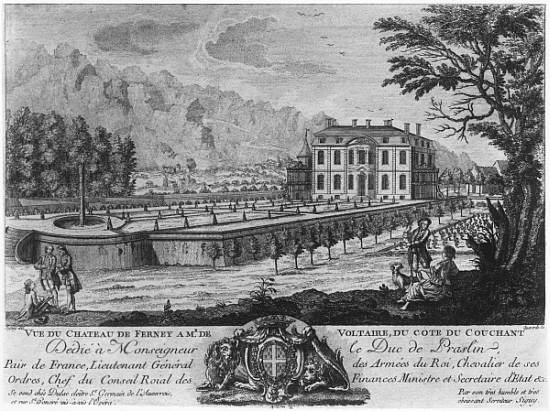
“No doubt, Smith must have admired the celebrated Lumière even before their encounters in 1765, for Voltaire is mentioned many times in Smith’s Theory of Moral Sentiments.[2] But why did Smith go out of his way to meet him in 1765, and what did they discuss? Though all accounts of Adam Smith’s time in the city-state of Geneva—i.e. when his meetings with Voltaire took place—are extremely sparse, we know that the Scottish moral philosopher left Toulouse and travelled to Geneva in the fall of 1765,[3] and we also know that during his time in the little republic he became personally acquainted with Voltaire, who at the time lived in nearby Ferney.[4] [N.B.: Voltaire’s estate at Ferney is pictured below.] But aside from the opportunity of arranging one or more meetings with Voltaire, why did Smith decide to visit Geneva at all instead of heading straight to Paris, where he would reside for the remainder of his grand tour? What did he hope to accomplish or observe there, and how long did he stay? Was Voltaire the primary purpose of Smith’s jaunt to Geneva?
“According to one hearsay account (Rae 1965/1895, p. 189), reporting what Adam Smith had told the English poet Samuel Rogers years later, in 1789, the Scottish philosopher had visited the famed lumière no less than five or six times during this period. Another hearsay account confirms Smith’s admiration—not just for Voltaire, but also for Rousseau![5] Did Smith and Voltaire talk about Rousseau? Samuel Rogers, Rae tells us, mentions two possible topics of conversation. One was ‘the Duke of Richelieu, the only famous Frenchman Smith had yet met,’[6] while the other was ‘the political question as to the revival of the provincial assemblies or the continuance of government by royal intendants.’[7]
“But this can’t be the whole story. Aside from the legendary martial exploits and sexual conquests of Louis François Armand de Vignerot du Plessis, 3rd duc de Richelieu (1696-1788), or the contemporaneous Brittany Affair (an ongoing power struggle between the chief magistrate or procureur of the local courts of Brittany, Louis-René de Caradeuc de La Chalotais (1701-1785), and the governor and royal representative of the region, Emmanuel Armand de Vignerot du Plessis, duc d’Aiguillon (1720-1780)), two additional and more immediate topics may have occupied Voltaire and Adam Smith at this time. One was the Voltaire-Needham controversy that was then playing out in real time in the fall of 1765. The other was what we call the ‘fracas at Ferney’: the Voltaire-Charles Dillon affair of December 1765. Both the Voltaire-Needham controversy and the fracas at Ferney are relevant to our Smithian inquiries because both occurred amid Smith’s visit to Geneva….”


Welcome to the online home of the IASS
Hopefully It’s Interesting.
In Conversation with Legal and Moral Philosophers
PhD, Jagiellonian University
Books, papers, and other jurisprudential things
Ramblings of a retiree in France
BY GRACE THROUGH FAITH
Natalia's space
hoping we know we're living the dream
Lover of math. Bad at drawing.
We hike, bike, and discover Central Florida and beyond
Making it big in business after age 40
Reasoning about reasoning, mathematically.
I don't mean to sound critical, but I am; so that's how it comes across
remember the good old days...
"Let me live, love and say it well in good sentences." - Sylvia Plath
a personal view of the theory of computation
Logic at Columbia University
Just like the Thesis Whisperer - but with more money
the sky is no longer the limit
Technology, Culture, and Ethics
Just like the horse whisperer - but with more pages
Poetry, Other Words, and Cats


