Acts of love …

Former Florida Governor Jeb Bush got it right … calling for compassion for illegal immigrants and recognizing that most undocumented workers come to the US to provide for their families: “Yes, they broke the law,” Mr Bush told a reporter, “but it’s not a felony. It’s an act of love … It shouldn’t rile people up that people are actually coming to this country to provide for their families.” This doesn’t sound like a man who is running for office. But if he does, and if he wins, would a Jeb Bush presidency produce any real changes in US immigration policy? Probably not. After all, Republicans controlled the White House, both houses of Congress, and the politically-active Supreme Court from 2001 to 2006, yet federal spending went up and not a federal government agency was cut during that bygone era. Nevertheless, prior probability applauds Mr Bush for appreciating the plight of most undocumented workers …

We are all Americans …

Posted in Uncategorized | Tagged , , | Leave a comment

Shouldn’t Smith & Wesson and the maker of Ambien be legally liable for the recent Fort Hood massacre?

Many reports indicate that the gunman, Ivan Lopez, had been prescribed the drug Ambien when he killed four men (including himself) and injured 16 others on 3 April 2014 with his .45-caliber Smith & Wesson pistol. This senseless massacre of innocent people raises an important legal question. Why can’t the victims and their families sue Smith & Wesson as well as the manufacturer of the drug for their losses? If you think it’s unfair to extend liability so far, isn’t it more unfair to let the loss lie where it falls, to borrow Oliver Wendell Holmes’ famous phrase?

So, sue us!

Posted in Uncategorized | Tagged , | 3 Comments

What % of basketball and football games are fixed?

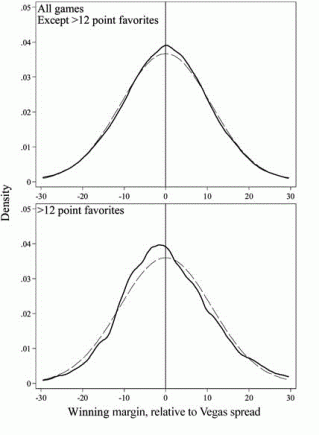
The fraction or number of such games has to be greater than zero, but how much greater? By way of example, do you detect any suspicious patterns or red flags in this box score of the Huskies’s 63-53 Final Four upset victory over the Gators yesterday evening?

You can read much more about various mathematical and statistical techniques (such as selective sampling) to detect cheating in sports here, here, and here too. (Image courtesy of Justin Wolfers.)

Posted in Uncategorized | Tagged , , | Leave a comment

Litigation and the game of poker

As we note in our 2012 working paper The Poker-Litigation Game, the process of legal litigation shares many important features in common with the game of poker:

1. Both poker and litigation are strategic games, that is, competitions in which the players/litigants must make their choices and decisions independently of each other.

2. Both activities are zero-sum or non-cooperative games in which the economic interests of the players/litigants are opposed. (Of course, although both parties in a given legal case may have a strong interest in settling rather than going to trial, we submit that this does not change the overall adversarial nature of the legal process.)

3. Both are games of incomplete information–just as a player in a game of poker does not know with certainty when another player is “bluffing,” a litigant in a civil or criminal case may not know with certainty the strength of his adversary’s case during pre-trial negotiations. (As an aside, there is no doubt that pre-trial discovery rules are designed to reduce this level of uncertainty in litigation, but it’s not clear to us by how much this uncertainty is reduced by modern discovery.)

4. Both games involve substantial elements of chance or luck: e.g. random assignment of the cards in poker; random selection of judges in civil and criminal cases. (Even the process of jury selection is somewhat random, based more on guesswork and hunches than anything else.)

Can you think of any other similarities or differences between the game of poker and the process of litigation?

 
 Litigation hold’em?
Posted in Uncategorized | Tagged , | 3 Comments

Information asymmetry (Kremlin edition)

The West has no idea what Russia is willing to do, but Russia knows exactly what the West will – and, more important, will not – do. This has created a dangerous asymmetry, which could spell disaster for the international order that has existed since the end of the Cold War.

This perceptive quotation is from Ivan Krastev’s insightful critique of the free world’s weak and pusillanimous response to Russia’s illegal annexation of the Crimea. By the way, George Akerlof was the first theorist to model the phenomenon of information asymmetry in his classic 1970 paper The Market for Lemons: Quality Uncertainty and the Market Mechanism. Although Akerlof’s simple game-theoretic model was designed to explain the effect of quality uncertainty in the market for used cars, the problem of uncertainty (as well as the problem of information asymmetry generally) has many applications in many different and unrelated areas of life, such as the decision in law whether to settle or go to trial (*) … Can you think of any other applications?

Don’t f*** with me!

Posted in Uncategorized | Tagged , , | Leave a comment

Why do consumers still purchase GM cars? *

According to this working paper by professors Susan Helper and Rebecca Henderson in the Harvard Business Review, GM’s market share in the US fell from 62.6% to 19.8% between 1980 and 2009 … In other words, a large fraction of US consumers are still buying GM cars. But why? Do GM-loyal consumers refute the “rational choice” model of economics? As Tyler Cowen noted yesterday in this post on his top-notch Marginal Revolution blog, “The market here is working, but oh so slowly. I would like to see behavioral economics papers on why so many people continued to buy General Motors (and here I mean the standard cars) for as long as they did.”

* By the way, the same question can be asked about Internet users who still rely on Yahoo, Hotmail, or AOL for their email instead of switching to Gmail.  In either case (automobiles or email accounts), do such simple explanations as “path dependence”, brand loyalty, or advertising provide satisfactory answers?

Posted in Uncategorized | Tagged , , , | 2 Comments

Thoughts On Northwestern Football Unionization

Should college football players form their own players’ unions? Should they be paid a salary for their services? (If so, how much?) And are student-athletes “employees” as a matter of law? We are reposting the entry below from our friends (and fellow “forty-something professors”) at Cheap Talk because it’s the most insightful post we’ve read thus far on the recent NLRB ruling in the Northwestern football litigation.

jeff's avatarCheap Talk

These are my thoughts and not those of Northwestern University, Northwestern Athletics, the Northwestern football team, nor of the Northwestern football players.

  1. As usual, the emergence of a unionization movement is the symptom of a problem rather than the cause.  Also as usual, a union is likely to only make the problem worse.
  2. From a strategic point of view the NCAA has made a huge blunder in not making a few pre-emptive moves that would have removed all of the political momentum this movement might eventually have.  Few in the general public are ever going to get behind the idea of paying college athletes.  Many however will support the idea of giving college athletes long-term health insurance and guaranteeing scholarships to players who can no longer play due to injury.  Eventually the NCAA will concede on at least those two dimensions.  Waiting to be forced into it by a union…

View original post 435 more words

Posted in Uncategorized | Tagged , , , | 1 Comment

Disney theme parks to announce lower ticket prices

It’s about time! Here’s a sneak peek at Mickey’s official announcement …

Posted in Uncategorized | Tagged | 1 Comment

Live Piracy Map

Check out this amazing live piracy map generated by the Commercial Crime Services of the International Chamber of Commerce. (Below, for example, is a partial version of the live piracy map from 2011 identifying the location of all piracy incidents during that year.) Given this spatial distribution of piracy, should commercial shipping companies consider joining forces and “paying off” the pirates in exchange for not hijacking their ships? In the alternative, should there be property rights in shipping lanes?

Posted in Uncategorized | Tagged , , | Leave a comment

The tragedy of the outer space commons?

Check out this fascinating paper Earth Orbit Debris: An Economic Model in which the problem of space debris is modeled as a negative externality. What is the optimal number of space satellites, and who decides? Do you believe there are already too many satellites in low-Earth orbit … or too few? Should there be property rights in space orbits?

Posted in Uncategorized | Tagged , , , | Leave a comment