

Who was the duchesse d’Enville, and what was Adam Smith’s relation to her? Thus far this week, Alain Alcouffe and I have explored this enigmatic relationship by surveying the secondary literature on Smith. But of all the works we have consulted during our months of scholarly research, it is a primary source that has caught our attention the most, a piece of correspondence that establishes a possible link between the Scottish philosopher and the French salonnière. (See generally Guerra-Pujol 2021, pp. 135-136.) This source is a personal letter addressed to Smith, dated 18 Sept 1766, from one “Grand Viccaire Eccossois,” who most likely was Seignelay Colbert de Castle-Hill (1736-1811), the Abbé Colbert (pictured above via Wikimedia Commons; ibid.).
Before proceeding to Colbert’s intriguing letter, it is worth explaining why Colbert is worth taking seriously, for he is a highly credible source. To the point, the Abbé Colbert became Adam Smith’s closest companion and confidant during Smith’s time in Toulouse (March 1764 to October 1765); in fact, he even travelled with Smith and Duke Henry to Bagnères, Bordeaux, and many other places in the South of France during this 18-month period (Alcouffe and Massot-Bordenave 2020, pp. 216–217; see also Rae 1895, p. 179). Colbert thus got to know Smith the man, not just Smith the scholar or man of letters. With these background facts in mind, one passage in particular in Colbert’s Sept. 1766 letter to Smith is especially tantalizing:
Et tu, Adam Smith, philosophe de Glasgow, heros et idole des high-broad Ladys, que fais tu, mon cher ami? Comment gouvernes tu La duchesse d’Anville [d’Enville] et Mad. de Boufflers, ou ton coeur est il toujours epris des charms de Mad. Nicol et des apparent apparens que laches de cette autre dame de Fife, que vous aimees tant? [National Archives of Scotland, GD224/2040/62/3, quoted in Alcouffe and Moore 2018, emphasis added]
In English:
And you, Adam Smith, Glasgow philosopher, high-broad Ladies’ hero and idol, what are you doing my dear friend? How do you govern the Duchess of Anville [d’Enville] and Madame de Boufflers, where your heart is always in love with Madame Nicol and with the attractions as apparent as hidden of this lady of Fife that you loved. [as translated in Alcouffe and Massot-Bordenave 2020, p. 260, emphasis added; for slightly different translations of Abbé Colbert’s letter of September 18, 1766, see Ross 2010, p. 227; Buchan 2006, p. 77; Mossner & Ross 1987, p. 111]
The jocular and intimate tone of this particular passage suggests camaraderie and close connections — or in the words of Alain Alcouffe and Philippe Massot-Bordenave (2020, p. 217), the letter “is probably a private correspondence between friends who have established trust” — but what does it mean? More specifically, why does Colbert refer to the duchesse d’Enville by name in this passage, and what does he really mean when he writes, “Comment gouvernes tu La duchesse d’Anville ….”? Did Smith and d’Enville fall in love? And if so, how did Colbert find out about Smith’s trysts or his sundry romantic attachments? Alas, these amorous secrets are buried with Smith, for the Scottish philosopher-economist insisted on the destruction of his private papers, manuscripts, and letters upon his death (cf. Guerra-Pujol 2021, p. 149).
Not all is lost, however. Building on the work of Guerra-Pujol (2021), Alain Alcouffe and I will present our own interpretation of Colbert’s curious letter in our next post …
Works cited
Alcouffe, Alain, and Andrew Moore. (2018) Smith’s Networks in Occitania—March 1764–October 1765. Presented at the 31st Annual Conference of Eighteenth- Century Scottish Studies Society, July 17–21, 2018 (Glasgow).
Alcouffe, Alain, and Philippe Massot-Bordenave. (2020) Adam Smith in Toulouse and Occitania: The Unknown Years. London: Palgrave Macmillan.
Buchan, James. (2006) The Authentic Adam Smith: His Life and Ideas. New York: Norton.
Guerra-Pujol, F. E. (2021) Adam Smith in Love. Econ Journal Watch, Vol. 18, No. 1, pp. 127–155.
Mossner, Ernest C., and Ian Simpson Ross, editors. (1987) The Correspondence of Adam Smith, 2nd ed. Oxford: Oxford University Press.
Rae, John. (1895) Life of Adam Smith. London: Macmillan.
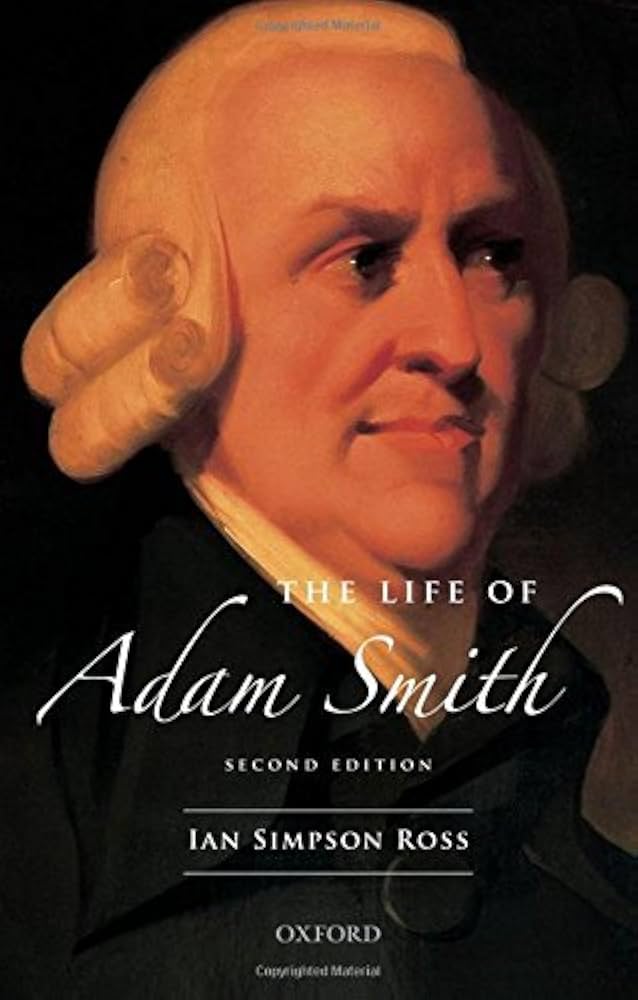
Ross, Ian Simpson. (2010) The Life of Adam Smith, 2nd ed. Oxford: Oxford University Press.
Wikimedia Commons. (Not dated) File:Seignelay Colbert de Castlehill.jpg.

![STEWART, Dugald.] Account of the life and writings of Adam Smith, LL.D. From the Transactions of the Royal Society of Edinburgh. by [SMITH, Adam.]: (1794) | Bernard Quaritch Ltd ABA ILAB](https://pictures.abebooks.com/inventory/31765048057.jpg)








