That is not only the title of this excellent survey of State and federal constitutional-level crimes; it was also my favorite work from this year’s Loyola Constitutional Law Colloquium. Shout out to the author: my colleague and friend Michael L. Smith (@msmith750).
I am presenting two works-in-progress at the 14th Annual Constitutional Law Colloquium, which is taking place at the Loyola Law School in Chicago this weekend. I will therefore resume my “prequel” to Gödel’s loophole in the next day or two.
PS: I am unable to post any pictures from the colloquium because my blog’s “media file” has run out of storage space. ☹️ In the meantime, while I look into upgrading my WordPress account, I have posted some pics on Facebook; see here. 😎
Here is a revised excerpt from my new work “Gödel’s Interbellum”; the footnotes are below the fold:
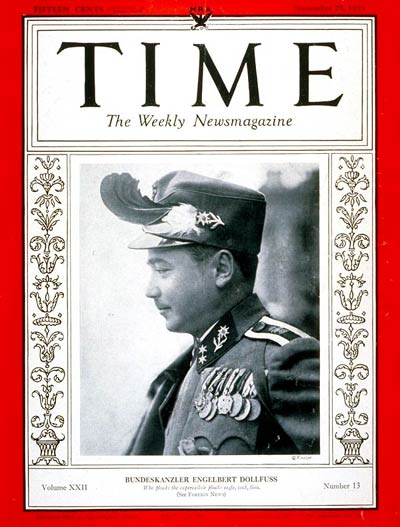
In many ways, Gödel’s fate was inextricably intertwined with Austria’s during the interwar period. He was born in 1906 in the small town of Brünn in the Austrian part of the now-defunct Austro-Hungarian Empire. Although Gödel became a “citizen by fiat” of Czechoslovakia when the Czechs and the Slovaks declared their independence in 1918,[1] one of his schoolmates once confirmed that “Gödel considered himself always Austrian …”[2] In any case, Gödel officially became a citizen of the Republic of Austria in 1929, and Vienna was his primary residence from 1924 until early 1940.[3] The year 1933 is especially significant–not only for Gödel, but also for Austria as a whole–for it was in March of 1933 that Gödel was officially appointed Privatdozent or “private lecturer” at the School of Philosophy of the University of Vienna, a position he would hold until 1938, and it was also in March 1933 that Austria’s chancellor, Engelbert Dollfuss, declared the “self-elimination” of Austria’s parliament and orchestrated a cunning extra-constitutional self-coup.
Gödel’s Austria began as a parliamentary democracy with the enactment of a new constitution in October of 1920, a charter in which legal scholar Hans Kelsen played a large role.[4] In summary, the 1920 Austrian Constitution allocated legislative power in the Bundesversammlung or Federal Assembly, a body composed of two houses, the Nationalrat (National Council) and the Bundesrat (Federal Council), and allocated executive power in a cabinet led by a chancellor, who in turn was appointed directly by the Bundesrat. The president was elected by both houses of the Federal Assembly and served as head of state. Austria’s interbellum constitution was then amended on December 7, 1929, when the Federal Assembly approved a series of constitutional amendments creating a presidential system of democracy by providing for the direct or popular election of the president.[5]
In March of 1933, however, a national railway strike precipitated a dramatic constitutional crisis, when a procedural snafu in the lower house of Austria’s parliament created an unexpected constitutional vacuum. In brief, Karl Renner, the president of the Nationalrat or National Council, strategically resigned his presidency on March 4, 1933 in order to cast the deciding vote on a controversial proposal to deal with the railroad strike. That same day (March 4), the lower house’s two vice-presidents, who represented Austria’s other major political parties, Rudolf Ramek of the Christian Social Party and Sepp Straffner of the Greater German People’s Party, also resigned for the same reason. The National Council was thus left without a presiding officer, due to the strategic resignations of Renner, Ramek, and Straffner, and in the absence of a presiding officer, the lower house could not meet. (Sound familiar?)
As it happens, Austria’s interbellum constitution had no mechanism for the National Council to meet without a president. On March 7, 1933, Chancellor Dollfuss described this constitutional vacuum as the “self-elimination of Parliament” (Selbstausschaltung des Parlaments) and assumed full legislative powers, citing an emergency law enacted during World War I, the Economic War Powers Act (Kriegswirtschaftliches Ermächtigungsgesetz).[6] After Dollfuss’s March 7 self-coup, the Austrian president Wilhelm Miklas issued a decree adjourning parliament indefinitely. When Austria’s main opposition parties, the Greater German People’s Party and the Social Democrats, attempted to reconvene the National Council on March 15, the opposition members were physically prevented from entering parliament by the police on Dollfuss’s orders. In a matter of days (March 4-15), democracy was dead.
Was Dollfuss’s self-coup “unconstitutional”? Thirteen months later (April 1934), Dollfuss convened a rump parliamentary session with only the members of his political party present. The psuedo-parliament not only retrospectively legalized all of the chancellor’s legislative decrees since the constitutional crisis of March 1933; it also enacted a new constitution, sweeping away the last remnants of parliamentary democracy. Among other things, the 1934 constitution abolished freedom of the press, established a one-party system, and created a state monopoly on employer-employee relations. (As a brief postscript, the 1934 psuedo-constitution remained in force until Adolf Hitler’s annexation of Austria in March 1938. After the defeat of Nazi Germany, the 1920 Constitution or BV-G was reinstated on May 1, 1945, and it remains in force to this day.)
Given the undemocratic ex post ratification of Dollfuss’s self-coup (opposition parties were excluded from the rump parliament), one could argue that Dollfuss lacked the legal authority to fill the constitutional vacuum that arose when the lower house of Austria’s parliament was left without a presiding officer. On the other hand, one could argue that politics abhors constitutional vacuums. In the absence of a legislature, the executive branch must legislate by default. Either way, Austria’s constitutional crisis of March 1933 offers an instructive lesson: constitutional vacuums are dangerous.
As an historical aside, just a few days after Dollfuss’s self-coup Adolf Hitler assumed the power to rule by decree via a constitutional amendment, the passage of the Enabling Law of March 23, 1933.[7] Did Kurt Gödel take notice of Hitler’s rapid rise to power in Berlin? If so, he would have noticed that, from a constitutional law perspective, Hitler’s evil dictatorship was a perfectly legal one! In fact, Germany’s democratic Weimar Constitution was never formally suspended or abrogated during the Hitler dictatorship, nor did the Austrian-born Führer stage a military coup or suspend his country’s constitution when he assumed power in 1933. Instead, after Hitler was appointed chancellor in January of 1933, he worked to subvert his country’s constitutional system internally from within, or in the words of one historian, “Though despising the rule of law, Hitler appreciated, after the fiasco of the 1923 Munich putsch, that he could gained power only through, not against the existing institutions.”[8]
In retrospect, March 1933 represents a symbolic turning point in the constitutional history of Central Europe during the interwar period–an “anti-constitutional” moment, if you will. In Austria, a legislative stalemate produced a constitutional vacuum that was filled by the chief executive, while in Nazi Germany the legislature effectively voted itself out of existence once it to transferred its powers to Hitler. Would-be dictators now had a new model for taking power: first, play by the rules of the political game to win power; then, once in power, change the rules of the game in order to stay in power. It is the recursive nature of this model that Gödel may have had in mind many years later when he reportedly discovered a logical contradiction in the U.S. Constitution. But that is getting ahead of our story, for the interbellum years were not over. Many more countries in Central Europe would become constitutional dictatorships.
Below is the next installment of my paper “Gödel’s Interbellum” (revised draft, 2023); footnotes below the fold:
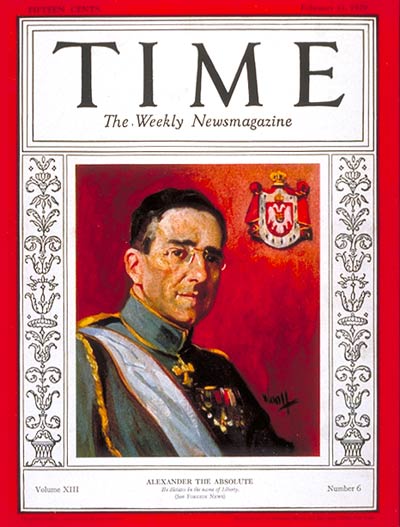
I will begin my survey with the self-coup of January 6, 1929, when King Aleksandar of Yugoslavia unilaterally abrogated his country’s constitution and assumed full dictatorial powers. This self-coup provides an early and ominous interwar example of a “recursive” transfer of power in which a previous extraconstitutional act is declared to be constitutional by a future constitutional act. Also, aside from Austria, the Central European country that Kurt Gödel may have been most likely familiar with was Yugoslavia. Austria not only shared a common border with Yugoslavia, during the summer of 1933 Gödel actually visited there and vacationed in the resort town of Bled with his mother.[1]
Following World War I, Yugoslavia was officially called the Kingdom of Serbs, Croats, and Slovenes, and his motley kingdom consisted of a diverse and far-flung federation of crown provinces (Bosnia and Herzegovina) and the formerly independent kingdoms of Serbia and Montenegro, along with an assorted collection of territories that were once part of Austria-Hungary, including Carniola, a portion of Styria, and most of Dalmatia (all from Austrian part of the former Austro-Hungarian Empire) as well as Croatia, Slavonia, and Vojvodina (all from the Hungarian part of the former empire).[2] Yugoslavia’s first parliamentary constitution was enacted in June of 1921 and was called the Vidovdan Constitution after the feast of St. Vitus, a Serbian Orthodox holiday that takes place every June.[3] The Vidovdan Constitution established a constitutional monarchy, led by King Aleksandar I, also known as King Aleksandar the Unifier,[4] who assumed the throne in August of 1921 and ruled Yugoslavia–first as king, then as dictator–until his assassination in October 1934.
Alas, Yugoslavia’s transition from democracy to dictatorship began as early as 20 June 1928, when the Croatian Peasant Party leader Stjepan Radić was shot by a Montenegrin Serb leader and People’s Radical Party politician Puniša Račić during a tense argument on the floor of Yugoslavia’s parliament.[5] Radić’s assassination not only embroiled Yugoslavia in political turmoil; it also allowed King Aleksandar to take full advantage of the crisis. He carried out a self-coup on 6 January 1929, proroguing the parliament,[6] abrogating the Vidovdan Constitution, and assuming full dictatorial powers.[7] Two years later, King Aleksandar formalized his dictatorship by promulgating a new constitution by decree on September 3, 1931. Yugoslavia’s new constitution, which was also known as the September Constitution or Octroic constitution, would remain in effect for another ten years, until the invasion of Yugoslavia by the Axis powers in 1941.
Did Gödel take notice of these events in neighboring Yugoslavia? Although Gödel did cross the Austro-Yugoslav border once, when he vacationed in Bled in 1933, it is unclear whether he took notice of any of these events. At the time of Aleksandar’s 6 January proclamation, for example, Gödel was in Vienna, beginning his work on his doctoral dissertation,[8] and when Aleksandar later decreed a new constitution in September of 1931, Gödel was preparing to attend a meeting of the German Mathematical Union in the spa town of Bad Elster, which is located in the state of Saxony in Germany, to give a lecture on his incompleteness theorem.[9]
Whether Gödel was aware of the September Constitution or the Yugoslavian self-coup, King Aleksandar’s decree of September 3, 1931–when he promulgated a new constitutional charter to replace the one he had abrogated in 1929–poses a deep constitutional conundrum or paradox: was this decree itself constitutional? After all, Aleksandar was acting outside his country’s constitutional process when he abrogated the Vidovdan Constitution on 6 January1929. Stated formally, Aleksandar’s abrogation of the Vidovdan Constitution effected an extraconstitutional transfer of power from parliament to king. So, from a theoretical perspective, was the 3 September decree itself an unconstitutional act, or did the decree create a new constitutional order, one that “legalized” his self-coup ex post?
I am interrupting my series of blog posts on the demise of Central European democracies during the interwar period to make the following statement: last night’s censure of Representative Rashida Tlaib is unamerican. Simply put, although I stand with Israel, the progressive Congresswoman should be free to express her views without fear or favor.
Although the story of Kurt Gödel’s discovery in late 1947 of a logical contradiction in the United States Constitution has been retold many times, the content of this discovery is often discounted as nonsense or as highly improbable.[1] This assessment, however, ignores Gödel’s Central European background and the dramatic constitutional histories of Central European states during the interbellum period, for during his years at the University Vienna (1924-1940)–first as a student and then as a lecturer–Gödel would have noticed that every single constitutional democracy in Central Europe ended in dictatorship.[2]
Although Gödel lived only 15 years in Vienna, in many ways those were the most productive and important years of his life. In summary, Kurt Gödel had matriculated at the University of Vienna in the fall of 1924, and by the summer of 1929, he had completed his doctoral thesis logically proving the completeness of the first-order predicate calculus. (Gödel’s dissertation was approved by his academic advisors on 6 July 1929,[3] and he was granted his Ph.D. on 6 February 1930.[4]) He then proved his now-famous “incompleteness theorem” in 1931, and finally obtained his Habilitation as well as the right to lecture in 1933.[5] In the words of fellow Austrian scholar Karl Sigmund, “Kurt Gödel spent barely fifteen years in Vienna … However, the years [in Vienna] … constituted his formative period. He was deeply affected by the extraordinary cultural and intellectual following of what has been called ‘Vienna’s Golden Autumn,’ and he may one day be seen as its most prestigious scion.”[6] Vienna is where Gödel attended university and received his doctoral degree, where he attended the philosophical discussions of the Vienna Circle, where he met and his wed his wife Adele, where he did his most important and original work, where he made landmark contributions in the fields of logic and mathematics.
To sum up, Vienna was not only Gödel’s primary residence from 1924 to 1940; it was also the grand capital city where Gödel came of age. But what many students of Gödel’s life and work fail to mention is that Vienna–the imperial capital of the former-Austro-Hungarian Empire–must have also offered Gödel a perfect vantage point from which to observe, even casually, the degeneration of constitutional democracies into constitutional dictatorships across Europe. In the fall of 1924, when the young Gödel began his studies at the University of Vienna, the vast majority of states in Europe were parliamentary democracies. But by the time Gödel and his wife Adele left their beloved Vienna fifteen years later in January 1940, thirteen European democracies had become dictatorships and every single constitutional democracy in Central Europe, Gödel’s corner of the world, had become a constitutional dictatorship.[7] In the words of two eminent European historians, “[Central] Europe was strangled by various dictatorships: some fascist/Nazi dictatorships, some puppet, and a variety of semi-fascist or right-wing nationalist and royalist authoritarian regimes.”[8]
Did Gödel have the time or the inclination to take notice of these dramatic anti-constitutional moments occurring across Europe during his days at the University of Vienna? How could he not have? Although “Gödel devoted himself intently on his studies … he was not asocial,”[9] for “he spent a good deal of time in the coffeehouses that were then so central to Viennese intellectual and cultural life.”[10] So it is certainly possible, perhaps even probable, that Gödel read about these extra-constitutional coups in one of Vienna’s leading newspapers or that he overheard talk about these dramatic events in one of his favorite coffeehouses.
Source: F. E. Guerra-Pujol, “Gödel’s Interbellum” (revised draft, 2023); footnotes below the fold:
“One of the great unsolved mysteries of constitutional law is ‘Gödel’s loophole‘. In brief, the great logician Kurt Gödel reportedly discovered a deep flaw in the United States Constitution, a logical contradiction that could lead to a constitutional dictatorship. In a previous work, I conjectured what the substance of this loophole might be. Here, by contrast, I will address a different constitutional question: how plausible is Gödel’s loophole as a practical matter? More to the point, how likely is it that a would-be dictator could exploit Gödel’s constitutional loophole in these turbulent times? It turns out, very likely, if the constitutional history of interwar Central Europe is any guide. By way of example, by the time Gödel was awarded the right to lecture at the University of Vienna in March 1933, democracy had died in at least nine or ten states in interbellum Europe, depending on whether Atatürk’s Turkey is classified a dictatorship: Hungary under Admiral Horthy, Italy under ‘Il Duce’ Benito Mussolini, Lithuania under President Smetona, Poland under First Marshal Piłsudski, Portugal under Prime Minister Salazar, Spain under Captain General Primo de Rivera, and Yugoslavia under King Aleksandar had all become constitutional dictatorships.”
Bonus video: “Chaos and Classicism: The Interwar Period” by Professor Atina Grossmann:
My most downloaded work of all time, Gödel’s Loophole, describes the logician Kurt Gödel’s discovery of a logical contradiction in the United States Constitution, a discovery he reportedly made while he was studying for his U.S. citizenship exam in 1947. To celebrate the 10-year anniversary of the publication of my loophole paper, I wrote a “prequel” titled Gödel’s Interbellum. My prequel surveys the demise of three Central European democracies through the eyes of Gödel: King Aleksandar’s “January 6” dictatorship in the Kingdom of Yugoslavia in 1929, Austrian Chancellor Engelbert Dollfuß’s declaration of the “self-elimination of Parliament” in March of 1933, and King Carol’s seizure of emergency powers in Romania in 1938. In short, I conjecture that Gödel was not only aware of these dramatic events in his corner of the world (Central Europe); I also surmise that the possibility of a self-coup–what I refer to as a “recursive” transfer of power–must have informed Gödel’s discovery of a loophole in the U.S. Constitution.
Bonus video: MetaMaths video on “Gödel’s constitutional Loophole”:
My colleague Dan Markel was murdered in his own home in Tallahassee, Florida on 18 July 2014. Yesterday, a jury found Markel’s brother-in-law, Charlie Adelson, guilty of conspiring to murder Markel.
Wendi Adelson, you’re next! One of the things we learned from Charlie’s trial is that his sister Wendi (Markel’s evil ex-wife) knew about the murder plot and did nothing to stop it from happening.











 prior probability