
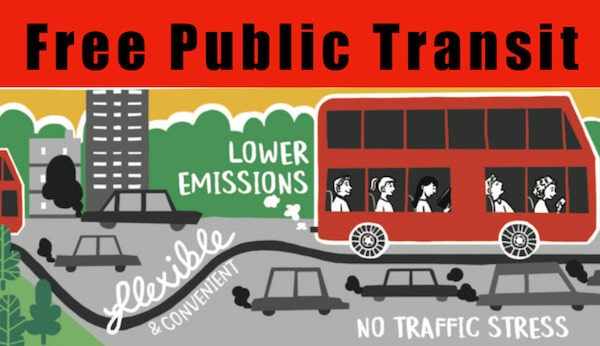
After all, State and federal governments already subsidize driving in myriad ways (see, e.g., this compelling research by law professor Gregory H. Shill), so why can’t we fully subsidize public transit as well? This website (via efficientgov.com) lists the pros and cons of making public transportation free, and frankly, the cons are so weak as to be laughable (e.g. “car sales would drop significantly” and “parking cops would lose their jobs”). Senator Warren, are you listening?










 prior probability
As a wanna-be traffic engineer, I rue the fact that the US was not able to build out or sustain a practical passenger rail system. I don’t think “free” would change that equation. Sure, I wish I could take high-speed trains to places that are “just too long” to drive but “just too short” to fly, which for me is now about 9 hours. But then, like flying, one is faced with how one gets around once you reach the destination — you’re back to renting a car in all but the largest cities. All our infrastructure has been suburbanized and spread out such that traditional mass transit does not / cannot reach it. The answer to both getting-around and congestion will (eventually) be an on-demand (like Uber) public bus system with no pre-defined routes but simply vehicles that circulate around and pick up passengers along the way, with computing power used to strike a balance between maximizing passenger-miles per vehicle and minimizing time-to-destination. That could be free or nominal cost. It could even start as a pilot program for the elderly staffed by volunteer drivers.