
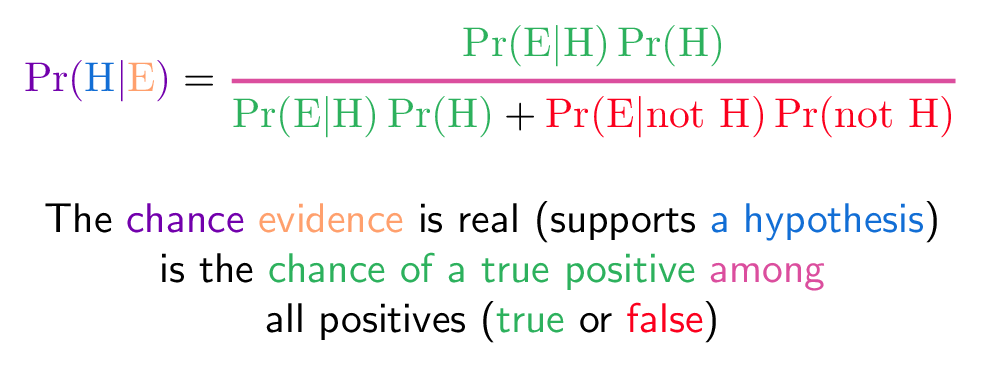
By all accounts (see, e.g., Frame 2015, p. 44; see also here and here), the Rev. Thomas Bayes (1701-1761) developed his now-famous theorem in the 1740s but never published his remarkable work during his lifetime; instead, it was his close friend and fellow dissenting minister, the moral philosopher and mathematician Richard Price (1723-1791), who edited and communicated Bayes’s unpublished work via a letter to physicist John Canton (1718-1772), who then read Bayes’s paper, along with an appendix prepared by Price, aloud to the famed Royal Society of London on 23 December 1763. (The mathematician-astronomer Pierre-Simon Laplace (1749-1827) made additional contributions to Bayesian probability in the late 1700s; see here.)
For his part, Adam Smith’s familiarity with inverse probability is unclear at best. Although Smith was elected a Fellow of the Royal Society on 21 May 1767, he could not have been present at that 1763 meeting of the Royal Society in which Bayes and Price’s work on probability was discussed (Smith was still in Glasgow), and he was either en route to France or in France when Bayes’s original paper and Price’s appendix were finally published and circulated (Bayes 1763; Price 1765). Also, although Smith and Price shared many mutual friends (e.g. David Hume) and moved in the same London social circles, Smith himself had a low opinion of Price. In a letter dated 22 December 1785, Smith writes: “Price’s speculations cannot fail to sink into the neglect that they have always deserved. I have always considered him as a factious citizen, a most superficial Philosopher and by no means an able calculator.” (Corr. No. 251) Ouch!
Nevertheless, although there is no other evidence that Smith engaged with or incorporated Bayesian probability theory in any of his works, he definitely had some implicit appreciation of the concept of probability, for the words “probability” and “probably” appear a lot of times in his Wealth of Nations — by my count, over 110 times in all! By way of comparison, the word “liberty” appears 88 times. (By way of further comparison, “probability” and “probably” appear about two dozen times in Smith’s Theory of Moral Sentiments, while the word “liberty” appears only 15 times.) Bonus link: Check out this paper by my colleague Michael Emmett Brady (2016), a lecturer at the Dominguez Hills campus of California State University.
WORKS CITED:
- Thomas Bayes: An essay towards solving a problem in the doctrine of chances, Philosophical Transactions of the Royal Society, Vol. 53 (1763), pp. 370-418, available here.
- Michael Emmett Brady: A study of Adam Smith’s original contributions to economic theory and decision making under uncertainty. International Journal of Business Policy & Governance, Vol. 3, No. 3 (2016), pp. 39-50.
- Paul Frame: Liberty’s Apostle: Richard Price, His Life and Times. University of Wales Press, 2015.
- Richard Price: A supplement to the essay on a method of calculating the exact probability of all conclusions founded on induction, Philosophical Transactions of the Royal Society, Vol. 54 (1765), pp. 296-325.
- Adam Smith:
- An Inquiry into the Nature and Causes of the Wealth of Nations (R. H. Campbell and A. S. Skinner, editors), 2 Vols. Liberty Fund, 1982.
- The Correspondence of Adam Smith. (Mossner, E. C., and Ross, I. S., editors). Liberty Fund, 1987.
- The Theory of Moral Sentiments (D. D. Raphael and A. L. Macfie, editors). Liberty Fund, 1994








 prior probability
Pingback: Adam Smith’s contributions to probability theory? | prior probability
Pingback: Adam Smith, Richard Price, and risk management | prior probability
Pingback: Adam Smith and probability: a recap | prior probability
Pingback: Final thoughts on Adam Smith and the psychology of probability | prior probability