
Act I: Balliol College, Oxford (1744) [*]
Adam Smith was enrolled in Balliol College at Oxford University from July 1740 until August 1746. During his Oxford years, the young scholar wrote to his mother on several occasions.[1] Although most of these letters are mundane,[2] two of them are worth taking a closer look at, for Smith self-diagnoses–not once, but twice!–a peculiar health condition: “laziness”! In one letter (dated 29 November 1743), for example, Smith informs his mother, “I am just recovered of a violent fit of laziness, which has confined me to my elbow-chair these three months.”[3] And in the other relevant letter (dated 2 July 1744), Smith explains to his mother why he has not gotten around to writing her more often:
“I am quite inexcusable for not writing to you oftener. I think of you every day, but always defer writing till the post is just going, and then sometimes business or company, but oftener laziness, hinders me. Tar water is a remedy very much in vogue here at present for almost all diseases. It has perfectly cured me of an inveterate scurvy and shaking in the head. I wish you’d try it. I fancy it might be of service to you.” (Corr. 6)
Today, “tar water” is an almost-forgotten footnote in the ignoble history of quackery,[4] but at the time, this potion was believed by many to be a panacea capable of curing or alleviating a staggering list of ailments, including asthma, gout, indigestion, smallpox, and even ulcers.[5] For his part, the young Adam Smith not only recommends this folksy home remedy to his mother; he also claims it has already cured him of at least two other maladies: “inveterate scurvy and shaking in the head.” But what was tar water, how did Smith discover this cure-all, and did it really work?
Tar water was a medicinal liquid consisting of pine tar mixed with water,[6] and this elixir may have come to Smith’s attention via the buzz generated by the Anglo-Irish philosopher George Berkeley’s final major philosophical work, Siris: A Chain of Philosophical Reflexions and Inquiries Concerning the Virtues of Tar-Water,[7] which was first published in London in April 1744 and the cover of which is pictured below.[8] Among other things, Bishop Berkeley’s treatise on tar water recommends that pine tar be stirred for three or four minutes with an equal quantity of water, that the mixture be allowed to stand for 48 hours, and after this time has elapsed, that the separated water be drawn off and consumed at the rate of one half-pint night and morning “on an empty stomach.”[9]
Alas, Adam Smith’s early encounter with quackery produced mixed results: he claimed tar water had cured him of his “inveterate scurvy and shaking in the head,” but by his own admission, this foul-smelling concoction was unable to counteract his recurring bouts of “laziness”; otherwise (one presumes), he would have written to his mother more often! In any case, although Smith’s biography thus far contains some evidence of his willingness to experiment with at least one popular pseudo-medical remedy (tar water), direct evidence of Smith’s skepticism toward doctors–or toward the medical profession more generally–is still lacking. In the meantime, Smith’s first direct encounter with the “absurd prescriptions” of doctors will occur during his college professor days in Glasgow.
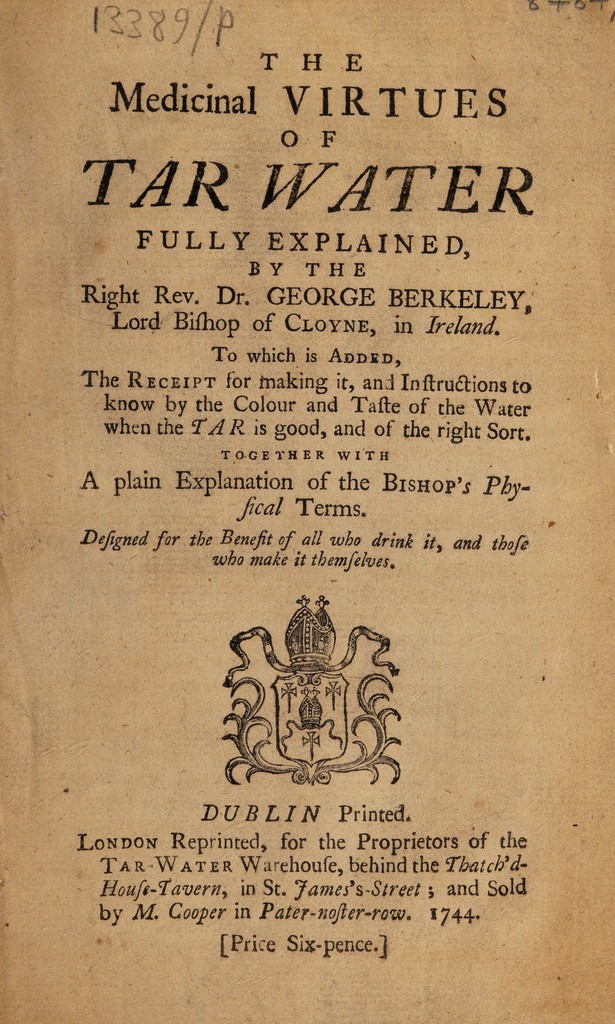
[*] For my Prologue, see my previous post.
[1] See letters nos. 2, 3, 4, 5, and 6 in The Correspondence of Adam Smith.
[2] In one undated letter from Oxford to his mother, for example, Smith writes: “Dear Mother I have but just time to tell you that I am well.” (Corr. 2) And in another letter (this one dated 23 October 1741), Smith requests an article of clothing: “In my last Letter I desir’d you to send me some Stocking’s, the sooner you send ’em the better.” (Corr. 3)
[3] Corr. 5; my emphasis. As an aside, my colleague and friend Sarah Skwire points out the “delightfully paradoxical” nature of Smith’s peculiar phrasing (“a violent fit of laziness”) in her contribution to the “Smith at 300” symposium issue of the Journal of the History of Economic Thought. See Sarah Skwire, “Smith at 300: a violent fit of laziness,” Journal of the History of Economic Thought, Vol. 43, No. 2 (2023), pp.182-183.
[4] See, e.g., Eric Jameson, The Natural History of Quackery (1961), pp. 31-33. Curiously, Lydia Kang and Nate Pederson’s more recent survey of medical quackery, which I featured in my previous post, omits tar water. See Kang & Pederson, Quackery: A Brief History of the Worst Ways to Cure Everything (2017).
[5] See generally Scott Breuninger, “A panacea for the nation: Berkeley’s tar-water and Irish domestic development,” Études irlandaises, Vol. 34, No. 2 (2009), pp. 29-41.
[6] Ibid.
[7] See George Berkeley, Siris: A Chain of Philosophical Reflexions and Inquiries Concerning the Virtues of Tar-Water. Dublin and London (1747) [1744]. Available online: https://archive.org/details/sirischainofphil00berkiala/page/n3/mode/2up
[8] According to Ernest Campbell Mossner and Ian Simpson Ross (1987, p. 3 n.2; Corr. 6), Bishop Berkeley’s treatise on tar water caused “an immediate sensation”: “George Berkeley’s Philosophical Reflexions and Inquiries Concerning the Virtues of Tar-Water (later prefixed by the title Siris) was first published in London in April 1744, and caused an immediate sensation. A correspondent of the Archbishop of York commented in June: ‘it is impossible to write a letter now without tincturing the ink with tar-water. This is the common topic of discourse, both among the rich and poor, high and low; and the Bishop of Cloyne has made it as fashionable as going to Vauxhall or Ranelagh.’ The Archbishop replied that he thought it a defect in Berkeley’s recommendation that he had made it a ‘catholicon’ (Letters from . . . Dr. Thomas Herring to William Duncombe, London, 1777).”
[9] Berkeley, op. cit., pp. 4-5.










Pingback: The bloodlettings of Adam Smith’s private pupil Thomas Petty-Fitzmaurice | prior probability
Pingback: Adam Smith and *absurd prescriptions* of doctors (continued): three moderate tea cupfuls of blood | prior probability
Pingback: Epilogue: Adam Smith on the *absurd prescriptions* of doctors | prior probability