
Act II: Glasgow College (1760) [*]
The next direct evidence of Smith’s encounters with the “absurd prescriptions” of doctors are two pieces of private correspondence–one dated March 10, 1760 (Corr. 45); the other, Nov. 11, 1760 (Corr. 52)–both of which are addressed to “Lord Shelburne.” [1] At the time, Adam Smith was a professor at the University of Glasgow as well as a private tutor to Lord Shelburne’s son, Thomas Petty-Fitzmaurice. [2] The first time the young aristocrat became ill during his studies in Glasgow, Smith describes his illness as a “slight fever” in a letter addressed to his pupil’s father:
“I think it my Duty to inform your Lordship that Mr. Fitzmaurice has been for some days past ill of a slight fever, from which, however, he never appeared to be in the least danger and from which I hope he is now in a fair way of recovery.” [3]
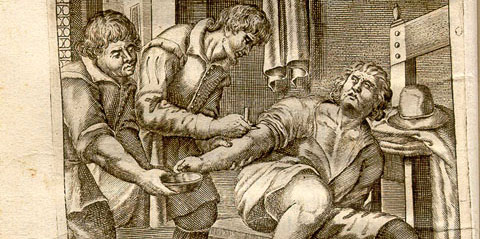
This supposed “slight fever,” however, was serious enough for Smith to call a doctor and for the doctor to perform a bloodletting:
“He [Thomas Petty-Fitzmaurice] was seized with it [“a slight fever”] on Wednesday last. I missed him that forenoon from the Class, which I had never done before and upon my return to my own house, I found him lying upon his bed and complaining of a headache. I immediately sent for a Physician who ordered him to be blooded. He was a good deal relieved by the bleeding, but became very feverish that evening. He continued so all next day but the day following found himself greatly relieved in consequence of a sweat and a sound Sleep.” [4]
Before proceeding any further, notice how Smith attributes his pupil’s recovery not so much to the bloodletting procedure but to “sweat” and “sound Sleep.” In addition, it turns out that Smith ended up calling on not just one doctor but on two medical men, for Smith concludes his letter thus:
“I have the greatest trust in the two Medical Gentlemen who waited upon him, Dr. Black and Mr. Hamilton. They are both with him at least five times a day. They never have suspected the least danger from this ailment which they now think is over, and it is contrary to both their opinions that I give your Lordship the trouble of this alarm.” [5]
Although Smith confirms Petty-Fitzmaurice’s speedy and complete recovery two days later (March 12, 1760) in his next letter to Lord Shelburne, his sickness-prone pupil suffered yet another medical relapse requiring yet another medical visitation just a few days letter. In his next letter (dated March 17, 1760) to Lord Shelburn, Smith writes:
“I expected that Mr. Fitzmaurice would have been able to have acquainted your Lordship by this Post of the entire reestablishment of his health. An accident, however, has prevented this from taking place as soon as I expected. I never saw any body appear to recover faster than he did on Friday and Saturday last. On Saturday, particularly, he was surprisingly well and went to bed about 8 o’clock, in appearance, in as good health as it is possible for anybody to have, who had so lately recovered of a fever. On Sunday morning he was seized with a purging which continued all that day, raised his pulse and seemed to threaten a return of his fever. The Doctor assured me that this would in all proba[bility] prove a final crisis, that his former bleeding at the nose had not been so plentiful as he could have wished and that he had always suspected that something of this kind might happen: And I remember, indeed, that after the bleeding of his nose had stopped the Dr. told him that it would probably bleed again that night, which, however, did not happen and is the only prediction of his in this disease that has not in some degree been fulfilled…. I write this at 8 o’clock at night. Tho’ much exhausted by the Disorder of yesterday, he is quite cool and easy and free from every symptom of fever. This slight fit, I hope, tho it has retarded, will ensure his future recovery.” [6]
Two days later (March 19, 1760), Smith confirms yet again that his private pupil “has been quite free from all feverish symptoms since Monday last, and begins now to recover his strength very fast ….” (Corr. 49), but in closing his letter Smith mentions in passing that his pupil at some point had to undergo yet another bloodletting: “He was only once blooded and the rest of his cure has been wrought by a dark, quiet room and great plenty of lemonade made of warm barley water.” (Ibid.; my emphasis)
Why does Adam Smith mention this gory treatment in passing, almost as a mere afterthought? Most likely because bloodletting was so common in Smith’s day–the 18th-century equivalent of taking two aspirins today. Even after William Harvey first proposed his blood-circulation theory in the 1600s, bloodletting was a medical “cure-all” used to treat almost any and every ailment imaginable, including insanity, [7] and bloodletting occupied such a prominent place in the annals of medical history because most doctors, even in Smith’s day, still subscribed to the now-debunked humoral theory of disease, a long-standing and entrenched mental medical paradigm going back to the days of Hippocrates. [8]
Alas, Smith’s sickly student would fall ill yet again in the fall, resulting in another round of letters from Smith to Shelburne. This time around, Petty-Fitzmaurice would suffer an eye infection, and this time his doctor would prescribe leeches! (To be continued…)
[*] For Act I, see my previous post.
[1] The Lord Shelburne that Smith is corresponding with is identified as the “1st Earl of Shelburne” in Mossner & Ross 1987, p. 29 n.1 (Corr. 29), and the 1st Earl of Shelburne was John Petty Fitzmaurice (1706–1761). See Lundy 2019
[2] Cf. Mossner & Ross 1987, p. 26 n.2: “Hon. Thomas Petty-Fitzmaurice (1742–93) of Llewenny Hall, Denb., Wales; educ. Eton; matriculated at Glasgow, 1759; St. Mary Hall, Oxford, 1761; called to the English Bar, 1768; M.P. 1762–80. In 1779, he set up as a linen merchant and established a bleaching factory at Llewenny, Wales, because his Irish estates were unproductive. He was reported to have lived on ‘the most intimate terms with Johnson, Hawkesworth and Garrick’ (Gentleman’s Magazine, 1793, 1053).”
[3] Corr. 45.
[4] Ibid.
[5] Ibid.
[6] Corr. 48.
[7] See generally Kang & Pederson 2017, pp. 129-139.
[8] See, e.g., ibid., p. 5.








Pingback: Painless parasites: how leeches saved one of Adam Smith’s students | prior probability
Pingback: Adam Smith and *absurd prescriptions* of doctors (continued): three moderate tea cupfuls of blood | prior probability
Pingback: Epilogue: Adam Smith on the *absurd prescriptions* of doctors | prior probability