Back to our regularly scheduled programming (so to speak), the next document in my sample of signed Adam Smith letters is Order #141. This order is dated 21 December 1784 and is signed by David Reid (top signature), Adam Smith (middle), and James Edgar (bottom). Here, the commissioners of the Board of Customs respond to a letter from the principal outport officers at Inverness regarding ten bushels of contraband salt:
“We have received your Letter of the [*] Instant, acquainting Us that William Walker Master of the Sloop Rathia from Anstruther entered at your Port two thousand and four hundred Bushels [of] Scots Salt — That by the Landwaiter[‘]s Blue Book it appears ten Bushels were discharged more than entered and contained in the Cocket, and submitting whether it ought not to be returned as a Seizure — We direct you to prosecute the said the Bushels of Salt to Condemnation before the Justices of the Peace, and when Condemned you are to sell the same by public Sale duly advertised to the best advantage taking care to Remit the King’s Share to the Receiver General and to transmit the Decree of Condemnation and Certificate of Sale to the Register of Seizures [,] acquainting us when you have so done.
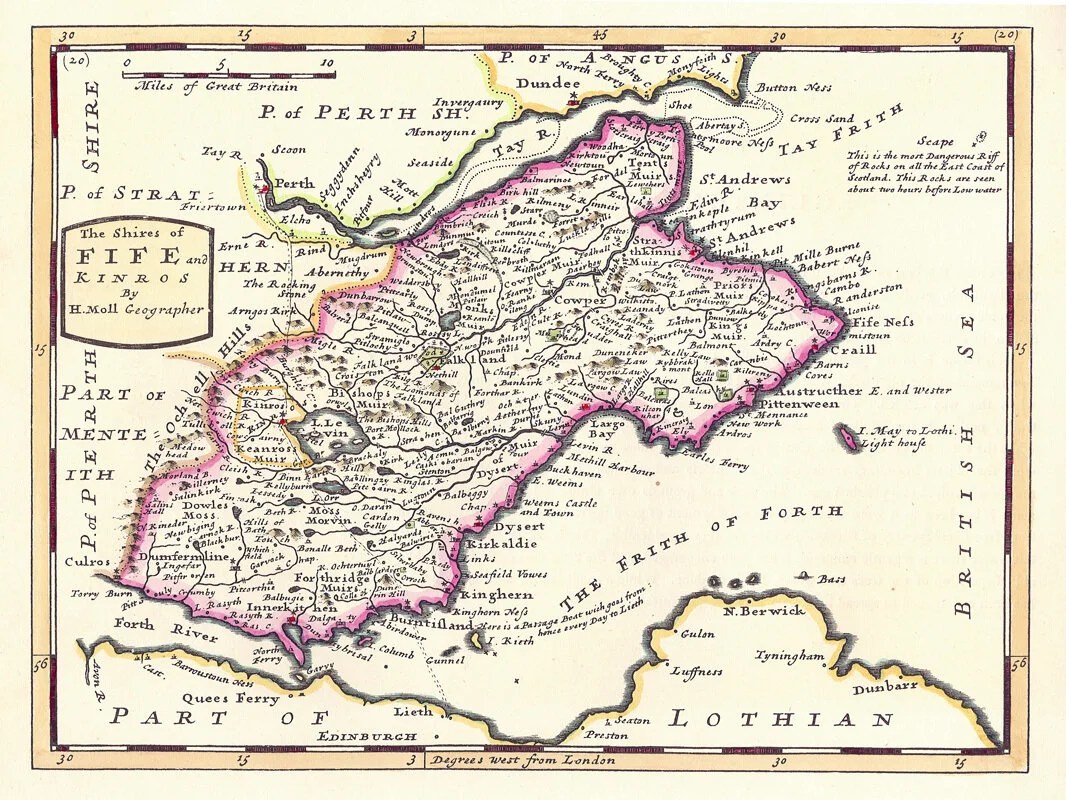
In summary, the captain of a sloop arriving at Inverness from Anstruther (see map below) had declared an entry of 2,400 bushels of “Scots Salt”. Upon the unloading of this cargo, however, a customs officer (the Landwaiter) recorded in his official log (the “Blue Book”) that 10 extra bushels of salt were unloaded beyond what was declared in the vessel’s official shipping manifest (“the Cocket”). (Cf. Samuel Johnson’s Dictionary, which defines cocket as “a scroll of parchment, sealed and delivered by the officers of the customhouse to merchants, as a warrant that their merchandize is entered.”) What should happen to those extra ten bushels of salt?
The Board of Customs orders the principal outport officers at Inverness (the Controller and Comptroller) to proceed with the prosecution and condemnation of the excess bushels of salt before the local justices of the peace, sell the excess salt at a public auction, and remit the government’s share of the proceeds (“King’s Share“) to the Receiver General in Edinburgh. In addition, the board orders them to submit the local court’s condemnation order as well as the certificate of sale from the public auction to the central Register of Seizures. This meticulous order thus highlights three features of the 18th-century customs system in Scotland:
- Zero-tolerance: This order underscores the no-nonsense zero-tolerance approach of the central Board of Customs: a discrepancy of a mere 10 bushels of salt out of a total shipment of 2,400 bushels (less than 0.4%) is treated as a serious infraction of the revenue laws. Every bushel must be accounted for!
- Decentralized enforcement: The board directs the outport officers to prosecute the seizure before the local justices of the peace, a far more streamlined and faster legal mechanism for handling petty smuggling or minor manifest discrepancies in outports than the Court of Exchequer.
- Tons of paperwork: The outport officers had to inform the central Board of Customs of the discrepancy from the Landwaiter’s Blue Book, secure a formal decree of condemnation from a local court, advertise and conduct a public auction, split and remit some of the proceeds to the Receiver General, and then submit additional paperwork with the Register of Seizures.
Why so much paperwork–multiple letters, local court filings, public auction advertisements, and central treasury remittances–over just 10 bushels of salt? The main reason for this cumbersome system of reporting must have been the possibility of collusion between local revenue officers and unscrupulous ship captains or cost-cutting merchants. This was an era when frontline customs officers were poorly paid (see Hoon 1968, Ch. 6, especially pp. 211-220) and thus vulnerable to bribery or informal deals with local merchants or the smugglers themselves (see generally Muskett 1997), so perhaps all this paperwork was a form of accounting “check and balances”.
[*] The date is illegible.
Bonus link: Scottish historian Richard Oram surveys Scotland’s medieval salt industry in the video lecture below.