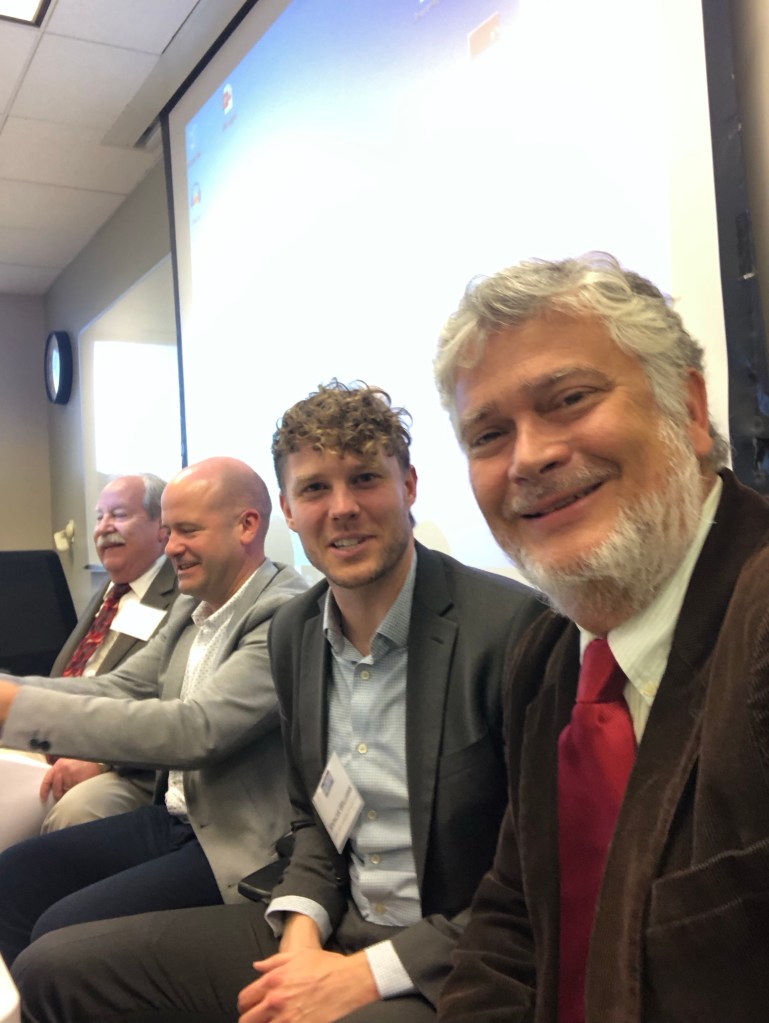
Greetings from Fort Worth, Texas! Pictured below are yours truly (far right) along with my colleagues and fellow KCON panelists: Spencer Williams (Golden Gate), who spoke on “contractual complexity”; Mitja Kovač (University of Ljubljana), who retold Cicero’s solution to the Rhodes famine case; and Mark Wessman (Tulane; far left) who moderated our panel.
Note: This blog post is designed to provide some background regarding my upcoming talk on “belief contracts” at KCON XVI this weekend.
Fake or fact? What is the best way of dealing with false information on the Internet, such as conspiracy theories, fake news, etc.? I recently proposed the creation of a truth market where people could buy and sell belief contracts regarding the truth values of conspiracy theories, disputed media reports (“fake news”), urban legends, and the like. Although I attempted to anticipate and address several possible objections to my proposal when I wrote it up (see especially pp. 8 to 14 of my “truth market” paper), two anonymous reviewers read my work and provided some additional excellent feedback after I submitted my manuscript to the Journal of Free Speech Law. Below is a summary of their main concerns and criticisms:
To begin with, one concern was logistical in nature: how would my truth market work in practice? To the point, how many contracts are initially created when a statement is proposed? How are new belief contracts created? And what is the market cap? Another concern was the possibility of market manipulation, or the potential for “insider trading” by influential media figures. But the main objection to my truth market proposal–an objection made by both of my reviewers–was the open-endedness of my truth market, i.e. its complete lack of a “disciplining function” or “external validation device” (to quote my reviewers).
In brief, unlike a traditional prediction market, where participants buy and sell carefully-worded “event contracts” and have to agree ahead of time to an arbiter to decide whether the event being bet on has occurred or not by a specified date, my truth market would eschew external arbiters and would remain open indefinitely. But without an arbiter or “some trusted person” (to quote one of my reviewers) to “resolve” on some certain date the belief contracts being bet on (i.e. to decide whether a given conspiracy theory or item of fake news is true or not), there would be no foolproof way of assessing whether my truth market was working or not, i.e. whether the price of a belief contract reflected the underlying truth or truth-value of the proposition being bet on.
These are legitimate concerns and objections, and I will respond to them next week.
I just attended a talk by N.Y. Times columnist Ross Douthat at the Church of the Palms in Sarasota, Florida, and I will next fly out to Fort Worth, Texas, where I will be attending the Sixteenth Annual International Conference on Contracts (or “KCON XVI” for short) at the Texas A&M Law School and presenting my work on “belief contracts”. I will say more about Douthat’s talk and the upcoming KCON conference in the next day or two.
I recently read this excellent essay by Smith scholar Erik W. Matson, who identifies and explores many connections between the ideas of Adam Smith and his intellectual mentor David Hume. (The final version of Dr Matson’s essay was published in Volume 11 of the Adam Smith Review; here is an ungated pre-print via SSRN.) To the point, among the myriad connections between Smith and Hume’s thought that Matson identifies, the one that resonated with me the most is Hume’s probabilistic picture of human knowledge, i.e. the idea that experience and observation can at best give us probable knowledge, not demonstrative or complete knowledge.
In summary, this idea that scientific theories or explanations are probabilistic (never certain) can be traced back to David Hume’s 1739 Treatise of Human Nature, where Hume himself explains that “all knowledge resolves itself into probability, and becomes at last of the same nature with that evidence, which we employ in common life.” (See Matson 2019, p. 274, citing Book 1, Part 4, Section 1, Paragraph 4 of Hume’s Treatise. As an aside, this idea can perhaps be traced even further back to John Locke’s 1689 “Essay Concerning Human Understanding”! See also here for more details about Humean probability.) For his part, Dr Matson refers to a lesser-known essay by Adam Smith titled “Of the external senses” or “OES”, which appears in Smith’s posthumous collection of philosophical essays (Smith 1982, pp. 135-168). According to Matson: “Smith uses the language of probability in reference to the status of systems of explanation on multiple occasions [in his essay on the external senses]. He speaks of the ‘probable foundations’ of philosophical doctrines; he speaks of ‘this great probability … still further confirmed by the computations of Sir Isaac Newton’ (OES 147.41).”
Why did this aspect of Hume’s (and Smith’s) thought resonate with me? Because I would argue that the concept of “truth” is itself probabilistic in nature; see here or here, for example. Alas, although Matson may very well be correct that Smith may have adopted a “Humean attitude” toward theory choice in his (Smith’s) early philosophical work, I don’t see much evidence of Adam Smith thinking in explicitly probabilistic terms in his more mature works, like Theory of Moral Sentiments or Wealth of Nations. (In fact, Matson himself describes Smith’s own back-sliding toward “truth-talk” in the last part of his (Smith’s) essay on the history of astronomy, where Smith praises Newton’s discovery of gravity as the culmination of thousands of years of sundry scientific endeavors.) Either way, as I mentioned in a different context in my previous post, the battle between absolute truth and probabilistic truth in Smith’s thought could be the subject of another paper.
P.S.: Below the fold is a bibliography of some of the works I have cited in this blog post:
Alternative title: Who is Adam Smith’s impartial spectator?
Adam Smith’s “impartial spectator” is an idea that has fascinated me for as long as I can remember–see here, for example. In summary, Smith’s spectator metaphor goes back to his moral-philosophical treatise The Theory of Moral Sentiments, where Smith first invented the idea of an impartial observer or imagined third party who makes it possible for an individual to objectively judge the ethical status of his or her actions. But who exactly—or what—is this imaginary entity?
In a paper published in Volume 11 of The Adam Smith Review, independent scholar Toni Vogel Carey (see her impressive research bio here) offers a new and intriguing interpretation of Smith’s impartial spectator. To the point: she compares Smith’s spectator to the “ideal observer” in scientific thought-experiments. For Vogel Carey, that is, Smith’s moral spectator is supposed to be a close approximation of an unbiased or perfectly impartial observer with perfect information, and in support of her interpretation of the impartial spectator, Vogel Carey cites four Smith scholars: Charles L. Griswold (author of Adam Smith and the Virtues of Enlightenment), James Otteson (Adam Smith’s Marketplace of Ideas), Nicholas Phillipson (Adam Smith: An Enlightened Life), and David D. Raphael (The Impartial Spectator: Adam Smith’s Moral Philosophy). Alas, these Smith scholars describe the impartial spectator in radically different ways.
Nicholas Phillipson, for example, identifies the impartial spectator with the “common sense” of mankind, while David D. Raphael describes Smith’s spectator as “any normal observer who is not personally affected.” Both of these interpretations of the impartial spectator, however, pose two further questions: how ideal–or close to ideal–is the common sense of the public, and where does one draw the “not personally affected” line? Likewise, James Otteson describes Smith’s spectator as “a perfectly average fellow who is simply familiar with the situation,” and by the same token, Charles Griswold refers to Smith’s spectator as a “stand-in for ‘the public’.” But, again, how ideal–or close to ideal–is an “average fellow” or “stand-in for ‘the public’,” and how much “familiar[ity] with the situation” is required?
Worse yet, by my count there are at least three different interpretations of Smith’s spectator: 1. the impartial spectator as an ideal observer (Vogel Carey’s interpretation); 2. the spectator as a hypothetical average fellow or stand-in for the public in the aggregate (Otteson; Griswold); and last but not least, 3. the spectator as any ordinary or “normal” individual observer with “common sense” (Raphael; Phillipson). So, which of these interpretations is best, and what criteria should we use for deciding which particular interpretation is best? Those questions no doubt merit their own paper; in the meantime, however, I am posting below my “impartial spectator scorecard”:
Also, for the record, below the fold is a bibliography of the works I have cited in this blog post:
To commemorate 3/14, I am reblogging my “Pi Day” post from five years ago. (Also, on this day in 1964, nightclub owner Jack Ruby was convicted by a Dallas jury of murder with malice and was sentenced to death in the killing of Lee Harvey Oswald, the presumed lone gunman in the assassination of President John F. Kennedy.)
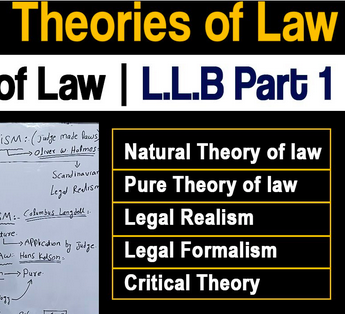
Via Brian Leiter (here), I discovered this strange blog post by Les Green, a philosophy of law professor at Oxford University. In summary, Professor Green offers a nuanced critique of the “pursuit of novelty” in fields like jurisprudence (philosophy of law): the pursuit of the new, which has now become a “fetish” (to quote Green), should take a back seat to the central goal of his field: the pursuit of truth. Professor Green’s diagnosis, however, has a fatal flaw: he fails to define truth. How do jurisprudes, for example, determine whether “the next general theory of law” — or even any of those listed in the picture below — is true or not? Alas, there is no way of testing, refuting, or “falsifying” (in the Popperian sense) such general legal theories; in a purely literary or linguistic field like jurisprudence, it’s all just a matter of opinion! As a result, although novelty is an imperfect proxy for truth (indeed, there might even be an inverse relation between novelty and truth), in a field like jurisprudence it is much easier to determine whether a theory is new than true.




 Happy Pi Day










 prior probability