Adam Smith’s patrons and possible father figures

(Walter Bagehot and Adam Smith, part 4)

I concluded my previous post by asking, How did an obscure bookworm like Adam Smith become a leading light of the Scottish Enlightenment? According to Walter Bagehot (see especially paragraphs 9 through 12 of his beautiful essay “Adam Smith as a Person”), it was a combination of powerful patrons and raw oratorical talent, along with a small dose of good luck, that would alter the course of the future economist’s fortunes–from college dropout to university professor, and all within the span of five pivotal years: 1746 to 1751!

Specifically, Bagehot singles out two prominent men (and possible father figures) who took Smith under their proverbial protective wings: a Lord Kames and a Provost Cochrane. Kames was Henry Home, Lord Kames (c.1696–1782), a great Scottish judge, philosopher, and man of letters who was a founding member of the Philosophical Society of Edinburgh. For his part, Cochrane was Andrew Cochrane of Brighouse (1693–1777), an 18th-century Glaswegian tobacco merchant and slave trader who led a private clique called the Political Economy Club and served three terms as Lord Provost of Glasgow. (Learn more about Provost Cochrane and the “tobacco lords” of Glasgow here.)

As it happens, the young Adam Smith must have not only befriended the founders of these social and scientific circles; Smith must have also somehow made a lasting impression on them. As early as 1748, for example, two years after Smith had left Oxford, Lord Kames arranged for the young college dropout cum scholar to deliver some guest lectures to the members of his learned society in Edinburgh. Against all odds, Smith somehow turned out to be a captivating and spellbinding speaker, perhaps the greatest of his generation! His Edinburgh lectures were so successful that he was offered a prestigious professorship at the University of Glasgow soon thereafter (around 1751).

And it was in Glasgow–where “Doctor Smith” spent the next 13 years of his quiet life–where the young philosopher would cross paths with the wealthy, powerful, and respected Provost Cochrane. By all accounts, they began to meet regularly at Cochrane’s Political Economy Club, which Bagehot describes as “this borderland between theory and practice” (p. 26; para. 12), and it was here, Bagehot conjectures, where this odd couple, a scholar and a slave trader, must have discussed a wide variety of economic topics. It was also here where Smith was most likely first exposed to the “heresy” of free trade, or in the immortal words of Bagehot: “From this club Adam Smith … learned much which he would he never have found in any book ….” (ibid.).

But Smith would not finish writing The Wealth of Nations until three decades later. In the meantime, Smith was still an up-and-coming professor of moral philosophy, and Smith the moral philosopher was teaching and writing a book on ethics–specifically, on the pivotal role that our emotions or “moral sentiments” play in helping us distinguish right from wrong. For his part, Bagehot will not only devote the next few pages of his essay to Smith’s first great work, The Theory of Moral Sentiments (pp. 26-29; paragraphs 13-15); Bagehot will subject Smith’s philosophical ideas to withering criticism. I will describe and further discuss Bagehot’s epic take-down of Smith’s moral philosophy next week, starting on Monday, April 3.

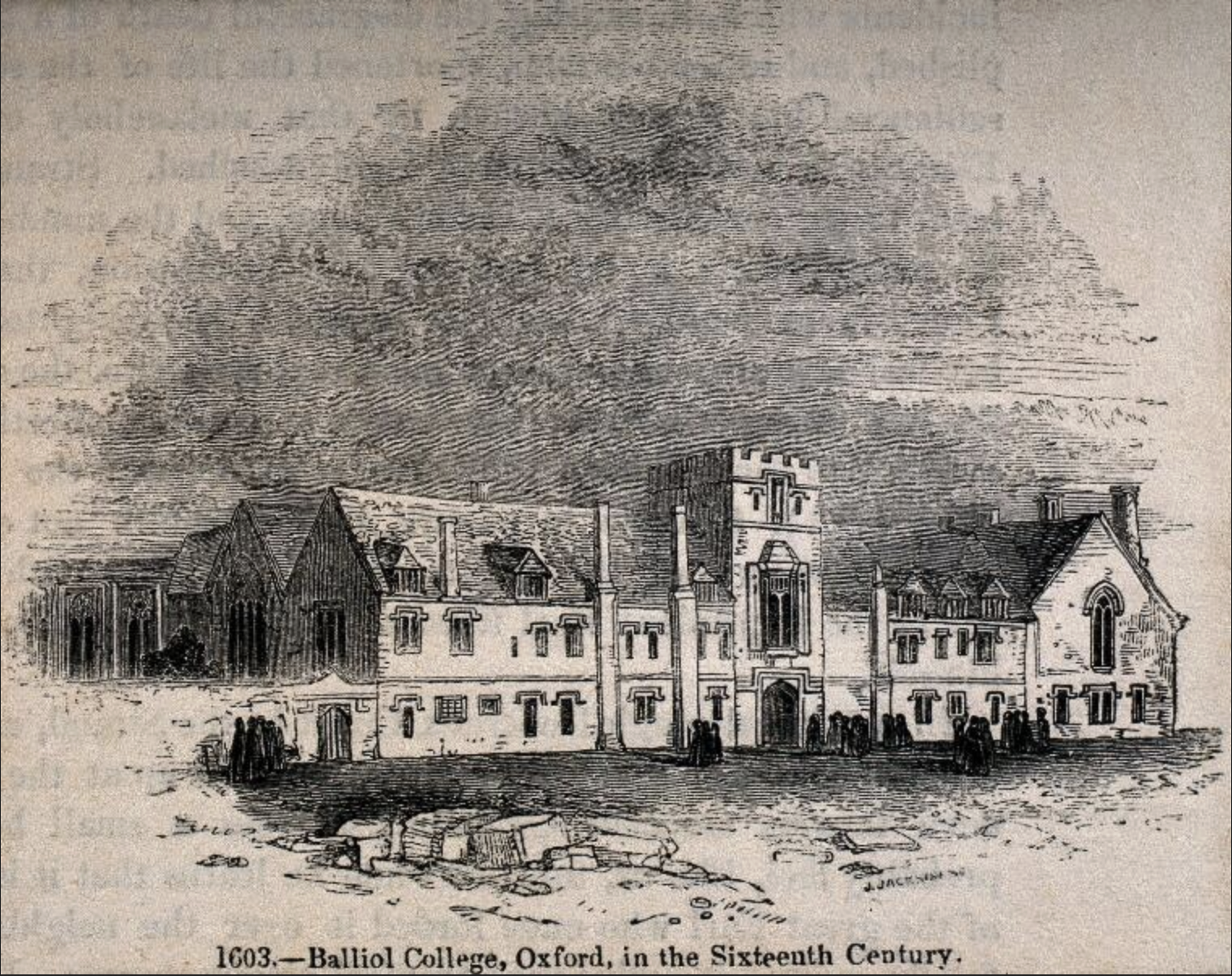
Image credits: see here (Kames) and here (Cochrane)
Posted in Uncategorized | 1 Comment

Balliol College and the road to Adam Smith’s Damascus

(Walter Bagehot and Adam Smith, part 3)

Thus far, I have reviewed the first five paragraphs of Walter Bagehot’s “Adam Smith as a Person” (see here and here). The next few paragraphs of Bagehot’s beautiful essay describe the circumstances surrounding Smith’s birth in Kirkcaldy and provide a brief sketch of Smith’s formal education at the universities of Glasgow and Oxford.

Although Bagehot incorrectly tells us in the sixth paragraph of his essay that the great Adam Smith was born in 1713 (Smith, in fact, was most likely born ten years later), Bagehot is right about two things: (1) the future economist was born to a widow, so Smith never met his father, and (2) we know next to nothing about Smith’s childhood and early years, except that Smith attended the University of Glasgow and that he must have been a good student, for he was awarded a special scholarship to attend Oxford. (Smith won a Snell Exhibition from the University of Glasgow to Balliol College, Oxford, to be more precise.) Bagehot then devotes the next two paragraphs (7 & 8) of his essay to Smith’s studies at Balliol College (pictured below), making the following points:

  1. If Oxford had allowed students to evaluate their courses (a common practice today), Smith would have written scathing reviews of his instructors, who (as Smith himself tells us in The Wealth of Nations) “have for these many years given up altogether even the pretence of teaching”;
  2. In spite of this, Smith spent “as many as seven years” at Balliol College, Oxford, where Smith was exposed to a new country, culture, and way of life (historically, Scotland and England were separate kingdoms until the Act of Union of 1707);
  3. Among other things, Smith studied modern and ancient philosophy during his Oxford years, including ancient Greek as well as a contraband copy of David Hume’s early philosophical writings.

The student scholarship that Smith was awarded to attend Oxford was reserved for future Anglican priests, i.e. for students who were destined to become clergymen, but as Bagehot correctly notes in the ninth paragraph of his essay, “for some reason or another, Adam Smith … gave up all idea of entering the Church of England, and returned to Scotland without fixed outlook or employment.” After abruptly leaving Oxford and abandoning the clergy, Smith lived with his mother for two years, “studying no doubt, but earning nothing, and visibly employed in nothing,” to quote Bagehot.

In other words, something dramatic must have occurred in the young Adam Smith’s intellectual life at this time–momentous enough to cause him to decamp from Oxford, give up his religious vocation, and beat a hasty retreat to his mother’s house. What happened on the road to Smith’s Damascus? And whatever it was, how did a washout with no prospects become a leading light of the Scottish Enlightenment, the man who would change the world by bringing down mercantilism and championing free trade?

Bagehot never answers the first question: what was the dramatic event that led Smith to abandon Oxford and jettison his prospects? (For my part, I suspect it was a broken heart caused by a love affair; see my 2021 paper “Adam Smith in Love“.) But in the next few paragraphs of his Adam Smith essay, Bagehot does describe the young scholar’s transformation from a proverbial loser living with his mom to an esteemed professor at the University of Glasgow, where Smith would spend the next 12 or 13 years of his life and where he would write his first great work, The Theory of Moral Sentiments. I will turn to Smith’s Glasgow years as well as his philosophical treatise in my next few posts.

Image credit: “Balliol College, Oxford: in sixteenth century” (wood engraving), via the Welcome Collection (see here)
Posted in Uncategorized | 4 Comments

Posted in Uncategorized | Leave a comment

Adam Smith’s dream

(Walter Bagehot and Adam Smith, part 2)

My previous post highlighted some of the main themes in Walter Bagehot’s beautiful essay “Adam Smith as a Person”. Today, I will pick up where I left off, beginning with the fourth paragraph, which surveys “the other works … [Adam Smith] published besides the Wealth of Nations”.

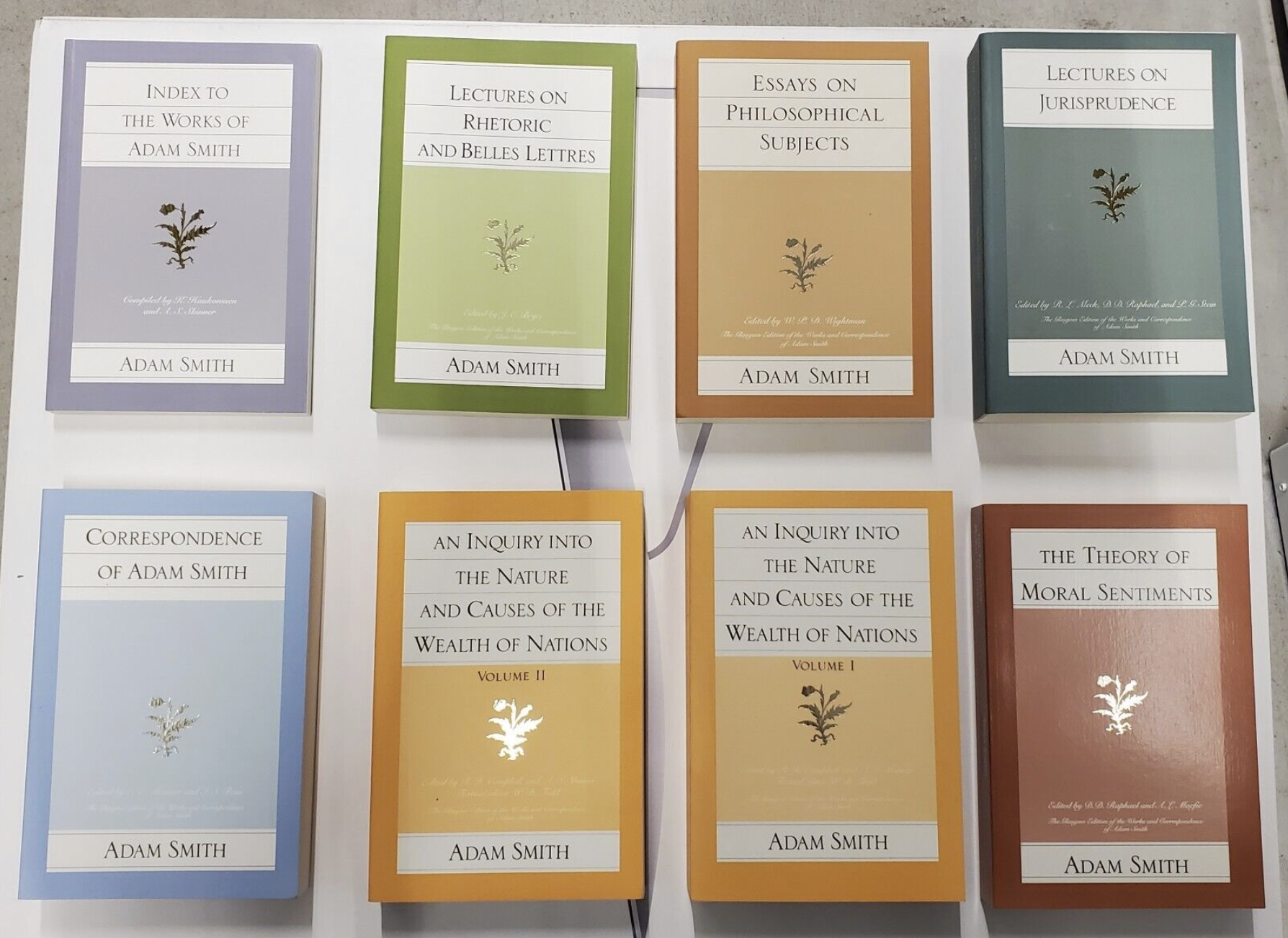
In all, Adam Smith published six substantial works on a wide variety of subjects, including his other great work, a comprehensive seven-part treatise on ethics (The Theory of Moral Sentiments). In addition to his tome on moral philosophy, Smith also published an appendix on the origins of language (Considerations Concerning the First Formation of Languages) as well as separate histories of astronomy, ancient physics, and ancient logic and metaphysics, which were all published posthumously as Essays on Philosophical Subjects. Smith even wrote a comprehensive survey of the fine arts, including painting, poetry, and music. (Moreover, as comprehensive as this brief survey of Smith’s writings appears, Bagehot left out Smith’s extensive correspondence and his lectures on rhetoric!)

Even more remarkable is that Adam Smith was working on another great book during his lifetime. Alas, this uncompleted work — which, in Smith’s own words, was to have provided “an account of the general principles of law and government, and of the different revolutions which they had undergone in the different ages and periods of society; not only in what concerns justice, but in what concerns police, revenue, and arms, and whatever else is the object of law” — never saw the light of day because Smith himself had requested his literary executors to burn and destroy it upon his death.

This prodigious and still unsurpassed level of intellectual production is perhaps best summed up by the immortal words of Walter Bagehot: “Scarcely any philosopher has imagined a vaster dream.”

But as Bagehot himself notes in the next paragraph of his essay (para. 5), why would such a great intellectual as Adam Smith — why would a thinker with such an abstract mind and with such a wide variety of eclectic and theoretical pursuits — ever decide to write a book like The Wealth of Nations? Why, in short, did this absent-minded Scottish philosopher, historian, and legal scholar turn to such mundane topics as “trade and money”? To have any hope of answering these pressing questions or solving this intellectual enigma, however, Bagehot concludes we must consider Adam Smith’s life and life experiences, and I will do just that in my next post …

Posted in Uncategorized | 2 Comments

Walter Bagehot and Adam Smith, part 1

As I mentioned in a previous post, I recently discovered (via the late David Winch) Walter Bagehot’s 1876 essay “Adam Smith as a Person”. Today, I will review the first three paragraphs of this beautiful essay, where Bagehot makes the following three points (in bold below) right off the bat about Adam Smith and his ideas:

  1. First and foremost, Bagehot begins his essay by noting how little we know about Adam Smith the man, about Smith’s own life and life experiences. The larger point that Bagehot is trying to make here is that Smith’s most influential work, The Wealth of Nations, was a one-of-a-kind intellectual achievement, a book that only Adam Smith himself could have written. No other author could have produced such an original treatise at this stage in history; no other thinker could have produced Smith’s “enduring particular result” (to quote Bagehot’s haunting phrase): the relationship between markets and progress.
  2. Next, Bagehot identifies a great irony in paragraph two of his essay: how could such an absent-minded bookworm like Adam Smith have written such a practical and world-changing work like The Wealth of Nations?
  3. Lastly (for now), Bagehot makes an important observation in paragraph three of his essay: The Wealth of Nations represents just one small corner of a much more ambitious project that Adam Smith was working on his entire life. Following Bagehot’s lead, I shall discuss Smith’s larger intellectual project in my next post …

Posthumous illustration of Walter Bagehot
Posthumous illustration of Walter Bagehot (image credit: W.W. Norton)
Posted in Uncategorized | 5 Comments

Music Monday: Hope Tala

Posted in Uncategorized | Leave a comment

Law’s metaphors

What is the best way to describe or visualize the law? As I mentioned in a previous blog post, it was the legal historian F. W. Maitland (1898, p. 13) who first compared law to a “seamless web” (see here). His 1898 essay A Prologue to a History of English Law begins with the following timeless sentence: “Such is the unity of all history that any one who endeavors to tell a piece of it must feel that his first sentence tears a seamless web.” But Maitland’s metaphor is not the only one out there. I came across two additional visualizations of law this weekend when I was reading a 2022 chapter on Law and Society in Eighteenth Century Scottish Thought by Peter Stein: the law as a large flowing river like the Nile (Stein 2022, p. 158) and the law as an ancient castle (ibid., p. 165).

The river Nile metaphor appears in Lord Kames’ Historical Law-Tracts (Kames 1758, pp. ix-x), which was first published in Edinburgh in 1758 and is available here for your reference. By way of background, Henry Home, Lord Kames (1696–1782), was an influential Scottish judge, a prolific man of letters, and one of Adam Smith’s early patrons, and his Historical Law-Tracts is considered one of the earliest contributions of the Scottish Enlightenment. In the preface to this historical work, Lord Kames compares law to the river Nile, and he also compares a student of law to a sailor crossing the Delta, who “loses his way among the numberless branches of the Egyptian river”:

“I have often amused myself with a fanciful resemblance of law to the river Nile. When we enter upon the municipal law of any country in its present state, we resemble a traveller, who, crossing the Delta, loses his way among the numberless branches of the Egyptian river. But when we begin at the source, and follow the current of law, it is in that case no less easy and agreeable; and all its relations and dependencies are traced with no greater difficulty than are the many streams into which that magnificent river is divided before it is lost in the sea.”

For its part, the ancient castle metaphor appears in Volume 1 of the Memoirs of the Life of Sir Walter Scott (Lockhart 1837, pp. 58–59), which is available here. Among other things, Walter Scott (1771–1832) was a Scottish historian, novelist, and playwright, and in his memoirs he acknowledges David Hume, Baron Hume of Ninewells as the source of this metaphor. Baron Hume was the philosopher David Hume’s nephew(!) and the Professor of Scots Law at the University of Edinburgh from 1786 to 1822. According to Scott, who attended Baron Hume’s law lectures in person and copied out his lecture notes twice in his own hand, it was Hume who first described law as an “ancient castle, partly entire, partly ruinous, partly dilapidated, patched and altered during the succession of ages by a thousand additions and combinations ….” Sir Walter Scott also uses this castle metaphor to describe Baron Hume’s teaching style and Hume’s intellectual contribution to the study of Scottish law:

“[My] Scotch Law lectures were those of Mr. David Hume [the nephew of the famous philosopher], who still continues to occupy that situation with as much honor to himself as advantage to his country. I copied over his lectures twice with my own hand, from notes taken in the class; and when I have had occasion to consult them, I can never sufficiently admire the penetration and clearness of conception which were necessary to the arrangement of the fabric of law, formed originally under the strictest influence of feudal principles, and innovated, altered, and broken in upon by the change of times, of habits, and of manners, until it resembles some ancient castle, partly entire, partly ruinous, partly dilapidated, patched and altered during the succession of ages by a thousand additions and combinations, yet still exhibiting, with the marks of its antiquity, symptoms of the skill and wisdom of its founders, and capable of being analyzed and made the subject of a methodical plan by an architect who can understand the various styles of the different ages in which it was subjected to alteration. Such an architect has Mr. Hume been to the law of Scotland, neither wandering into fanciful and abstruse disquisitions, which are the more proper subject of the antiquary, nor satisfied with presenting to his pupils a dry and undigested detail of the laws in their present state, but combining the past state of our legal enactments with the present, and tracing clearly and judiciously the changes which took place, and the causes which led to them.”

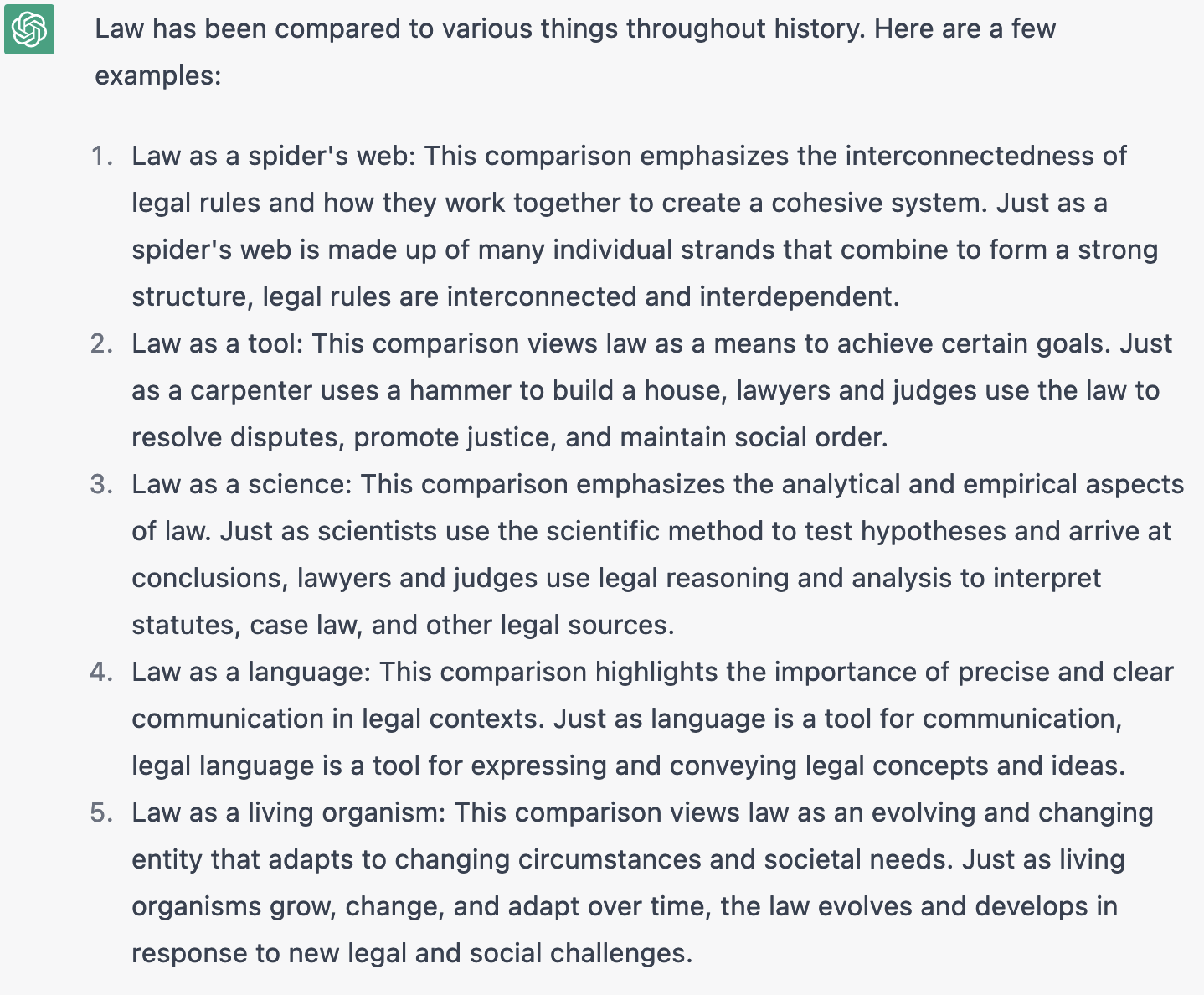
In addition to these three metaphors, ChatGPT regurgitated several others (see screenshot below). So, which metaphor do you like best?

P.S.: Aside from ChatGPT, below the fold is a bibliography of the scholarly works I have cited in this blog post:

Continue reading
Posted in Uncategorized | Leave a comment

Adam Smith as a Person

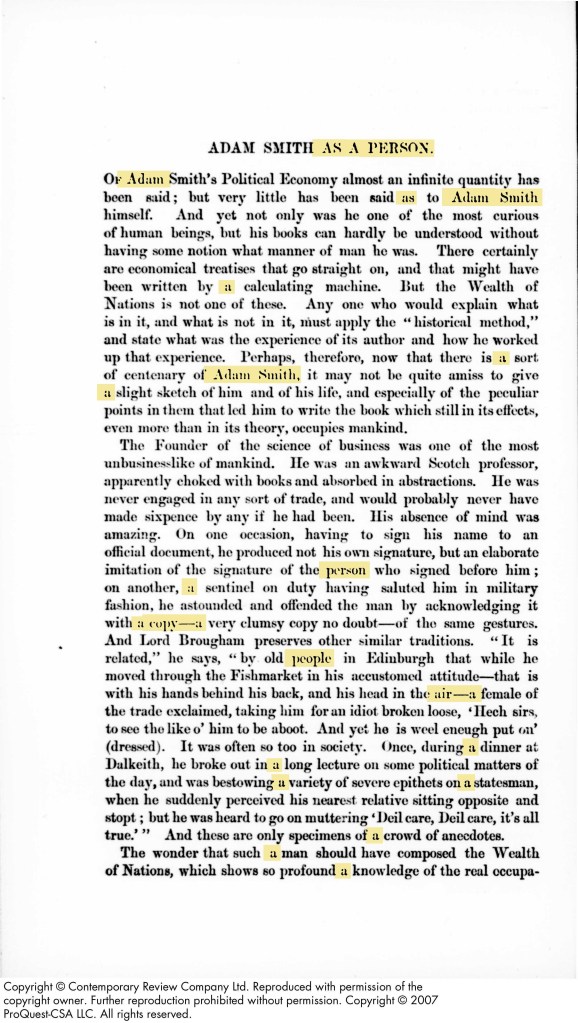
That is the title of this excellent essay published in 1876, the first page of which is pictured below, by the great English essayist Walter Bagehot. (I serendipitously stumbled upon this work via the late David Winch.) Although this text is relatively short — just 40 paragraphs spanning across 25 pages — it is full of so many original insights that I have decided to write up a paragraph-by-paragraph review of Bagehot’s beautiful essay, starting next week. Stay tuned!

Posted in Uncategorized | 2 Comments

Friday fun break: fireflies (for as far as we could see)

Posted in Uncategorized | Leave a comment

The Michael Jordan of baseball

The greatest of all time? Yes, as a lifelong baseball fan, Shohei Ohtani has my vote!

Posted in Uncategorized | Leave a comment