(Walter Bagehot and Adam Smith, part 5)
Happy Monday! Thus far, we have reviewed the first few pages of Bagehot’s 1876 essay “Adam Smith as a Person” (pp. 18-26 or paragraphs 1-12, to be more precise); today, we will turn to the next three pages of his excellent essay (pp. 26-29 or paragraphs 13-15).
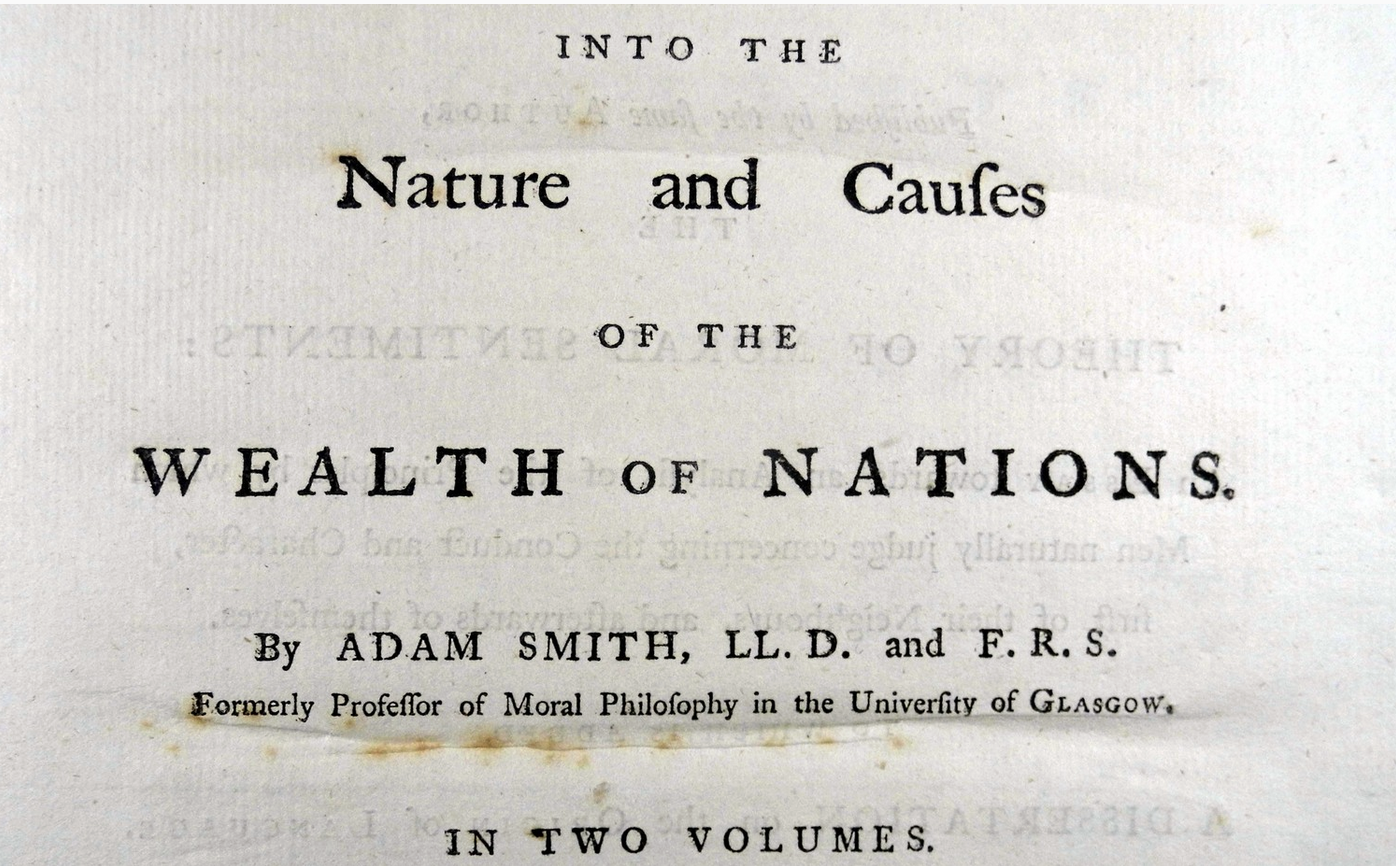
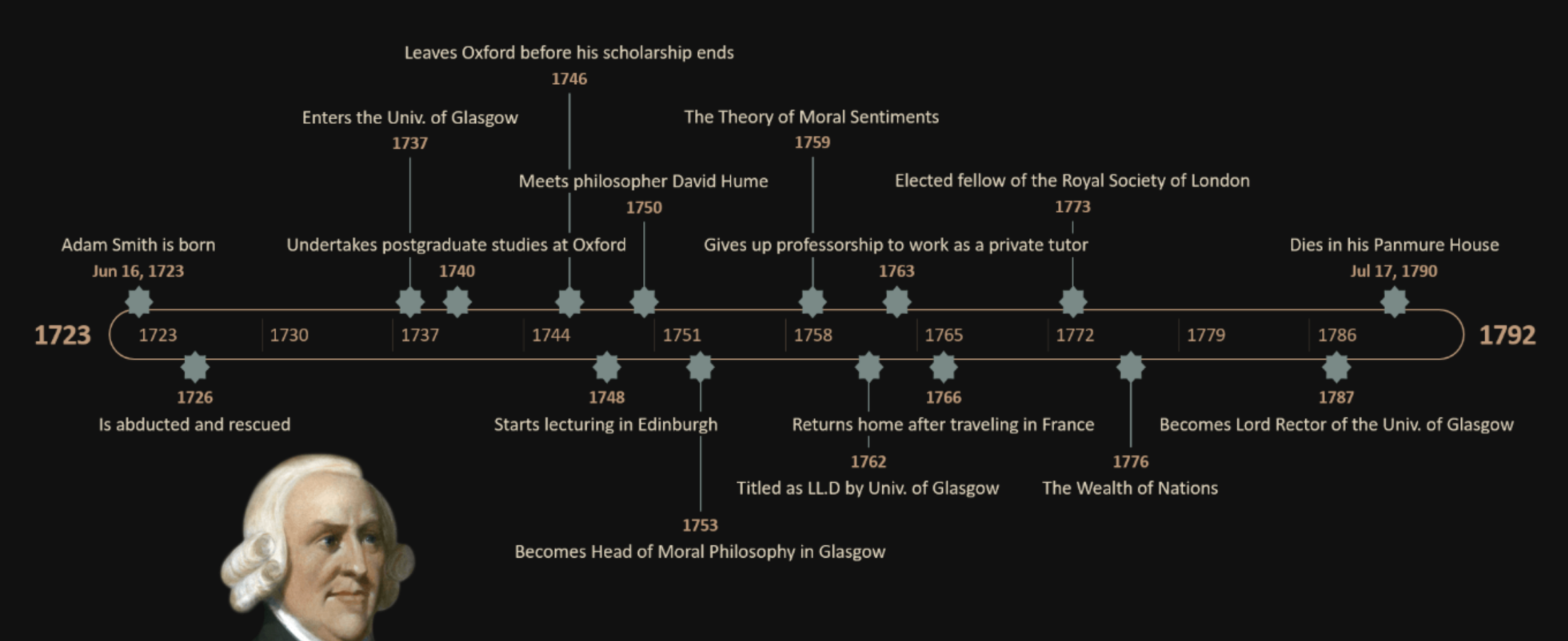
After joining the faculty of the University of Glasgow in the fall of 1751, Adam Smith began lecturing on a wide variety of topics, including rhetoric, ethics, and law, and it was during this time–his professor years (1751 to 1763) in Glasgow–that the now middle-aged Adam Smith would begin to play a small part on the intellectual stage of Enlightenment Europe. Smith’s lectures not only attracted students from all over the United Kingdom as well as the Continent; Smith also made his first major contribution to the world of letters: The Theory of Moral Sentiments. (The first edition of this great tome was first published in 1759, the year Smith celebrated his 36th birthday.)
Adam Smith’s philosophical treatise not only catapulted its author on the world stage in a literal sense, for as I shall further explain in my next post, it was the publication of “this celebrated book” that would lead to Adam Smith’s three-year “Grand Tour” of Paris, Geneva, and the South of France with the Duke of Buccleugh starting in January of 1764; Moral Sentiments was also the main source of Adam Smith’s scholarly and literary reputation while he was still alive. (As Bagehot correctly notes, except for a little essay on the origins of language, which Smith added to the third edition of The Theory of Moral Sentiments in 1767, Smith did not publish any other new work until the first edition of The Wealth of Nations was published in April of 1776.)
Although Smith’s Moral Sentiments was by all accounts “much praised and much read” (p. 26, paragraph 13) at the time of its initial publication in 1759, Bagehot, writing a century later, wastes no time in showing what a weak and flimsy a work of moral philosophy it really was. To the point, Bagehot launches a devastating two-pronged pincer movement, so to speak, against Smith’s work, simultaneously attacking both intellectual flanks of Smith’s ethical theory: the sentiment of sympathy and the device of the impartial spectator.
First off, Adam Smith tried to build a comprehensive and sophisticated theory of ethics on the foundation of human sympathy. In brief, according to Smith the moral philosopher, man is not just a selfish creature but an other-regarding one too, or in Smith’s own “pompous” words: “How selfish soever man may be supposed, there are evidently some principles in his nature, which interest him in the fortune of others, and render their happiness necessary to him, though he derives nothing from it except the pleasure of seeing it“. (This famous passage appears in the very first sentence of Smith’s Theory of Moral Sentiments.)
Bagehot, however, spots an “obvious objection” to Smith’s pro-sympathy premise: “We often sympathize where we cannot approve, and approve where we cannot sympathize.” (p. 27, para. 14). In other words, unlike the Pope, Smith’s lofty sentiment of sympathy is not infallible! Moreover, even if Smith’s theory is really based on what we now call “empathy” (I always get the two confused!), Bagehot’s “obvious objection” still stands. Either way, people often sympathize (i.e. feel pity for) or empathize (i.e. understand how others feel) with the wrong people, an observation that is especially true in a real-world domain like politics, where “[e]ven the wisest party men more or less sympathize with the errors of their own side ….” (ibid.).
To his credit, Bagehot acknowledges that Adam Smith anticipated this “obvious objection” to his theory and that Smith tried to remedy it by introducing the imaginary device of the impartial spectator, perhaps the most original aspect of all of Smith’s moral philosophy. Alas, Bagehot’s take-down of the impartial spectator is so deadly and devastating that it is worth quoting in full:
Adam Smith could not help being aware of this obvious objection …. But the way in which he tries to meet the objection only shows that the objection is invincible. He [Smith] sets up a supplementary theory–a little epicycle–that the sympathy which is to test good morals [i.e. properly distinguish right from wrong] must be the sympathy of an “impartial spectator.” But, then, who is to watch the watchman? Who is to say when the spectator is impartial, and when it is not?
As it happens, Bagehot is not the only public intellectual to “diss” Smith’s great work of moral philosophy. My colleague and friend Daniel Klein, for example, has identified no less than 26 different authors who have found one fault or another in Smith’s Theory of Moral Sentiments. (See here: Dan Klien, “Dissing The Theory of Moral Sentiments: Twenty-Six Critics, from 1765 to 1949,” in Volume 15 of Econ Journal Watch.) But Bagehot’s critique, to my mind, is the most fatal one. (If Bagehot were a modern-day hip hop artist, his two-track Adam Smith diss songs might be called “Too Much Sympathy, Yo'” and “Who’s Watchin’ My Watcher?”)
Aside from the question of its intellectual merit, The Theory of Moral Sentiments led to Adam Smith’s tour of Europe, a voyage of discovery that most likely shaped Adam Smith’s intellectual destiny more than other episode in Smith’s life. I shall turn to Smith’s appointment as a travelling tutor to the Duke of Buccleugh and their short-lived “Grand Tour” in my next post.








 prior probability