Metaphors, markets, and morality (part 2): some questions about Adam Smith’s impartial spectator

Before I proceed with my review of the remaining chapters of Robin Paul Malloy’s Law and the Invisible Hand (Chs. 4-12), I want to pose a few additional questions about Adam Smith’s impartial spectator, one of the most compelling and memorable metaphors in the history of ideas, along with Plato’s cave, Schrödinger’s cat, and Rawls’ veil of ignorance. Among other things, at the end of my previous post I identified a fundamental disagreement between Professor Malloy and myself regarding this metaphor. To the point: Malloy models Smith’s spectator after a common law judge, while I would liken him to a theater-goer, i.e. a member of the audience at a theatrical performance. Which of us is right? Either way, Smith’s impartial spectator metaphor also presents a peskier set of puzzles and conundrums, a deep and difficult set of questions that I once posed to Ryan Patrick Hanley (see here) and that I now pose to Professor Malloy:

  1. Who is this impartial spectator? First and foremost, what is the ontological status or metaphysical origins of this imaginary being? Specifically, is he (she?) (them?) (it?) an artificial human creation–i.e. something we conjure up out of whole cloth–or is this imaginary being somehow “hardwired” by natural or sexual selection into every human brain–an innate faculty we are born with? (Cf. McHugh 2016.) Either way (human invention or innate faculty), does this abstract entity have an ethnicity, a gender, or a sexual preference? (Cf. Weinstein 2016, p. 356.) [Note: All author and page references are to Volume 13, Issue 2 of Econ Journal Watch (May 2016), which contains a special symposium devoted to Adam Smith’s impartial spectator.]
  2. When and how does this spectator come into play? Secondly, and from a purely logistical or practical perspective, when does the impartial spectator, if he (her/them/it) really exists, actually come into play? To the point: if it’s true, for example, that the average person makes up to 2000 decisions every hour (see here), which of these myriad decisions are subject to review by one’s impartial spectator–i.e. actually go up “on appeal”, so to speak. Put another way, if Smith’s impartial spectator operates like a Court of Appeal, what criteria does he (the impartial spectator) use in deciding which of our decisions will be taken on appeal?
  3. Is the impartial spectator a moral relativist? Next, what is the moral or normative status of the moral judgements generated by this heuristic, i.e. the decisions or verdicts rendered by the impartial spectator? (Note: I prefer the British spelling of the word “judgement.”) Are these verdicts/judgements fallible or infallible? Final or tentative? Put differently (cf. Mueller 2016), do the judgements and identity of this imaginary entity vary from person to person, or is Smith’s impartial spectator capable of generating universal and timeless moral judgements?
  4. How does the impartial spectator overcome its biases? Also, how helpful or reliable is Smith’s imaginary spectator, really? Specifically, can he or she or them transcend or correct our “entrenched cultural biases” (Fleischacker, 2016, p. 278)? By way of example, Walt Disney’s Jiminy Cricket famously admonished Pinocchio to ”let your conscience be your guide.” This is helpful advice if your impartial spectator is able to reliably discern right from wrong, but how reliable is your conscience? Circling back to Smith, since the impartial spectator is not a real person–it is an imaginary being–it is only as reliable as the person conjuring him/her/them up. After all, the impartial spectator, being an imaginary entity, has no store of knowledge beyond that of the person who is conjuring it up.
  5. How does the impartial spectator enforce its judgements? Lastly, isn’t Smith’s impartial spectator, assuming it really exists, a superfluous entity? If not, what work does this imaginary being really do? (Cf. Craig Smith 2016.) To the point: if a virtuous person is someone who is guided by the judgements of the impartial spectator, then by definition a non-virtuous person is someone who neglects or ignores these judgements. In that case, the impartial spectator falls into a circular trap; it is the mysterious quality of “virtue” (not the judgements of the impartial spectator) that is doing the heavy moral lifting.

To his credit, Professor Malloy devotes several additional chapters of his book to Smith’s impartial spectator, so we will revisit the questions above in future blog posts. For now, it suffices to say that this imaginary device, which appears over five dozen times in The Theory of Moral Sentiments, is the centerpiece of Smith’s theory of morality (see, for example, the book cover pictured below) and thus deserves careful scrutiny. In the meantime, I will proceed to Chapters 4 and 5 of Law and the Invisible Hand in the next day or two …
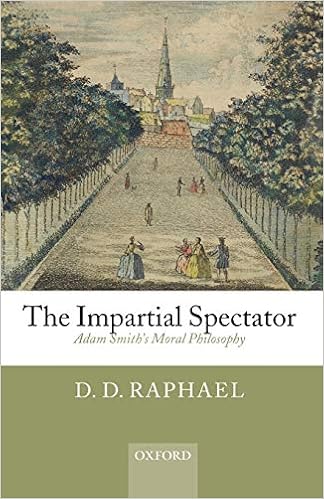
Amazon - The Impartial Spectator: Adam Smith's Moral Philosophy: Raphael,  D. D.: 9780199568260: Books
Posted in Uncategorized | 1 Comment

Metaphors, markets, and morality: review of Chapter 3 of Law and the Invisible Hand

Robin Paul Malloy makes two key moves in Chapter 3 of his new book Law and the Invisible Hand. First, he describes three of the most memorable, compelling, and complex metaphors in the writings of Adam Smith: the invisible hand, the man in the mirror (a phrase, however, that Smith himself did not use), and the impartial spectator. Next, he attempts to “connect” these three metaphors, i.e. identify what the common thread among them, if there is one, is. I will explore the connections among these metaphors in a future post; for now I will just say a few words about each metaphor:

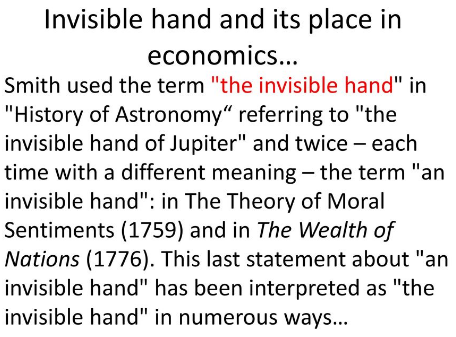
  1. Invisible hands. Adam Smith’s most famous metaphor has to be “the invisible hand,” a metaphor that appears in three of Smith’s works: in his essay on “The History of Astronomy”; in his treatise on moral philosophy (The Theory of Moral Sentiments); and in “Book I” of his work on The Wealth of Nations. Here, however, Professor Malloy commits a major mistake. Specifically, he fails to mentions that Smith uses his “invisible hand” metaphor in different ways in each one of these three works; as a result, we can’t say that Smith’s “invisible hand” metaphor has a single, stable meaning. (I could go into the nitty-gritty details here (see slide below), but I want to keep this blog post short, so just take my word for it for now.)
  2. Adam and the looking-glass. Although Smith never used the phrase “man in the mirror” (this phrase is Malloy’s own invention), he did write about looking-glasses and mirrors in The Theory of Moral Sentiments. Among other things, Smith writes: “Were it possible that a human creature could grow up to manhood in some solitary place, without any communication with his own species, he could no more think … of the propriety or demerit of his own sentiments and conduct … than of the beauty or deformity of his own face…. Bring him into society, and he is immediately provided with the mirror which he [lacked] before…. [I]t is here that he first views the propriety and impropriety of his own passions, the beauty and deformity of his own mind.” [Quoted in Malloy 2022, pp. 27-28.] In other words, for Smith man is a social animal because we care what other people think about us.
  3. Impartial spectators. The last of Smith’s three major metaphors is “the impartial spectator,” a term of art that appears over 60 separate times in The Theory of Moral Sentiments. (By contrast, as I mentioned above, Smith used the phrase “the invisible hand” only three times in his entire lifetime.) That Smith employed this theatrical metaphor so frequently in his first magnum opus tells us that the impartial spectator is a crucial part of Smith’s moral philosophy, but who is this impartial spectator, and what is his role in our lives? Alas, Malloy and I have a fundamental disagreement about Smith’s spectator. Malloy, for example, compares the impartial spectator to a common law judge, but in reality the metaphor of a spectator originates from the world of the theater, not law. Also, because the impartial spectator is such a crucial aspect of Smith’s thought, I will say a few more words about this metaphor in my next post.
Credit: Charlotte Rice
Posted in Uncategorized | 2 Comments

June 21, 1788

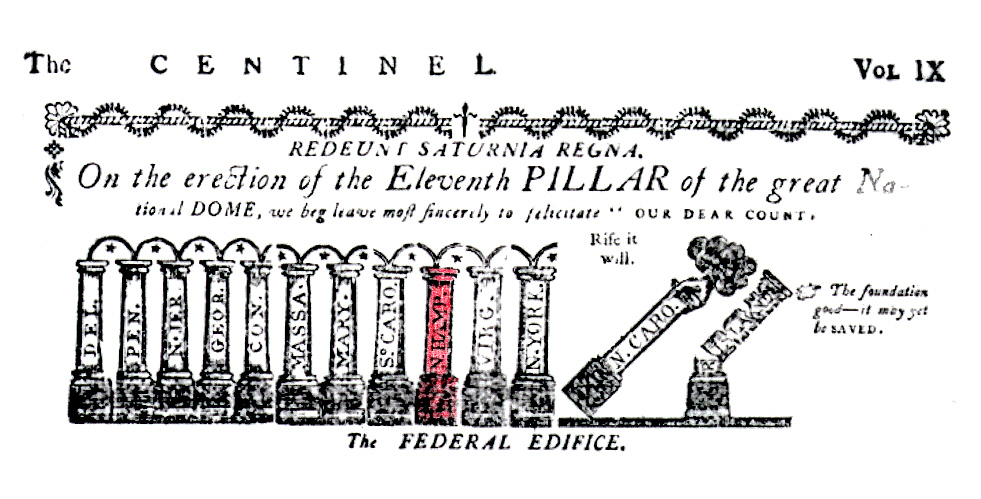
To celebrate the day the Constitution of the United States officially became the law of the land–i.e., June 21, 1788, the day on which our nation’s charter was ratified by the requisite number of States–, below is a chronological listing of my constitutional law papers:

  1. Comment on Bush v. Gore and the Clemens-Piazza broken-bat incident” (2001) (analysis of Bush v. Gore).
  2. The most senile Justice?” (2007) (stinging critique of David Garrow’s law review article on mental decrepitude on the U.S. Supreme Court).
  3. A stag-hunt model of the U.S. Constitution” (2008) (game-theoretic model of the constitutional ratification process).
  4. Coase and the Constitution” (2011) (analysis of federalism).
  5. Gödel’s loophole” (2013) (analysis of Article V).
  6. Why don’t juries try ‘range voting’?” (2015) (analysis of jury trials).
  7. The problem with precedent” (2017) (review of Randy Kozel’s Settled Versus Right: A Theory of Precedent).
  8. Domestic constitutional violence” (2018) (historical analysis of the president’s authority to use military force inside the United States).
  9. Bitcoin, the commerce clause, and Bayesian stare decisis” (2019) (analysis of South Dakota v. Wayfair).
  10. Lockdowns as takings” (work-in-progress) (analysis of the takings clause).
New Hampshire & the U.S. Constitution – 1788
Posted in Uncategorized | Leave a comment

Review of Chapters 1 & 2 of Malloy’s Law and the Invisible Hand: Does Adam Smith have a theory of justice?

As I mentioned in a previous post, I have decided to review Robin Paul Malloy’s Law and the Invisible Hand. (Note and full disclosure: I was going to review Better Call Saul and Philosophy, a collection of essays published last month, but I have decided to prioritize Professor Malloy’s work because I haven’t received my copy of the “Better Call Saul” book yet, while Malloy graciously gave me a copy of his beautiful book when we met at the History of Economics Society last weekend.) So, let’s get started with Chapters 1 and 2 of Malloy’s new book, shall we?

Professor Malloy not only quickly introduces his readers to the most compelling and memorable metaphors that appear in Adam Smith’s writings (see p. 5), such as the invisible hand, the impartial spectator, and the man in the mirror; he (Malloy) also identifies perhaps the single-most important question of all time, a paradox that Smith himself spent a lifetime trying to solve: how is it possible to reconcile the pursuit of private self-interest while at the same time promoting the common good?

For my part, however, although I commend Prof Malloy for putting this key question center stage, I am highly skeptical of his attempted solution: his mystical and multiple invocations of the ideal of “justice.” In Malloy’s own words (p. 3, footnote omitted), for example, “Smith subordinated concerns for self-interest to the requirements of justice because he understood that justice was the most important pillar on which civil society rested.” (Malloy repeats this same argument in different ways in Chapter 2 as well.) To the point, Malloy’s justice thesis has a fatal flaw, for what is Adam Smith’s theory of justice? Alas, Smith never developed one, since he ended up abandoning the book he was writing on law and justice in order to write The Wealth of Nations. (Malloy himself acknowledges this embarrassing omission on page 7 of his introduction.)

The best we can do, then, is to try to guess what Smith’s theory of justice — had he ever decided to develop one — might have looked like, and in fairness to Malloy and to his ambitious project, we do have some material to help us make this guess. Among other things, we have Smith’s 1759 treatise on moral philosophy, The Theory of Moral Sentiments, to which he made significant revisions in subsequent editions. We also have Smith’s “Lectures on Jurisprudence,” a set of lecture notes transcribed by one of Smith’s students, and we have the last part of The Wealth of Nations (Book V), which talks about the administration of justice and the proper role of government generally.

As such, like a good Bayesian, I will try to keep an open mind as I read the remaining 10 chapters of his book. Even if we are unable to reconstruct Smith’s theory of justice, this effort is still a worthwhile one, for the tension between the public interest and the private pursuit of self-interest is not only a major theme in Smith’s writings; it is also very much relevant in our times–think of climate change, the proliferation of “fake news” on social media, and NIMBY-hypocrisy, just to name a few contemporary challenges.

Definition of Justice stock image. Image of weigh, punishment - 27429509
Posted in Uncategorized | Leave a comment

Postcards from Minneapolis (George Floyd Square)

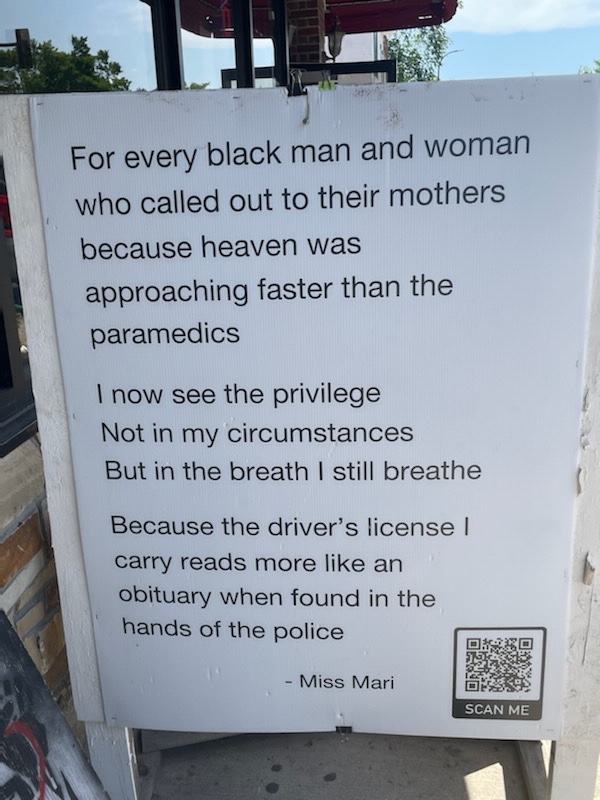
I will resume my review of “Law and the Invisible Hand” in my next post; in the meantime, below are some of the pictures my wife Sydjia and I took during our visit to “George Floyd Square” in Minneapolis this weekend.

Posted in Uncategorized | Leave a comment

Review of Law and the Invisible Hand (part 1)

The first full paragraph of Robin Malloy’s Law and the Invisible Hand reads thus (footnote omitted):

Fundamentally, law is to society as gravity is to the solar system; it is the invisible force that holds society together and keeps it operating smoothly and productively. Law enchances social cooperation, facilitates trade, and extends the market. In these ways, law functions like Adam Smith’s invisible hand, guiding and facilitating the progress of humankind.

Alas, as Brett tells Jake at the end of Hemingway’s novel The Sun Also Rises, Isn’t it pretty to think so? Although I am a law professor, I don’t agree with this “law-centric” view of the world for three reasons. First off, what if the causation between law and markets runs in the opposite direction? That is, are legal institutions necessary for markets to evolve, or is law a by-product of prosperous markets?

Secondly, what about laws that protect monopolies and prohibit free trade, such as zoning and licensure requirements? Also, the existence of too many laws and regulations might actually deter trade and economic growth. As a result, we need some criterion or set of criteria for distinguishing laws that promote markets from those that inhibit trade. (Paging public choice theory!)

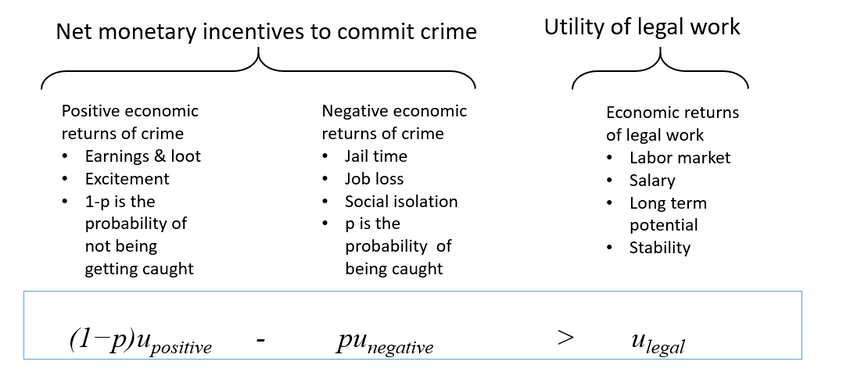
Last but not least, even if we could agree on how to distinguish “good” laws from “bad” ones, law’s role in life is often secondary to the role of ethics and morality, to our sense of right and wrong. To begin with, from a purely economic or “rational actor” perspective, the efficacy of law depends on two key variables: p1 and p2, the probability of detection and the severity of the punishment if one is caught, and p1 and p2, in turn, will vary depending on the costs of monitoring behavior and the costs of enforcement. Morality, by contrast, relies on self-monitoring and self-enforcement.

But what is the relationship between law and morality, and what happens when people have different conceptions of right and wrong, different moral codes? I will proceed with my review of “Law and the Invisible Hand” in my next post.

Posted in Uncategorized | 2 Comments

Adam Smith as legal scholar

Adam Smith is mostly known as a political economist (The Wealth of Nations) or a moral philosopher (Theory of Moral Sentiments), but did you know that he was also a legal scholar? In fact, Smith was awarded a Doctorate of Law by the University of Glasgow in October of 1762, and he had lectured about law and jurisprudence during the 1762-63 academic year. (Update: Smith’s “Lectures on Jurisprudence” are available here, via AdamSmithWorks. Hat tip: Inverted Logic.)

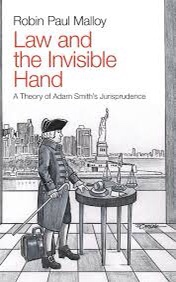
Although Smith himself promised to write a book about the law, he never completed that work. To help fill this gap, my colleague and friend Robin Paul Malloy, a law professor at Syracuse University, recently published a book on “Law and the Invisible Hand” (the cover of which is pictured below), which explores the legal side of Adam Smith’s thought. I got to see Professor Malloy present his work at this weekend’s History of Economics Society, and I will be reviewing it here soon.

Posted in Uncategorized | 5 Comments

History of Economics Society

I will be presenting my most recent work on Adam Smith (see here) at the annual meeting of the History of Economics Society, which is taking place at the University of St Thomas in downtown Minneapolis. Updates from the conference to be posted here soon.

Posted in Uncategorized | 1 Comment

Florida sunsets

Posted in Uncategorized | Leave a comment

Judging the Magna Carta

In honor of the 807th anniversary of the “Great Charter of Freedoms“–it was on this day (June 15) in 1215 that King John was compelled to put his seal on the Magna Carta Libertatum–I am reblogging my 2016 post on “Judging the Magna Carta.”

F. E. Guerra-Pujol's avatarprior probability

You may have heard of “The Living Constitution” (i.e. the idea that the Constitution changes over time to meet our current needs), but have you ever heard of “The Living Magna Carta”? If not, check out this beautiful paper by R.H. Helmholz titled “The Myth of the Magna Carta Revisited,” published in the latest issue of the University of North Carolina Law Review: Vol. 94, No. 5 (2016), pp. 1475-1493. The paper explores how the meaning of the Magna Carta has evolved over time and how some of its substantive provisions were interpreted by the leading English jurists Sir Edward Coke (b.1552-d.1634) and Sir William Blackstone (b.1723-d.1780). Professor Helmholz concludes that Coke and Blackstone gave “expansive readings” to the Magna Carta by looking beyond the specific words used in the text of the Great Charter in order to discern its goals and purposes. More importantly, Professor Helmholz claims that this…

View original post 63 more words

Posted in Uncategorized | Leave a comment