Assorted links (Apple iPhone edition)

The first iPhones were sold to the public on this day 15 years ago (June 29, 2007). We now take “smartphones” for granted, but are these little electronic talismans more of a blessing or a curse? Either way, here is a fun “smartphone addiction test“.

F. E. Guerra-Pujol's avatarprior probability

Although we’re a day late, 29 June 2017 marks the 10th anniversary of the launching of the original Apple iPhone.* To honor this occasion, here are some useful links:

1. Tyler Cowen’s essay in praise of the iPhone:Put down the iPhone and appreciate its genius.

2. Adam Greenfield’s critique:A sociology of the smartphone.

3. Steve Jobs’s original iPhone presentation from January 2007.

* Full disclosure: I drafted this blog post on my Apple iPhone 5s. That I was able to access the Internet, link to various sources, and track down and post a picture — in a matter of minutes and on such a small and portable device — is remarkable.

View original post

Posted in Uncategorized | Leave a comment

When goals and values collide: law, liberty, and Adam Smith

Alternative Title: Review of Chapter 12 of Law and the Invisible Hand

I will conclude my review of Robin Paul Malloy’s Law and the Invisible Hand by recommending his book to my loyal readers. In brief, Professor Malloy’s beautiful book is not only a thoughtful and well-written tome; it also poses an eternal question — the relationship between law and liberty — and offers a new and original solution to this timeless dilemma.

To the point, Malloy concludes his book by identifying three features that all successful societies have in common (pp. 147-152): (1) they promote the common interest, i.e. they find ways of balancing self-interest and the common good; (2) they advance justice through the rule of law, i.e. they protect the security of persons and property, regulate harms, and guarantee procedural due process; and (3) they promote free markets, i.e. allow for decentralized decision-making. In addition, according to Malloy, these three goals or values also correspond with Adam Smith’s theory of justice or “market jurisdprudence” (Malloy’s apt term).

But there are two big problems with Malloy’s picture. Putting aside the fact that this “market jurisprudence” is just one interpretation or version of Smith’s theory of justice (since Smith himself never developed a theory of justice), one problem is that general terms like “common interest” and “rule of law” are always too vague or open-ended to be of any real value. The other problem (and the more serious one, in my view) is that the three goals in Malloy’s laundry list are often in direct conflict with each other. After all, how many times have markets been curtailed or regulated in the name of the public interest or common good? Although the rule of law can promote voluntary exchange by defining property rights and enforcing contracts, the police power is also just as often misused to protect monopolies and stifle free markets.

The ultimate problem for Malloy’s Smithian theory of justice is this: how do we find the right balance between law and liberty? That is, how do we allow markets to flourish, so that people and firms are free to make and buy what they want, while at the same time protecting health, safety, and welfare as well as minimizing harmful effects to third parties? Most of the time, however, we brush this tension aside by invoking one of several forms sophistry. Some try to distinguish liberty from “libertinage” (a hopeless task in a world of pluralistic lifestyles and values). Others invoke rhetorical chants like “well-ordered liberty” (an oxymoron if there ever was one). Still others repeat formulaic incantations or mystical slogans like “your liberty to swing your arm ends where my nose begins” or John Stuart Mill’s idea that law and coercion are justified only to prevent harm to others (a superficially appealing idea that collapses of its own weight once we realize that restrictions on liberty are themselves harms).

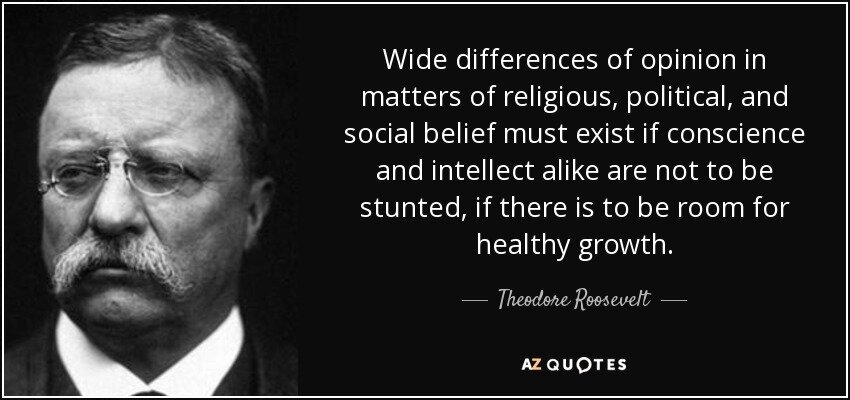
To his credit, Malloy offers an ingenious and Smithian-inspired solution to this timeless dilemma. For Malloy, it’s the impartial spectator, not the invisible hand, that offers a way out. In summary, Malloy takes the impartial spectator from Smith’s Theory of Moral Sentiments and expands his jurisdiction to include conflicts about law, politics, and economics. But is Malloy’s solution a workable one? Alas, here is where Malloy and I part ways. Although I am willing to award Malloy bonus points for creativity, his solution not only won’t work in domains like law and politics; it would be a bad thing if it did work in those domains! (See, for example, the quote by Teddy Roosevelt below.) For starters, the impartial spectator is supposed to judge or evaluate your actions from a neutral observer or disinterested third-person point of view, but once we leave the domain of ethics and enter the domain of politics, what is preventing this “spectator” from becoming a rabid fan of your team or tribe? And once the spectator becomes a fan, he can just as easily be misused to justify or root for your actions or those of your team.

It takes a theory to beat a theory, as academics like to say, so at the risk of sounding naive, I will conclude my review with a Smithian observation: why not just trust the invisible hand? In fact, why not extend Smith’s invisible hand metaphor to the marketplace of ideas by allowing our “impartial” spectators to take sides and root for our teams, which he is bound to do anyways? Either way, instead of placing so much hope in Smith’s spectator (a tool that is doomed to fail in the domains of law, politics, and economics, domains where the existence of differences of opinion is actually a sign of a free and vibrant society), maybe we should place more trust in Smith’s invisible hand, the invisible hand of The Wealth of Nations, the invisible hand of decentralized decision-making and spontaneous order–in short, the invisible hand of freedom and prosperity!

The beauty and elegance of Smith’s invisible hand metaphor is that it doesn’t require some external talisman for society to succeed. In place of imaginary spectators or dangerous men of system, we only need the invisible hand. Of course, at a minimum, the invisible hand won’t work without well-defined property rights and the freedom to exchange those rights as well as a strong-enough sovereign to protect and enforce these rights and transfers. What else does the invisible hand need to produce high levels of prosperity and liberty? This, after all, is the question that Adam Smith himself was asking when he wrote The Wealth of Nations, so this is the question that we too should be asking today. In any case, Smith never completed his promised book about law and justice; maybe he didn’t have more to say.

The Federalist Papers #10 A: Conflicts Arising from Differences of Opinion  Are an Inevitable Accompaniment of Liberty—James Madison — Confessions of a  Supply-Side Liberal
Posted in Uncategorized | Leave a comment

Malloy’s Adam Smith enigma

Alternative Title: Review of Chapter 11 of Law and the Invisible Hand

After Chapter 6, my second-favorite chapter in Robin Paul Malloy’s Law and the Invisible Hand is Chapter 11 (the next-to-last chapter), which is titled “Adam Smith in American Law.” Among other things, Professor Malloy tracked down the total number of citations to the works of Adam Smith in the published opinions of the federal courts of the United States. (What about the State courts?) In summary, the first federal case to cite Smith was decided in 1796; the most recent case citing Smith, in 2020. During this span of 225 years (inclusive), Prof Malloy was able to identify 204 federal case opinions with direct references to Adam Smith.

Malloy describes nine of these 204 cases in greater detail and makes two intriguing observations. One is that, of the 204 cases to cite Adm Smith, almost three-quarters of these case citations, 145 of 204 or 74%, have occurred since 1980. (See Malloy 2022, p. 122.) The other is that most, if not all, of the federal judges who cite Smith have a shallow understanding of Smith’s ideas. Specifically, Malloy concludes that “[m]ost of the time … [Smith] is invoked in a one-dimensional and iconic way, with a reference to his famous metaphor of the invisible hand.” (See Malloy 2022, p. 143. In fact, of the 204 federal cases to cite Adam Smith, 203 cite to Smith’s Wealth of Nations. See ibid., p. 122. The remaining citation is to Smith’s Theory of Moral Sentiments; none of these 204 cases cite Smith’s Lectures on Jurisprudence. Ibid.)

Ironically, Malloy falls into this trap himself, for his book is titled “Law and the Invisible Hand” and not “Law and the Impartial Spectator”. For Malloy, however, Smith’s “invisible hand” mechanism must always be seen through the eyes of Smith’s impartial spectator. (I would even argue that this conclusion is the main lesson of Malloy’s book.) But as I mentioned in my previous post, this observation poses an even deeper puzzle, what I call “Malloy’s enigma”. To the point, the puzzle/enigma is this: what, if anything, does the impartial spectator have to say about the invisible hand, and vice versa, what does the invisible hand teach us about the impartial spectator? In short, what is the relation between the invisible hand of the market and the impartial spectator of ethics and aesthetics?

Put another way, does Smith’s invisible hand really need an impartial spectator or imaginary referee in order to function properly? Think, for example, of other domains or scientific fields with invisible hand explanations of their own, such as Sir Isaac Newton’s laws of gravity and planetary motion or natural and sexual selection in Alfred Russel Wallace and Charles Darwin’s theories of evolution. As I mentioned in a previous post, however, Smith invoked the invisible hand metaphor in three different ways, and in none of these three ways does Smith even allude to his impartial spectator. Also, how are the various “invisible hands” in Smith’s work similar to or different from these other (e.g. Newtonian/Darwinian) invisible hand mechanisms? I will further explore these puzzles and wrap up my review in my next post.

Shakespeare's Invisible Hand in Economics - Big Think
Posted in Uncategorized | 1 Comment

Happy Djibouti Independence Day?

Djibouti, a small country nestled between Eritrea and Somalia on the horn of Africa, was granted independence from France on this day (June 27, 1977). I wonder, however, if the people of Djibouti would have been better off if their country had instead become an overseas region of France, like the island of Martinique. See, for example, this recent human rights report via reliefweb.

Posted in Uncategorized | Leave a comment

Adam Smith’s blind spot?

Alternative Title: Review of Chapter 10 of Law and the Invisible Hand

Nine chapters down (1-9); three to go (10-12). Among other things, the antepenultimate chapter (Ch. 10) of Robin Paul Malloy’s Law and the Invisible Hand identifies an enormous blind spot in Adam Smith’s theory of political economy: where do new ideas come from? Alas, there are no inventors or entrepreneurs in Smith’s writings. Inventors and entrepreneurs, however, are essential for prosperity and economic growth; without them, we wouldn’t have new products and services or new technologies. In a word, without new ideas, we wouldn’t have progress.

In fairness to Adam Smith, most mainstream economists and legal theorists have also ignored the vital role that inventors and entrepreneurs play in developing and testing new ideas. To help fill this embarrassing gap, Professor Malloy identifies possible links between the work of Adam Smith and the ideas of Israel Kirzner (pictured below), an economist who has explored the process of creative discovery. For his part, Malloy makes the following critical connection between Kirzner’s emphasis on new ideas and Smith’s invisible hand and defense of free markets: the “invisible hand” of free trade and voluntary exchange creates new opportunities for alert, profit-seeking individuals to make new discoveries; so the larger the extent of the market, the more opportunities for inventors and entrepreneurs to emerge.

In other words, although Adam Smith himself did not discuss the role of inventors or entrepreneurs, Smith’s “invisible hand” approach to political economy makes ample room for these pivotal figures. Specifically, by extending the domain of Smith’s metaphorical invisible hand, i.e. by expanding the market and creating new opportunities for trade and voluntary exchange, we make it more likely for inventors and entrepreneurs to emerge and work their magic. To put this idea in Smithian terms, the emergence of inventors and entrepreneurs, like the division of labor (specialization), is limited by the extent of the market!

As it happens, the next chapter of Law and the Invisible Hand (Ch. 11) revisits an even deeper theoretical puzzle, an enigma at the heart of Malloy’s beautiful book: what is the relation between the invisible hand of the market and the impartial spectator of ethics and aesthetics? I will further explore “Malloy’s enigma” in my next two posts.

Why Israel Kirzner Deserves a Nobel Prize - Foundation for Economic  Education
Posted in Uncategorized | 1 Comment

Adam Smith’s impartial spectator: equity, efficiency, or justice?

Alternative Title: Review of Chapter 9 of Law and the Invisible Hand

If you are a legal theory geek like myself, then Chapter 9 of Robin Paul Malloy’s Law and the Invisible Hand is a really fun chapter to read. In that chapter, Professor Malloy compares and contrasts Adam Smith’s “impartial spectator” with two competing legal-theory constructs. One is homo economicus: the so-called “rational actor model” that dominated the old-school “Law & Economics” movement associated with Judge Richard Posner and the University of Chicago. The other is homo identicus, Malloy’s short-hand for critical race theory (CRT), which emphasizes race and the primacy of group identity.

As Malloy correctly notes, these two legal-theory “paradigms” (in the Kuhnian sense) espouse radically different ends or goals. The central aim of homo economicus, the “economic man” of the rational actor model, is utility maximization at the individual level and wealth maximization at the social level, or “efficiency” at both levels. By contrast, the main goal of critical race theorists is anti-subordination or “equity”, such as reparations for past wrongs like slavery and genocide. Both efficiency and equity are no doubt laudable goals; in fact, the two most iconic legal documents in U.S. history–the Declaration of Independence of July 4, 1776 and the Emancipation Proclamation of January 1, 1863–are more about anti-subordination than they are about the efficient use of scarce resources.

[As an aside, my 2006 paper “Cornel West, Meet Richard Posner” explores what these two influential legal-theory paradigms might share in common. Also, there are two problems with Malloy’s picture of “Law & Economics” and CRT in Chapter 9. For starters, Malloy himself concedes that homo economicus and homo identicus are both simplified caricatures of the theories they are standing in for. The more serious problem is that these caricatures are either incorrect or incomplete. A key concept developed by CRT scholars, for example, is missing from Malloy’s description of homo identicus: the idea of “intersectionality.” Worse yet, homo economicus is for all practical purposes dead and buried; so-called “behavioral economics” has replaced the unrealistic economic assumptions of yore.]

In any case, what is the impartial spectator’s goal? Alas, here is where Professor Malloy’s interpretation of the impartial spectator starts to fall apart. On the one hand, Malloy claims in a previous chapter that Smith’s spectator is about process, not about outcomes or end-states. For Malloy, the impartial spectator is a useful tool we can use, if we so choose, to help us judge the morality of our actions (cf. Malloy’s inner spectator) and the justice of our social norms and laws (cf. his “outer” spectator), and these inner and outer spectators are more like the “reasonable man” of the common law tradition, a familiar legal standard used by Anglo-American courts to judge individual conduct. At the same time, however, Malloy is trying to build a Smithian theory of justice, and according to Malloy’s version of Smith’s theory, the ideal of justice (defined by Smith himself as the protection of one’s person and property) is the most important goal of all, the “pillar” that holds civil society together. If Malloy’s version of Smith’s theory is correct, then one could easily conclude that the impartial spectator does have an ultimate end: the supreme goal of justice.

If so, then what is the impartial spectator’s view of justice? More to the point, why should we prefer Smith’s conception of justice (protection of private property at all costs) over other conceptions of justice, such as Kantian duties, utilitarian efficiency (cf. homo economicus), or even equity (cf. homo identicus)? Alas, as I shall explain in a future blog post, it is here where we may encounter an insurmountable difficulty.

Racial Equity | ELA

Posted in Uncategorized | Leave a comment

A more “Smithian” theory of justice: refocusing the gaze of Adam Smith’s impartial spectator

Alternative title: Review of Chapters 6-8 of Law and the Invisible Hand

Chapters 6, 7, and 8, the three most important chapters of Law and the Invisible Hand, should be read as a whole. Briefly, although these chapters, especially Ch. 6, are somewhat technical and full of digressions, covering contemporary theories of linguistics and aesthetics as well as Adam Smith’s own theory on the origins of language, Robin Paul Malloy–perhaps unwittingly–makes another creative move, an Adam Smith-inspired conjecture that, in my view, provides a more solid foundation for building a truly “Smithian” theory of justice.

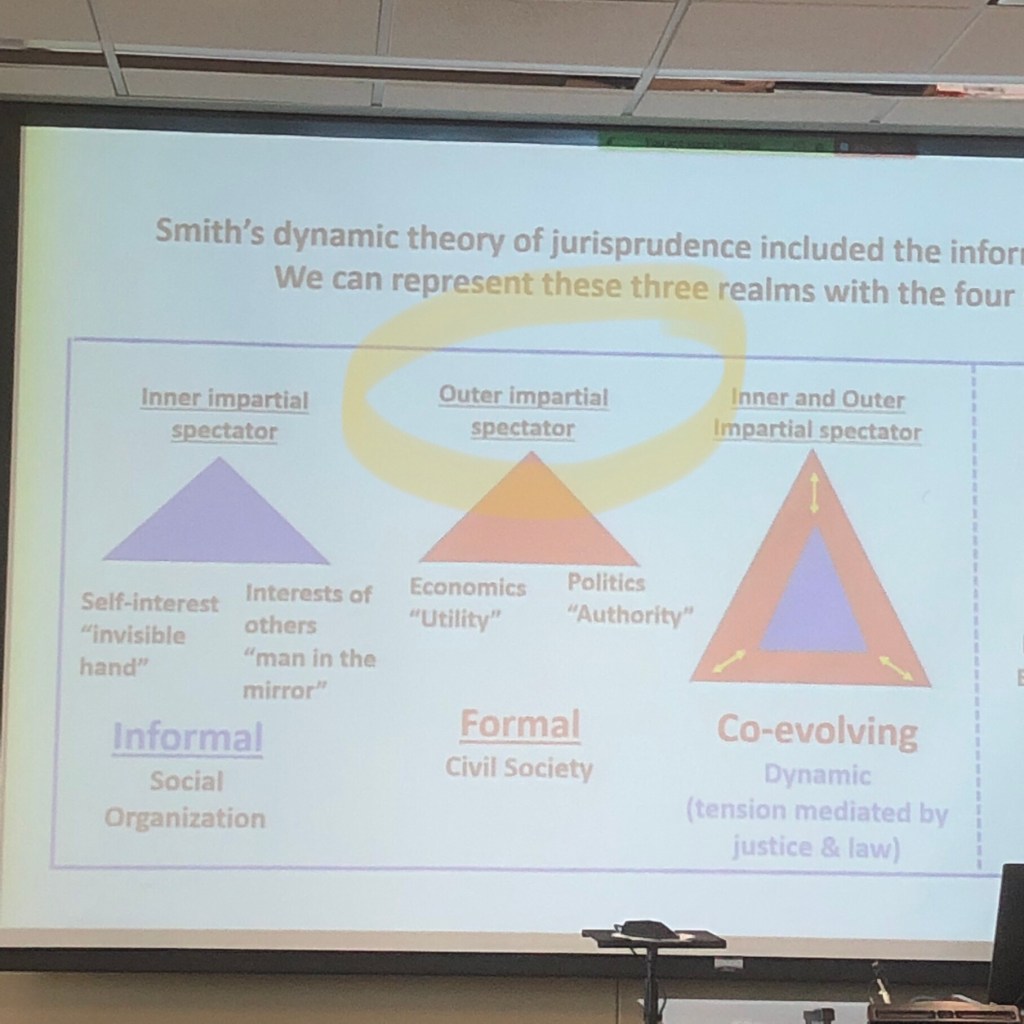
To the point, Professor Malloy further refines and extends Adam Smith’s original “impartial spectator” metaphor by positing the existence of an “outer spectator” or outward-looking observer. Although this modified metaphor had appeared in previous chapters, it is in these three chapters, 6 through 8, where Malloy explains how this outward-looking observer is able to make judgements about beauty, politics, and culture. Among other things, for example, Malloy explains how Smith’s spectator not only has the ability to make internal moral judgements about one’s own conduct; it is also able to make external aesthetic judgements, i.e. judgements about beauty, the common good, and justice (see, e.g., pp. 71-72 & pp. 85-86). To see why this simple but ingenious move is so brilliant, I have to say a few words about the original spectator metaphor in Smith’s work.

In summary, Smith’s “impartial spectator” was by definition an introspective and inward-looking inner being, an imaginary third party who enables each individual to objectively judge the morality of his actions. Although Smith’s original device of the impartial spectator was designed to be a purely introspective or inward-looking tool, why can’t this inner spectator expand his or her or its gaze toward the wider world around us? That is, in addition to judging the ethical status of one’s actions, what is preventing our “inner” spectators from becoming “external” ones, from judging the normative status of social norms, formal rules (laws), and other worldly things? In short, what Malloy does in these chapters that is so brilliant — an ingenious move that is at once plausible and promising — is to turn the direction of this spectator’s gaze outward, toward the external world itself!

Would Adam Smith have endorsed this extension of the impartial spectator’s jurisdiction? If so, why didn’t he make this move himself? Either way, who cares, for Malloy’s outward-looking spectator move is a creative one and deserves further scrutiny. Specifically, how would this external spectator actually work in a morally-and culturally-pluralistic society as ours? I will revisit these key questions when I review the last part of Malloy’s book (Chapters 9-12) in my next few posts.

Credit: Robin Paul Malloy (6/18/22)
Posted in Uncategorized | Leave a comment

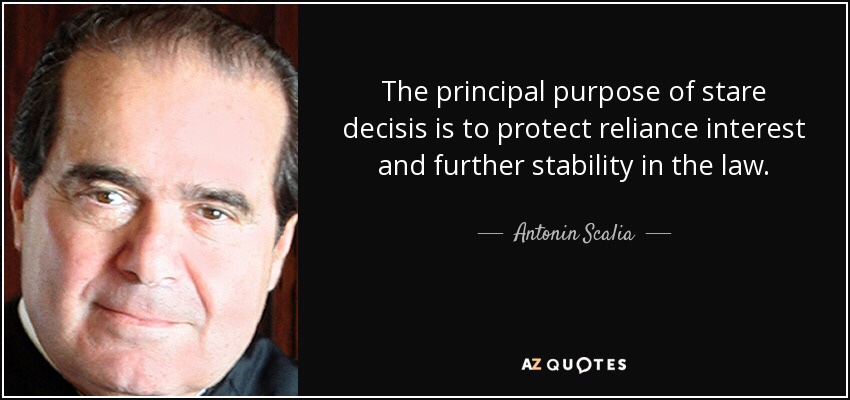
Is stare decisis dead?

Stare decisis for thee but not for me?

Update (6/25): Check out this excellent analysis of stare decisis by my collegaue and friend Ilya Somin. Here is an excerpt:

” I have previously suggested that ‘Stare decisis will not stop the justices from overturning a precedent they think is badly wrong and causes significant harm’ — a point I believe applies to both liberal and conservative jurists. Nothing in yesterday’s opinions leads me to change that view. This point can be recast in terms of the Supreme Court’s doctrinal standards for reversing previous decisions: its ‘precedent on precedent.’ The doctrine requires the Court to consider such factors as the quality of the earlier precedent’s reasoning, the extent to which changing circumstances have undermined its utility, the ‘workability’ of the precedent, and whether it has generated significant reliance interests. But much of this just a fancier and more sophisticated way of saying that courts must consider 1) how bad was the precedent, and 2) how much harm it causes, which perhaps should be weighed against the potential harm of upsetting settled expectations.

F. E. Guerra-Pujol's avatarprior probability

SCOTUS overruled another venerable precedent this week. (Will Roe v. Wade be the next to go?) The case is South Dakota v. Wayfair, Inc., a decision we hope is quickly overruled by Congress. Due to other commitments (Summer A grading), we will discuss the sordid details of the Wayfair case–and propose a bill to Congress to overrule this hideous decision–next week. In the meantime, check out Will Baude’s excellent summary, via Volokh, of this stare decisis divide.

Update (29 June 2018): I have now posted part 1 and part 2 of my analysis of the Wayfair case.

View original post

Posted in Uncategorized | Leave a comment

“Adam Smith’s theory of justice”: conjectures and refutations

Alternative title: Review of Chapter 5 of Law and the Invisible Hand

Chapter 5 of Law and the Invisible Hand is the most speculative chapter in Robin Paul Malloy’s new book–and also the most original and creative one. In summary, having identified the main ingredients of “Smith’s theory of jurisprudence” in his two previous chapters — i.e. Smith’s “three metaphors” in Chapter 3 and Smith’s “three pillars of civil society” in Chapter 4 –, Professor Malloy then dons his academic chef’s hat and combines this hodgepodge of ingredients in a new and novel way in Chapter 5 to develop a Smithian-inspired theory of justice. For the sake of brevity, I won’t restate the specific steps of Malloy’s intricate intellectual recipe here; instead, I will limit myself to making the following few observations, criticisms, and suggestions:

  1. Stop saying “Smith’s theory of jurisprudence”; Adam Smith did not have one. Although the subtitle of Malloy’s book is “A Theory of Adam Smith’s jurisprudence,” Malloy keeps referring to “Smith’s theory of jurisprudence” and to “Smith’s theory” in each of the chapters of his book when Smith never developed a theory of jurisprudence. In truth, Malloy is just presenting his conjecture of what Smith’s theory of law and justice would have looked like had Smith actually completed his promised book on jurisprudence, which Smith did not. That said, is Malloy’s novel conjecture in Chapter 5 a good one?
  2. Entities are not to be multiplied beyond necessity.” We know from Smith’s early essay on “The History of Astronomy” that Smith himself admired the elegant simplicity of Newton’s three laws of gravity, not the ad hoc or makeshift epicycles of Ptolemaic astronomy. Alas, Malloy’s conjecture, his attempt to formulate a Smithian theory of justice out of a hodgepodge of Smithian concepts, falls more on the Ptolemaic end of the social-science spectrum. To sum up, although Malloy’s efforts are admirable and his guess is a plausible one, my main criticism is that it has too many moving parts to be considered a “Smithian” or Enlightenment theory of justice.
  3. It takes a theory to beat a theory. Even if my criticisms above are on point, Malloy still deserves great credit for bringing to our attention a lesser-known aspect of Adam Smith’s work, his lectures on jurisprudence, and for identifying possible connections between these lectures and Smith’s published work. Moreover, Malloy himself, perhaps unwittingly, effectively responds to objection #2 above in the very next chapter of his book, where he presents a simpler and more plausible Smithian theory of justice. I will thus turn to chapter 6 in my next post …
Applying Occam's Razor to your writing - Punchline
Posted in Uncategorized | Leave a comment

Markets, metaphors, and morality (part 3)

Robin Paul Malloy identifies and describes “three pillars of civil society” (p. 5) in Chapter 4 of Law and the Invisible Hand, three key concepts that appear in various parts of the work of Adam Smith: utility, authority, and justice. In brief, “authority” (pp. 41-44) refers to the power of the sovereign to resolve disputes and protect one’s person and property, while “utility” (pp. 44-49) refers to propriety of the methods used by sovereign to perform these essential tasks (i.e. society as a whole is better off when disputes are resolved peacefully and when everyone’s personal safety and property are protected), but of these three pillars, Malloy devotes the most space to “justice” (pp. 49-57). According to Malloy’s interpretation of Smith, “justice” refers to the protection of one’s person and property and is the most important of these three pillars, the one that holds the edifice of society together (p. 40).

This tripartite picture of “civil society” is no doubt a useful and reasonable one, but is it really the picture that Adam Smith himself would have painted? I pose this key question here because Smith himself never developed a theory of justice. Yes, Smith acknowledged that one of the principal duties of the sovereign is “to protect[], as far as possible, every member of the society from the injustice or oppression of every other member of it.” [See The Wealth of Nations, Glasgow edition, pp. 708-709 (para. 1).] And, yes, Smith defined justice as “a mere negative virtue” (i.e. not harming others) in his treatise on moral sentiments. [See The Theory of Moral Sentiments, II.ii.1.9.] But as I mentioned in a previous post, Smith never completed his promised book about law and justice.

Furthermore, to equate justice with restraint from harming others (justice as a negative virtue), as Smith does in The Theory of Moral Sentiments, or conversely, to equate injustice with oppression, as Smith does in The Wealth of Nations, is not enough to build a full-fledged theory of justice. Why not? Because one man’s harm or oppression is another man’s natural liberty! We therefore need to define what forms of conduct constitute “harm” and what types of acts constitute “oppression”, and we also need to identify the circumstances, if any, in which such harms and acts of oppression can be justified or excused. In short, at a minimum, we need a theory of harm as well as a theory of justification and excuse.

Perhaps, however, we could we use one of Adam Smith’s three metaphors–the invisible hand, the man in the mirror, or the impartial spectator, or some combination thereof–to fill this massive gap in Smith’s work, i.e. to develop “a Smithian theory of justice.” As it happens, this is precisely what Professor Malloy attempts to do in Chapter 5 of Law and the Invisible Hand, his most original and thought-provoking chapter. In the alternative, perhaps this gap in Smith’s work was an intentional one; that is, perhaps Smith came to believe that developing a comprehensive theory of justice would be a complete waste of time! Either way, I will proceed to Chapter 5 in my next blog post.

Supporting Social Justice – Youth Community Service
Posted in Uncategorized | 1 Comment