I have blogged about Rosa Parks before (see here and here, for example), but I did not know that the actual city bus in which she was arrested on December 1, 1955 for refusing to give up her seat to a white man–a brave act of defiance that ended up changing the entire world–still exists. It was restored and brought back to life by the Henry Ford Museum in Dearborn, Michigan, going from a discarded relic in a lonesome Alabama field (see below) to one of the most popular artifacts in that museum’s collection. Via The Henry Ford (THF), more details are available here.
During the past 12 years, I have authored or co-authored a number of scholarly works exploring various aspects of markets and property rights using a “Coasean” lens. In addition to my 2011 paper on “Coase and the Constitution“, for example, which I blogged about recently, I have also explored or applied the logic of markets and property rights in the following contexts:
Science fiction. Another 2011 paper of mine, Clones and the Coase theorem (co-authored with my colleague and friend Orlando Martínez-García), explores Ridley Scott’s 1982 film Blade Runner from a Coasean perspective.
Blackmail. Why not a market in secrets? Yet another 2011 paper, this one titled The problem of blackmail: a critique of Coase, “out-Coases” Coase (so to speak) and explains why blackmail is a reciprocal problem.
The prisoner’s dilemma. My 2014 essay on the famous “prisoner’s dilemma” (also co-authored with Martínez-García) asks, What would happen if the prisoners in this dilemma were allowed to talk and bargain with each other? Would they strike a Coasean bargain?
Vampires. Another 2014 essay of mine, Buy or bite?, which found its way into The Economics of the Undead, discusses the possibility of contracts between humans and vampires for the purchase and sale of blood.
The trolley problem. Yet another 2014 paper, Trolley Problems, proposes a market solution to both versions of the famous “trolley problem” in moral philosophy: why not conduct an auction from behind a veil of ignorance?
Literary fan art. My 2019 NYU paper Of Coase and copyrights explains why copyright infringement — and, more generally, disputes between “creators” and mere “copiers” — is a reciprocal problem and defends literary fan art as fair use.
Lockdowns. My work-in-progress Lockdowns as takings, which I began writing in 2020 and significantly revised in 2021, explains why workers have a property right to their labor and why stay-at-home orders constitute a government taking of such labor rights.
Illegal and immoral promises. My most recent work, Breaking bad promises (forthcoming), explores the problem of illegal and immoral agreements.
Conspiracy theories. My other forthcoming work, The Leibniz Conspiracy, proposes a retrodiction market to allow people to bet on their favorite conspiracy theories.
Academic trolling, or flashes of insight? Either way, I will leave it up to my loyal readers to decide which of these scholarly works are totally loony and which are perfectly lucid.
Check out this short paper on “Variables and parameters” by Douglas Altman and J. Martin Bland, who identify at least three different meanings of the statistical term “parameter” and attempt to distinguish parameters from variables as follows (note: the introductory labels in bold are mine):
Parameters as statistical quantities: “… parameters [unlike variables] do not relate to actual measurements or attributes but to quantities defining a theoretical model,” such as the mean and standard deviation of the data pictured in the figure pictured below.
Parameters as slope-intercepts: “Another use of the word parameter relates to its original mathematical meaning as the value(s) defining one of a family of curves,” i.e. the slope and intercept of a line or curve.
Parameters as variables(!): “In some contexts parameters are values that can be altered to see what happens to the performance of some system.” (Wait, isn’t this what a “variable” is?)
So, which is it? In the alternative, is the definition of the term parameter provided by Wikipedia (see here) even less helpful?
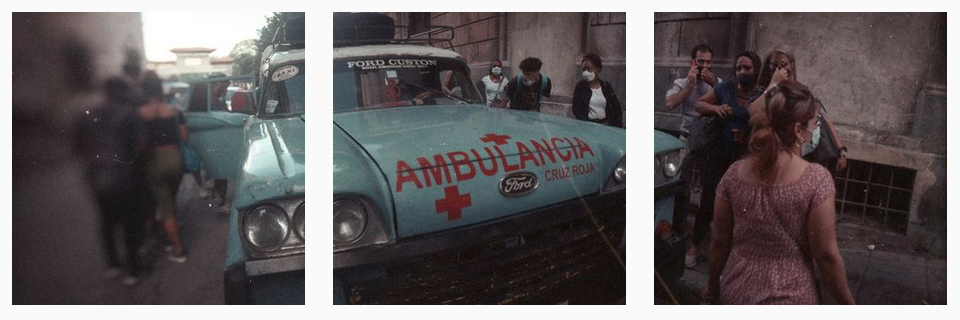
Following up on my Garrincha post, another Cuban artist whose work was featured during the Thirteenth Conference on Cuban and Cuban-American Studies last week was Manuel Almenares Estrada, a photographer who lives and works in Havana. (Here is a short bio.) Via Instagram, pictured below are some of his “street scenes” of daily life in Centro Habana — note too the spatial arrangement of the street scenes on his Instagram page:
It’s time to wrap up my series on “Coase and the Constitution“, which I had put on hold last week to attend to other matters. The top two citations to my work appear on the pages of the Columbia Law Review. Erin Ryan, a law professor at Florida State, shouts me out twice in his law review article “Negotiating Federalism” (Ryan, 2015, pp. 10 & 21), along with a number of other scholars who have contributed to the literature on federalism — Heather Gerken, Jessica Bulman-Pozen, Abbe Gluck, Cristina Rodríguez, Samuel Bagenstos, Bridget Fahey, Ari Holztblatt, Abigail Moncrieff, Jim Rossi, Adrian Vermeule, Mark Rosen, Curtis Bradley, and Trevor Morrison — while Aziz Huq, a law professor at the University of Chicago (where Coase himself used to teach!), simply dismisses my proposed federalism market as “implausible” in his article on “The Negotiated Structural Constitution” (Huq, 2014, pp. 1598-1599, n.10).
Alas, something is amiss. If the sundry legal scholars referred to above “agree that institutional bargaining is inevitable in the absence of clear constitutional entitlements” and “that structural bargaining takes place among the major institutions of governance”, to quote Professor Ryan (2015, p. 24), then why has my federalism market idea either not been taken seriously or been rejected out of hand? Although legal scholars’ blatant hostility toward explicit markets is to be expected — after all, as Coase himself often noted, law professors generally love to solve the world’s problems with complex, top-down administrative solutions — what is less forgivable is the utter lack of creativity in the domain of constitutional law.
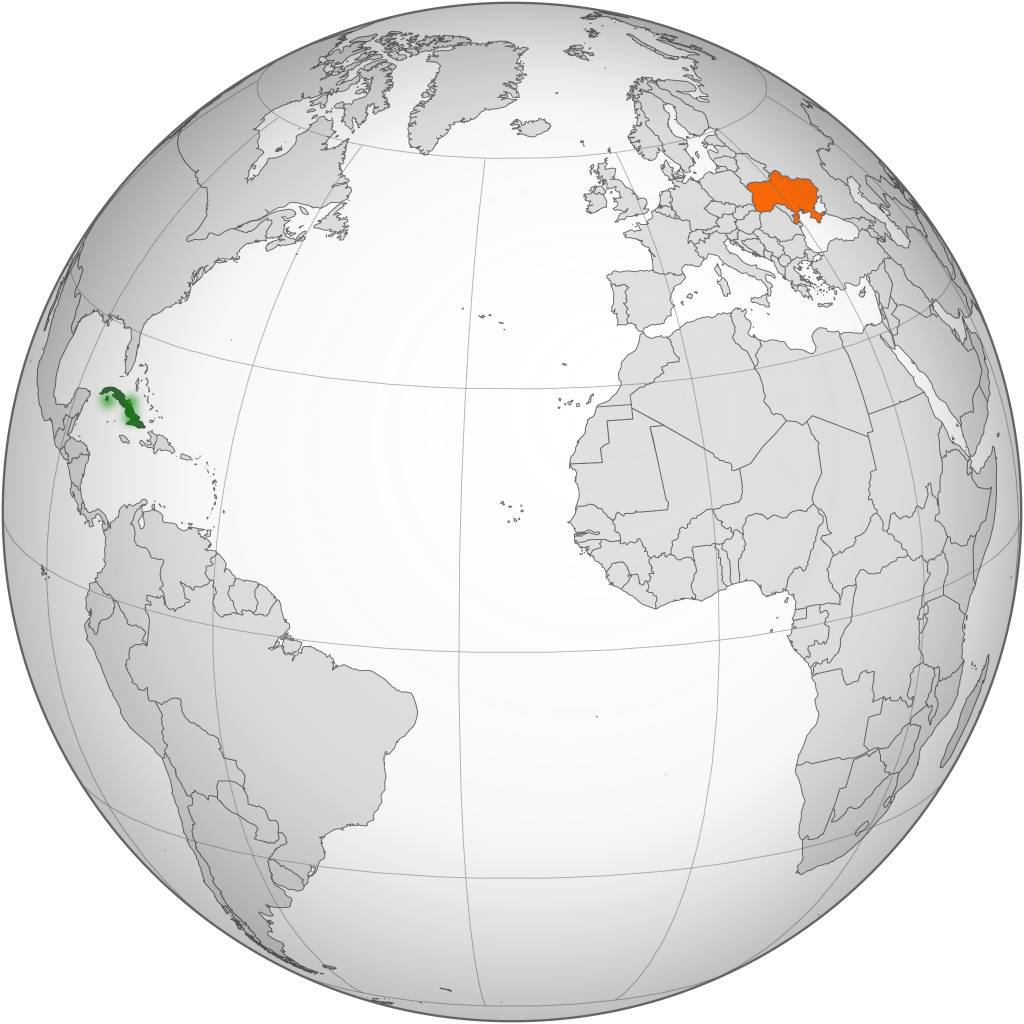
Ukraine for Cuba? Why not? I’m just thinking out loud here, but if the Russians were to launch an invasion of Ukraine (even a “minor” one), then the United States should invoke the Monroe Doctrine (look it up!) and invade Cuba. #LiberateCuba #TitForTat
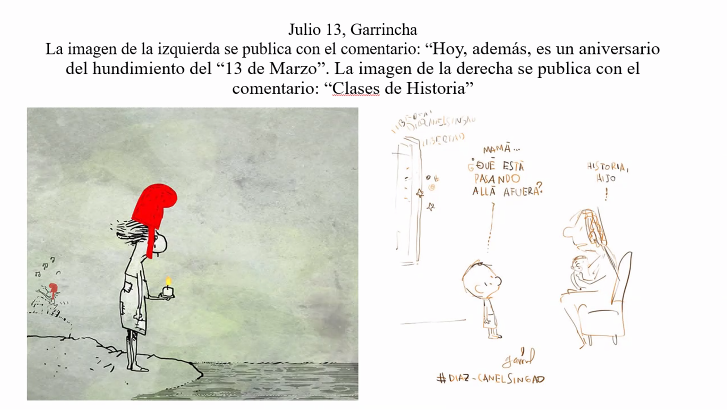
During the Thirteenth Conference on Cuban and Cuban-American Studies at FIU this past week, I discovered the work of Garrincha, which is the pen name of Gustavo Rodriguez, a Cuban-born artist who now resides in the USA. Both of his cartoons pictured below were published on 13 July 2021, two days after the unprecedented July 11 populist revolt in Cuba, which was brutally repressed by the Cuban military. The cartoon to the left refers to the 37 men, women, and children who drowned at sea when their vessel — the tugboat “13 de marzo” — was deliberately fired upon and destroyed by the Cuban Coast Guard on 13 July 1994, a crime that will live infamy. In the cartoon to the right, a child asks his mother what is going on outside. Her reply: “History, my son.”
where c is the universal constant for the speed of light.
In words, the speed of light traveling through a vacuum is about 186,282 miles per second, or exactly 299,792,458 meters per second (hat tip: @pickover).
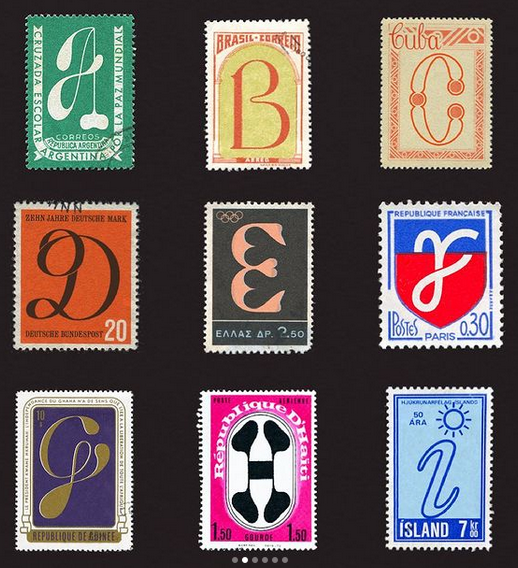
Via Kottke: “artist and type designer Marie Boulanger selected 26 postage stamps from around the world with letters on them (C for Cuba, F for France, K for Kenya, etc.) and 10 stamps with the numerals 0-9 on them.” Nine of her postage stamps are pictured below. Check out her Instagram here.
















 prior probability