I have just posted to SSRN a revised and corrected version of my forthcoming chapter “Breaking Bad Promises” — to be published in Joshua Heter & Brett Coppenger, editors, Better Call Saul and Philosophy (Open Universe), which is now in press. (You may pre-order a copy of the book here.)
I am interrupting my multi-part series on “Coase and the Constitution” to let everyone know that I have posted to SSRN a revised version of my latest paper, which is titled “The Leibniz Conspiracy” and which will be published in the Journal of Law & Public Policy in the spring. In summary, I retell the story of Godel’s belief in a worldwide, centuries-long conspiracy to suppress the work of Gottfreid Leibniz (pictured below, left), showing how even the greatest logician since Aristotle could engage in conspiracy thinking, and I propose a solution for dealing with conspiracy theories today: a retrodiction conspiracy theory market. But at the suggestion of Professor Steven J. Brams, I made one significant revision to my paper: I replaced my proposed “conspiracy theory court” with a more simple and elegant solution. Specifically, instead of appointing an external arbiter to resolve the truth or falsity of any given conspiracy theory, let’s just keep the conspiracy theory market open indefinitely. That way, any bettor can opt out at any time, pocketing his winnings if the current price is above what he paid for his bet (either for or against the conspiracy) or taking a loss at the current price. In summary, the logic of keeping the market open indefinitely, instead of appointing an arbiter, is that bettors will presumably stay in if they think the price of their bets will increase, or they can opt out if they think the price will fall. The price will therefore track aggregate belief or non-belief in any given conspiracy theory, with no necessary final resolution, and as Professor Brams pointed out to me, bettors would still have an incentive to seek new information, information that not only supports their choice but that is also likely to persuade other bettors, thereby advancing the search for the truth.
Trent J. MacDonald, a research fellow at RMIT University, cites “Coase and the Constitution” on page 86 of The Political Economy of Non-Territorial Exit(Elgar, 2019), a beautiful book that “explores the theoretical possibility of ‘unbundling’ government functions and decentralising territorial governance.” Below is a screenshot of the relevant passage (just click on the passage to see it in its entirety), along with a picture of the book’s cover:
Alas, although MacDonald is correct to note “the transferability of legal rights” and the possibility of transfers of authority between different governmental units, his focus is on the ability of people to “vote with their feet” (so to speak) by moving to those cities and states whose public policies they prefer. The fatal flaw with this observation, however, is that it ignores what Coase’s disciples like to call “transaction costs.” To the point: moving from one place to another is not costless, so many people will, in fact, stay put even if they don’t like the government policies of the place where they live.
Moreover, putting the transacation-cost problem aside, MacDonald — like Sundquist; see my previous post — is talking about markets in a metaphorical sense, whereas my Coase paper proposes an actual “federalism market” in which various governmental units and private firms would compete with each otherto purchase the right to provide a particular public good or for the right to enact their own preferred policies and legal rules for a specific sector of the economy. I explain how this market would work in my Coase paper, but so far, it looks like I don’t have any takers …
Christian B. Sundquist, a law professor at the University of Pittsburgh, cites “Coase and the Constitution” as part of his discussion of “competitive federalism” in his 2017 law review article “Positive Education Federalism.” To the point, Professor Sundquist writes (p. 359):
“The model of competitive federalism … seeks to promote a deregulated ‘free market’ at both the state and federal level through incorporation of the economic principles of consumer choice and competition.” (Here, Sundquist drops a footnote, #44, and cites several scholars, including yours truly.)
Although Sundquist’s one-sentence description of “competitive federalism” — an ideal world in which national and state governments compete with each other to win over the hearts and souls of the people — is no doubt an attractive one, this vision is too watered-down compared to what I specifically propose in my Coase paper. What I propose is an actual “federalism market” in which various governmental units and private firms would have to compete with each other for the right to enact rules for a specific domain.
My second-most cited law review article, “Coase and the Constitution” (Guerra-Pujol, 2011), one of six scholarly papers I have written inspired by the ideas of the late Ronald Coase, presents a Coasean or property-rights method for resolving disputes over federalism. That is, instead of attempting to draw an arbitrary boundary line between local and national spheres of power through legal, historical, or semantic analyses of a country’s constitution, my Quixotic paper proposes the creation of alternative “federalism markets” in which governmental powers and functions would be allocated to Congress, the States, or even private firms through decentralized auction mechanisms and secondary markets. Since its initial publication in volume 14 of the Richmond Journal of Law and Public Interest, “Coase and the Constitution” has been cited at least five times in the scholarly literature, including, I confess, one self-citation:
Enrique Guerra-Pujol (self-citation), “The Poker-Litigation Game,” arxiv:1509.01214 (20 Jun 2015), pp. 1-17.
I will be reading the first four of these scholarly works and replying to them in the next few days. (As an aside, I will revisit my six other Coasean papers as well, and I will also resume my extended review of Nozick’s Anarchy, State, and Utopia, which I began late last year.)
I began this series of blog posts one week ago (Jan. 20) by listing 11 serious researchers who have cited or otherwise mentioned my 2013 law review article “Gödel’s Loophole” — to keep my list manageable, I included only scholarly works, thus excluding all general media mentions — and I have since replied to the first nine of those authors. But I have saved the best for last: a 2020 paper by Valeria Zahoransky and Christoph Benzmüller, which builds on previous work by Zahoransky (2019; see here).
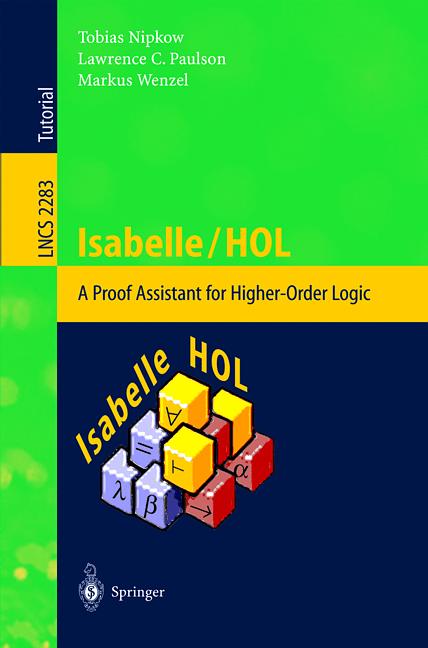
To the point, unlike most of the other works in my Jan. 20 listing, Zahoransky &Benzmüller take Gödel’s constitutional contradiction seriously: how to introduce a dictatorship in the USA without violating the rules laid out in the U.S. Constitution. Specifically, they formally model the argument in Part 3 of my paper (i.e. my Gödelian conjecture) with the language of Higher-Order Logic using Isabelle/HOL, a proof assistant for Higher-Order Logic (HOL) (see, for example, the textbook pictured below). From the introduction to their paper (footnotes omitted):
“There is an infamous anecdote [involving Gödel’s citizenship hearing] …. When preparing for the hearing Gödel found that the Constitution allowed for the introduction of a constitutional dictatorship. He set out to explain this to the judge once the discussion turned towards the governmental system of the United States. The judge was not interested in hearing Gödel’s argument but did grant him the US citizenship.
“In the following we shall model an argument for installing lawful dictatorship on the basis of the U.S. Constitution. It is not, however, Gödel own argument, but rather one suggested by legal scholar Guerra-Pujol.”
Zahoransky &Benzmüller then go on to outline my argument as follows:
“… we outline the argument as provided by [Guerra-Pujol, 2013]. The constitution does not allow for the direct installation of a dictatorship,since dictatorship requires the consolidation of legislative, executive and judicial powers in one person or institution [Levinson & Balkan, 2009]. This is not possible due to the separation of powers as set out in U.S. Const. Arts. I-III. In order to allow for this kind of consolidation of powers the Constitution has to be amended in a two-step process. First, an amendment that changes Art.V has to be introduced and secondly an amendment that actually installs dictatorship by consolidating power in one person or institution.
“Art.V needs to be amended since it regulates the amendment process and protects some articles from being amended altogether, such as U.S. Const. Art.I, §3., cl.1 and U.S. Const. Amend. XXVII, which ensure that each state has two votes in Senate. Directly introducing an amendment that would abolish the distribution of powers and thus strip the states of their suffrage rights would not be constitutional. One can however remove the protection of certain articles from Art.V with a first amendment, amd1, and then introduce dictatorship with a second amendment, amd2. This is constitutional since Art.V does not protect itself.”
Among other things, the remainder of their beautiful paper formalizes my reconstruction of Gödel’s loophole by identifying those constitutional provisions that are relevant to my Gödelian conjecture and by representing those provisions in higher order logic (HOL). If I may now be permitted a second-order conjecture, I believe Kurt Gödel himself would have loved it!
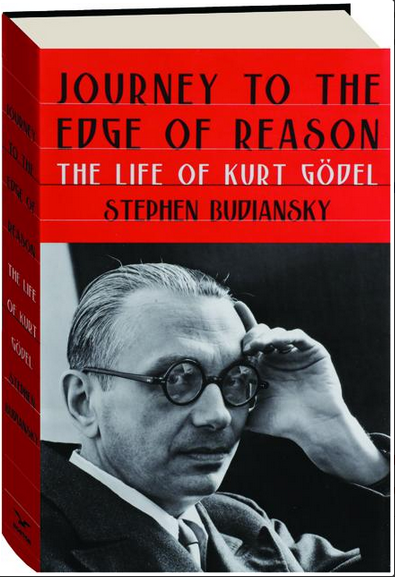
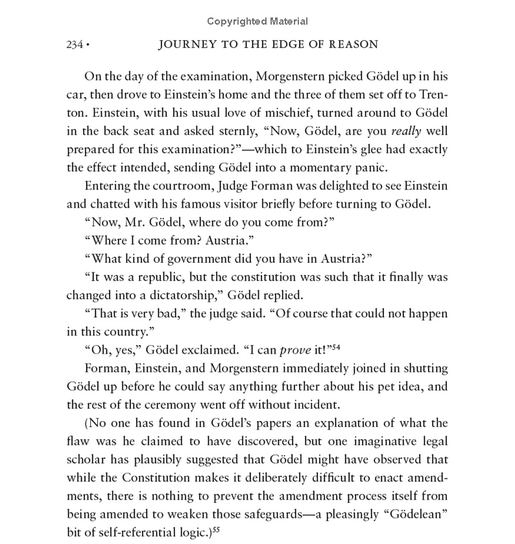
I picked up a copy of Stephen Budiansky‘s new biography of Kurt Gödel — Journey to the Edge of Reason, W. W. Norton (2021) — by chance at a book store in Winter Park, Florida in June of 2021, and I was pleasantly surprised to find my work on “Gödel’s Loophole” cited on pages 234 & 327 of Budiansky’s beautiful book, where he retells the story of Gödel’s citizenship exam and his discovery of a logical contradiction in the U.S. Constitution. Although Budiansky devotes only one paragraph to my conjecture, he gets the general idea of my argument — and its Gödelian spirit — right! (For your reference, both the cover of Budiansky’s book and the relevant excerpt on p. 234 are pictured below.)
“A self-governed [group] must have rules by which group decisions are made. These rules are often codified by a written constitution that specifies not only the rules by which decisions are made, but also the means by which these rules can be changed, or amended. One of the defining characteristics of constitutions is entrenchment, or the difficulty of enacting changes. Too little entrenchment means a constitution has little force behind it and can change frequently. Excessive entrenchment can be similarly destabilizing if it frustrates too many of its constituents, and can undermine the collective will.”
The last two statements above (in bold) captures perfectly the problem of constitutional decision rules. Abramowitz, Shaprio, & Talmon then cite my Godel paper in Part 3.1 of their research article, where they write (emphasis in the original):
“Since agent preferences are over decision rules themselves, we assume that these preferences reflect some properties agents desire in any group decision, i.e. level of consensus required for change. Ideally, these same principles should be reflected by the amendment rule itself. If the status quo has special status, say for purposes of entrenchment, then perhaps any change to it should not violate the principles behind the status quo. For example if 2/3rds of the agents are required to accept proposals, but they only need a simple majority to change this decision rule, then the 2/3rds threshold is only entrenched in a very limited sense, since a smaller majority can undermine it. We codify this sense of internal coherence as anterior consistency. (The example above relates to Godel’s loophole [Guerra-Pujol, 2013] of the US constitution.)”
In reply, I wish to make one point of clarification. To borrow their own example of a 2/3rds threshold versus a simple majority, Godel’s loophole would apply even if a 2/3rds super-majority, and not just a simple majority, were required to change a group’s decision rule. I won’t repeat my argument here (see part 3 of my paper), except to say that that is Godel’s loophole, i.e any decision rule can be amended, even entrenched or unamendable ones!



















 prior probability