Gödel’s Loophole: Reply to Das Gupta

Anuj Das Gupta, the Chief Research Officer of Stratumn SAS in Paris, France, cites “Gödel’s Loophole” in his excellent essay “Looking for the Soul in Satoshi’s Work” (Das Gupta, 2019), which provides a general overview of blockchain technology. Toward the end of his essay, especially parts 7 and 8, he observes that blockchain transactions, once executed, cannot be reversed or altered; in other words, the soul of blockchains is supposed to be immutable. To illustrate his point, he draws an analogy between blockchain protocols and unamendable constitutional provisions like the “Eternal Clauses” in Bangladesh’s 1972 Constitution:

You can see a parallel to this [i.e. the immutability of blockchains] in legal systems, where some constitutions, such as the Bangladeshi one, have Eternal Clauses, like the clause that specifies how to make amendments cannot be amended itself.”

It is here — specifically, after the phrase “Eternal Clauses” — that my Gödel paper is cited (footnote 14). Moreover, not only does Das Gupta cite my paper; he also restates my Gödelian self-amendment argument in detail, i.e. how the provision authorizing amendments to a constitution can itself be amended. Despite this, Das Gupta draws the wrong lesson from my Gödel paper. He writes (part 7.3, link in the original): “The Eternal Clauses prevent the ultimate demise of the constitutional system from a slippery slope of amendments amending itself to a state of irrecoverable chaos…. [T]hese special clauses act as Schelling fences, which is a kind of a hard line (‘no more amendments beyond this point’) to stop slippage along the proverbial slope.” In reality, however, for the reasons I give in my paper — and which are restated in footnote 14 of Das Gupta’s essay no less — no constitutional provision is unamendable, immutable, or eternal. That is Gödel’s Loophole!

As an aside, Lima Aktar, a graduate student at Jahangirnagar University in Bangladesh, further explores the paradox of unamendability in her excellent essay ‘Article 7B and the Paradox of Eternalising the Constitution of Bangladesh,’ IACL-AIDC Blog (11 May 2021).

Bangladesh Flag And Name Poster by Frederick Holiday

Posted in Uncategorized | 2 Comments

Gödel’s Loophole: Replies to Bianchi and Kubas

Two foreign-language works cite my 2013 paper “Gödel’s Loophole”: one in Italian (Bianchi, 2020, available here); the other in Polish (Kubas, 2017, here). Let’s begin with Sergio Bianchi, a professor of financial mathematics at the University of Rome (“La Sapienza”), who explores the thematic links between legal theory and mathematics in his beautiful paper “Matematica e cognizione guirisdizionale” (in Italian with an abstract in English). In footnote 12 of his paper, Bianchi tries to draw a connection between Gödel’s incompleteness theorems and the “self-amendment” argument in my 2013 paper. Respectfully, however, I would reply that the connection between Gödel’s constitutional contradiction (self-amendment) and his famous incompleteness theorems is tenuous at best. In fact, although my work notes Gödel’s interest in self-reference, it does not make direct use of Gödel’s famous theorems.

By contrast, the paper by Sebastian Kubas, a law professor at Jagiellonian University in Kraków, Poland and the author of “The global democratic disorder”(in Polish with an abstract in English), reviews four important books about contemporary liberal democracy: (1) “The Future of Freedom” by Fareed Zakaria, (2) “How Democracy Dies” by Steven Levitsky and Daniel Ziblatt, (3) “The People vs. Democracy” by Yasha Mounk, and (4) a collection of essays edited by Cass Sunstein in “Can It Happen Here? Authoritarianism in America”. He concludes his mega-review of these works by noting “the illusory nature of constitutional precautions against the democratic breakdown, especially the deceptive reliance on judges” (p. 16), and to prove his point, Kubas briefly retells the story of Kurt Gödel’s discovery of a logical contradiction in the U.S. Constitution. As Kubas correctly notes (p. 38, translation via Google), Gödel’s discovery shows “the illusory nature of the guarantees contained [in the Constitution],” since these guarantees can either be amended away or simply ignored.

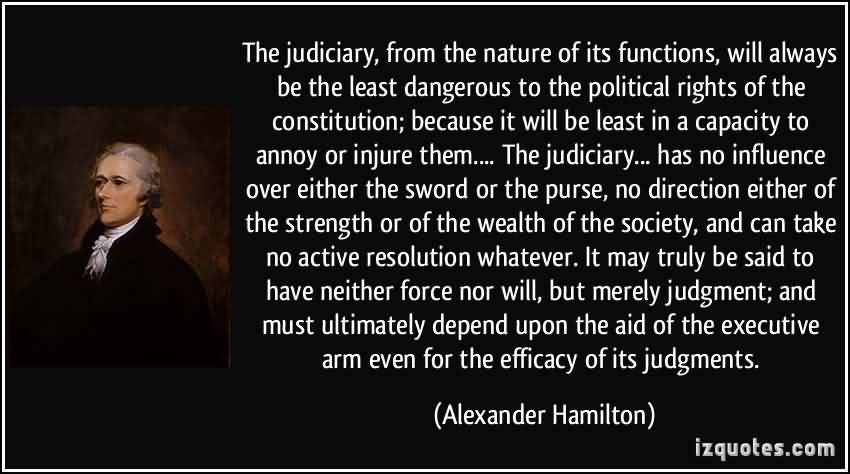
In two words, my reply to Kubas is: Right on! Moreover, I will join Kubas in asking, Why do so many people — especially law professors, who should know better — put so much trust in judges and in “the Constitution”? The practical problem with judges is that their powers are fairly limited: courts have neither the powers of the sword (i.e. the power to enforce their own judgments) nor the powers of the purse (the powers to tax and spend), to borrow Alexander Hamilton’s apt formulation. By contrast, although constitutions are often designed to limit the abuses of government power and to protect individual rights, the main theoretical problem with “the Constitution” is that its provisions can always be amended (even the so-called “unamendable” ones, as Gödel himself must have discovered) … or ignored.

The judiciary, from the nature of its functions, will always be the least  dangerous to the
Posted in Uncategorized | Leave a comment

Gödel’s Loophole: Replies to Mader and Roznai

In my previous post, I listed the works of several authors who have cited my 2013 law review article “Gödel’s Loophole“, and I also said that I would read their works and reply to them soon, so let’s begin with two scholarly papers, one by George Mader (see here), the other by Yaniv Roznai (here). I lump Mader and Roznai together here because both address the same theoretical constitutional puzzle: are some provisions of the Constitution “unamendable”, and if so, which ones? In the course of attempting to solve this puzzle, both Mader and Roznai refer in passing to Kurt Gödel’s discovery of a logical contradiction in the U.S. Constitution, the subject of my 2013 paper. Having thus set the stage, I have two replies to the works of Mader and Roznai:

  1. First and foremost, Mader and Roznai are barking up the wrong tree, so to speak. Why? Because from a purely logical perspective, there is no such thing as an “unamendable” or sacrosanct constitutional provision. For example, even if our Constitution were to explicitly say “X provision is so important that it is ‘unamendable'”, such as the rule in Article I, section 3, clause 1 that “The Senate shall be composed of two senators from each state” (specifically, Article V purports makes this provision unamendable), even that provision could be amended following the two-step procedure that I outlined in my “Gödel’s Loophole” paper. Look it up!
  2. But my main critique of Mader and Roznai is that they wait until the end of their respective law review articles to mention the story of Gödel’s discovery of a logical contradiction in the Constitution, and even then, they merely mention Gödel’s remarkable discovery in passing. Sure, Gödel’s fears may have been exaggerated, but we are talking about — to borrow Rudy Rucker’s memorable formulation — “Kurt Fucking Gödel” here, the greatest European logician since Aristotle! Had Mader or Roznai given Gödel their full attention, instead of just mentioning him in passing, or had they tried to reconstruct the content of Gödel’s discovery for themselves, they would have seen that the problem of self-reference — Gödel’s area of expertise — bedevils all rule-systems and thus all written constitutions.
Barking Up the Wrong Tree: What Works and What Doesn't | Morton Training  Systems

Posted in Uncategorized | Leave a comment

Works Citing Gödel’s Loophole

My 2013 paper “Gödel’s Loophole” reconstructs the story of Kurt Gödel’s purported discovery of a logical contradiction in the U.S. Constitution — there are multiple versions of this story; Part 2 of the paper revisits them all. Part 3 of the paper then attempts to decipher and reconstruct the content of the discovery itself, while Part 4 concludes by offering a simple criterion (self-reference) to distinguish between “Gödelian” and “non-Gödelian” constitutional contradictions. Since its initial publication, the paper has generated its own Wikipedia page (see here) and has been cited by at least ten other scholars. Below is a listing, in alphabetical ordering, of the authors who have cited my paper; I will be reading their works and replying to them in due course …

  1. Ben Abramowitz, Ehud Shapiro, & Nimrod Talmon, “How to Amend a Constitution? Model, Axioms, and Supermajority Rules,” arXiv:2011.03111 (9 Nov. 2020).
  2. Sergio Bianchi, “Matematica e cognizione giurisdizionale,” Diritto Pubblico Europeo-Rassegna online, Vol. 2 (2020), pp. 1-27 (in Italian).
  3. Stephen Budiansky, Journey to the Edge of Reason: The Life of Kurt Gödel, Norton (2021).
  4. Anuj Das Gupta, “Looking for the Soul in Satoshi’s Work,” Crypto Law Review (Mar. 28, 2019).
  5. Sebastian Kubas, “Globalny nieład demokratyczny–współczesne perspektywy,” Studia Krytyczne, Vol. 5 (2017), pp. 14-47 (in Polish).
  6. George Mader, “Generation Gaps and Ties That Bind: Constitutional Commitments and the Framers’ Bequest of Unamendable Provisions,” Howard Law Journal, Vol. 60 (2016), pp. 483-517.
  7. Yaniv Roznai, “Towards a theory of unamendability,” NYU School of Law, Public Law Research Paper #15-12 (2015).
  8. Yaniv Roznai, Unconstitutional Constitutional Amendments: The Limits of Amendment Powers, Oxford (2017).
  9. Valeria Zahoransky, “Modelling the U.S. Constitution in HOL,” Doctoral dissertation, BSc thesis, Freie Universität Berlin (2019).
  10. Valeria Zahoransky & Christoph Benzmüller, “Modelling the U.S. Constitution to Establish Constitutional Dictatorship,” ceur-ws.org, Vol. 2632 (2020).
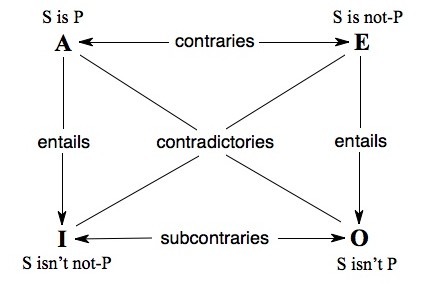
negation square
Posted in Uncategorized | 1 Comment

Defund the TSA?

Britney Spears is now free, but what about the rest of us? Via Reason (11/19/21), J. D. Tuccille makes the case for killing the TSA, another one of George W. Bush’s monumental and moronic failures, along with his illegal war in Iraq and his “Common Core” takeover of local education standards. PS: Why isn’t Bush Jr. in jail yet for his illegal invasion and his war crimes against the peoples of Iraq?

Posted in Uncategorized | 9 Comments

New New York?

r/MapPorn - Proposed plan to expand Manhattan

Check out this recent op-ed in the N.Y. Times by Jason M. Barr (@JasonBarrRU), a professor of economics at Rutgers University. IMO, Professor Barr’s proposed plan to expand Manhattan is long overdue! File under: “Why didn’t I think of that?”

Posted in Uncategorized | Leave a comment

A friendly critique of the Holmesian bad man

First off, I confess that “The Path of the Law” by Oliver Wendell Holmes (1897) is one of my favorite essays of all time, along with David Hume’s critique of consent theories in “Of the Original Contract” (1748), James Madison’s solution to the problem of factions in Federalist #10 (1787), Martin Shubik’s perverse “Dollar Auction Game” (1971), Stephen Yandle’s beautiful “Bootleggers and Baptists” essay (1983), and Mancur Olson’s democracy and dictatorship paper (1993).

Among other things, Holmes’s probabilistic definition of law — “The prophecies of what the courts will do in fact, and nothing more pretentious, are what I mean by the law” — has shaped my research agenda (see here and here, for example) and forever changed the way I see the law. But I have a major bone to pick with Holmes’ famous metaphor of the “bad man.” In brief, in describing his prediction theory of law, Holmes conjures up two “ideal types” — the bad man and the good man — and he then compares and contrasts their motives for action in the following famous sentence:

If you want to know the law and nothing else, you must look at it as a bad man, who cares only for the material consequences which such knowledge enables him to predict,not as a good one, who finds his reasons for conduct, whether inside the law or outside of it, in the vaguer sanctions of conscience.”

To illustrate this classic Holmesian dichotomy with a familiar example from our times, the bad man is your average owner of an oversized SUV or truck, an amoral actor who has no regard for the safety of pedestrians; he only wants to avoid a speeding ticket. The good man drives a Prius. Moreover, this Holmesian division provides a useful way of understanding what the law really is. If you want to know what the true rules of the road are in the USA, for instance, then don’t look at the drivers of Priuses; instead, look at the behavior of the drivers of all those massive SUVs and trucks.

My problem with Holmes’ dichotomy, however, is that it presents us with a false choice. In truth, an individual actor in the real world is not either all bad or all good. More realistically, there is a continuum between the bad man and the good man, and most people fall somewhere along that continuum rather than on the extremes. In other words, when we are making decisions, we often act out of both selfish or materialistic motives (like Holmes’ bad man) and out of altruistic or moral considerations (like the good man).

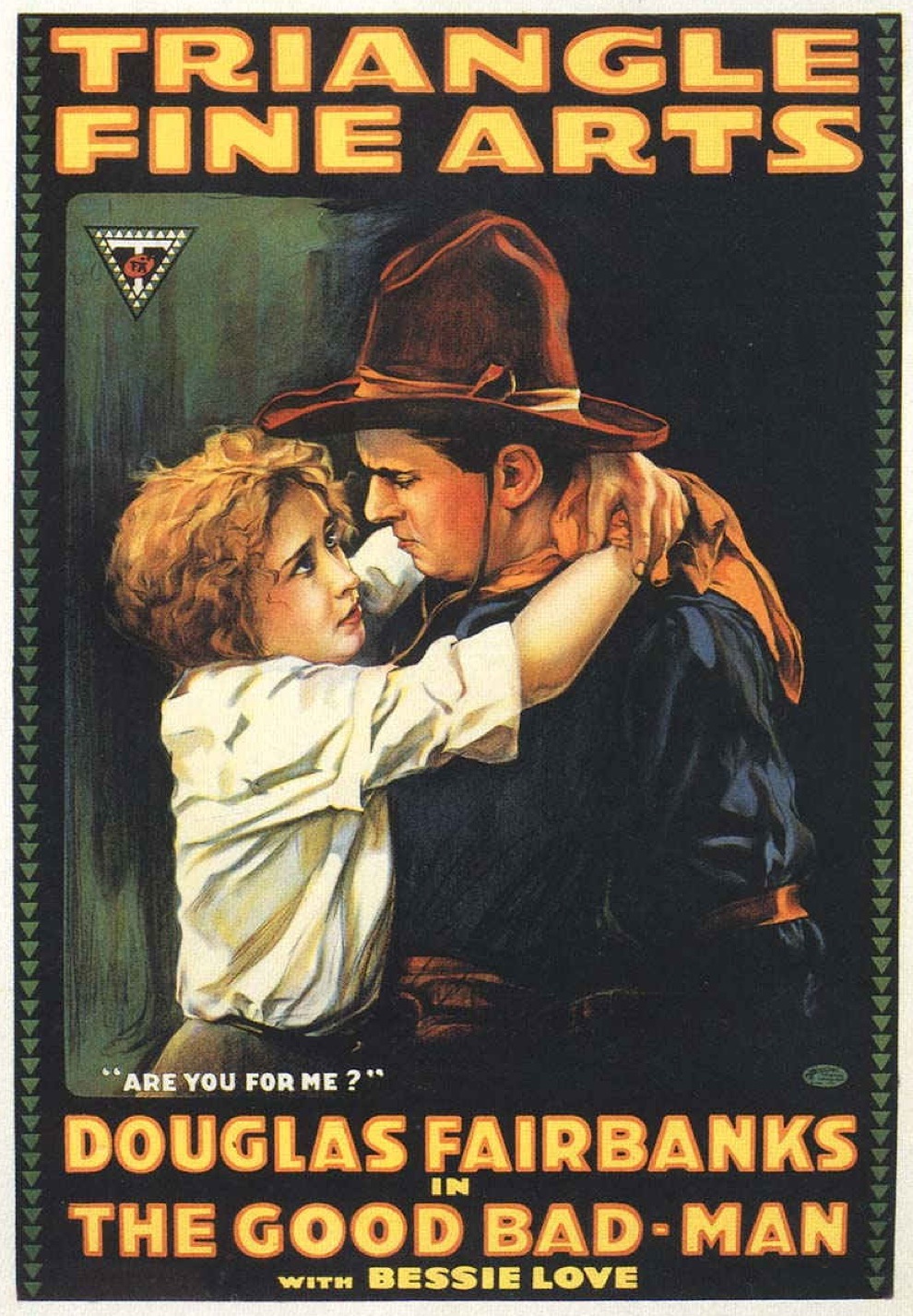
To sum up, we all have a little bad and little good in all of us, like Douglas Fairbanks’ character “Passin’ Through” in the 1916 silent Western film “The Good Bad-Man“, a benevolent outlaw who robs trains to feed orphans. Which of these mixed motives predominate in any given situation, and to what degree, are real-world empirical questions that may or may not be hard to predict ahead of time.

The Good Bad-Man - Wikipedia
Happy MLK Day!
Posted in Uncategorized | 1 Comment

Adam Smith in Love versus Gödel’s Loophole

Time to toot my own horn! As of today (16 Jan. 2022), my scholarly paper “Adam Smith in Love” has already been downloaded over 1000 times from the Econ Journal Watch (EJW) website, while the pre-print of my Adam Smith paper has been downloaded 421 times from the SSRN website. My most downloaded paper by far, however, continues to be my 2013 paper “Gödel’s Loophole” (over 7,500 downloads). Among other things, my Gödel paper has been cited by Adam Gopnik in the 26 Nov. 2021 edition of The New Yorker (see here) and by Stephen Budiansky in his 2021 biography of Kurt Gödel, Journey to the Edge of Reason. That said, my Adam Smith paper, which was published electronically less than ten months ago (31 March 2021), is being read at a much faster rate than my Gödel paper.

Posted in Uncategorized | Leave a comment

My 2022 winter anthem

Posted in Uncategorized | Leave a comment

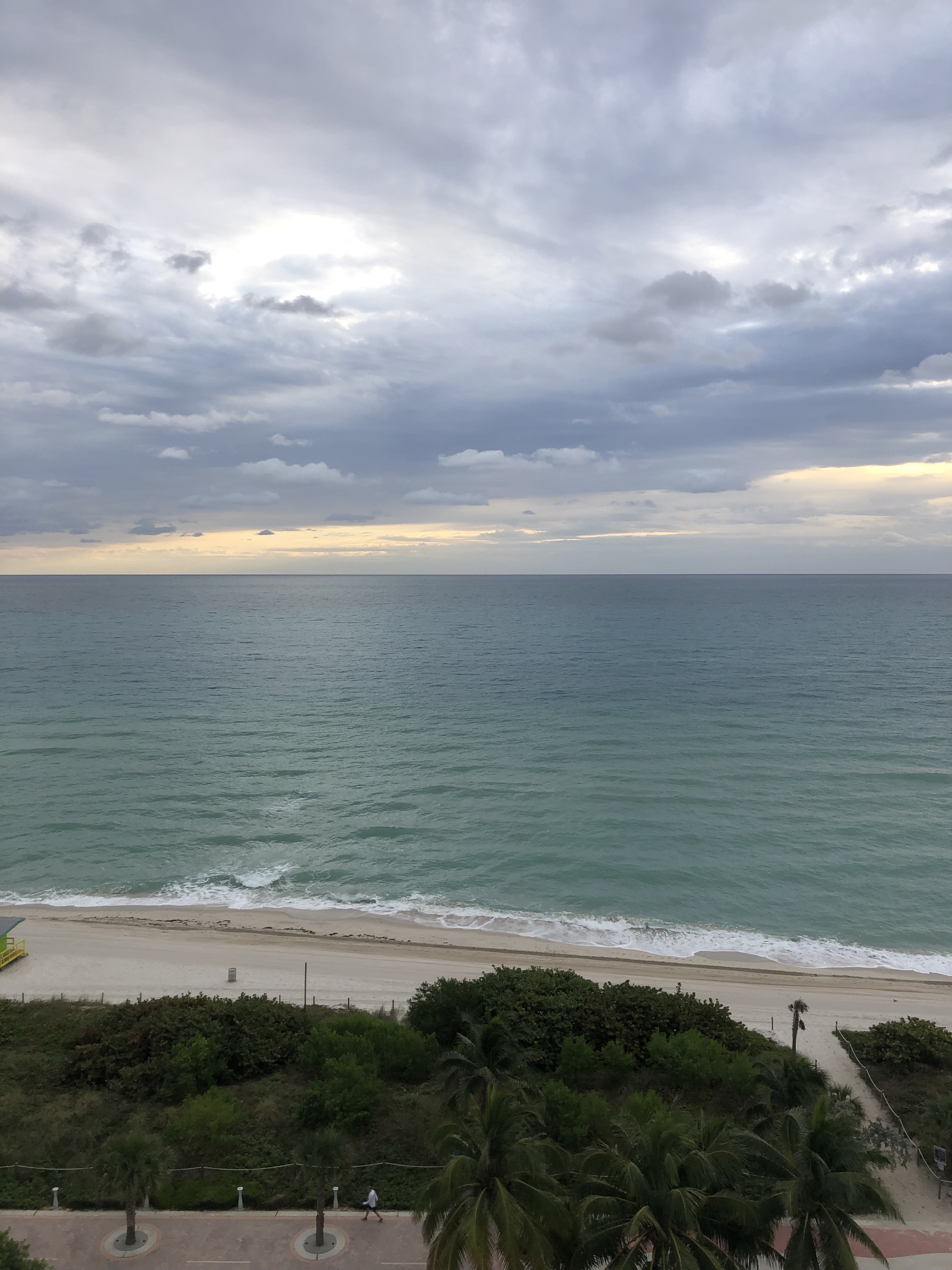
Postcards from Miami

I drove down to Miami this week to take my son to the airport — he will be studying abroad in Spain this semester, and Iberia has a direct flight from Miami to Madrid.

Posted in Uncategorized | Leave a comment