Thanks to the careful work of Sarah Skwire, especially her beautiful draft paper “As If: Clueless about the Invisible Hand”, we have seen how people often add the words “as if” to Adam Smith’s original formulation of the invisible hand metaphor, and we have traced the source of this error back to Paul Samuelson’s 1948 textbook on economics, but why does this “as if” error matter?
Simply put, this seemingly-innocent error matters because adding the words “as if” to Smith’s passage changes the entire tenor and meaning of the invisible hand metaphor, or in Skwire’s own words: “when ‘as if’ is added to ‘led by an invisible hand,’ it changes the rhetorical figure from a metaphor to something else.” To be more precise, the phrase “as if” converts Smith’s invisible hand metaphor into a conditional or counter-factual statement.
Why is this problematic? Because a counter-factual statement, by definition, consists of a conditional claim with the following logical structure: “if p were true, then q would be true.” (See generally B. K. Milmed, “Counterfactual Statements and Logical Modality,” Mind, Vol. 66, No. 264 (1957), pp. 453-470, available here.) That is, logically speaking, when when say “if p were true, then q would be true” what we really are saying is that both the antecedent (p) and the consequent (q) are false. As a result, the phrase “as if” injects doubt and uncertainty into the sentence into which these words are added.
To see this, compare Paul Samuelson’s formulation of the invisible hand theory with Adam Smith’s original formulation:
A. What Paul Samuelson thinks Adam Smith said: “[Smith] proclaimed the mystical principle of the ‘invisible hand’: that each individual in pursuing his own selfish good was led, as if by an invisible hand, to achieve the best good of all ….”
B. What Adam Smith really said: “… by directing [our] industry in such a manner as its produce maybe of the greatest value, [we] intend[] only [our] own gain; and [we are] in this, as in many other cases, led by an invisible hand to promote an end which was no part of [our] intention.” [Note to my Millennial & Gen-Z readers — you win: I have changed Smith’s pronouns from “he/his” to “we/our”.]
Do you see the difference in tone and meaning? What Samuelson is basically saying is that Smith’s “invisible hand” is bullshit. Of course, maybe Samuelson is right; maybe the economy is not always guided by Smith’s Panglossian invisible hand, but that is definitely not what the great Adam Smith himself is saying. Instead, Smith is using the idea of a harmonious invisible hand as a metaphor, not as a counter-factual. For Smith, the paradox of people “intending only their own gain” (to paraphrase Smith) and yet producing good outcomes in the aggregate is real.
Now, walk into your local market or grocery store and look around … Isn’t Smith right?
In my previous post, I took the liberty of cutting-and-pasting the introduction of Sarah Skwire’s beautiful draft paper “As If: Clueless About the Invisible Hand.” In brief, Adam Smith’s invisible hand metaphor is probably the most well-known and popular idea in all of economics, and as Dr Skwire notes, most people often restate Smith’s famous metaphor in the following terms:
“Each individual, in pursuing his own good, is led as if by an invisible hand to increase the welfare of others.”
The problem is that the great Adam Smith never used the words “as if” in the original formulation of his invisible hand metaphor! In fact, according to Dr Skwire, it was none other than Paul Samuelson who first put the words “as if” into Smith’s mouth, so to speak. Specifically, on page 36 of the original 1948 edition of his textbook (pictured below), Professor Samuelson (as quoted on page 2 of Skwire’s draft paper; emphasis added) formulates Smith’s invisible hand idea in the following terms:
“Even Adam Smith, the canny Scot whose monumental book, ‘The Wealth of Nations’ (1776), represents the beginning of modern economics or political economy — even he was so thrilled by the recognition of an order in the economic system that he proclaimed the mystical principle of the ‘invisible hand’: that each individual in pursuing his own selfish good was led, as if by an invisible hand, to achieve the best good of all, so that any interference with free competition by government was almost certain to be injurious.”
Samuelson’s popular textbook went through multiple editions — all of them with the words “as if” grafted onto Smith’s invisible hand metaphor — and was highly influential, for it was used to teach economics to several generations of Anglophone students. Okay, so what? Now that we have identified our main culprit, why is this misstatement of Smith’s invisible hand theorem such a problem? I will address this next question in my next blog post …
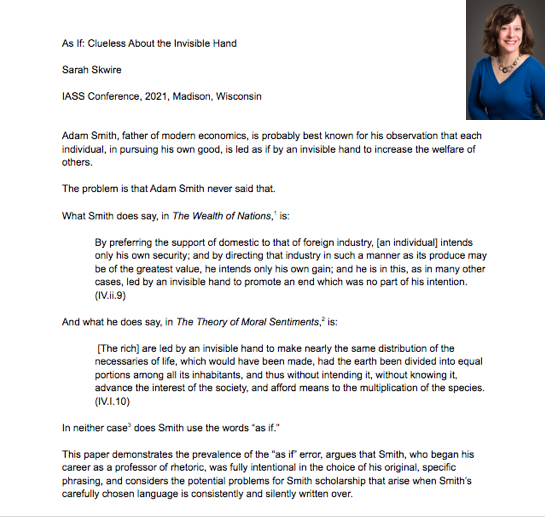
Moving on, the third of my three favorite talks at this year’s International Adam Smith Society (IASS) meeting was Sarah Skwire’s Saturday morning presentation (10/16/21) titled “As If: Clueless About the Invisible Hand“; in fact, I loved Dr Skwire’s beautiful paper so much that (starting tomorrow) I am going to devote my next few blog posts to it. For now, however, check out the introduction to Skwire’s IASS talk, which I am posting below (I have added a picture of Dr Skwire):
“A recent work of text mining of Smith’s works … shows that ‘silver’ is the most relevant word in the Wealth of Nations (followed by expense, tax, profit, rent, corn, colonies).” — Paganelli (draft paper)
As the quote above indicates, another of my favorite talks at this year’s International Adam Smith Society (IASS) meeting was Maria Pia Paganelli’s fascinating presentation on “Adam Smith’s Digression on Silver.” By way of background, the “Digression on Silver” is a long passage that appears at the end of Book I, Chapter 9 of Adam Smith’s magnum opus on The Wealth of Nations (WN). This digression, however, is usually dismissed by scholars as too long, too detailed, or too boring. Professor Paganelli’s contribution is to explain why the Digression on Silver contains Smith’s most powerful argument against mercantilism and should thus be read as the centerpiece of WN!
In summary, mercantilism is a fallacious, zero-sum economic theory that politicians from Joe Biden to Donald Trump continue to espouse in order to justify restrictions on free international trade. According to this now-debunked economic theory, a government should take aggressive steps to ensure that exports (domestic products sold overseas) exceed imports (especially foreign-made finished goods) in order to increase capital inflows and thus accumulate wealth and prosperity. In other words, for mercantilists, the money generated from capital inflows is equated to wealth and prosperity, and mercantilists in Adam Smith’s day believed that when money increased, prices increased, and so did a nation’s wealth.
But according to Professor Paganelli’s careful analysis of Smith’s “Digression on Silver”, Adam Smith attacked the logic of mercantilism in his digression by taking a deeper and critical look at the relationship between the value of silver and the level of wealth. Specifically, Smith asserts, contra the mercantilists, that it was an increase in political stability (i.e. a decline in domestic insurrections and foreign wars) that allowed wealth to grow, which in turn is what caused real prices to decrease and what also simultaneously caused an increase in the quantity of silver that led to an increase in nominal prices.
For Smith, then, the mercantilists’ main error was to focus on nominal prices instead of real prices, leading them to incorrectly attribute a causal relation between the increases in silver and in wealth. Smith, by contrast, showed that the mercantilist correlation between nominal prices and wealth was not causation but just the coincidence of many simultaneous and independent events, or in the eloquent words of Paganelli, “The Digression on Silver leaves mercantilists with nothing: what seems to be is not what is. Money may seem to be wealth, but it is not.”
Note: I will conclude this three-part series in the next day or two with Sarah Skwire’s IASS talk “As If: Clueless about the Invisible Hand.”
As I mentioned in a previous post, Toshiaki Ota’s presentation on “The roles of judges in Adam Smith’s jurisprudence” was one of my favorite works at this year’s meeting of the International Adam Smith Society (IASS). In summary, Professor Ota makes three crucial points in his draft paper:
Correspondence between Law Judges and Impartial Spectators? According to Professor Ota, some Smith scholars, such as Knud Haakonssen, see a correspondence between Smith’s “impartial spectator” in The Theory of Moral Sentiments (TMS) and Smith’s theory of law in his Lectures of Jurisprudence (LJ), especially his views on the pivotal role of judges in legal systems. (For a timeline of when Smith developed these ideas, see the slide pictured below.) What is the correspondence? On the one hand, the impartial spectator in TMS is a fictional being who judges the morality and propriety of our actions, while on the other hand, flesh-and-blood judges in legal systems are public actors who should strive toward impartiality when judging disputes and law cases.
Ota’s Contribution. Professor Ota, however, invites us to reconsider this supposed correspondence between law judges and impartial spectators. Why? Because Smith himself had a negative view of law judges. Specifically, Smith identified two structural problems with the administration of justice that would make it difficult for law judges to maintain their impartiality: (i) judicial salaries — i.e. judges whose salaries depend on litigation fees will be tempted to favor the party paying those fees –, and (ii) the limited nature of the judicial power — i.e. judges must rely on the political branches (the king and parliament in Smith’s day; the president or prime Minister and legislature in ours) to enforce their decisions. Or in the immortal words of Alexander Hamilton in Federalist #78: judges lack the power of the sword and the power of the purse.
Continuing Relevance of Smith’s Critique of Judges. For my part, I wish to add the following observation before concluding my review of Ota’s paper: Although the first problem (re: judicial salaries) was solved by the framers of the U.S. Constitution by granting judges lifetime tenure with a salary guarantee, the second problem (re: the limited nature of the judicial power) is built into the system government: the Congress has the power of the purse, a power over which courts have no control, and the president (executive branch) has the power of the sword: he decides which laws to enforce, and how to enforce them.
Correspondence between the Jury and the Impartial Spectator. Lastly, Professor Ota concludes his draft paper by drawing a correspondence between jurors and impartial spectators. According to Ota, Smith thought jurors would be impartial for two reasons: (i) the parties in a case have the ability to remove a biased juror from the jury during voir dire or the jury-selection process, and (ii) jurors must reside “near the place where the crime was committed, that they may have an opportunity of being acquainted with it” (quoting Smith’s Lectures on Jurisprudence (B), p. 72).
Alas, Point #4 is where Professor Ota’s paper breaks down and needs to be further developed, for there are two massive problems with Smith’s view of the jury. First and foremost, there is no guarantee that the parties to a case will be able to eliminate all biased jurors during the jury-selection process. (Also, on the issue of bias, I can’t help but add that perhaps we should be asking a different question instead: “What is the optimal level of bias in a jury?”) Secondly, jurors who reside “near the place where the crime was committed” are likely to have some knowledge about the facts of the case ahead of time. In other words, as Ota himself notes in his draft (p. 10), the jurors are likely to be “well-informed spectators”, but isn’t there an inherent tension between the goal of impartiality and the state of being informed about a case?
Aside from my two criticisms of Ota, I still loved his work because I agree with him (and Smith) that judges and jurors must strive to be “impartial spectators” and that legal systems should be designed with this aim in mind.
One last postcard from this year’s International Adam Smith Society meeting at the University of Wisconsin. The two pictures in the top row show Professor Dan Klein (front left), Professor Erik Matson (front right), doctoral student Patrick Fitzsimmons (back left) and yours truly (with fedora). The two pictures on the bottom row feature the cast from the movie “Reservoir Dogs.”
I presented my work on “Adam Smith in Love” at the annual meeting of the International Adam Smith Society (IASS), which took place at the University of Wisconsin in Madison. (As an aside, I am currently working on a sequel to my Adam Smith paper, which is tentatively titled “Adam Smith in Paris”, in anticipation of the next meeting of the IASS, to take place at the University of the Andes in Bogota, Colombia in July of 2022.) Suffice it to say that many excellent papers — and two books! — were presented at this year’s conference, but my three favorite presentations were the following:
Toshiaki Ota: “The Roles of Judges in Adam Smith’s Jurisprudence”
Maria Pia Paganelli: “Adam Smith’s Digression on Silver: The Centerpiece of The Wealth of Nations“
Sarah Skwire: “As If: Clueless About the Invisible Hand”
Alas, I have a flight to catch, and in any case, I am unable to provide a direct link to any of these three wonderful works as they have not yet been published, but I will summarize each paper and comment on them over the next few days after I return home to Central Florida …
That is the title of this work of “street sign art” (pictured below from various angles) located in Madison, Wisconsin. This whimsical work of art was created by Portland, Maine-based artist Aaron Stephan and consists of a forest of street signs clustered around a small semi-circular concrete stage across the street from Madison’s Capitol Square. Each street sign bears a word or phrase from poetry, fairy tales, or children’s games, and the blue and green sign colors are meant to evoke lakes and trees. More details are available here via the Wisconsin State Journal.














 prior probability