Although I dislike and distrust what President Dwight D. Eisenhower once described as our “military-industrial complex”, I am re-blogging this post from 2020 in honor of our fallen men and women of the U.S. Armed Forces.
In honor of Memorial Day, I won’t be blogging for the next few days. In the meantime, kindly join me in taking a moment to pause and remember the men and women of our armed forces, especially those who have made the ultimate sacrifice for our freedoms.
Want to take a dip in the sky? This 82-foot long and 10-foot deep swimming pool is located in London and is suspended 110 feet off the ground. More details here, via Moss & Fog.
One of the minor irritations of living in Central Florida is the veritable orgy of annoying lawyer ads all over Orlando (#AdPorn). I always try to mentally block out these crass and ugly billboards whenever I am on the road, so I did not notice, as one newly arrived Floridian puts it, the “epidemic of bald men having billboards extended in order to fit their bald heads.” (Via Reddit: u/mnhaverland.)
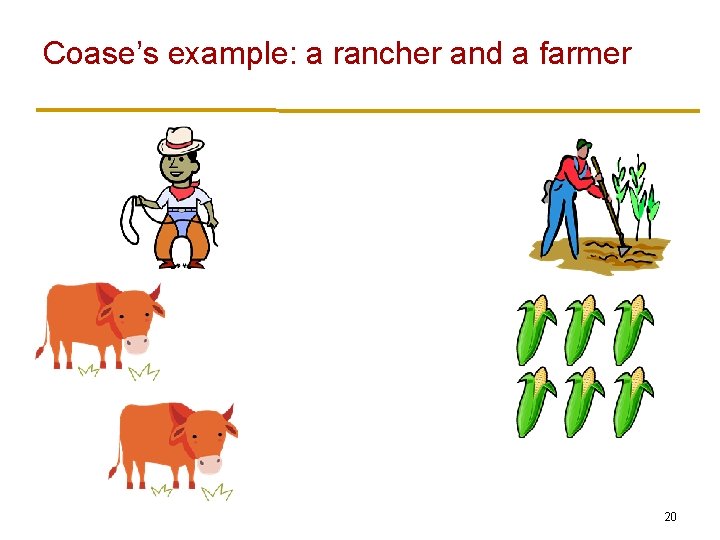
For this installment of my Game-Theory Thursday series (here is the previous installment), I want to feature my 2012 paper “Modelling the Coase Theorem,” which is available here via SSRN. What is so special about this paper, you might ask? In a nutshell, it’s the first paper to apply the methods of game theory to Ronald Coase’s now-famous “farmer-rancher” dispute. By way of background, when Professor Coase published his landmark paper on “The Problem of Social Cost” in the early 1960s, Coase presented this bucolic example to illustrate an intriguing and counter-intuitive idea that has since become known among economists and lawyers as the Coase Theorem–an idea that has shaped my own view of the world and that I have blogged about many times before. But unlike most forms of modern economic analysis, Coase’s “theorem” is based on a verbal argument and is almost always proved arithmetically. That is to say, the so-called Coase Theorem is not really a “theorem” in the formal or mathematical sense of the word. My paper, however, attempts to remedy this deficiency by modelling Coase’s original farmer-rancher problem as a strategic game using the formal methods of game theory. Enjoy!
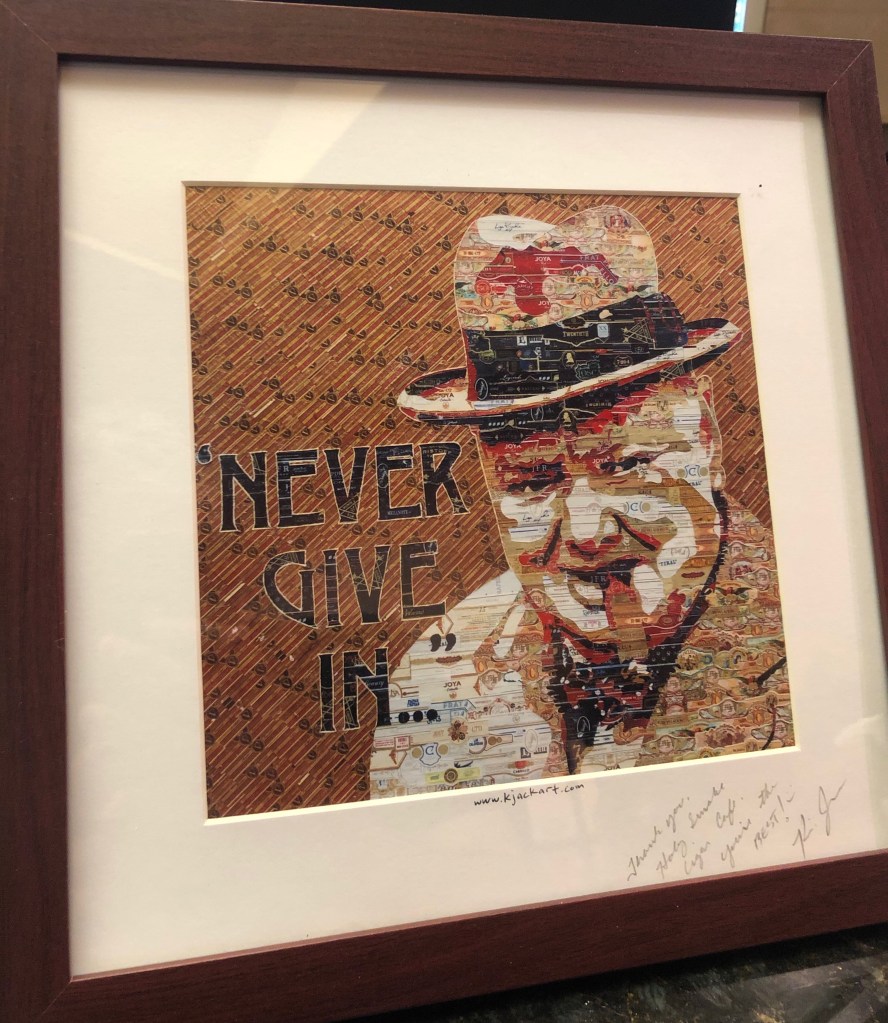
Check out this unique portrait of Winston Churchill by artist Kim Jackson. Look closely, for this collage is composed entirely of cigar labels! Also, check out Kim Jackson’s website here. (Hat tip to Mark, the friendly and expert proprietor of the Holy Smokes cigar shop in Palm Harbor, Florida.)
Kris (@KrisAbdelmessih) asks, and I paraphrase, “How is Twitter disrupting academia?” Tyler Cowen (@tylercowen), the world’s most prolific (and eclectic!) academic blogger, responds here. Tyler’s response, however, begs the following second-order question, Should serious academics (ha!) be on Twitter in the first place?
@alexeyguzey Do you have any articles/sources on how Twitter is disrupting academia? I feel like I've seen you or @tylercowen discuss this but I'm not sure where
More details about composer Karl Jenkins and his Diamond Music album are available here. (Via YouTube: “Camille et Julie Berthollet avec l’orchestre Philharmonique de Monte-Carlo dirigé par Julien Masmondet.”)
Did Adam Smith know what it was like to be in love? AdamSmithWorks, a beautiful website devoted to all things Smith, has just published my “Adam Smith in Love” primer here. (By the way, one of my favorite parts of AdamSmithWorks is the series “What Adam Smith Ate,” containg recipes of Smith’s favorite meals, like Basque Cabbage Soup.) In my primer, I present the available evidence and let readers draw their own conclusions. For the full-length version of “Adam Smith in Love,” along with my own conjectures about Smith’s enigmatic loves, see here.
Note: We will be blogging much less frequently until Monday, June 7. Next month, we will turn our attention to the Zapruder film, Kurt Goedel’s “Leibniz Conspiracy,” and my friend Bob Sanger’s beautiful paper on Gettier cases.
This will be my 10th and last blog post devoted to the contested concept of self-ownership. In summary, I have presented the main arguments against self-ownership, and I have found those arguments to be overrated or woefully inadequate. At the same time, however, I agree with Ben Bryant, whose work I mentioned in my previous post, that self-ownership cannot be an absolute right, that self-owners owe limited duties toward others. But who are those others, and what do these limited duties consist of?
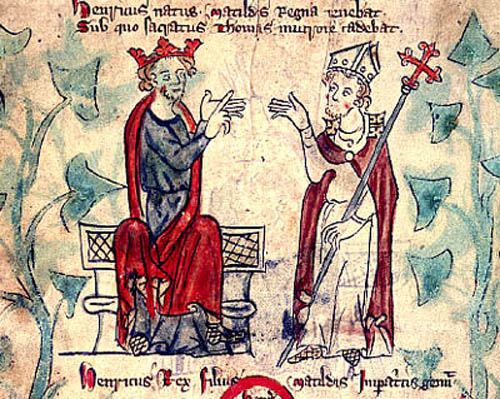
Before proceeding, I agree with Barbara Fried, who I introduced in another previous post, that there are many ways of answering those key questions. This is why even left-libertarians disagree among themselves about the practical implications of self-ownership. But at the same time, let’s not miss the larger and more amazing point here: that both left-libertarians and right-libertarians share the same paradigm or premise: the moral axiom of self-ownership! For my part, I now want to conclude this series by channeling my “inner Richard Epstein”, so to speak — by turning to our Anglo-American common law tradition for answers, a venerable tradition going back to King Henry II and to the immortal jurists of ancient Rome, instead of trying re-invent the philosophical wheel. Specifically, if we take a step back and begin to look at the common law as a whole — especially the law of torts, the law of property, and the law of contracts — something beautiful will begin to emerge, and that something is what I like to call “The Law of Self-Ownership.”
Simply stated, the law of self-ownership can be reduced to a secular Silver Rule for interactions among strangers, i.e. for interactions outside the family or outside other voluntary associations. Broadly speaking, this code contains two parts: (1) a default right, along with a corresponding duty, and (2) a default remedy. The first part consists of one’s default right to negative liberty. Absent a voluntary agreement between A and B, A can’t tell B what to do, and B can’t tell A what to do. (This default right to be left alone, in turn, generates a corresponding or Hohfeldian duty: absent an emergency, A is not allowed to injure or interfere with B’s person or property, and B is not allowed to injure A’s person or property.) The remedy part tells us what happens when the above rule is broken. A must compensate B if A does injure or interfere with B’s person or property, even in an emergency, and likewise, B must compensate A if B injures or interferes with A.
These two “simple rules” (to borrow Professor Epstein’s apt phrase) are, in a nutshell, what the Law of Self-Ownership is all about. We get to decide how to live our lives and how to raise our children, but at the same time, we also owe corresponding duties to others. Although most of these duties are voluntarily assumed by us via contract, some of them are imposed on us via the common law, such as the general duty of ordinary care and the duty to provide compensation for breaches of these voluntary and involuntary duties. What is wrong with this common law picture? I think it’s beautiful!
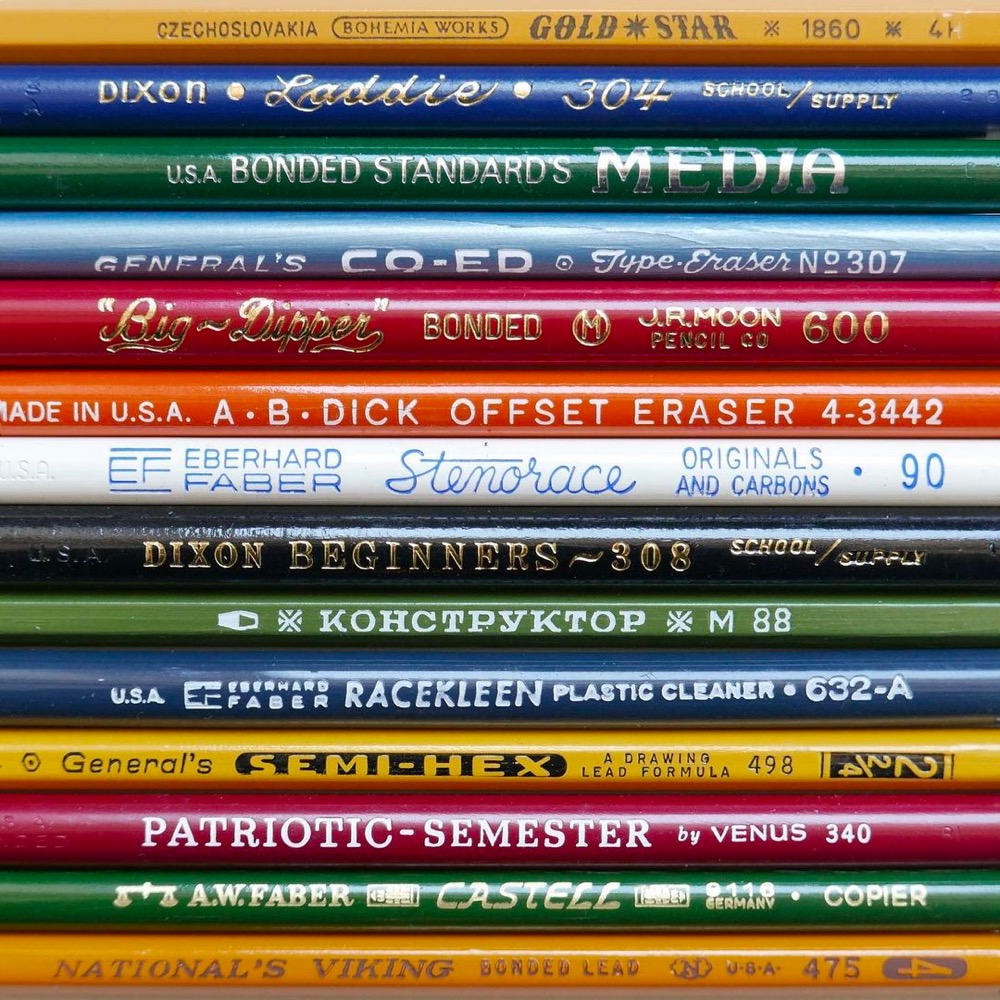
Can ordinary office supplies like the humble pencil be works of art? Why not? I will conclude my series on the theory of self-ownership in my next post before turning my attention to the Zapruder film, but in the meantime, check out the Instagram page of “Pencil & Correct” here, the source of the beautiful picture below. Hat tip: Kottke.














 prior probability