The Zapruder Film as a Gettier Problem

Alternative Title: Review of Robert Sanger, “Gettier in a Court of Law” (Part 1)

Now that I am back from my short beach vacation, I want to turn my attention to Bob Sanger’s beautiful 2018 paper “Gettier in a Court of Law,” available here (via SSRN), which I read for the first time a couple of months ago. I forgot how I first found Sanger’s excellent paper, but I am glad I did because it explores the intersection between evidence law and epistemology, specifically something called the “Gettier problem.” (Update: I now remember how I discovered Sanger’s paper. When I first heard that philosopher Edmund Gettier had died earlier this year, his death had revived my interest in his ideas and Google Scholar then led me to Sanger’s Gettier paper.)

As Sanger (2018, p. 409) himself notes in the opening of his paper, following the publication in 1963 of Edmund Gettier’s landmark paper, available here (via JSTOR), this special problem has perplexed scholars for decades, and an “incredible amount” of literature has been devoted to it. Stated as simply as possible, a “justified true belief” is not always sufficient for knowledge, an unusual state of affairs that occurs when one holds a belief that is justified and true, but the justification for one’s belief turns out to be false. For his part, Sanger does two cool things in his 2018 paper, two things that makes his paper well worth reading. He provides a simple hypothetical involving a shepherd to illustrate the Gettier problem, and then he shows how this example would be dealt with under the modern rules of evidence in a court of law. Here is Sanger’s pastoral example (2018, p. 412, footnote omitted): “A hypothetical problem that illustrates [the Gettier problem] … might involve a [shepherd] claiming knowledge that a sheep was in the field.”

But what if the shepherd’s belief was based on seeing a dog that only looked liked a sheep? And what if an actual sheep was, in fact, in the field out of sight behind a hill? Given these facts (i.e., a dog that looks like a sheep and an actual sheep that is not visible), this hypo presents a Gettier problem because, in the words of Sanger (ibid., emphasis omitted), “how can this [the shepherd’s justified true belief that a sheep was in the field], count as knowledge where the empirical basis for that belief was not accurate?”

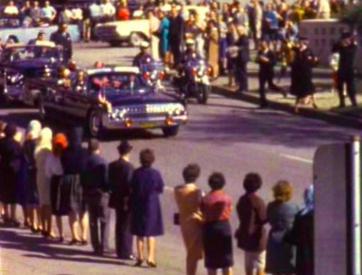
Before I proceed to the second part of Sanger’s paper, however, I want to provide a more compelling and controversial example of the Gettier problem: the Zapruder film of the assassination of JFK in Dallas on November 22, 1963. (One of the frames of this infamous film is pictured below.) Although this home movie is not the only photographic evidence of the JFK assassination–Abraham Zapruder was one of at least 32(!) witnesses in Dealey Plaza who captured this tragic event on film; see, e.g., Bugliosi, 2007, p. 291–his 26-second film provides the most complete picture of the ambush and contains crucial evidence. Yet at the same time, despite being one of the most studied films in history, it is open to multiple interpretations. How many shots were fired in Dealey Plaza on that fateful day? How many of those shots hit President Kennedy? Were all of those shots fired from the sixth floor of the Texas School Book Depository building? Was there only one gunman, or two? Etc., etc.

To the point, you can watch the Zapruder film many times and at many speeds, with or without sound, and reasonably conclude that the fatal shot to President Kennedy in frame 313 of the film was either fired from behind (consistent with the lone gunman theory) or fired from the front (the two gunmen or Grass Knoll theory). Worse yet, on either interpretation of the Zapruder film, the alleged role of Lee Harvey Oswald can still be subjected to further scrutiny. Some serious conspiracy theorists (Garrison, 2012; see also Wrone, 2003), for example, believe that Oswald was innocent, that he was either set up by rogue CIA agents or framed by the Dallas police.

In other words, the Zapruder film provides a compelling demonstration of the Gettier problem because this infamous film appears to generate not just one set of justified true beliefs about what happened in Dallas on November 22, 1963, but a whole gamut of such justified true beliefs. With this further example in mind, I will turn to the second part of Sanger’s paper in my next post …
Zapruder film - Wikipedia

Works Cited

Vincent Bugliosi. 2007. Reclaiming History: The Assassination of President John F. Kennedy. Norton.

Jim Garrison. 2012. On the Trail of Assassins: One Man’s Quest to Solve the Murder of President Kennedy. Skyhorse.

Edmund L. Gettier. 1963. “Is Justified True Belief Knowledge?” Analysis, Vol. 23, No. 6, pp. 121-123.

Robert Sanger. 2018. “Gettier in a Court of Law.” Southern Illinois University Law Journal, Vol. 42, pp. 409-420.

David Wrone. 2003. The Zapruder Film: Reframing JFK’s Assassination. University Press of Kansas.

Posted in Uncategorized | Leave a comment

Monday Mathematics

Check out this beautiful paper by Jöran Friberg: “A Remarkable Collection of Babylonian Mathematical Texts” — the final page of which is pictured below — hat tip: @pickover.

Posted in Uncategorized | 2 Comments

Visualizing 6 June 1944 (D-Day)

In honor of the anniversary of D-Day, I am re-blogging my “D-Day in Numbers” post below.

F. E. Guerra-Pujol's avatarprior probability

chart

View original post

Posted in Uncategorized | Leave a comment

Sunday Sunrise

Posted in Uncategorized | Leave a comment

Starship Saturday

Are you ready to fly to Mars? In addition to my summer readings (see my previous post), I have also read this fascinating essay titled “The profound potential of Elon Musk’s new rocket: an aerospace engineer explains why SpaceX’s Starship will change everything.” See also the Starship explainer video below. All I can say is “wow!”

Posted in Uncategorized | Leave a comment

My top ten readings (summer break)

My family and I will be spending the weekend at Ormond Beach to celebrate the end of the school year, so I will be blogging less frequently, if at all, until Tuesday. (My youngest daughter’s last day of school was on Thursday.) In the meantime, below are some of the books, essays, and interviews — an eclectic collection assembled in alphabetical order by author — that I have recently read or will be reading during the weekend:

  1. Simon Beard’s biographical essay about Derek Parfit’s “Repugnant Conclusion”
  2. Samuel Bray, A student’s guide to the meanings of “equity” (via SSRN)
  3. Liam Kofi Bright, Why do scientists lie?
  4. Bryan Caplan, Why I am not an Austrian economist
  5. Tyler Cowen’s conversation with David Deutsch
  6. New Orleans District Attorney Jim Garrison’s 1967 Playboy interview
  7. John Morgan, Financing Public Goods by Means of Lotteries
  8. Haim Sandberg, What is legal innovation?
  9. Robert Sanger, Gettier in a court of law (re-read)
  10. David Wrone, The Zapruder Film: Reassessing JFK’s Assassination (book cover pictured below)
The Zapruder Film: Reframing JFK's Assassination: Wrone, David R.:  9780700619436: Amazon.com: Books
Posted in Uncategorized | 1 Comment

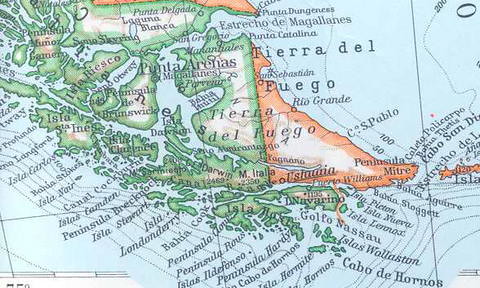
Throwback Thursday: Darwin in Tierra del Fuego

Deconstructing Darwin” was one of my first scholarly papers — it was published in Volume 14 of the Griffith Law Review, a law journal in Australia, way back in 2005! Below is the abstract:

“The paper considers Charles Darwin’s physical and intellectual journeys in Tierra del Fuego. In this account, there are really two Darwins. There is the young, brash, ambitious Darwin (D1) — an ugly cultural chauvinist who perceives the indigenous peoples of Tierra del Fuego as ‘savages of the lowest grade’. However, there is another side to Darwin — indeed, there is metaphorically another Darwin. This is the older, mature, wise Darwin (D2) — an enlightened scientist and cultural pluralist who concludes that all men and women are members of a single species and that all religious beliefs and cultural practices are entitled to respect. This Darwin is also a part of an encounter with South America.”

My old Darwin essay is available here, via SSRN.

Mapa antiguo de Tierra del Fuego, Patagonia (old map of Ti… | Flickr
Posted in Uncategorized | Leave a comment

Is free speech dead at Stanford?

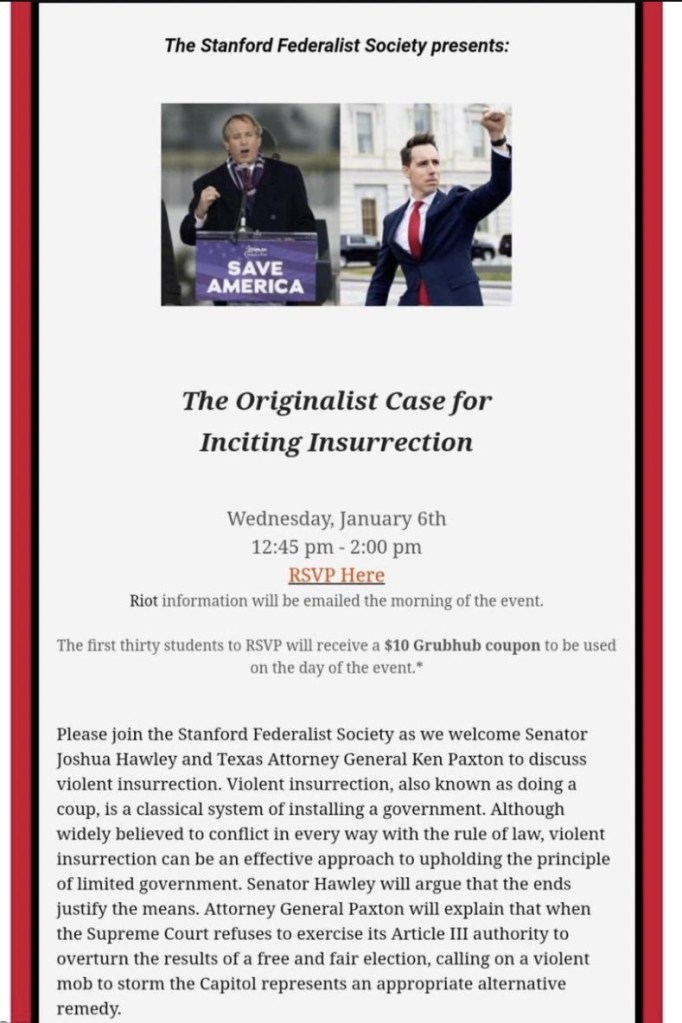
A Sanford law student posted the satirical poster pictured below and now Stanford has put his law degree on hold. As a card-carrying member of The Federalist Society myself, I object to Stanford’s anti-free speech administrators and call on Stanford’s president to suspend or fire them immediately. More details here and here.

Update (June 7): Because of negative publicity generated by this sorry state of affairs, Stanford has backed down, but no administrator has suffered any adverse consequences for unlawfully putting the student’s degree on hold in the first place.

Posted in Uncategorized | 2 Comments

Ban the bots?

Or at least require full disclosure, i.e. require bots on social media platforms to self-identify as such? A Twitter bot, for example, is a type of software that controls a Twitter account without human intervention (i.e. autonomously), performing such actions as tweeting, re-tweeting, liking, following, unfollowing, etc. Some of these bots are harmless, but which ones? Also, what fraction of all Twitter accounts happen to be bots? According to this 2017 study, up to 15% of Twitter users were automated bots, and according to this 2018 study, these bots generated 66% of all links on Twitter! I wonder whether these numbers have gone up or down since then.

iStock-586712790-bot-social-media-300x300
Posted in Uncategorized | Leave a comment

Two cheers for Los Dinos

One of the things I like the most about Selena: The Series on Netflix is how the series also features some of the lesser-known members of Selena’s band Los Dinos, like A.B. Quintanilla (composer and producer), Suzette Quintanilla (drums), Pete Astudillo (vocals), and Ricky Vela (keyboard). Below is one of my favorite songs and scenes from the series:

Posted in Uncategorized | Leave a comment