What is the opposite of self-ownership?

Alternative Title #1: The Paradigm of Self-Ownership (Part 2)

Alternative Title #2: Ben Bryant’s Middle-Way

In this post, I want to challenge the paradigm of self-ownership by presenting a competing paradigm, one that recognizes our collective obligations to society and to our fellow man. But I have a problem. Simply stated, the problem is this: From a theoretical perspective, isn’t the opposite of self-ownership “slavery”? If so, this has to be one of the most unattractive moral principles in the world! (As an aside, I can’t resist taking one last dig at the leading critics of self-ownership–scholars like Barbara Fried, David Sobel, and Kasper Lippert-Rasmussen–who themselves are unable to propose a workable alternative to self-ownership.)

Nevertheless, despite the difficulty of imagining a workable alternative to the self-ownership paradigm–i.e. an alternative that does not involve the unpalatable extreme of slavery–I will do my best here to imagine a less extreme alternative. To do so, allow me to introduce you to Ben Bryant and to his beautiful 2017 paper titled “Duty-Sensitive Self-Ownership,” which is available here (via ProQuest) for your reference. To his credit, Professor Bryant does try to paint a workable alternative to self-ownership. Strictly speaking, Bryant himself does not reject self-ownership outright. (How could he, given the lack of alternatives?) Instead, Bryant presents a modified version of the self-ownership paradigm–a version he calls “duty-sensitive self-ownership.”

According to Bryant (2017, p. 265, emphasis added by me), “people have some limited but enforceable duties of assistance to one another.” Alas, the problem with Bryant’s “duty-sensitive” theory is that it has no real stopping point. Bryant (p. 278) himself concedes that “working out the details here will, of course, be tricky.” We could, however, try to rescue Bryant’s duty approach by strictly limiting the outer scope of these positive duties to one’s family and to the members of one’s political community. After all, no one chooses one’s family, just as no one chooses the political community you are born into, so perhaps it makes intuitive sense to limit our positive duties to these two domains (family and politics). But even in these two contexts, we still have to decide what the scope of these parental duties or community duties are–specifically, which family members and community members are entitled to support, and how much support are they entitled to?

Nevertheless, despite this fatal flaw, Bryant is on the right track. Why? Because he has found middle ground between absolute self-ownership on the one hand (in which I am not even allowed to blow smoke in your face or create minor risks) and absolute slavery on the other (which is even worse, in principle, than absolute self-ownership). Moreover, what is most attractive about Bryant’s middle-way is how it comports with our moral intuitions and with our Anglo-American legal traditions. The law of negligence, for example, imposes a general “duty of care” on all persons–one has a duty to take reasonable steps to avoid or reduce the risks of foreseeable harms. That is, even self-owners have a legal duty to avoid imposing unreasonable harms, or the risks of such harms, on third parties. But beyond this general common law duty of care, what other limited duties, if any, do self-owners owe each other?

I will explore that all-important question–and then conclude my self-ownership series–in my next post.
Vedantic Reflections: Duty?
Okay, fine, but what do my duties consist of?
Posted in Uncategorized | 1 Comment

Tenure and wokeness

I will resume my series on self-ownership in my next post, but in the meantime, it has come to my attention (see here, hat tip: Kottke) that the Hussman School of Journalism and Media at the University of North Carolina was considering awarding Nikole Hannah-Jones a tenured position on their faculty but that the offer of academic tenure fell through because of “pressure from conservatives.” (The reason why this seemingly-minor incident is making the rounds is because Hannah-Jones is one of the contributors to the controversial “1619 Project.”)

Oh, the irony! My left-of-center friends and colleagues–most of whom are academics themselves–are always complaining about all the injustice and inequality in the world, and perhaps rightly so. But what about injustice and inequality in academia? Although tenure is usually defended on academic freedom grounds (see here, for example), I call bullshit. After all, why is it that only tenured academics get to enjoy such freedom? The supreme irony here is that tenure is one of the last remaining vestiges of the retrograde feudal system of the Middle Ages. If my colleagues were truly woke, they would call for the immediate abolishment of this academic caste system altogether, right?

Posted in Uncategorized | 2 Comments

The Paradigm of Self-Ownership (Part 1)

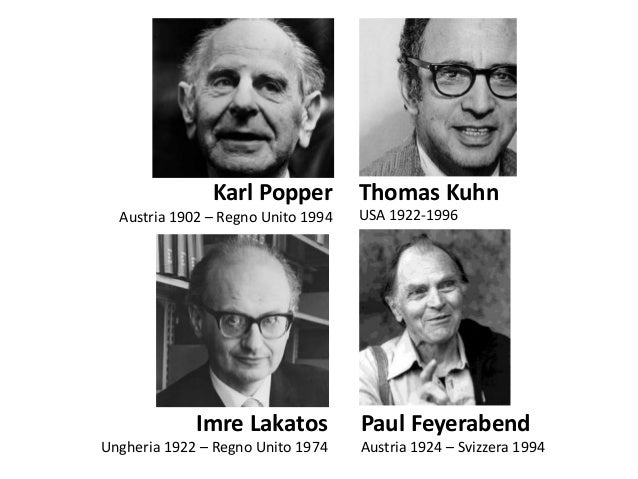
Now that I have surveyed the main arguments against self-ownership, I will conclude this series of blog posts by taking a detour into the philosophy of science–specifically, by talking about Kuhnian “paradigms” and Lakotian “research programs.” (Four of the world’s leading philosophers of science are pictured below.) In his influential book “The Structure of Scientific Revolutions” (3rd ed., 1996), for example, the late Thomas S. Kuhn introduced the idea of “paradigms” to explain how “normal science” works on a day-to-day basis. Broadly speaking, a paradigm in this Kuhnian sense refers to one’s general world-view or frame of reference. The biologist Ernst Mayr (1991, p. ix) calls this type of paradigm one’s “conceptual framework.” At this higher level of abstraction, one’s paradigm or conceptual framework consists of, in the words of Kuhn (1996, p. 175) himself, “the entire constellation of beliefs, values, techniques, and so on shared by members of a given [scientific] community.”

Kuhn’s emphasis on the “shared” nature of our conceptual frameworks has led some philosophers of science to emphasize research programs and traditions in place of paradigms. To the point, in an influential 1971 paper titled “The Methodology of Scientific Research Programmes,” Imre Lakatos explains that a scientist qua scientist is one who works within an established tradition of research. Either way, the key point here is that some of our beliefs are foundational or pre-theoretical–these beliefs, assumptions, values, etc. shape how we see and make sense of the world around us.

I now want to argue that self-ownership not only operates like a shared research program, something that the left-libertarian literature amply attests to; it is also a pre-theoretical paradigm or foundational moral axiom, something that most people–including myself, before I began this series of blog posts–simply take for granted or assume is true by definition. But should we? Can different conceptual frameworks or moral axioms co-exist at the same time, and if so, how should we choose among them? In my next post, I will present a different moral paradigm–one inspired by John Rawls and others, one that emphasizes duties of mutual aid and duties to help others in need.

Thomas Kuhn tra rivoluzione e normalità nella filosofia della scienza
Image credit: Alfredo Imbellone
Posted in Uncategorized | Leave a comment

The Law of Self-Ownership

Hello! I will be resuming my series on the concept of “self-ownership” in the next day or two. In the meantime, for convenience, I have compiled my previous posts on this subject below:

  1. Against Self-Ownership? Lit Review, Part 1 (May 10)
  2. Sophistry and self-reference: the Kantian critique of self-ownership (May 11)
  3. Competing conceptions of self-ownership and the ghost of Ronald Coase (May 12)
  4. In defense of self-ownership (reply to Barbara Fried) (May 13)
  5. Sobel’s Paradox (May 14)
  6. A common law solution to Sobel’s paradox (May 15)
  7. Are children and non-human animals self-owners? (May 15)

These posts are all part of a much larger work-in-progress that I am currently working on and that I will be presenting at the 11th Annual Meeting of the Association for Law, Property, and Society (ALPS) at Tulane Law School later this month. My project is tentatively titled “The Law of Self-Ownership.”

TOP 8 SELF OWNERSHIP QUOTES | A-Z Quotes
Posted in Uncategorized | Leave a comment

Twitter Tuesday: 52!

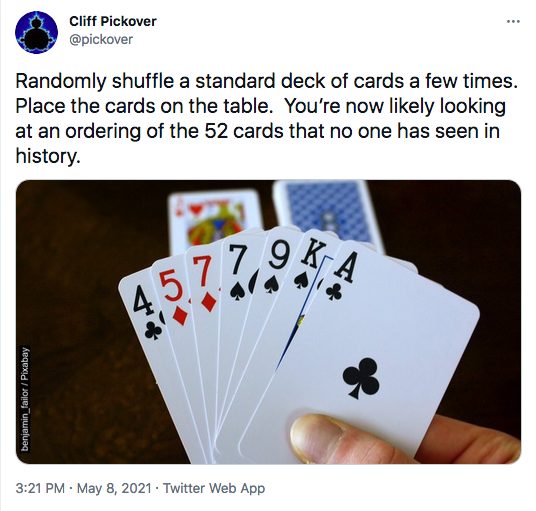
A deck of cards contains 52 cards. The mathematical symbol “!” is called a “factorial” and refers to the product of an integer as well as all the integers below it. For example, the factorial of the number four (4!) is equal to 24 because 4 x 3 x 2 x 1 = 24. So, yes, 52! is an astronomically large number. How large? See tweet below:

Mind blown!
Posted in Uncategorized | Leave a comment

Monday Map: The United States of Books

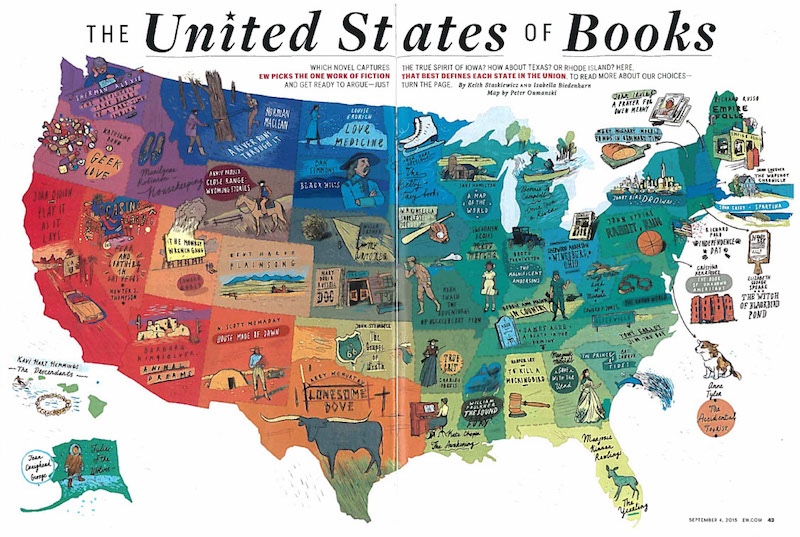
For a close-up of this beautiful map, see here; hat tip: The Frivolous Bibliophile.
Posted in Uncategorized | Leave a comment

Are children and non-human animals self-owners?

Alternative Title #1: Against Self-Ownership? Lit Review, Part 5

Alternative Title #2: The Problem of “Special Cases”: Self-Ownership of Children and Non-Human Animals

Thus far in this series, I have presented–and refuted–several theoretical critiques of the concept of self-ownership. Among these theoretical objections are logical incoherence (the problem of self-reference), indeterminacy (the level-of-generality problem), and the ghost of Ronald Coase (the problem of minor intrusions). But that said, how should we handle special cases like children and non-human animals?

Libertarian theories of self-ownership, however, tend to be “fact-insensitive”–to borrow G. A. Cohen’s apt term. That is, libertarian theorists by-and-large wave away or brush this important question aside. Calling forth their “inner economist” (in a bad way), they simply assume these special cases away. Consider, for example, this incredible statement by Peter Vallentyne (1998, p. [4]), a leading proponent of self-ownership: “… to keep things simple, we’ll assume that all beings with moral standings are fully psychological autonomous (fully capable of self-governance), and that they pop into existence in this state (as opposed to developing gradually).” WTF?

Alas, this strategy of side-stepping these special cases simply will not do. Any workable theory of self-ownership should be able to handle these cases or at least explain them away–explain why children or animals are not self-owners–instead of assuming the problem away. As it happens, I am happy to report that several scholars have, in fact, attempted to address different aspects of this problem head on. By way of example, David Favre’s 2000 Duke Law Journal paper on “Equitable Self-Ownership for Animals” uses existing property law concepts to propose a limited form of self-ownership for animals, while Hillel Steiner’s 2009 Public Reason paper on “Left Libertarianism and the Ownership of Natural Resources” (especially pp. 3-5) explains why parental rights over one’s children is consistent with left-libertarian theories of self-ownership.

I won’t evaluate the relative merits of either of these special theories here. It simply suffices to say that, although I don’t necessarily endorse Favre’s creative theory of animal self-ownership or Steiner’s qualified theory of temporal parental rights over children, the work of professors Favre and Steiner in this domain show that it is, in principle, possible to accommodate children, non-human animals, and other special cases into a self-ownership framework. Their works also show us just how versatile most theories of self-ownership are. Contra Barbara Fried and other critics of self-ownership, this flexibility is a feature, not a bug. Self-ownership is a moral axiom with implications for all sentient beings.

But wait up. What if self-ownership is a “bad” moral axiom? To the point, why should we prefer individualism over some social form of “communitarianism” or “collectivism” as our paradigm? I suspect that what is really going on here is that most, if not all, of the critics of self-ownership reject the individualistic nature of the self-ownership paradigm out of hand and would prefer a more communitarian or socialist model of ownership. After a brief hiatus, I will explore this fundamental objection–and then wrap up this series–in my next few blog posts starting on Wednesday, May 19.

The History of Finding (or Building) Noah's Ark - OZY | A Modern Media  Company
Who owns the animals? Who owns Noah’s children? Noah or no one?
Posted in Uncategorized | 1 Comment

A common law solution to Sobel’s paradox

Alternative Title #1: Against Self-Ownership? Lit Review, Part 4b

Alternative Title #2: Live and Let Live, Mother-Bleepers!

I presented Sobel’s self-ownership paradox–the problem of minor intrusions–in my previous post. In summary, ordinary activities like smoking (blowing smoke in someone’s face), listening to music (noise), driving cars and flying aircraft (accidents), etc., often generate minor risks of injury to third parties. Don’t these risks or minor intrusions somehow violate the deontological rights that self-owners are supposed to have, such as the right to one’s body and health? That is precisely the type of slam-dunk argument that scholars like David Sobel and others have made.

Before proceeding any further, it’s funny–or should I say ironic–how so many high-level scholars and brilliant minds can get all tied up in knots over such a simple problem, i.e. the problem of minor intrusions. In truth, this wouldn’t be the first time–or the last–that moral philosophers “overthink” a particular problem or make such a simple, everyday dilemma unnecessarily complex. For it turns out that the problem of minor intrusions has a prosaic and common-sense solution: the live and let live rule.

The live and let live rule originated the in the law of nuisance, an area of common law involving the intersection of property law and the law of torts or wrongs (injury law). Legally speaking, a “nuisance” occurs when someone uses his property in such a way as to produce a significant and unreasonable annoyance, inconvenience, discomfort, or injury to another person or to the public at large. These harms might consist of foul odors, loud noises, pollution, etc., but in order to prove a wrongful or unlawful nuisance, the plaintiff must show that the harm resulting from the defendant’s activities is a substantial and unreasonable one. In other words, minor or reasonable harms are not wrongful or unlawful from a common law perspective. Boom: problem solved!

This famous rule was explained by Baron Bramwell in the 1862(!) case of Bamford v. Turnley: “It is an obvious truth that each individual in a community must put up with a certain amount of annoyance, inconvenience, and interference and must take a certain amount of risk in order that all may get on together. The very existence of organised society depends on the principle of ‘give and take, live and let live’.” (For a modern-day nuisance case, see here, for example.) Of course, the mental act of deciding what types of annoyances or harms are sufficiently “substantial” or “unreasonable” so as to constitute a nuisance is not always easy. When in doubt, contemporary common law courts will weigh the following four factors in order to make these types of close calls:

  1. the severity of the harm;
  2. the geography of the alleged nuisance, e.g. is the nuisance occurring in a residential area or in an industrial district?;
  3. the utility of the defendant’s conduct, e.g. the benefits generated by the harm; and last but not least,
  4. the sensitivity of the plaintiff, e.g. is the person complaining about the alleged nuisance overly or unreasonably sensitive?

One more clarification is in order before we move on. I will be the first first to concede that any set of balancing factors will either be incomplete or will leave a lot of latitude and room for maneuvering, but my larger and more important point is this: we can easily rescue self-ownership from the problem of minor intrusions by adding on or incorporating some version of the live-and-let-live rule. The alternative is to abandon the concept of self-ownership altogether, and yet, as I explained in my response to Barbara Fried’s indeterminacy objection, the critics of self-ownership have yet to offer a viable or less indeterminate alternative.

Okay, fine, but what about special cases like children and non-human animals? Are all sentient beings self-owners? If not, where should we draw the self-ownership line? Rest assured, I will further explore the problem of special cases in my next blog post and then wrap up this series on self-ownership soon thereafter …

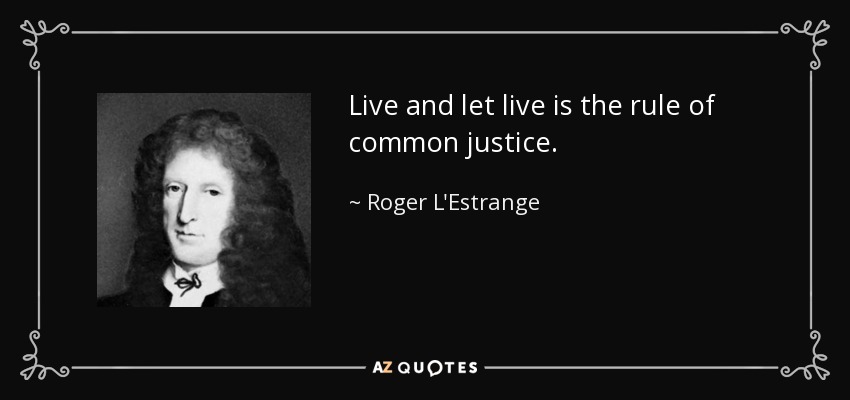
Roger L'Estrange quote: Live and let live is the rule of common justice.
Posted in Uncategorized | 1 Comment

Sobel’s Paradox

Alternative Title #1: Against Self-Ownership? Lit Review, Part 4a

Alternative Title #2: Self-Ownership and the Problem of Minor Intrusions

Thus far, I have presented several theoretical critiques of the concept of self-ownership, including incoherence and indeterminacy. I was also able to demonstrate without too much fuss why self-ownership is, in fact, a coherent concept and explain why this moral axiom is no more indeterminate than any other viable alternative, but what about “the ghost of Ronald Coase”? What about the reciprocal nature of the self-ownership problem? That is, at a minimum, one’s supposed right to self-ownership generates corresponding duties of non-aggression and non-interference, thus limiting the freedom of everyone else to really do as they please.

From a Humean perspective, however, one could argue that Coase’s critique does not pose a significant problem; to the contrary, one could even argue that the reciprocal nature of self-ownership is a feature, not a bug. Like Hume’s oarsmen, who are able to tacitly coordinate their actions for their mutual gain, I am happy to give up my right to harm you or to interfere with your life choices so long as you agree not to harm me or interfere with my life. [FYI: David Hume’s famous example of the oarsmen appears in Appendix III of his Enquiry Concerning Human Understanding as well as in Book III, Part 2, Sec. 3 of his Treatise of Human Nature.] But what about minor harms or actions that generate minor risks of injury?

At this point, I want to introduce you to David Sobel and his 2012 paper titled “Backing away from libertarian self-ownership.” Among other things, Professor Sobel notes in his 2012 paper that minor intrusions–such as minor but involuntary risks of injury–are ubiquitous in real life, and he shows how the existence of these minor risks produces a potentially fatal paradox. Simply put, full self-ownership, if taken to its logical conclusion, would have the counter-intuitive effect of restricting everyone’s liberty rights, thus making everyone worse off. Why? Because many of our actions impose a trivial risk of injury on others, but full self-ownership prohibits all “boundary-crossings” or infringements, even trivial ones, of one’s deontological rights.

Sobel (2012, p. 35) himself, following in Coase’s original footsteps, uses the problem of air pollution to illustrate this paradox, to point out this Coasean flaw in the logic of self-ownership: “Suppose there is a pollutant that is produced by a wide range of human activity, such as driving a car, flying a plane, running [a] lawnmower, making toasters, and so on.” Sobel then asks us to further suppose that (i) “this pollutant’s only effect is to produce itchiness once a year in proportion to the amount [that] lands on one’s skin” but that (ii) the effects of this itchiness, at worst, are “not debilitating but only annoying.” (Ibid., footnote omitted.) Having described this concrete example of a minor intrusion or involuntary but minor risk imposition, Sobel concludes (pp. 35-36, footnotes omitted): “Presumably putting this pollutant into the air such that it lands on me and I am affected by it is an infringement of my powerful property right to my skin. So, if you cause this stuff to end up on my skin without my permission, you infringe my rights.”

Unlike the previous arguments we have seen thus far, this Coasean critique of libertarian self-ownership–what I like to call “Sobel’s paradox”–is a potentially fatal one. For Sobel, Coase’s critique stings once we take a closer look at the concept of harm and focus on minor harms or minor intrusions. After all, the whole point of self-ownership is to promote freedom and protect autonomy, but given the wide variety of actions that impose minor but involuntary risks on others, Sobel shows us how the reverse might be true. Does Sobel’s paradox have a solution?

Stay tuned. It turns out that the problem of minor intrusions is greatly exaggerated and easily solvable. All we have to do is follow Coase’s own footsteps and look to the common law for answers. I shall thus explain how the common law is able to solve Sobel’s paradox in my next post …

Are Property Rights a Solution to Pollution?
Image credit: PERC (Property & Environment Research Center)
Posted in Uncategorized | 1 Comment

Friday funnies

In my next post I will pick up where I left off in my series on self-ownership.

Posted in Uncategorized | Leave a comment