Aside from status signalling, of course? According to this essay by Agnes Callard, “a university is a place where people help each other access the highest intellectual goods. A university is a place of heterodidacticism.” Robin Hanson, however, replies to Callard and corrects her here. According to Hanson, “… most complex social institutions just don’t have a single thing they are for; they are for many things.” Hanson 1, Callard 0.
Why does my university want me dead?
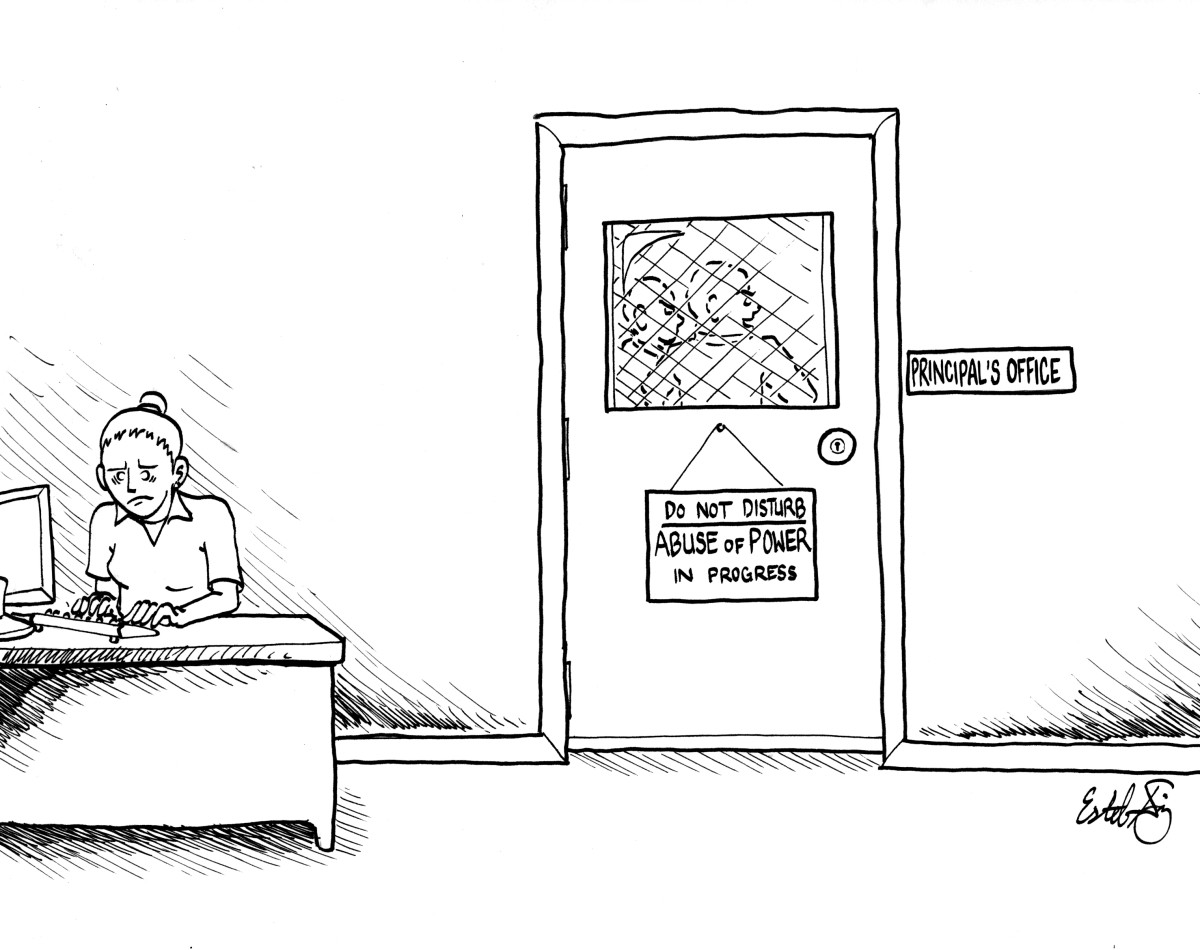
Despite my repeated and public protests (see here, for example), I am scheduled to teach five in person sections (with up to 200 students per section) in the same small crowded classroom! To make matters worse, three of those sections meet back to back to back every other Tuesday from 4:30 pm to 8:50 pm, while the remaining two sections also meet back to back every other Thursday, from 4:30 pm to 7:20 pm, putting me and my students in harm’s way for another three hours. I have repeatedly requested a “reasonable accommodation” to space out my classes or move them outdoors, but to no avail. Alas, not only is my university insisting on holding such large-scale super-spreader gatherings; professors like me who refuse on public health grounds to convene them will themselves be subject to disciplinary proceedings. Worse yet, many of my colleagues have decided to stick their heads in the sand by remaining silent. I suppose this situation will change once enough students and faculty become sick or hospitalized; in the meantime, the only conclusion I can reach is that university administrators don’t give two bits about my health or that of my students.

Signals versus noise
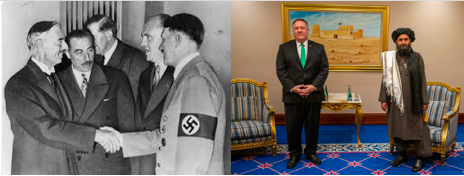
Joe Biden is our Neville Chamberlain
Update (8/30): See this report about the ignominious end of Bush’s war.
Talk about a hasty surrender, one that has destroyed the reputation of the USA and that cost the lives of 13 young members of our armed forces as well as the lives of scores of Afghans … To hell with the Taliban, and to hell with Joe for letting them win. #ImpeachBiden
Although it was Trump people’s who negotiated the now-infamous withdrawal deal with representatives of the Taliban last year (see picture below, right), Joe Biden’s incompetent implementation of this illicit agreement, his continued prevarications (see here), and our pusillanimous surrender in Kabul are too much for me to bear. We don’t abandon our friends. #WorseThanTrump

Happy Birthday, Scientific American
Scientific American published its very first issue on this day (Aug. 28) in 1845. But what does it mean to think in “scientific” terms? To me, it means thinking in terms of probabilities and degrees of belief, not moral certainties, as well as open-mindedness and the willingness to revise one’s probabilities. What does “science” mean to you?

Could Gambling Save Democracy?
With apologies to my colleague and friend Robin Hanson, that is the tentative title of my next project, which builds on my previous work “Betting on Conspiracies,” which is forthcoming in The Journal of Law & Public Policy. By way of example, was 9/11 an “inside job”? Was the 2020 election stolen? Did Trump collude with “the Russians”? In summary, the conventional wisdom is that the spread of conspiracy theories is dangerous to democracy, and a growing chorus of voices are thus calling for direct regulation of social media platforms to counter this threat. Some have even called for the appointment of a “reality czar” (see here, for example) and big tech firms like Facebook have gone as far as to de-platform (i.e. censor) President Trump.
Pause. Isn’t it possible that these drastic measures and proposals (e.g. direct regulation of speech, reality czars, and the de-platforming of elected leaders) pose greater dangers to democracy than conspiracy theorists themselves? The classical liberal in me certainly thinks so! That is why I proposed and outlined a “Conspiracy Theory Betting Market” in my previous work. In brief, instead of censorship or reality czars, why not allow people to place actual money bets on the truth values of various conspiracy theories, however far-fetched these theories may seem? It is my contention that a betting market in conspiracy theories would aggregate all available information about the truth values of such beliefs better than a regulator or a reality czar could.
But how would such a “Conspiracy Theory Betting Market” work in practice? Unlike a prediction market, in which participants place bets on the occurrence or non-occurrence of future events, my proposal involves the “retrodiction” of past events, such as the 2020 election, 9/11, and the assassination of JFK. Accordingly, next month I will devote considerable time and effort to the design of my “retrodiction” market and share my findings here …

Throwback Thursday: Bargaining and Betrayal in Breaking Bad
While we are on the subject of pedagogical papers (see my previous post), I thought I would share a link to my previous teaching note, “So Long Suckers: Bargaining and Betrayal in Breaking Bad,” which is available here via SSRN. In this formal paper, which I wrote up in 2016, I introduce the rules of a bargaining game called “So Long Sucker” to help instructors convey strategic concepts and impart good negotiation skills to their students. In addition, to further bridge the gap between negotiation theory and strategic reality, this note explores several commonalities between “So Long Sucker” and the many strategic interactions in the critically acclaimed TV series Breaking Bad.
Teaching Tiger King: final edits
Kudos to my past and present teaching assistants–Christiana Champnella, Benjamin Mayo, Morgan Travers, and Antonella Vitulli–and to Michael McMahon and the editors of the St Louis University Law Review. Our pedagogical paper “Teaching Tiger King“–the final draft of which is now available here–describes the changes we made to our business law survey course when it went fully online during the first year of the pandemic. It also illustrates the snail’s pace of scholarly publishing: I wrote up the first draft of our Tiger King paper during the month of June of 2020, and the paper was accepted for publication in August of that same year. One year later, after several rounds of stylistic revisions and substantive edits, our paper is now ready for publication!

Today is Paris Liberation Day
I am reblogging my “Paris Liberation Day” post to commemorate my birthday … and the liberation of Paris in 1944!
(And my birthday!) On this day in 1944 the Allies liberated Paris from the Nazis, a major victory and symbolic turning point in the Second World War.
It’s time to throw the book at Chegg
Note: this is my last blog post on “the law and ethics of Chegg.”
Why hasn’t Chegg, the largest and most successful online contract-cheating platform in the world, been shut down yet? My Criminal Complaint against Chegg is now available here, via SSRN. Note that I am going after Chegg for wire fraud and conspiracy to commit wire fraud and not for copyright infringement. One could argue that Chegg facilitates IP theft by allowing students to post test questions and exam problems on its platforms because, technically speaking, many of those tests and exams are the intellectual property of the professors who wrote them up. The problem with this argument, however, is that Chegg is able to avoid liability for copyright infringement through a loophole in copyright law, a crafty loophole created by the Digital Millennium Copyright Act of 1998. To the point, Chegg is able to avoid copyright infringement through its notice and take-down policies. Although its cumbersome take-down procedures are bullshit (faculty can’t just fire off an email to Chegg demanding to have their exam questions taken down; Chegg requires a formal letter from a university administrator), Chegg exploits this loophole to stay in business. As a result, my Criminal Complaint against Chegg alleges wire fraud and conspiracy to commit wire fraud. Also, as I mentioned in my previous Chegg post, because Chegg is an online service and does business across the United States, any U.S. Attorney in any federal judicial district could bring charges against Chegg. Any takers?