Note: this blog post is the fifth in a multi-part series on “the law and ethics of Chegg.”
I will be posting my Model Criminal Complaint against Chegg, Inc. and Chegg CEO Dan Rosensweig next week (most likely on Tuesday or Wednesday). I am still debating whether students who use Chegg should be named as unindicted co-conspirators in this case, which would make “the Chegg Conspiracy” (as I have re-named my research project) one of the largest criminal enterprises in world history(!), but here is a preview of where I am thus far. In brief, the indictment will allege two criminal counts against Chegg: wire fraud and conspiracy to commit wire fraud. My theory of the case is that Chegg commits fraud in two ways: (1) fraud writ large, and (2) individualized fraud against its users. As I see it, Chegg commits fraud writ large because it bills itself as a legitimate business, a seller of honest tutoring services–when, in reality, Chegg is nothing more than a glorified contract-cheating website–and it commits individualized fraud against its users by cheating them out of a real education. (When students use Chegg to look up the answers to their test questions, they are not really learning the material.)
Did you know that more people were fired for the “Bridge Gate” scandal of 2013 — when local government officials ordered the closure of three lanes on the New Jersey side of the George Washington Bridge — than have been fired for our ignoble and disgraceful exit from Afghanistan? In all, three state officials were fired for their direct role in the 2013 Fort Lee, NJ lane closure scandal, and two of them even faced criminal charges. No military general or cabinet secretary — not even a single lower-level official — has yet to be fired for the ongoing Afghanistan disaster. #ImpeachBiden
I am interrupting my moral and legal analysis of Chegg’s evil business model to ask, Where is the accountability? Why has no one in our government or military been fired for our defeat in Afghanistan and the ongoing disaster in Kabul?
I am still in the process of writing up my Model Criminal Indictment against Chegg; in the meantime, here is a link to my 2015 paper “Legal Liability for Research Fraud.” (Also, check out the myriad instances of research fraud chronicled on a daily basis on the popular “Retraction Watch” website.)
Update (8/20): A prominent professor at Duke University, Dan Ariely, has just been accused of using fake data in one of his research papers, a “study” (ironically enough) about dishonesty! (See here and here.)
I am interrupting my moral and legal analysis of Chegg’s evil business model to ask, Where is the accountability? Why has no one in our government or military been fired for our defeat in Afghanistan and the ongoing disaster in Kabul?
Note: this blog post is the fourth in a multi-part series on “the law and ethics of Chegg.”
Thus far, we have seen how students use Chegg to cheat (see my 8.16 post “The Napster of cheating“), and we have compared Chegg’s business model to the illicit market in the College Admissions Bribery Scandal, both from the seller’s perspective (see my 8.17 post “Argument by analogy“) and from the buyer’s (my 8.18 post “Chegg is evil“), and have concluded that Chegg is guilty of committing fraud and conspiracy to commit fraud on a massive scale. But before I lay out the elements of wire fraud and conspiracy in my Model Indictment against Chegg, I want to discuss a more recent precedent that might be relevant to this matter: the case of Professor Edward C. Ennels.
Among other things, Professor Ennels allegedly solicited and received bribes from his students at Baltimore City Community College (BCCC) in exchange for favorable final grades in mathematics courses he taught. (See Brian E. Frosh, Maryland Attorney General, Press Release dated Aug. 5, 2021, available here.) According to the Maryland Attorney General’s Office, Professor Ennels often haggled with students regarding the amount of the bribe, and set different prices based on the course and grade desired. For example, he would charge $150 for a C, $250 for a B, and $500 for an A in a higher-level course. (Ibid.)
Professor Ennels was prosecuted by the Maryland Attorney General’s Office, and he recently pled guilty to charges of bribery and official misconduct before the Circuit Court for Baltimore County. (Ibid. He was charged with bribery instead of fraud because BCCC is a public institution, making Ennels a public employee.) Unlike the wealthy parents like Jane Buckingham, Felicity Huffman, and Lori Loughlin in the College Admissions Bribery Scandal, who all received light sentences (see, for example, my 11.13.19 blog post), Professor Ennels was sentenced to 10 years incarceration, followed by five years of supervised probation upon release, and ordered to pay restitution in the amount of of $60,000.
Would it surprise you to learn that Ennels is black, while Buckingham, et al. are all rich white women? Regardless, the larger point I want to make here is that Chegg’s business model is really no different from Professor Ennels’ illicit bribery scheme. Suppose that Ennels was not selling grades per se; suppose instead that he was selling the answers to his tests. Wouldn’t he (and the students who paid the bribes) still be guilty of a crime? If so, how is this conduct any different from what Chegg does? That’s the thing, my friends, it’s not!
Note: this blog post is the third in a multi-part series on “the law and ethics of Chegg.”
Is Chegg evil? This is the question I posed to my students in the spring of 2021, when I discovered that many of the quiz questions in my survey business law class had been posted to Chegg, along with the correct answers.
My previous post made a direct analogy between Rick Singer, the alleged mastermind of the College Admissions Bribery Scandal, and Chegg, the contract-cheating online platform. In exchange for a monthly fee, Chegg allows its users to look up the answers to college exam questions, problem sets, and homework assignments. Likewise, in exchange for “donations” to his sham charity, Mr Singer would facilitate various forms of cheating on college entrance exams for the children of his despicable clients.
Today, however, I will explore the ethics of Chegg and explain why Chegg is indeed evil by taking a closer look at one of the wealthy and prominent individuals who paid for Mr Singer’s services: Jane Ruth Buckingham, pictured below. Who is Jane Ruth Buckingham (née Rinzler)? Among other things, she is the author of “The Modern Girl’s Guide to Life” book series; here is her glowing bio on Amazon (see here):
“Jane Buckingham is the president of Trendera, an innovative marketing and media consulting firm with numerous Fortune 500 companies as clients. She is a contributing editor to Cosmopolitan, a regular guest on Good Morning America and The View, and was recently named by Elle as one of the 25 Most Powerful Women in Hollywood. She lives in Los Angeles with her husband, bestselling business author Marcus Buckingham, and their two children, Jack and Lilia.”
In addition to these impressive accomplishments (wink, wink), Buckingham was charged by the Feds in connection with the College Admissions Bribery Scandal (see Valeriya Safronova, “Jane Buckingham, expert on youth marketing, charged in college fraud scandal,” N.Y. Times, March 14, 2019), and she eventually pled guilty to two criminal charges: conspiracy to commit mail fraud, and honest services mail fraud. (See David Ng & Ryan Faughnder, “Felicity Huffman, other parents agree to plead guilty in college admissions scandal,” L.A. Times, March 13, 2019.) According to federal authorities, Buckingham had paid $50,000 to Rick Singer — to Singer’s sham non-profit college-counseling firm Key Worldwide Foundation, to be more precise — in order to arrange for a proctor to take a college entrance examination on her son’s behalf. (See “Affidavit in Support of Criminal Complaint,” dated March 2019.) The prosecution further alleged that she was more deeply engaged in the mechanics of the fraud than many of the other parents in the college admissions scandal. Buckingham, for example, provided the proctor with a sample of her son’s writing to emulate and had her son take a practice entrance exam in order to have him believe he had actually taken the test.
Although the U.S. Attorney’s Office had sought a stiff six-month prison sentence, Buckingham was sentenced to a mere 21 days in prison, along with one year of supervised release and a $40,000 fine. (U.S. District Court Judge Indira Talwani imposed this incredibly light bullshit sentence on October 23, 2019. See Matthew Ormseth, “Jane Buckingham, parenting book author, gets three weeks in prison in admissions scandal,” L. A. Times., October 23, 2019.) Be that as it may, during her sentencing hearing, prosecutors made an argument that is especially relevant to my moral and legal case against Chegg. They argued that, by paying a proctor to take the exam for her son, Buckingham deprived her son “of even the opportunity to get any of the answers right on his own.” This is precisely what is wrong with Chegg. By providing students (for a fee) the opportunity to look up the answers to their exams and homework problems, Chegg is likewise depriving its users of the opportunity to get any of the answers right on their own.
Simply put: if it’s wrong, either legally or morally, or both, for A to pay C to arrange for someone to fraudulently take a college entrance exam on B’s behalf (i.e. the College Admissions Bribery Scandal), then isn’t it just as wrong for B to pay C in exchange for the answers to exams once you are in college (i.e. Chegg’s business model)? That is the essence of my legal/moral argument against Chegg.
Enough already! It’s time for federal or State prosecutors to go after Chegg in the same way they went after Rick Singer and his wealthy clients, like Jane Buckingham. I am in the process of writing up a model indictment and will post it here for your reference in the next day or two …
Note: this blog post is the second in a multi-part series on “the law and ethics of Chegg.”
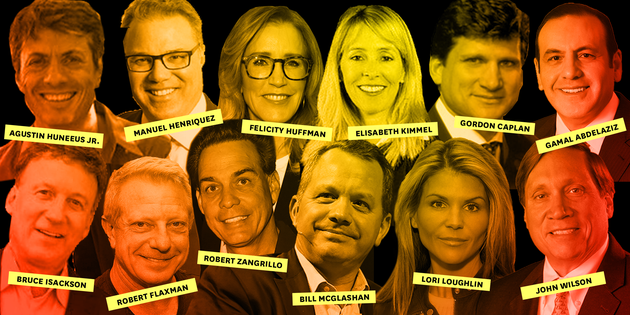
Remember Rick Singer? He was the alleged mastermind of the now-infamous College Admissions Bribery Scandal. In summary, in March of 2019, federal authorities brought criminal charges against dozens of individuals–not just against the ringleader of this illicit scheme, Mr Singer, but also against the many wealthy mothers and fathers who paid him off, 33 parents in all, some of which are pictured below. [1] Among other crimes, Singer and his client-parents were accused of participating in a nationwide conspiracy to cheat on college entrance exams in order to corruptly and unlawfully influence admissions decisions at several elite universities. [2]
My legal theory regarding Chegg’s potential criminal liability is therefore as follows: the business models of Rick Singer and Chegg are essentially the same. Both have received (and in the case of Chegg, continue to receive) payments in exchange for facilitating cheating on exams. Specifically, to the extent the Chegg platform facilitates cheating on college exams and homework assignments — by allowing paid subscribers to literally look up the answers and fraudulently turn those same answers in as their own work –, then Chegg’s business model is essentially no different than that of Mr Singer’s alleged illicit scheme: the payment of money in exchange for higher test scores. Simply put, Chegg has become the Rick Singer of cheating!
But it takes two to tango. That is, in addition to Chegg’s potential criminal liability, what about the many college students themselves who are using Chegg to cheat? This is a key question because, if Chegg’s paid-subscribers are guilty of committing wire fraud, then Chegg itself can potentially be accused of conspiracy to commit wire fraud as well! As I will explain in my next post, a strong case can be made that students who use Chegg to cheat and fraudulently obtain good grades are just as guilty of wire fraud as the wealthy parents who paid Mr Singer off to help them fraudulently inflate the entrance exams of their children. I will take a closer look at the case of one such parent, Jane Ruth Buckingham (née Rinzler), in my next post …
Remember us? We get to play by our own rules!
Footnotes
[1] See Press Release of the U.S. Attorney’s Office for the District of Massachusetts, “Investigations of College Admissions and Testing Bribery Scheme,” available here.
[2] See Affidavit in Support of Criminal Complaint dated March 11, 2019 and signed by Laura Smith, Special Agent of the FBI, available here.
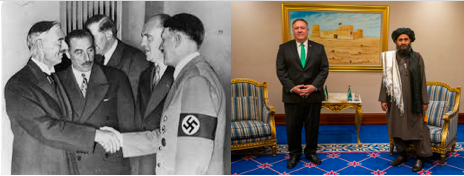
Although it was Trump people’s who negotiated the now-infamous withdrawal deal with representatives of the Taliban last year (see picture below, right), Joe Biden’s incompetent implementation of this illicit agreement, his continued prevarications (see here), and our pusillanimous surrender in Kabul are too much for me to bear. We don’t abandon our friends. #WorseThanTrump
I am interrupting my series on “the law and ethics of Chegg,” which will resume on Tuesday morning, in order to let everyone know that the distance between the Arg (Presidential Palace), which is now under the Taliban’s control, and the Hamid Karzai International Airport is a mere 6.2 kilometers (less than four miles).
Note: this blog post is the first in a multi-part series on “the law and ethics of Chegg.”
What is Chegg? I want to begin my series by describing what Chegg is and by explaining how college students use Chegg and other similar platforms to cheat on their assignments.
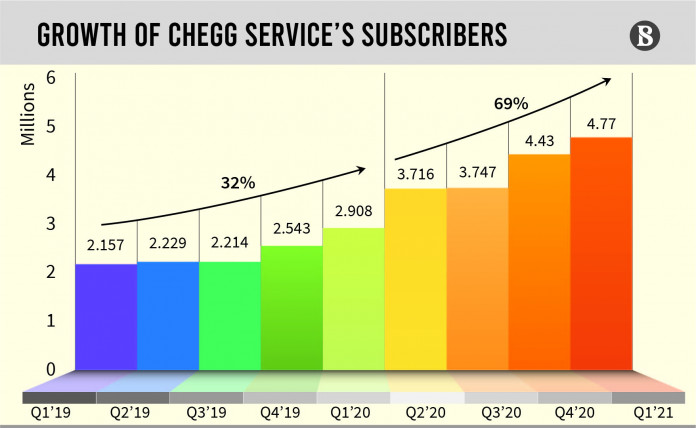
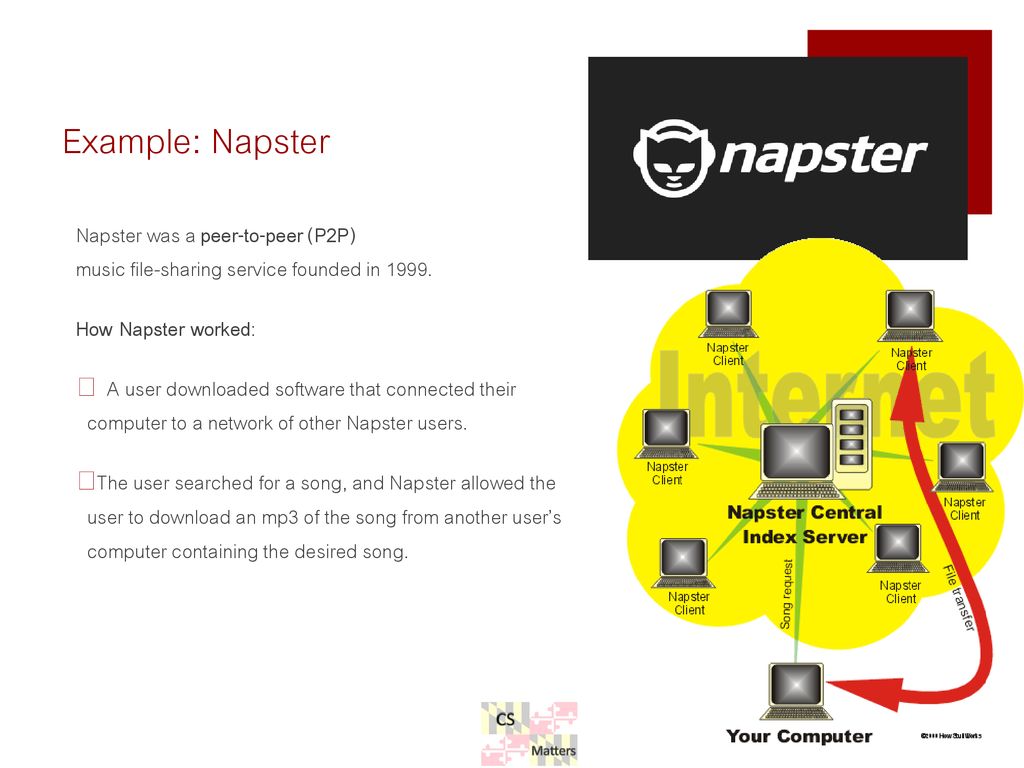
To the point, Chegg is a contract cheating website (see Lancaster & Cotarlan, 2021; see also Wikipedia), a kind of Napster for college exams, problem sets, and homework assignments. Instead of Mp3 music files, however, Chegg’s database contains millions of textbook and exam problems. Chegg makes money by charging its users a monthly subscription fee; in return, users are able to look up the answers to their assignments in Chegg’s database and then turn in those answers as their own. (Chegg subscriptions start at $14.95 a month.) In other words, students use Chegg to cheat.
Whether this business model is “ethical” or not I will leave for others to decide. Rest assured, I will return to the moral question in a future post; in the meantime, however, I want to ask a more practical question: Is Chegg’s business model legal? Specifically, can an online contract-cheating platform like Chegg give rise to a civil claim for common law fraud or even to a criminal prosecution for “wire fraud” under federal law?
I will devote my next few posts to these legal and ethical questions by revisiting the infamous College Admissions Bribery Scandal of 2019-2020, when dozens of rich and powerful parents, like the actress Felicity Huffman, went to jail for facilitating cheating on college entrance examinations for their children (by bribing a third party to take the entrance exams for them). Spoiler alert: my argument will be as follows: if it’s illegal to facilitate cheating on college entrance exams in order to fraudulently gain admission into a college, then it should also be illegal to use Chegg in order to cheat on college exams and homework assignments after you are already enrolled in college. Later, I will explain why Chegg’s CEO and board members (and many of Chegg’s users as well) should be criminally prosecuted for “wire fraud.”
Image Credit: Milo McCarthy
Works Cited
Thomas Lancaster and Codrin Cotarlan. 2021. Contract cheating by STEM students through a file sharing website: a Covid-19 pandemic perspective. International Journal for Educational Integrity, Vol. 17, Article #3, pp. 1-16, available here.
Wikipedia. 2021. Entry for “Chegg”, available here.