Newcomb’s paradox update

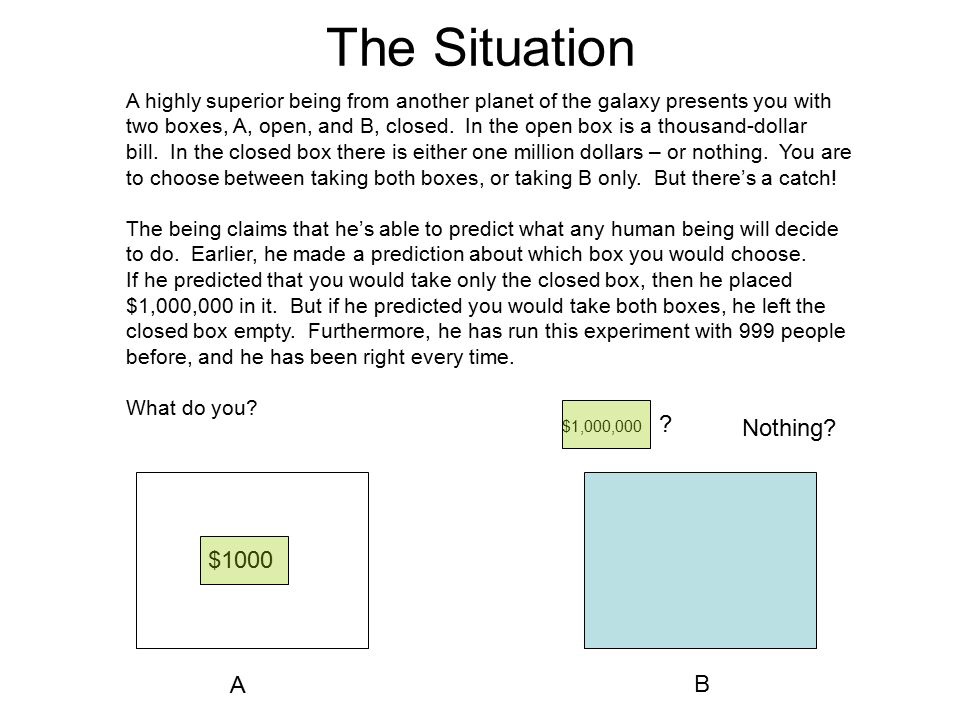
Paradoxes have always fascinated me, and one of the philosophical puzzles that has captured my imagination the most is a probabilistic problem called Newcomb’s paradox (see image below). With this background in mind, I recently stumbled across a 2020 paper by Adam Elga (Princeton) titled “Newcomb University: A Play in One Act.” Professor Elga’s excellent paper explores in depth two variants of this paradox and identifies some salient weaknesses with some of the leading approaches to this philsophical/probabilistic problem. For my part, I would like to pose a seemingly childish question, Can we all agree that this paradox cannot be solved, that there is no “right answer”? In other words, isn’t that the main point or lesson of this particular paradox: that some problems are simply unsolvable? That, at least, is the position I take in my work-in-progress titled “Judge Hercules or Judge Bayes?

Image credit: Selmer Bringsjord
Posted in Uncategorized | 2 Comments

Yoani Sanchez on Cuba’s prognosis

Yoani Sanchez is the future of a free Cuba. Here is her excellent essay (in Spanish); here is an English translation. After diagnosing the current situation, she correctly concludes as follows:

Reactionary and immobile, fearful of news and distrustful of everything that has not come out of the laboratories of the Communist Party, all that remains to the current Cuban model is to repress. For the coming year it will finally set aside its mask of revolution and social justice to show itself as it is: a twentieth century dictatorship that geopolitics, chance and fear have allowed to get this far.”

Posted in Uncategorized | Leave a comment

World Plugs

No, not those types of “plugs” but rather electrical outlets, one of the modern marvels (along with plumbing and WiFi) of the developed world. Specifically, check out this informative and interactive guide created by the International Electrotechnical Commission (IEC). You’re welcome! Hat tip: u/arran-reddit.

Posted in Uncategorized | Leave a comment

“Our Anti-Korematsu”

That is the title of Professor Cass Sunstein’s most recent paper, which is available here via SSRN. Hat tip: Adrian Vermeulle (@Vermeullarmine). Here is an excerpt:

“In Roman Catholic Diocese of Brooklyn v. Cuomo, the Supreme Court took a highly aggressive approach to restrictions imposed by the state of New York on houses of worship, even though those restrictions were vigorously defended on public health grounds. Because of the serious health effects of the COVID-19 pandemic, and because of the plausibility of a plea for judicial respect for complex choices and tradeoffs by elected officials, Roman Catholic Diocese can reasonably be seen as a kind of anti-Korematsu – that is, as a strong signal of judicial solicitude for constitutional rights, and of judicial willingness to protect against discrimination, even under emergency circumstances in which life is on the line.”

Posted in Uncategorized | Leave a comment

Mask Nazis strike again

This time it’s American Airlines (again). More details here. Hat tip: Gary Leff.

Posted in Uncategorized | Leave a comment

Happy New Year?

I am reposting this blog post from 25 March 2020 to explain why I won’t be celebrating the New Year on 1 January. Instead, I will go “old school” (literally) and wait until 25 March 2021 to celebrate the new year …

F. E. Guerra-Pujol's avatarprior probability

Did you know that March 25 used to mark the beginning of the new year in Britain and in her North American colonies? Rebecca Onion explains why in The Boston Globe. Here is an excerpt from her fascinating essay:

This March 25 will likely pass quietly, another chilly Tuesday in early spring. But in the Boston of 300 years ago, the day would have been very noteworthy indeed: It marked the start of the new calendar year. The Colonists, as Britain had for centuries, celebrated the change of the year in late March—the Feast of the Annunciation, or Lady Day. Rents were due, contracts began, and obligations renewed on March 25, the “New Year.” *** Under the Julian system, New Year’s tended to vary from country to country; Britain preferred to mark it on March 25, a Christian holiday, rather than the original Roman New Year’s Day of Jan…

View original post 58 more words

Posted in Uncategorized | Leave a comment

Election-dispute update: rejection rates of mail-in ballots in Georgia

Alternate title: Was Trump robbed in Georgia? Maybe, but check your math!

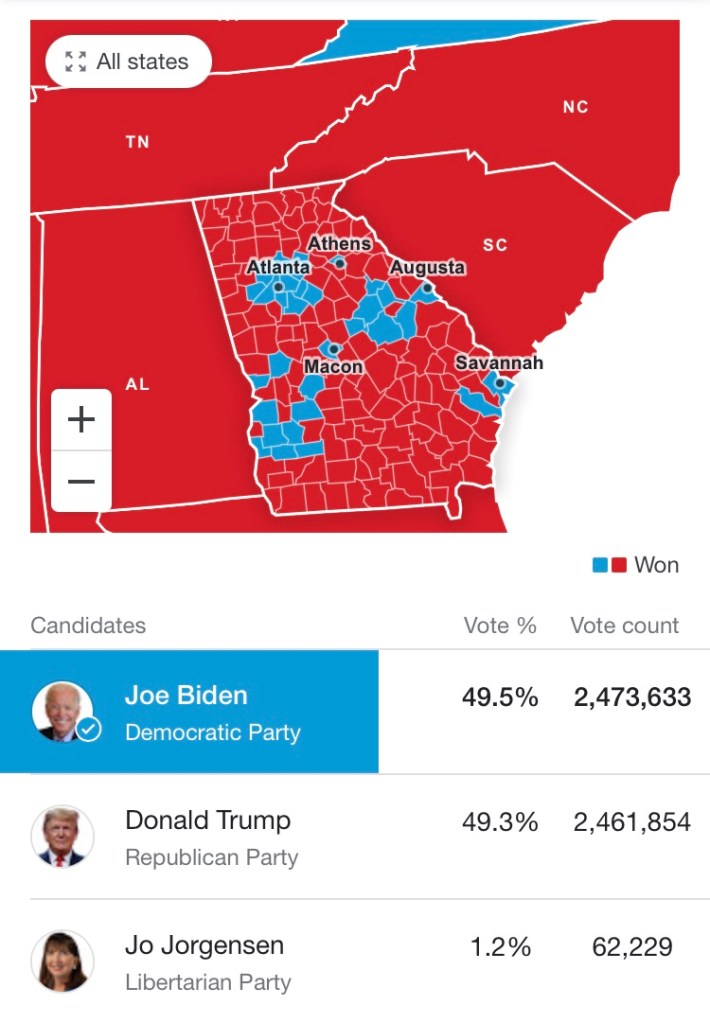
Check out this report from Georgia’s Secretary of State, especially the extended excerpt below:

The rejection rate for absentee ballots with missing or non-matching signatures in the 2020 General Election was 0.15%, the same rejection rate for signature issues as the 2018 General Election.

2,011 absentee ballots were rejected in the November 2020 election for missing or non-matching signatures out of 1,322,529 absentee ballots cast. In November 2018, 454 absentee ballots were rejected for missing or non-matching signatures out of 284,393 absentee ballots cast. The 0.15% rejection rate for signature issues was the same in both the 2018 and 2020 General Elections.

In the 2020 Primary, 3,266 absentee ballot were rejected for missing or non-matching signatures out of 1,151,371 absentee ballots cast, a rejection rate of 0.28%. The lower rejection rate in the general election compared to the primary is likely the result of both parties attempting to help voters cure their absentee ballots pursuant to the process set forth in Georgia statute.”

In other words, the rejection rate was almost twice as large during the June 9 primaries than during the November 3 general election, even though much fewer votes were cast during the primaries. At the same time, even if the mail-in ballots had been rejected at the higher rate during the general election, Joe Biden would still have won this contest by around 10,000 votes. (This analysis, however, leaves out the other close States that Biden won: AZ, MI, NV, PA, and WI*.) Maybe the problem is with the “winner-take-all” nature of our current Electoral College system: the winner of a given State contest receives all of that State’s allotted electors even if his margin of victory is razor thin. Why not allocate the electors on a pro rata basis or on the basis of congressional districts, like Maine and Nebraska do? Either way, the full report from the Secretary of State of Georgia is available here. Hat tip: Jonathan Adler.

*Via Andrew McCarthy (National Review), here is an analysis of Trump’s vote fraud lawsuit in Wisconsin, the only one of these fateful Trump cases to be heard “on the merits.”

Posted in Uncategorized | Leave a comment

Tokyo Railway Map

Via Zero per Zero: “This map includes more than 1500 stations and over 100 lines covering not only Tokyo but also the surrounding regions of Yokohama, Chiba, Omiya, Hachioji, and Kawagoe.” More details here.

Hat tip: u/Adaffor
Posted in Uncategorized | Leave a comment

Progress (Checkpoint Charlie edition)

Alternate Title: Two Cheers for Freedom & Open Borders!

Hat tip: @pickover
Posted in Uncategorized | Leave a comment

Remembering Ronald Coase

The Anglo-American economist Ronald Coase was born on this day (29 December) in 1910. My mentor Guido Calabresi introduced me to Professor Coase’s path-breaking paper “The Problem of Social Cost” back in 1990, a paper I did not fully appreciate at the time. I returned to Coase’s work after I began teaching law in 1998 and eventually became a “Ronald Coase Fellow” in 2006. In his honor, here is my 2012 paper “Modelling the Coase Theorem.” Also, here is an excellent survey of Coase’s ideas (via David Friedman).

Posted in Uncategorized | 1 Comment