Advanced Topics: Intro to the Course

This week, I taught two sections of Advanced Business Law Topics, a graduate-level course. One section was via Zoom (60+ students); the other was in person (14 students). Class #1 in both sections consisted of an introduction to the course, so I just went over my three-page syllabus and presented an overview of the various legal and ethical puzzles that we will be studying together during the remainder of the semester. Logistically speaking, each class in this course will be devoted to an open or unresolved question relevant to business law, and each class will also feature a full-length movie or scene from a Hollywood production that brings that question to life. (Why assign movies and film clips? In order to make it easier to generate lively discussions during our class sessions!) In summary, here is the ordering of topics and movies/movie scenes:

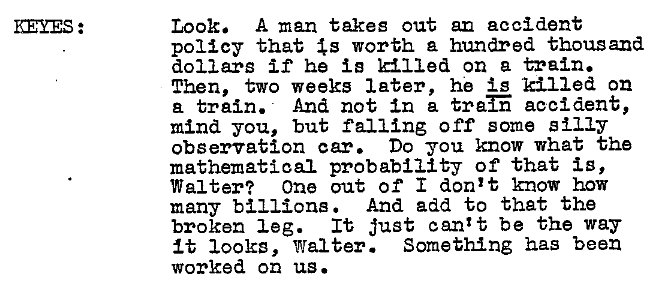
Class #2: The Blue Bus Problem: Is Qualitative Evidence Better Than Quantitative Evidence? (recommended movies: Double Indemnity and/or 12 Angry Men)

Class #3: The Commerce Clause Problem: Are There Any Real Limits on Congress’s Powers? (any episode of Tiger King)

Class #4: The Prisoner’s Dilemma: Cooperate or Defect? (the “blonde dilemma” scene in A Beautiful Mind)

Class #5: The Trolley Problem: Do We Kill One Man to Save Five? (the passenger ferry scene in The Dark Knight)

Class #6: The Friedman Doctrine: Is Greed Good? (the “greed is good” speech in Wall Street)

Class #7: Ronda Rousey’s Employment Status: Contractor or Employee? (Fightsville)

Class #8: The Coase Theorem: Sense or Nonsense? (the final director’s cut of Blade Runner)

Class #9: The Law & Ethics of Making, Keeping, and Breaking Promises (the opening scene in The Godfather)

Class #10: Immoral and Illegal Promises (the pilot episode of Breaking Bad)

Class #11: Is Big Tech Evil? (the “facemash” sequence in The Social Network)

Class #12: Pending SCOTUS Case (we will discuss one or more of the cases that are currently pending before the Supreme Court)

Class #13: Exit Interviews (students will split up into pairs and each duo will choose a legal or ethical puzzle to discuss)

Logos for the top tv companies | Film logo, Film companies, Classic movie  posters
Posted in Uncategorized | Leave a comment

Self-defense or attempted murder?

Quis custodiet ipsos custodes? (Who guards the guardians?) Why hasn’t the name of the policeman who shot Jacob Blake been released yet, and why hasn’t he even been arrested, let alone charged? Is the Kenosha Police Department above the law? Update (8/27): Mr Blake’s attempted-murderer has now been identified as Rusten Sheskey. According to various reports, Mr Sheskey’s defense is that Mr Blake was reaching for a knife on the floorboard of his car right before those seven shots were fired. Assuming the knife was visible to Mr Sheskey and was not planted by the police after the fact, then the police officer’s defense sounds plausible to me, but those are two BIG assumptions. Also, given that Mr Blake was shot in the back multiple times at point-blank range, this case should be decided by a jury–not next year, or in two years, but before the end of this year–in an outdoor courtroom, if necessary.

Jacob Blake Justice Stickers | Redbubble
Posted in Uncategorized | 2 Comments

Syllabus for Advanced Topics in Law

FYI: I have just added a 13th movie to my Advanced Topics syllabus: the 1944 film noir “Double Indemnity,” considered to be the best film noir of all time. As an aside, the reason I waited to add this movie to my syllabus is that I did not watch it until last night, but as it happens, this motion picture is directly relevant to the blue bus problem that my students and I will be discussing next week in our second class session, and it’s also relevant to the prisoner’s dilemma, our topic during Week 4 of the course. (Although I had recorded “Double Indemnity” when it was screened on the Turner Classic Movies (TCM) channel on August 1st, I had intentionally waited until the night of August 25–my birthday!–to watch this classic movie.)

Screen Shot 2020-08-26 at 1.29.22 AM

F. E. Guerra-Pujol's avatarprior probability

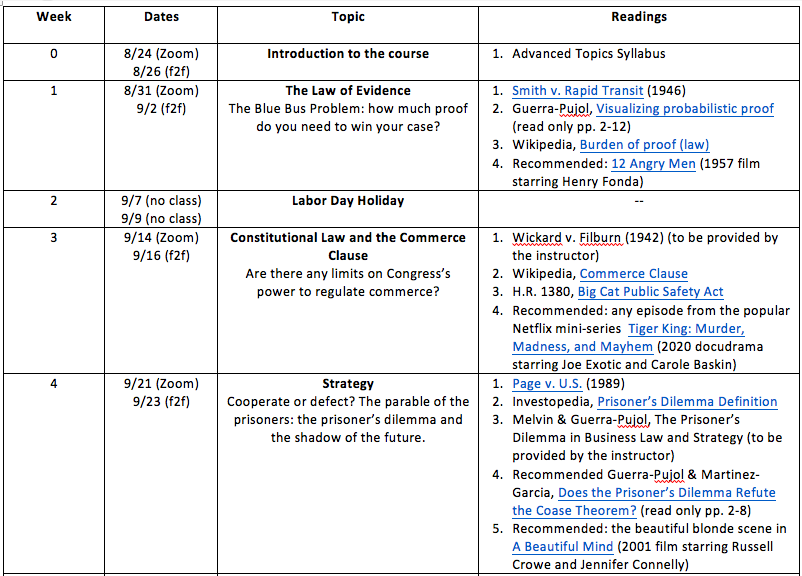
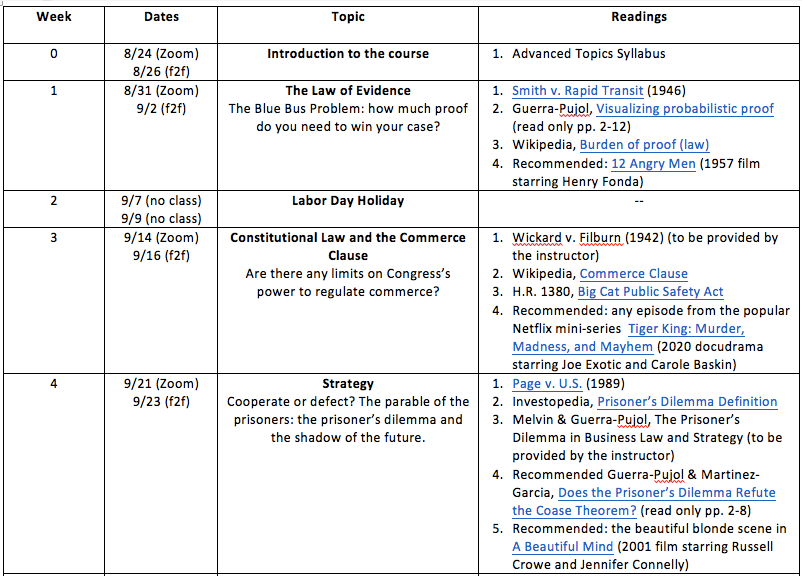
I am teaching a course on “Advanced Business Law Topics” in the fall. Here is a link to my new syllabus (updated again on 8/24). Instead of assigning a textbook, I have decided to devote each class to a particular legal or ethical puzzle, beginning with the blue bus problem from the law of evidence. My first classes are scheduled for the week of 8/24, and I will be blogging in depth about each one of these legal and ethical puzzles every Friday during the upcoming fall semester, starting on 8/28. For now, the top half of page 2 of my three-page syllabus is pictured below. (Memo to WordPress: I absolutely hate this new “Block Editor” feature you have imposed on me; what you used to take make a few seconds to accomplish now generates several exasperating minutes of bewilderment.)

View original post

Posted in Uncategorized | 2 Comments

Classroom democracy

Updated (8/27, 9:30 PM): This semester, I am asking my students to choose the theme of their business law survey course: “Tiger King” or “The Social Netwtork”, Joe Exotic or Mark Zuckerberg, big cats or social media. So far, a total of 764 out of 866(!) enrolled students–88% of the entire class–has voted. I will post the final tally as soon as the survey closes on Friday. Pictured below is the homepage of my course (Canvas App version):

Posted in Uncategorized | 1 Comment

Today is Paris Liberation Day

(And my birthday!) On this day in 1944 the Allies liberated Paris from the Nazis, a major victory and symbolic turning point in the Second World War.

Posted in Uncategorized | 3 Comments

Tactics in law

Following up on my previous post (“Tactics versus strategy”), I will focus on the meaning of “tactics” in this post. In the world of chess, tactics refer to the specific sequences of one’s moves, such as a “fork,” a chess tactic in which a player positions one of his pieces in such a way as to threaten to capture two or more pieces of his opponent. This insight, that the sequence of one’s moves can decide the overall outcome of a contest, applies to almost every domain in life, including sports, love, and law. In sports, for example, “flopping” is, alas, an all too common tactic (see the humorous video below), especially in sports like soccer and basketball, and in the game of love, winking or offering to buy someone you are attracted to a drink is another common tactic. Here, however, I want to focus on my area of expertise, the law, by presenting two prosaic examples of legal tactics.

In legislation, a common tactic is the so-called “killer amendment” designed to shoot down proposed laws that are supported by a majority of the voters. My colleague and friend Leo Katz has written an excellent paper titled “A theory of loopholes” explaining how this tactic works. In brief, a legislator who opposes a proposed law may often try to insert a provision in the bill that is designed to appeal to the most radical or extreme group of voters, thus killing the bill’s chances to win majority approval. Likewise, in litigation one of the most common tactics is “forum shopping”–the practice of choosing a court that is most likely to provide a judgment in one’s favor. As a result of this tactic, the plaintiff, like the first mover in chess, enjoys a strategic advantage over the defendant, since it is the plaintiff who generally gets to decide in which court to bring his case. Like chess, however, there are some limits to the plaintiff’s first move. In chess, the first mover is only allowed to move his knights or his pawns. Similarly, a plaintiff is required to bring his action in a court located in a State that has some connection to the legal issues being litigated, but since most business and commerce occur across State lines, the plaintiff may often have significant leeway in selecting a forum. Generally speaking, the plaintiff will prefer to bring his action in his home jurisdiction or in a court with a reputation for being “plaintiff-friendly.” If the defendant lives in a different State or is overseas, the defendant will thus have to incur significant travel expenses to defend the case in the plaintiff’s home State.

I now want to conclude this blog post by posing a delicate and difficult philosophical question about the ethics or morality of such tactics. In chess, for example, we praise a player for his astute and beautiful tactics, but oftentimes tactics can appear to be unethical or “dirty,” as in the case of “flopping” in soccer or “killer amendments” in legislation. Moreover, my colleague, friend, and co-author David Orozco has written about a third type of legal tactic, a tactic that we both find repugnant: legal bullying. So, here is my general philosophical question: Is there a principled way of distinguishing between clean and dirty tactics?

Posted in Uncategorized | Leave a comment

Tactics versus strategy

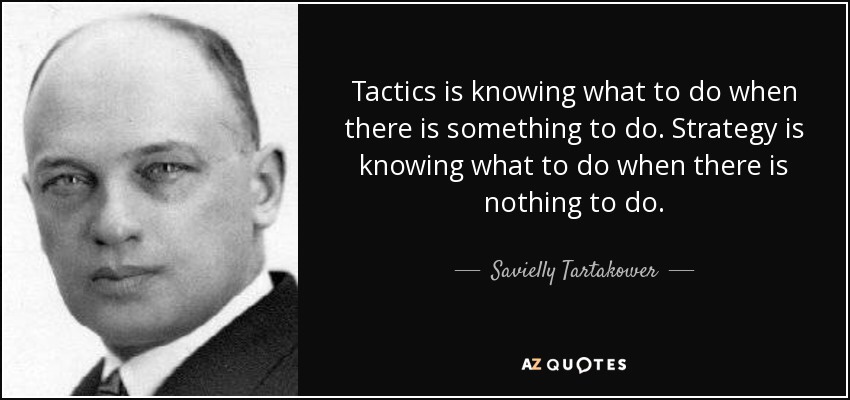
Tactics is knowing what to do when there is something to do. Strategy is knowing what to do when there is nothing to do.” Discuss.

For my part, one of the things I love about this aphorism–which is attributed to the great 20th century grandmaster Savielly Tartakower–is that it not only explains the difference between tactics and strategy; it also applies to domains beyond chess, like law. I will elaborate further on this distinction, as it applies to law, in the next day or two. In the meantime, I will be putting the finishing touches on my new “legal environment” and “advanced business law topics” courses …

Posted in Uncategorized | Leave a comment

Only God Can Make a Tree

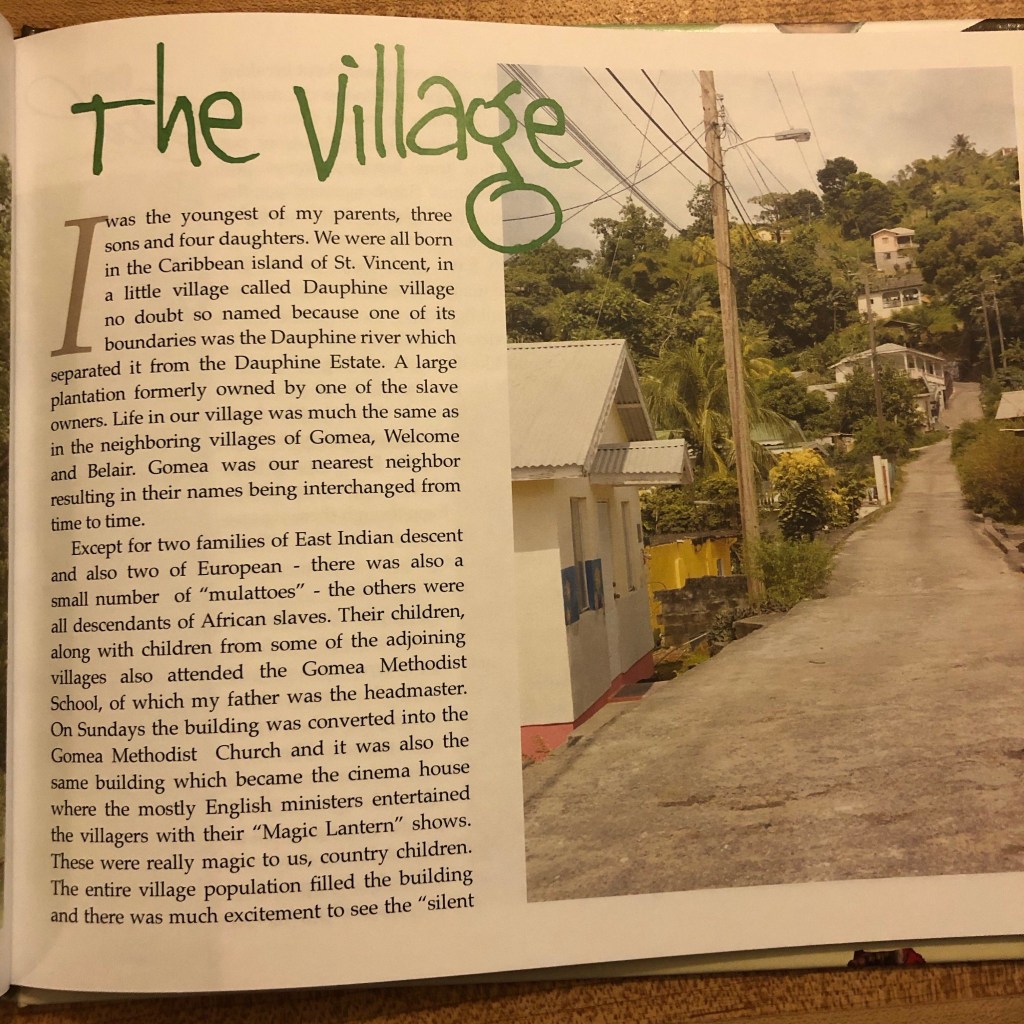
My wife’s paternal grandmother Mrs Doris Robinson died earlier this month. Before she went to Heaven, our matriarch published a family memoir titled “Only God Can Make a Tree.” The cover and first page of her beautiful book are pictured below. For my part, I will be reading her memoir over the weekend in her honor and will resume my blogging duties on Monday or Tuesday of next week.

Posted in Uncategorized | 5 Comments

What is your favorite Hamilton song?

Mine is “Ten Duel Commandments” hands down! In addition to the musical beat and the lyrics, I like how Lin-Manuel Miranda breaks down the intricate formal rules of this deadly and fascinating ritual. Here is the Wikipedia page for Ten Duel Commandments. Bonus link: Here is a previous blog post of mine on “Dueling for Dummies.”

Posted in Uncategorized | 2 Comments

Syllabus for Advanced Topics in Law

I am teaching a course on “Advanced Business Law Topics” in the fall. Here is a link to my new syllabus (updated again on 8/24). Instead of assigning a textbook, I have decided to devote each class to a particular legal or ethical puzzle, beginning with the blue bus problem from the law of evidence. My first classes are scheduled for the week of 8/24, and I will be blogging in depth about each one of these legal and ethical puzzles every Friday during the upcoming fall semester, starting on 8/28. For now, the top half of page 2 of my three-page syllabus is pictured below. (Memo to WordPress: I absolutely hate this new “Block Editor” feature you have imposed on me; what you used to take make a few seconds to accomplish now generates several exasperating minutes of bewilderment.)

Posted in Uncategorized | 2 Comments