I want to shout out the Spanish remix version of Camila Cabello’s beautiful song “Havana,” a song about a lost love, especially Daddy Yankee’s masterful contribution to the song, which begins at 1’24” … Among other things, Daddy Yankee sings: “La libertad … cuando volvera’ solo Dios sabe …” Sixty-one years of an obsolete and decrepit military dictatorship is enough; may my dear Cuba, my lost love, one day be free.
Sneak Preview of The War Room
At the suggestion of some of my friends, I have decided to reserve the domain name for “the-war-room.org” and convert this virtual space into my personal website. My new website will house my research papers, course syllabi, and some personal photos and will become operational in the fall. Below is a sneak preview:
Is public meaning originalism dead?
Paging my friends Randy Barnett, Josh Blackman, Will Baude, Larry Solum, and others … In preparing for my July 22 talk on “Constitutional Aspects of Puerto Rico’s Political Status,” I noticed that no other Justice of the U.S. Supreme Court joined Justice Thomas’s concurring opinion in the landmark Appointments Clause case that was decided on June 10, 2020. (That case involves the constitutional status of the members of Puerto Rico’s new neo-colonial financial oversight board.) Justice Thomas’s concurring opinion was explicitly based on the original public meaning of the Appointsments Clause, so either “public meaning originalism” is dead or the other textualist judges (e.g. Alito, Gorsuch, and Kavanaugh) disagreed with Thomas’s interpretation of what the original public meaning of the Appointments Clause is. (I will have more to say about my July 22 talk and the Appointments Clause case in the next day or two.)

Are Polish castles exempt from zoning laws?
Not the one featured in the video below! The story is here. (Hat tip: Tyler Cowen.)
The NBA snitch hotline is a terrible idea
While I am on vacation (actually, working on sundry scholarly projects), I am re-posting my 6/18 blog post in which I criticize Adam Silver’s “snitch hotline.” P.S.: Two cheers for Paige Spiranac!
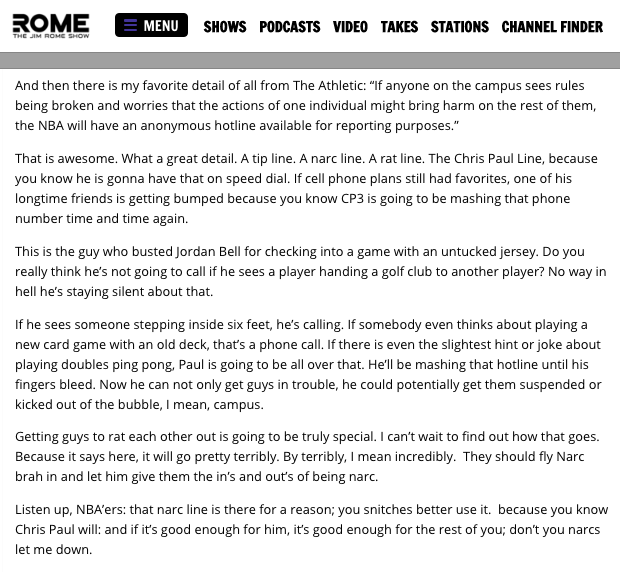
As you may have heard by now, the NBA recently released a 113-page manual in anticipation of the resumption of the 2019-20 season. (Check out this summary of the manual by Ben Cohen for The Wall Street Journal.) The manual contains a whole host of health and safety protocols that basketball players (and coaches, I presume) must follow when the season resumes in Orlando, Florida next month. Among other things, the NBA is setting up a “snitch hotline” to allow anyone to anonymously report a player or coach who is breaking the guidelines. So, who will be the first player to call the new NBA snitch hotline? According to my fellow Gaucho Jim Rome (both of us went to UCSB in the 80s), it will be Chris Paul–check out Rome’s “hot take” below:
Source: jimrome.com
In all seriousness, this anonymous snitch hotline is a terrible idea. Instead of building trust…
View original post 92 more words
The paradox of the anti-progress canon
As promised, I am re-posting part 2 of my review of Matthew Slaboch’s beautiful book “A Road to Nowhere: The Idea of Progress and Its Critics.” Enjoy!
Review (part 2 of 2) of Matthew W. Slaboch, A Road to Nowhere: The Idea of Progress and Its Critics (U Penn Press, 2018).
In my previous post, I mentioned that the concept of progress might have a cultural or spatial dimension, one of the most important ideas I learned from reading Slaboch’s book on anti-progress. Here, I shall discuss another insightful idea in Slaboch’s book, what I call “the paradox of the anti-progress canon.” Simply put, why should anyone bother to improve man’s lot or change the course of history for the better if the ideal of progress is bullshit?
Slaboch presents this dire paradox in the chapter devoted to Henry Adams (Chapter 3), who attempted to apply the law of physics to the study of history. Briefly, Adams’s view of world history was a pessimistic one (p. 80): social and political collapse are inevitable; all such systems will…
View original post 547 more words
Review of Slaboch (2018)
While I am on vacation working on various scholarly projects, I am re-posting part 1 of my review of Matthew Slaboch’s 2018 book “A Road to Nowhere: The Idea of Progress and Its Critics.” (I will re-post part 2 tonight.)
Review (part 1 of 2) of Matthew W. Slaboch, A Road to Nowhere: The Idea of Progress and Its Critics (U Penn Press, 2018).
As soon as I heard about Patrick Collison and Tyler Cowen’s recent call for a new field of “progress studies” (Collison & Cowen, 2019, available here), my initial reaction was one of deep skepticism. Simply put, I mistrust our collective ability to discover, let alone implement, a reliable recipe for boosting long-term economic growth or for promoting ever-higher levels of human flourishing generally. But my skepticism poses a deeper, second-order question: is this mistrust warranted, or is it the result of my own Burkean and Humean biases or what Cowen likes to call “mood affiliation”? It turns out that I am not the only one to be skeptical of the concept of progress. Matthew Slaboch, a research fellow at Princeton, has devoted an entire scholarly…
View original post 631 more words
On Vacation
I am re-posting my July 8th vacation post as I need to get off the Internet in order to mourn the death of my friend Carlitos del Valle, refocus on my scholarly projects, and tend to my own garden, so to speak. In the meantime, stay happy and healthy; I will return soon …
Hello. Because this is a one-man blog, and because I will be taking a vacation for the rest of July and for most of August, I will be blogging much more sporadically, if at all, during the next few weeks. Rest assured, however, that I will present my grand synthesis of Oliver Wendell Holmes’s prediction theory of law and H.L.A. Hart’s internal point of view upon my return in late August or early September. Note: I won’t really be “on vacation” per se; instead, I will be using this time to give talks (via Zoom, of course) at several academic conferences and to complete some other scholarly projects, including a book-length treatment of “Goedel’s Loophole.” (If time permits, I may blog about these other projects in the days ahead.)
Rear Window via a Coasean lens
“Rear Window” has to be one of the most beautiful films of all time. Yet, if you google “rear window” what you will find is a lot of cutting-edge essays commenting on the themes of voyeurism, the “male gaze”, etc. etc. What these critics fail to see, however, is the reciprocal nature of the voyeurism problem: if you don’t want to be seen, then you should close your window shades!
Hasta siempre, Carlitos

Carlos “Carlitos” del Valle Cruz (8 Jan. 1955 — 11 July 2020)