
I can’t ask for a better son in the whole world! Kleber Enrique just graduated from Lake Mary H.S. and is going to attend college at the University of Florida (#GoGators) in the fall. May the Force be with you in your future endeavors!


I can’t ask for a better son in the whole world! Kleber Enrique just graduated from Lake Mary H.S. and is going to attend college at the University of Florida (#GoGators) in the fall. May the Force be with you in your future endeavors!


My Guaranteed Income paper now appears in print. It is part of a symposium issue of the Chapman Law Review devoted to the 91st Congress. (An electronic version of the paper is also available here free of charge via SSRN.)
Note: This is the last of several blog posts reviewing Tyler Cowen’s book “Big Business: A Love Letter to an American Anti-Hero.”
Now that we have reviewed the first eight chapters of Tyler Cowen’s “Love Letter,” it’s time to conclude our extended review with Chapter 9, the last chapter of Professor Cowen’s ode to big business, but before proceeding any further, let me say that Cowen has saved the best for last, for in many ways his concluding chapter is the most intriguing and fascinating chapter in a book full of intriguing and fascinating chapters!
To begin with, Professor Cowen’s concluding chapter poses a paradoxical query: If big business is so great in so many different ways, why do people “hate on” (to use the popular expression) business so much? Although Cowen offers an intriguing conjecture, alas, it is totally wrong! Specifically, Cowen speculates (p. 184, emphasis in the original) that “we anthropomorphize corporations–we imbue them with human qualities,” instead of seeing business firms for what they really are: cold, impersonal, legal abstractions with “a legally binding responsibility” to maximize their profits (p. 197).
I call bullshit (again)! Maybe this is how Professor Cowen himself sees corporations (though I highly doubt it), but I don’t know of a single person who “thinks of corporations as people” (p. 184) or who sees business firms as their “friends” (p. 198). People are not that stupid, and an economist no less should know better. Yes, I will concede that most people are most likely unaware that the managers of a corporation owe a common law “fiduciary duty” to the shareholders, but most people already know that most companies, especially the big business firms that Cowen is writing about in his book, are cold, impersonal, legal abstractions whose main corporate mission is to maximize profits. That’s precisely why “we” hate on big business firms, engage in shoplifting, lie on our resumes, etc.! Because large corporations are seen as cold and impersonal and abstract entities!
In closing, let me end my extended review on a positive note. Tyler Cowen concludes Ch. 9 by asking, what is the social responsibility of business? Is it to just make profits, or is it something more? Professor Cowen’s pithy riposte to this question is (pp. 205-206, emphasis in the original), the social responsibility of business is to come up with new and better conceptions of the social responsibility of business. At a surface level, this response is pretty lame, but at a deeper level, Cowen’s aphorism blew me away. Markets are not limited to products and services. Maybe markets also extend to ethical paradigms and moral doctrines. In addition to providing us a wide array of products and services, perhaps business firms also provide us differing degrees of ethical dogmas and moral menus!
In my view, ethics and morality are not just about choosing between good and bad, right and wrong. After all, often in life we must choose between two or more bads, two or more wrongs! Fundamentally, ethics and morality are about how we treat and interact with other people (and with nonhuman animals), and that is one way of understanding what business firms do. Business firms are an agglomeration of stakeholders, and most of these stakeholders are people: owners, managers, employees, contractors, customers, etc. Moreover, business firms employ a wide variety of methods of treating or interacting with these sundry stakeholders, and these different ways are, at bottom, guided by different visions of ethics and morality …
Professor Cowen (with apologies to DJ Khaled, pictured below), maybe it is time for you to “make” another book!

First, we were told not to wear masks. Next, we were told to stay home. And then, an exception was made for anti-police protestors. With apologies to my colleague and friend Alex Tabarrok, is the Wuhan coronavirus an existential threat to humanity, or is the so-called “lockdown” the biggest government farce since the bogus pretext for the invasion of Iraq? Either way, the lamestream media, our elected officials, and our so-called public health “experts” have lost whatever little credibility they had in the first place. More below the fold: Continue reading
Note: This is the sixth of seven blog posts reviewing Tyler Cowen’s book “Big Business: A Love Letter to an American Anti-Hero.”
Let’s proceed into Chapters 7 & 8 of Tyler Cowen’s “Love Letter to Big Business.” Like the previous two chapters (Chs. 5 & 6, which I reviewed in my previous post), these two chapters do not appear to be related. Chapter 6 (“What is Wall Street good for, anyway?”) is devoted to the financial services industry, e.g. banks, brokers, credit card companies, insurance firms, payday lenders, etc., while Chapter 7 (“How much does big business control the American government?”) is about rent-seeking behavior or “crony capitalism.” Nevertheless, I am lumping these two chapters together because among the usual crony-capitalist suspects are big banks, especially the ones that are supposedly “too big too fail”!
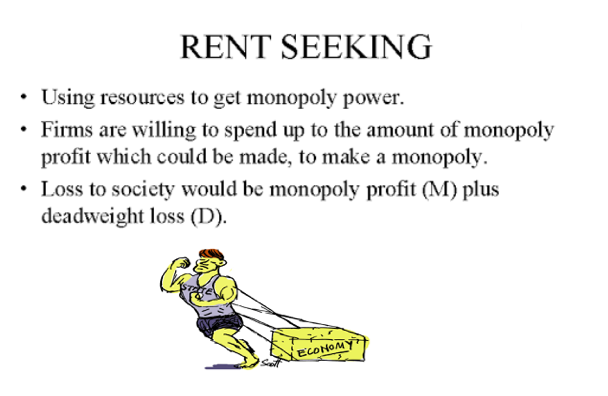
First off, what is rent-seeking or “crony capitalism”? Professor Cowen provides the best definition of these terms that I have seen to date (p. 171): rent seekers and crony capitalists are business firms who “suck[] up to power and cultivat[e] the coercive power of the state to be on one’s side.” Whether it be bribing bureaucrats for government contracts, lobbying elected officials for favorable legislative treatment, or spending millions of dollars on TV ads to shape public opinion in one’s favor–all these things and more fall under the rubric of rent-seeking. Alas, as Cowen admits, all business firms engage in rent-seeking to a lesser or greater extent, if only to ensure their own survival; the real question, however, is how destructive are these pervasive rent-seeking activities to the overall economy?
Cowen makes a persuasive case that rent-seeking is not that big of a problem. Although corporations spend about $3 billion per year lobbying the federal government, they spend over $200 billion per year to advertise their products and services. (See note 3 on p. 224 of Cowen’s book.) Furthermore, if you were to scrutinize the yearly budgets of both State and federal governments, as Cowen does (pp. 173-175), the only real evidence of rent-seeking you will find are farm subsidies, but even this egregious example of rent seeking represents only $20 billion per year out of a total federal budget of $4.4 trillion. If anything, then, if Cowen is to be believed, non-agricultural business firms are not rent-seeking enough?
What about rent-seeking by big banks? Cowen employs a different strategy to defend big banks and the financial services industry writ large. He admits that the financial services industry in the U.S. is “relatively large” in terms of GDP or Gross Domestic Product, the standard method used by economists to measure the size of the economy, but Cowen argues that this growth in the financial sector is actually a good thing! To the point, Cowen’s argument is that a large financial sector reflects a healthy economy, or in Cowen’s own words (p. 153): “There may be specific parts of the financial sector that are too large …, but a large financial sector relative to GDP is frequently a sign of previous economic success and stability.”
For my part, although I am inclined to give Professor Cowen the benefit of the doubt (that rent-seeking is exaggerated), his complete loss of credibility in Chapters 3 & 4 of his big business book (where he simultaneously defends high CEO compensation and stagnant worker pay) gives me pause. At the same time, perhaps Cowen is right. That is, perhaps there is an “optimal level” of rent-seeking, and perhaps we are below or right at that optimal level. But rent-seeking, by definition, does not generate any new economic value (unlike trade), so why is the optimal level of rent-seeking not zero? Easy. Because efforts spent trying to eradicate or reduce rent-seeking behavior might be more costly than the inefficiencies generated by such rent-seeking in the first place! I will conclude my review of Professor Cowen’s “Love Letter to Big Business” in my next post.
Note: This is the fifth of seven blog posts reviewing Tyler Cowen’s book “Big Business: A Love Letter to an American Anti-Hero.”
Thus far, I have reviewed the first four chapters, as well as the appendix, of Tyler Cowen’s “Love Letter to Big Business.” (Check out my blog posts of June 6 and June 7.) Next, let’s turn to Chapters 5 and 6 of Professor Cowen’s beautiful love letter.
At first glance, these two chapters do not appear to be related. Chapter 5 (“How monopolistic is American big business?”) is devoted to a wide variety of industries, everything from clothing to health care, commercial aviation to cable TV, etc., etc., while Chapter 6 (“Are the big tech companies evil?”) drills down on the tech industry, big data, and Silicon Valley. So, why am I lumping these two chapters together? Because Cowen himself applies the same antitrust framework to all these different industries, and here, Cowen gets it right: the claim that big business firms are dangerous monopolies is greatly exaggerated.
So, why is Cowen right to downplay these monopoly concerns? For two reasons. First off, as Cowen correctly notes (p. 84), consumers have significantly greater choice than in the past in most sectors of the economy, but secondly (and, I would argue, more importantly), in those few areas where we do see monopoly firms (like cable TV) or anti-competitive prices (like health care and aviation), those monopolistic practices are, ironically, the result of government licenses or excessive government regulations, which make it more costly or impossible for new firms to enter those particular markets. (To his credit, Cowen provides many examples of how government is to blame for most of our economic woes.)
What about Big Tech, especially companies like Amazon, Apple, Facebook, Google, and Microsoft? Once again, Professor Cowen is spot on: with the possible exception of Microsoft, which has historically overcharged for its lame products and tried to stifle innovation in the Internet browser market, almost all the products and services that the Big Tech firms have unleashed upon the world have improved our lives at many different margins. Even Facebook and Twitter, with their loathsome and tone-deaf CEOs, selective censorship policies, and weak privacy protections, are worthy of our praise, or in the words of Professor Cowen (p. 100):
“I would like to speak up for the tech companies, especially the big ones. They have brought human beings into closer contact with each other than ever before … mostly through social media. They also have placed so much of the world’s information at our fingertips, and more often than not it is accessible within minutes or even seconds. Whatever problems these developments may have brought in their wake, they are unparalleled achievements and arguably the greatest advances of the contemporary world.”
What about privacy, you might ask? Even Professor Cowen is worried about “the enduring loss of privacy” (p. 121), especially the development of sophisticated facial recognition technologies, detailed genetic profiles, and the ever-present risk of black hat hackers, calling out these particular privacy issues as the elephant in the room. The irony, however, is that the best way to fix or address these legitimate privacy concerns is with more technology, not less. Think of spam filters, encryption, and anti-facial-recognition strategies, just to name a few examples.
In any case, I have always wondered whether privacy is overrated. As Cowen himself notes, no one is immune from negative gossip, and privacy (like liberty) must always give way to public safety. Also, how can we have a meaningful discussion about privacy if no one has even bothered to define this amorphous concept? Alas, a comprehensive analysis of privacy is beyond the scope of this blog post, but a good place to start is Richard A. Posner’s classic essay on the economics of privacy, available here.
We will proceed to Chapters 7 & 8 of Cowen’s Love Letter to Big Business in my next blog post …

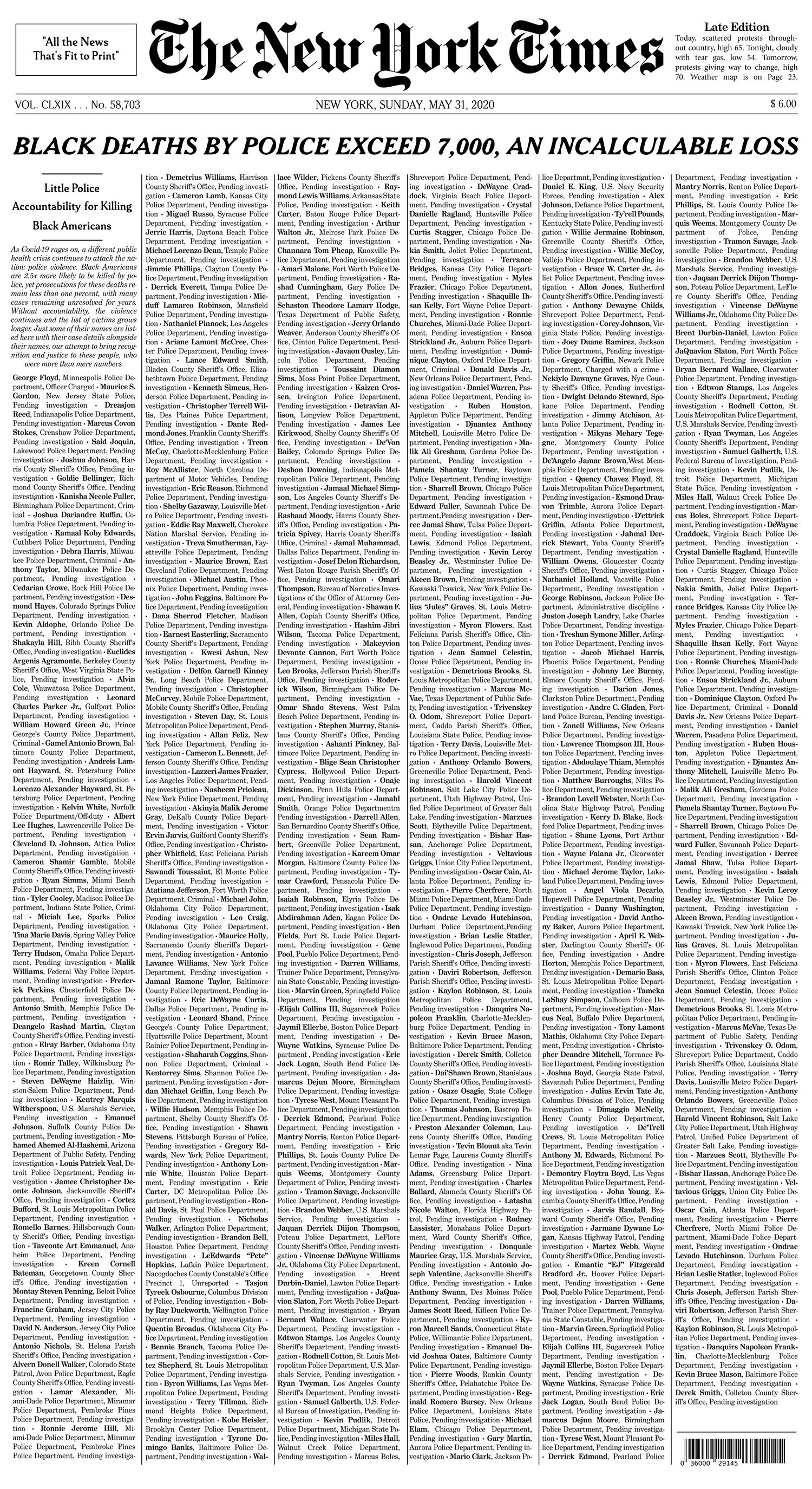
Did you know that since 9/11 more people (of all races) have been killed by the police in the USA than the number of U.S. soldiers killed in action in Iraq and Afghanistan? (Check out this police shooting database via Jeff Bezos’s Washington Post.) Also, check out the reimagined front page headline pictured below via the Incalculable Loss Project: “We took the iconic New York Times cover from Memorial Day and featured just some of the names of Black lives lost to police violence alongside the status of their case.” Alas, the status of most of these cases is “pending investigation.” Note of clarification: not all of the dead listed below were unarmed at the time of their deaths. You can see a better-quality version of the entire reimagined front page here. (This post was revised and corrected on 6/12.)
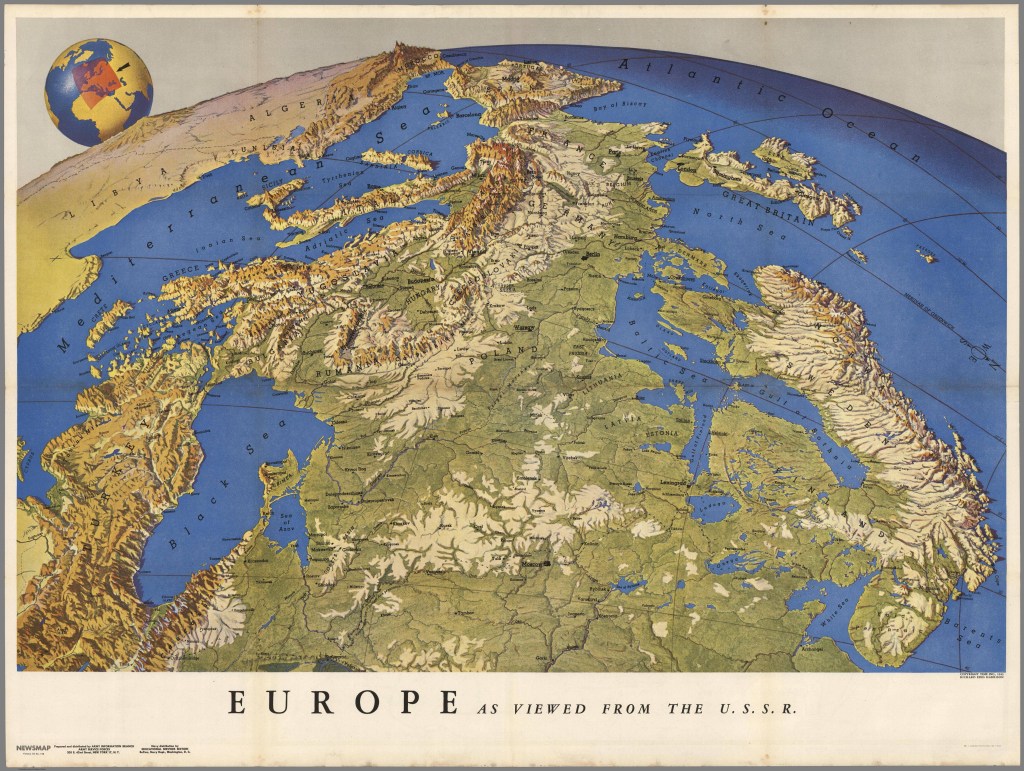
According to u/matias90 (via Reddit), there is a straight line path (over 13,000 kilometers in length) between Liberia and China without crossing any ocean or major body of water. This exotic route sounds like a backpacking adventure of a lifetime! Any takers?











Welcome to the online home of the IASS
Hopefully It’s Interesting.
In Conversation with Legal and Moral Philosophers
Relitigating Our Favorite Disputes
PhD, Jagiellonian University
Inquiry and opinion
Life is all about being curious, asking questions, and discovering your passion. And it can be fun!
Books, papers, and other jurisprudential things
Ramblings of a retiree in France
BY GRACE THROUGH FAITH
Natalia's space
hoping we know we're living the dream
Lover of math. Bad at drawing.
We hike, bike, and discover Central Florida and beyond
Making it big in business after age 40
Reasoning about reasoning, mathematically.
I don't mean to sound critical, but I am; so that's how it comes across
remember the good old days...
"Let me live, love and say it well in good sentences." - Sylvia Plath
a personal view of the theory of computation
Submitted For Your Perusal is a weblog wherein Matt Thomas shares and writes about things he thinks are interesting.
Logic at Columbia University
Just like the Thesis Whisperer - but with more money
the sky is no longer the limit
Technology, Culture, and Ethics
Just like the horse whisperer - but with more pages
Poetry, Other Words, and Cats


 prior probability