Settle or go to trial?

Note: This is the last of four blog posts devoted to Week 5/Module 5 of my business law summer course.

This week, we are exploring civil and criminal cases, and I devoted my previous post to the ideal of “due process of law”, the single-most important procedural ideal of our legal system. Personally, for example, I think Joe Exotic’s criminal conviction should be commuted by President Trump, but due process is not about outcomes; it is about the way people are treated by the legal system, and Joe Exotic was tried by a jury of his peers and given the opportunity to defend himself against the charges against him. (As for Carole Baskin, the docuseries Tiger King raises many legitimate questions about her role in the disappearance of Don Lewis, but legally speaking Mrs. Baskin is not required to prove her innocence. Instead, it is up to the accusing party to bring formal charges or file a civil complaint and to prove his or her case in a court of law.)

But, in reality, Joe Exotic’s jury trial was an extremely rare event. How rare? As we saw in a previous post, most criminal cases result in plea bargains, not jury trials, and likewise, most civil cases settle out of court. (And when I say most, I mean over 98% of all civil and criminal cases, State or federal.) I thus devote the last part of my module on civil and criminal cases to a strategic question that all litigants–civil or criminal–must eventually contend with: when should you cop a plea or settle out of court, and when should you go to trial?

First off, recall from a previous post that going to trial, especially in civil cases, is costly and time-consuming because of the discovery process. But cost is just one part of the settle-or-go-to-trial equation. The other key variable is uncertainty. That is, even if you have all the time and money in the world to fight your case in court, do you really want to take your chances with a jury?

This is not a rhetorical question. Whenever a case goes to a jury, it is next to impossible to predict with any degree of certainty what the outcome of that case will be. Why? Because of another aspect of due process: the burden of proof. In a criminal case, for example, the prosecution must prove its allegations beyond a reasonable doubt, a demanding standard of proof. Even in civil cases, where the plaintiff’s burden of proof is much lower (preponderance of the evidence or “more likely than not”), the defendant is still able to prevail in the case of tie, i.e. if the jury believes the defendant as much as it believes the plaintiff.

If you want to go deeper into these strategic questions, you may have to pay Google Scholar a visit or read my textbook chapter on “Strategic Aspects of Litigation & Settlement.” For now, it suffices to say that the interplay between these two variables–cost and uncertainty–are the main reason why so many civil cases settle out of court and why so many criminal cases end up in plea bargains. FYI: Next week, we will conclude our summer survey course by taking a closer look at ethics, including natural law, animal rights, and business ethics. In the meantime, I will resume my review of Tyler Cowen’s “Love Letter to Big Business” in my next few blog posts.
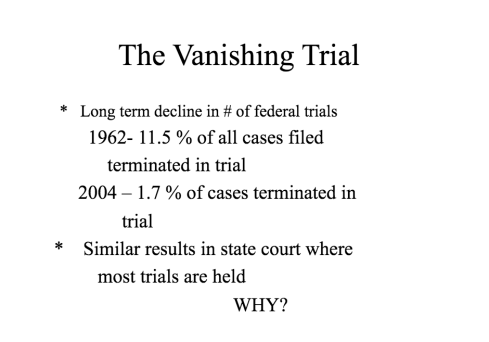
The Vanishing Trial

Source: Brandon Carpenter

Posted in Uncategorized | 1 Comment

Unbundle the police?

Yes, unbundle the police! I am interrupting Week 5 of my business law survey course to share this thought-provoking blog post titled “Why are the police in charge of road safety?” by my colleague, friend, and fellow libertarian scholar Alex Tabarrok. I, too, have always wondered why the police often act as roadside tax collectors (or worse) instead of devoting their valuable time and efforts to fighting crime. Here are some excerpts from Professor Tabarrok’s excellent post (link in the original):

It’s an unacknowledged peculiarity that police are in charge of road safety. Why should the arm of the state that investigates murder, rape, and robbery also give out traffic tickets? Traffic stops are the most common reason for contact with the police…. But why do we need armed men (mostly) to issue a traffic citation?

Don’t use a hammer if you don’t need to pound a nail. Road safety does not require a hammer. The responsibility for handing out speeding tickets and citations should be handled by a unarmed agency. Put the safety patrol in bright yellow cars and have them carry a bit of extra gasoline and jumper cables to help stranded motorists as part of their job–make road safety nice….

Defunding the police, whatever that means, is a political non-starter. But we can unbundle the police.

traffic-signs-for-road-safety
Posted in Uncategorized | 2 Comments

Teaching Tiger King: Criminal Cases

Note: This is the third of four blog posts devoted to Week 5/Module 5 of my business law summer course.

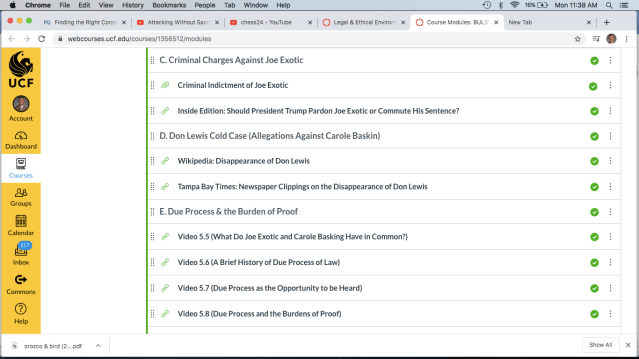
In my previous post, we saw why getting your “day in court” (i.e. a jury trial) in a civil case can take forever and be so damn expensive: “discovery.” By way of example, during the discovery phase of a civil case, the parties can send each other burdensome requests for the production of documents (including the production of electronic records like emails, texts, and social media posts) and take as many depositions (including depos of non-parties to the case) as they need or are able to afford! The next parts of Module 5 are devoted to criminal cases. (See the top image below.)

Tiger King is a veritable gold mine here. Among other things, my module contains the original criminal indictment against Joe Exotic as well as newspaper clippings about the Don Lewis cold case. In addition, I recorded a video in which I pose the following question, “What do Joe Exotic and Carole Basking have in common?” To the point, whether we are talking about Joe Exotic’s criminal conviction for murder-for-hire (check out his mugshot, bottom left) or the lingering allegations against Carole Baskin that she played a role in Mr Lewis’s mysterious disappearance (check out the cold case notice pictured below, bottom right), everyone is entitled to “due process of law.”

Ok, but what is due process of law, and why is this legal ideal worth studying in a business law survey course? Simply put, the concept of “due process of law” is the single-most important ideal of the Anglo-American legal tradition, so I spend a lot of time (four additional videos in all) exploring the historical origins (going back to the Magna Carta of 1215 A.D.) and the operational meaning of due process. In summary, due process means at the very least two things: (1) whenever someone is accused of misconduct (civil or criminal), he must be given a chance to defend himself, and (2) it is the party who is making the accusation (the plaintiff in a civil case or the prosecutor in a criminal one) who has the burden of proving the truth of those allegations.

Nevertheless, despite the ideal of due process, the fact remains that most criminal cases (like most civil cases) never go to trial; most criminal charges result in plea bargains. Accordingly, the last part of my Week 5 Module is devoted to the following question: Settle or Go to Trial? This is really a strategic question, not a legal one, and rest assured, we will explore this strategic choice in my next blog post.

Module 5 Criminal Cases

Screen Shot 2020-06-08 at 3.43.30 PM
Posted in Uncategorized | Leave a comment

Teaching Tiger Law: Civil Cases

Note: This is the second of four short blog posts devoted to Week 5/Module 5 of my business law summer course.

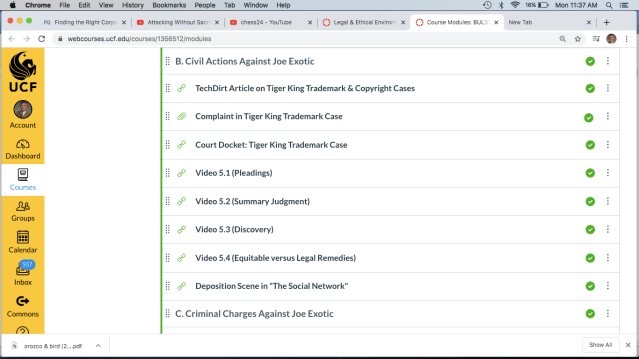
My Week 5 module on “Civil and Criminal Cases” begins with the civil actions for trademark and copyright infringement against Joe Exotic (see image below), but before I discuss this area of law, I need to provide some background. When I took Civil Procedure during my first year of law school (the late Geoffrey C. Hazard, Jr. was my “Civ Pro” professor), and later when I became a full-fledged law professor and taught Civ Pro myself, this subject was a two-semester course, so how could I possibly do Joe Exotic’s civil cases any justice in just a minuscule one-week module? By enlisting my secret weapon: my super-smart Jamaican wife Sydjia Robinson, who was my civil procedure student when we first met on my birthday in 2009 (#TeachersPet!) and who today is a successful trial attorney and expert litigator.

Specifically, I asked Sydjia to record three videos explaining the pre-trial process: the pleadings stage, the discovery stage, and summary judgment. In addition, because a court last week granted Big Cat Rescue full control of Joe Exotic’s roadside zoo (an extraordinary remedy to say the least!), I hastily recorded a fourth video explaining the difference between equitable remedies and legal remedies. I also included a copy of the complaint in the Tiger King trademark case (Big Cat Rescue, Inc. v. Big Cat Rescue Entertainment, LLC.), a link to the court’s docket in the trademark case, and a short video clip of one of the deposition scenes from the movie “The Social Network” (my second-favorite scene of the entire movie).

Notice, however, there are absolutely zero videos about juries or civil trials per se in this part of my Week 5 module on “Civil and Criminal Cases.” This omission was diabolically intentional on my part. Why? Because the three main lessons I want to get across here are as follows: (a) how time-consuming and costly the process of suing someone is, (b) the sad fact that very few civil cases ever go to trial anymore (most civil actions are either dismissed or settle out of court); and (c) the legal reality that the previous two items (a) and (b) are directly related. Next up, we will take a look at the criminal side of legal procedure beginning with Joe Exotic’s conviction on murder-for-hire charges as well as the Don Lewis Cold Case …

Screen Shot 2020-06-08 at 11.37.15 AM


Posted in Uncategorized | Leave a comment

#BlackLivesMatter (Tiger Law edition)

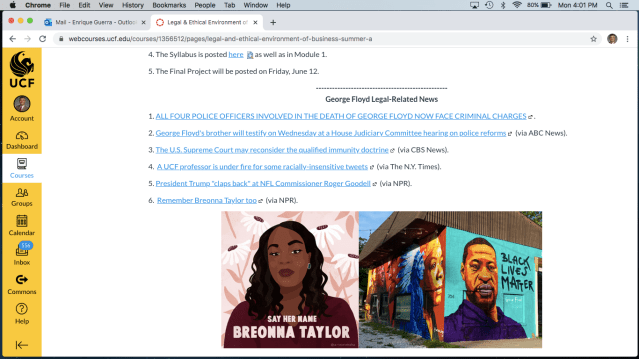
Before we delve into the details of Module 5 of my business law survey course, I would like to share a screenshot of the bottom half of my course homepage for Week 5, which I forgot to include in my previous post. The bottom of my course homepage contains legally-relevant links about real-time events relating to the recent police killing of George Floyd. Most of the BLM protests have been led by young people, and a lot of my students happen to be persons of color, so the idea here is to signal to my students that their voices are being heard (at least by yours truly). Personally, however, I don’t think we should “defund the police”; why not defund electronic license plate readers and the drug war instead?

Screen Shot 2020-06-08 at 4.01.49 PM

Posted in Uncategorized | Leave a comment

Overview of Week 5 of Tiger Law

Note: This is the first of several blog posts devoted to Week 5/Module 5 of my business law summer course.

We are now moving into Week 5 of my “Summer A” survey course in business law. My university went to remote instruction until further notice, so this course is entirely online. As a result, to make the best of a bad situation (online ed is no substitute for face-to-face classes, in my view), I have been using the surprise hit Netflix show Tiger King to explore the legal and ethical environments of business and to make the course as entertaining and engaging as possible. In this post, I will provide a general overview of Week 5 of the course and describe the contents of Module 5.

To the point, when most people think of “law” they probably conjure up images of criminal or civil trials, so Week 5 of the course is devoted to “Civil and Criminal Cases.” Tiger King is especially on point this week, since two of the main protagonists of the docuseries, Joe Exotic and Carole Baskin, were involved in protracted civil litigation and since Joe Exotic himself was convicted of murder-for-hire. Accordingly, my module on Civil and Criminal Cases is divided into seven parts as follows:

  • A. Intro Video, Textbook Chapters, & Theme Song
  • B. Civil Actions Against Joe Exotic
  • C. Criminal Charges Against Joe Exotic
  • D. Don Lewis Cold Case
  • E. Due Process & the Burdens of Proof
  • F. Settle or Go to Trial?
  • G. Quiz & Discussion Post

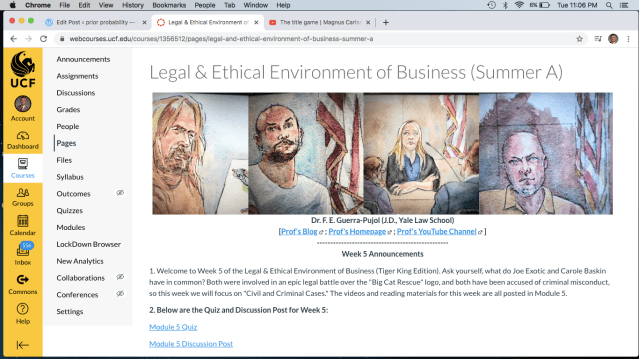
Again, because of my Tiger King theme, all of the sections in this module features artifacts, reading materials, and video clips that are specific to the Tiger King docuseries. Also, because this summer course is a short one (it ends next week!), my coverage of civil and criminal cases will focus mostly on the ideal of due process and on the burdens of proof. But once again, let’s not get too far ahead of ourselves. We will delve into the details of Module 5 during the rest of this week; in the meantime, below are some screenshots of the homepage of my course for Week 5 (the Canvas App version is below the fold):

Desktop version:

Screen Shot 2020-06-09 at 11.06.36 PM

Continue reading

Posted in Uncategorized | Leave a comment

Defund the war on drugs

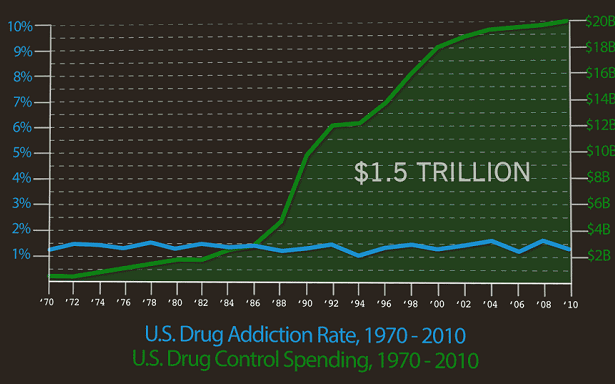
Before we begin Week 5 of my Tiger Law course on “Civil & Criminal Cases” or return to my extended review of Tyler Cowen’s Love Letter to Big Business, I want to take a time out and make a personal observation about the nationwide George Floyd protests and to my friends in the BLM movement generally. Specifically, I want to say this: The slogan “defund the police” is counter-productive. Why? Because we need someone to put violent criminals and sex offenders in jail, and that someone is the police. So, instead of “defunding the police” writ large, let’s defund the war on drugs, or at the very least, let’s return to our nation’s founding principles (#federalism) and leave it to each State to enact or repeal its own drug laws without federal interference. Am I wrong? Change my mind!

Postscript: While we’re at it, let’s defund “electronic license plate” readers (an obscene invasion of privacy) and abolish the pernicious “qualified immunity” doctrine as well!

A Chart That Says the War on Drugs Isn't Working - The Atlantic

Source: Serena Dai (via The Atlantic)

Posted in Uncategorized | 2 Comments

Ok, Boomer (Tyler Cowen edition)

Note: This is the fourth of several blog posts reviewing Tyler Cowen’s book “Big Business: A Love Letter to an American Anti-Hero.”

Let’s proceed into Chapters 3 and 4 of Tyler Cowen’s tome on “Big Business.” Warning: Although I agree with Professor Cowen’s pro-business manifesto in Chapter 1 and with his “corporate natural selection” thesis in Chapter 2, Professor Cowen is going to try to pull a fast one in Chapters 3 and 4 of his book: He is going to applaud the sixfold increase in CEO pay since 1980, and then he is going to turn right around in Chapter 4 and simultaneously defend the stagnation of worker salaries.

Here is how Professor Cowen tries to pull off this huge intellectual heist. First, he is going to draw a direct connection in Chapter 3 (“Are CEOs paid too much?”) between CEO pay and the market value of the business firms they run. Simply put, Cowen’s thesis is (p. 44): “Overall CEO compensation for the top companies rises pretty much in lockstep with the value of those companies on the stock market, largely because of the use of equity holdings and options as part of CEO compensation packages.”

Worse yet, Tyler Cowen attributes the historical rise in the market value of large corporations to CEO skill, not luck, but in fairness to Cowen, I can totally understand his utter neglect of the luck versus skill problem. Any exploration of the role of luck in CEO pay might derail his single-minded defense of the corporate status quo. After all, Chapter 3 is titled “Are CEOs paid too much?,” and Cowen’s contrarian answer is no, they are not; they should be paid even more!

What about worker pay, you might ask, which has remained relatively stagnant during this same period of time? Specifically, why hasn’t worker pay risen along with firm market value as CEO pay has? Alas, Professor Cowen utterly avoids this fundamental question. Instead of asking “Are workers paid too little?,” he changes the subject entirely and asks, “Are workers having fun?” Stated crudely (but accurately), Cowen’s thesis about stagnant worker pay is this: hey, you are lucky just to have a job, and your job is the source of most of your friendships and romantic liaisons, so shut the f*ck up and stop complaining about your pay. My reply consists of two words: Ok, Boomer…

I’ve got to hand it to Tyler Cowen. He is either a Master Troll or the most myopic economist in the world. In any case, sit tight, I will be turning to Week 5 of my “Tiger Law” course in my next few blog posts, but rest assured, I will review the rest of Cowen’s big business book at the end of this week.

CEOs made 287 times more money than their workers in 2018 - Vox

More details here, via Alexia Fernandez Campbell (Vox).

Posted in Uncategorized | 1 Comment

Natural selection in the business world?

Note: This is the third of several blog posts reviewing Tyler Cowen’s book “Big Business: A Love Letter to an American Anti-Hero.”

Let’s proceed into Chapter 2 of Tyler Cowen’s book on “Big Business.” Chapter 2 poses an intriguing question: Are business firms more fraudulent than the rest of us? Strategically speaking, I like Professor Cowen’s bold decision to begin his book (after his opening roadmap chapter) with the problem of corporate corruption and business fraud, especially given all the media attention to big-time business scandals in recent years, like Volkswagen (doctored emissions controls), Theranos (bogus medical devices), and Wells Fargo (phantom accounts).

In brief, Professor Cowen invites us to take a pragmatic view of the problem–not a Puritanical one. I will summarize his argument this way: Given human nature, some amount of fraud is unavoidable, so the question is not whether business fraud is bad. Of course it is. The question is, how pervasive is business fraud? And to answer that question, we must ask: compared to what? So, Cowen concedes up front that business firms often engage in rampant fraud. But instead of trying to explain away such corporate malfeasance, Cowen literally “turns the tables” and points an accusatory finger at the rest of us! His novel defense of business fraud can thus be summed up crudely but accurately in three words: Get over it! Yes, business firms often engage in unscrupulous behavior, but so do most, if not all, people to various degrees. We lie on our resumes and on dating sites; we cheat on our taxes; we download stuff illegally; etc., etc.

But wait; there’s more! Professor Cowen’s has something else up his proverbial sleeve, and this “something else” is even stronger than his “compared to what?” argument. Specifically, the rise of the Internet and of social media platforms has made it much easier than ever before for individual consumers and watchdog groups to call out corporations that engage in fraudulent activities. Furthermore, Cowen points out that the CEOs of business firms care about their companies’ reputations (and about their firms’ potential legal liability, I would add). As a result, these two powerful forces–the Internet and reputation costs–operate as a kind of “corporate natural selection” (my term, not Cowen’s), so to speak. Business firms thus have a strong incentive to minimize their misconduct and level of dishonesty because only the most honest business firms can thrive in such a treacherous environment!

For my part, I find Professor Cowen’s “corporate natural selection” argument far more persuasive than his “compared to what?” argument. After all, who gives a hoot if some 25 year-old lies on a dating site or illegally downloads the latest superhero movie. Cowen is comparing individual apples (e.g. the social cost of people lying on dating sites) to corporate oranges (e.g. the social cost of Theranos’s fraudulent medical devices). The next two chapters of Cowen’s book (Chs. 3 & 4) will address the issue of CEO pay (which has risen astronomically) and worker pay (which has remained stagnant), so we will proceed to Chapters 3 and 4 in our next post …

What Is Natural Selection? — Definition & Importance - Expii

Posted in Uncategorized | Leave a comment

Cowen’s Manifesto

Note: This is the second of several blog posts reviewing Tyler Cowen’s book “Big Business: A Love Letter to an American Anti-Hero.”

Now that we have gotten the appendix out of the way (see my previous post), let’s proceed to Chapter 1 of Tyler Cowen’s beautiful book on Big Business. This first chapter is titled “A new pro-business manifesto,” and to the point, Professor Cowen’s powerful manifesto can be reduced into a single tweet (p. 1): “First, business makes most of the stuff we enjoy and consume. Second, business is what gives most of us jobs.

Indeed, Cowen’s manifesto can be further boiled down into two words: “prosperity” and “opportunity”!

In other words, business firms are largely responsible for our livelihoods and for our material wealth. Let me say, right off the bat, that Professor Cowen’s succinct manifesto captured my imagination and deserves to be shouted from many Ivory Tower rooftops. Why? Because his manifesto explodes a common fallacy committed by progressive college professors and idealistic college students alike–what the late great Robert Nozick once referred to as the-manna-from-heaven fallacy in his classic work Anarchy, State, and Utopia. Although ASU is chock-full of many important ideas (almost all of which we have explored on this blog), to my mind the manna-from-heaven fallacy is Nozick’s single-most important contribution to contemporary debates about income inequality and the role of business in society.

Consider, by way of example, the issue of “affordable housing.” Put aside for the moment the fact that the lack of affordable housing in most U.S. cities is due to unconstitutional zoning regulations and self-serving NIMBYism by existing homeowners. For now, I just want note the loud calls for affordable housing from all quarters. After all, who can be against affordable housing or affordable prescription drugs or affordable whatever? Of course, no one. My point here is to show how calls or demands for more X, where X is housing or health care or whatever, are fallacious. Why are these demands fallacious? Because, before we can figure out the best way of distributing X to the people, someone has to produce that X in the first place.

In other words, progressive academics and statist politicians both commit the same fallacy, the manna-from-heaven fallacy, when they demand free stuff or promise to provide such stuff. The problem is, as Nozick and now Cowen make clear, we cannot simply assume the existence of a sufficiently large economic pie that is worth dividing while simultaneously ignoring the all-important question of incentives for production. Simply put, my dear friends, prosperity and opportunity do not fall from the sky. Goods and services must be produced by someone, and that someone are business firms. Professor Cowen, having thus started off on the right track, deserves our full attention. But does he deserve our assent? We shall proceed to Chapter 2 in my next post.

Exodus 16:1-18, Manna from Heaven | Toward a Sane Faith - Kevin ...

Posted in Uncategorized | 8 Comments