Trademarks are magic

Note: This is the fourth of five blog posts devoted to Week 4/Module 4 of my business law course (Tiger King edition). Credit for the title of this particular blog post goes to the excellent Ed Timberlake (@TimberlakeLaw), a trademark and copyright lawyer who I follow on Twitter.

As I have explained in my last few posts, week 4 of my Tiger Law course is devoted to intellectual property rights, or what I prefer to call “the law of ideas.” Thus far, I have explained why this area of law should be included in any business law survey course, and we introduced the law of copyrights. The remainder of my week 4 IP module is devoted to trademark law. In summary, I decided to emphasize trademarks and copyrights for two reasons. One is that many marketing majors are enrolled in my course; the other reason has to do with Tiger King. It turns out that the legal battles between the two central characters in Tiger King–Carole Baskin and Joe Exotic–involve a copyrighted photo and a trademarked logo.

To make my trademark coverage more manageable, I broke my trademark section into three separate parts. The first part contains an infographic explaining how the trademark registration process works as well as a series of how-to videos by the excellent and entertaining Aiden Durham explaining various aspects of trademark law, including the difference between a trademark and a service mark and whether LeBron James can register the phrase “Taco Tuesday.”

The second part of the trademark section is devoted to USPTO v. Booking.com, a pending case that was argued before the U.S. Supreme Court last month. This case itself is not that important in the grand scheme of things, but I added this section in order to give my students a small sample of how the U.S. legal system really works. I also wanted to teach my students a larger lesson. Most law courses focus on cases that are already decided. But a live dispute shows us that the law is often contested and that it’s not always easy to predict the outcome of a live case.

The last part of my trademark section includes legal artifacts that are specific to the Tiger King docuseries, including the original trademark registration of the “Big Cat Rescue” logo as well as a new trademark application for a Joe Exotic Halloween costume set (pictured below). Since Module 5 of my course is devoted to criminal and civil cases, I will wait until week 5 to discuss the details of the Tiger King case between Carole Baskin and Joe Exotic. But before I move into week 5, there is one more aspect of intellectual property law that I wish to discuss before I conclude this series of blog posts: the fair use doctrine.

Posted in Uncategorized | Leave a comment

Ok, zoomers, how many selfies have you taken today?

Note: This is the third of five blog posts devoted to Week 4/Module 4 of my business law course (Tiger King edition).

Last time, we explained why intellectual property rights are so important and deserve to be studied in depth in any business law survey course. Since my business law IP module focuses on copyrights and trademarks, let’s jump right in with copyright law. I always like to begin my analysis of copyright law by asking my students whether they have ever created any intellectual property, like a musical recording, a painting, a business logo, etc. Before we proceed, let me ask you a modified version of the same question, Have you created any intellectual property today?

It turns out that almost everyone in the world has created some form of IP in the last day or two alone! If you have ever written a love letter, drawn a doodle, or taken a selfie on your phone, then yes, you too have created intellectual property! And this observation is precisely why I like to begin to copyright law. Under the common law, any original work that can be expressed in a tangible means of expression (i.e. printed or drawn on a piece of paper) automatically belongs to the creator of the work. And that is why I like to begin with copyright law–to show my students that every single one of them has the brain power and creativity to create IP! Any questions?

We will proceed into trademark law in my next post …

SELFIE (Official Music Video) - The Chainsmokers - YouTube

Posted in Uncategorized | Leave a comment

Tiger Law Update

I am interrupting my series of blog posts on Week 4 of my Tiger Law course because, in the last 24 hours, major newsworthy events have occurred in both the Tiger King saga and in the George Floyd case. Among other things, a court granted Carole Baskin’s Big Cat Rescue full control of Joe Exotic’s roadside zoo, giving Jeff Lowe (the current owner of Joe Exotic’s zoo) 120 days to vacate the premises! In addition, as you may have already heard, all four police officers involved in the death of George Floyd have now been charged in Mr Floyd’s murder. I am in the process of recording some videos to explain the legal aspects of these new developments (e.g. the law of fraudulent transfers and the felony murder rule); in the meantime, I took the extraordinary step of updating my course homepage as follows:

Screen Shot 2020-06-03 at 9.23.53 PMScreen Shot 2020-06-03 at 9.24.03 PM

Posted in Uncategorized | Leave a comment

Peter Thiel, meet Aiden Durham

Note: This is the second of several blog posts devoted to Week 4/Module 4 of my business law course (Tiger King edition).

In my previous post, I provided an overview of Module 4 of my business law survey course. Module 4 is devoted to intellectual property rights, or what I like to call the “Law of Ideas.” I begin this module by painting the big picture with the help of Aiden Durham, a business lawyer in Denver, Colorado, whose YouTube channel (“All Up in Yo’ Business”) contains an accessible and absorbing series of videos on various aspects of business law, including intellectual property law. (FYI: Here is a link to her excellent YouTube channel.) Most law videos on YouTube are horrible, beginning with my own! Ms Durham’s videos, by contrast, are a refreshing change of pace. By way of example, here is her highly entertaining and engaging IP law explainer video:

The remainder of this module delves into the details of copyrights and trademarks, but in the remainder of this post, I want to further explain why IP law should be an essential part of any business law survey course. To see why, check out the first 90 seconds of these remarks made by Peter Thiel in 2015:

In brief, Peter Thiel makes two really important points in that video. First off, he says that, in order to succeed in the world of business, you have to have a good idea. That is, you have come up with a product or service that people would want to use. Alas, a good idea alone is not enough to succeed in business. In addition to having a good idea, you also have to figure out a way of capturing some of the value of your idea, or in Mr Thiel’s own words: “you have to create X dollars of value for the world, and you have to capture Y percent of X.” The problem, however, as Mr Thiel makes clear, is that X and Y are completely independent variables!

Here is where the Law of Ideas comes into play. Whether it be trade secrets, design patents or utility patents, copyrights, or trademarks or service marks, this area of law is what allows inventors and business firms to capture some of the value generated by their ideas. In plain English, if you want to succeed in business, you first have to come up with an original idea, but once you do this, you still need to find a way of protecting your ownership of that idea (or of the expression of that idea), and this is what the Law of Ideas allows you to do. Although Mr Thiel does not discuss intellectual property rights in his remarks (in the video clip above), I drew this crucial connection one day after reading this remarkable essay by my colleagues David Orozco and Robert Bird. (Below is a screenshot of the cover page of their paper. Also, shout out to my friend and co-author Sean P. Melvin, who brought this beautiful paper to my attention many years ago.)

With this background in mind, I will describe the rest of my week 4 IP module in the next day or two …

Screen Shot 2020-06-03 at 2.52.54 AM

Posted in Uncategorized | Leave a comment

Overview of Week 4 of Tiger Law: The Law of Ideas

Note: This is the first of several blog posts devoted to Week 4/Module 4 of my business law summer course (Tiger King edition).

I have been teaching a survey course in business law this summer. This course is entirely online (as my university moved to remote instruction until further notice), so to capture my students’ attention, I assigned my students to watch the surprise hit Netflix show Tiger King during the first week of the course (May 11-15). Two weeks ago (May 18-22), I introduced my students to the main sources of law (State, federal, and international law), and last week (May 26-29), we surveyed three major areas of the Common Law: property, torts and contracts. In this post, I will provide a general overview of Week 4 of the course and describe the contents of Module 4.

The fourth week of the course is devoted to intellectual property rights like trademarks and copyrights, or what I like to call “The Law of Ideas“. But why spend an entire week to this area of law in such a short six-week course? Why are intellectual property rights so important? In brief, business firms provide a wide variety of products and services, but ask yourself, what do all these products and services have in common? Simply put, all products and all services embody a set of ideas, and it is intellectual property law that makes it possible for persons and business firms to own their ideas or the expression of their ideas. (In plain English, if you have a good idea, intellectual property law is the area of law that allows you to legally protect your idea and make money off it. So, yeah, we are going to spend a lot of time on this area of law!)

Specifically, my module on the Law of Ideas is divided into seven parts as follows:

  • A. Intro Video, Textbook Chapter, & Theme Song
  • B. The Big Picture
  • C. Copyrights
  • D. Trademarks
  • E. The Fair Use Doctrine
  • F. Bonus Section: Tiger King-Related Trademarks & Copyrights
  • G. Quiz & Discussion Post

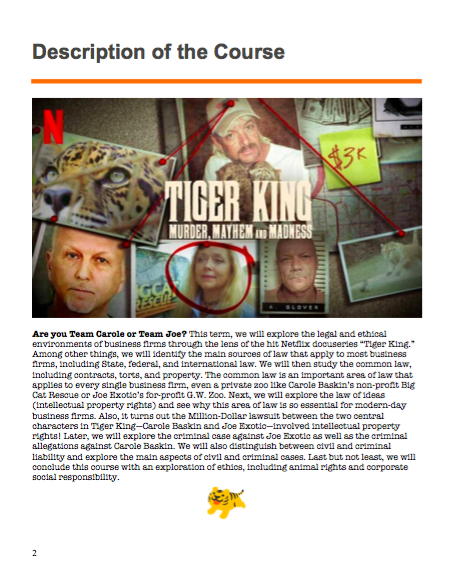
Because of my Tiger King theme, one of the sections of this module features materials that are specific to the Tiger King docuseries. Also, since this is a short, six-week summer course, I decided to narrow my coverage of intellectual property rights on copyrights and trademarks, and even with this limited focus, I still had to cram a lot of information into this module. But let’s not get too far ahead of ourselves. We will delve into the details of Module 4 during the rest of this week; in the meantime, below are some screenshots of the homepage of my course for Week 4:

Desktop version:

Screen Shot 2020-06-02 at 1.15.31 AMScreen Shot 2020-06-02 at 1.15.58 AM

Canvas App version:

Screen Shot 2020-06-02 at 1.32.34 AM

Footnote: Notice that I added an image inspired  by the “Black Lives Matter” movement on the bottom of my homepage as well as links to two news reports relating to the recent unrest following the death of George Floyd while in police custody. Part of me felt awkward doing this, as I am not a political person (I am a registered Independent, though I lean towards the libertarian side of things). But at the same time, another part of me is mad as hell that (as of today, June 2, one full week after Mr Floyd’s death), three of the four officers involved in his unlawful arrest have still not been charged by the authorities.

Posted in Uncategorized | Leave a comment

What is Minnesota waiting for?

Why haven’t the other three police officers involved in George Floyd’s death been charged yet? Here is Minnesota’s aiding and abetting statute, which makes it a crime to “intentionally aid” someone else to commit a crime.

Screen Shot 2020-06-02 at 12.40.42 PM

Source: LJ (@_one8_)

Posted in Uncategorized | Leave a comment

Recap of the laws of national necessity

Note: This is the last blog post in a series of posts on the president’s power to use military force to quell domestic disturbances inside the United States.

Thus far, we have surveyed the enactment of five federal “domestic violence” laws under Article IV of the Constitution, i.e. laws authorizing the president to use military force inside the United States under certain conditions. (The term “domestic violence” appears in Article IV, Section 4 of the Constitution. See my 2019 paper “Domestic Constitutional Violence” for a scholarly treatment of these laws.) For your reference, these laws are currently codified in Sections 251 to 254 of Volume 10 of the United States Code as follows:

  1. Internal Insurrections (10 U.S. Code § 251): among other things, this provision, which is based on the Insurrection Act of 1807, authorizes the president to use military force to respond to internal insurrections within a State.
  2. Unlawful obstructions (10 U.S. Code § 252) this provision, which is based on Section 1 of the Suppression of the Rebellion Act of 1861, authorizes the president to use military force to deal with unlawful obstructions of federal law.
  3. Civil rights (10 U.S. Code § 253): this provision, which is based on Section 3 of the Third Enforcement Act, authorizes the president to use military force to deal with private acts of violence in violation of federal law.
  4. Proclamation requirement (10 U.S. Code § 254): this procedural provision is based on the proclamation requirement contained in the original Militia Acts of 1792 and 1795.

Aside from the merely procedural proclamation requirement, what are the substantive limits, if any, to the president’s “domestic violence” powers? This dangerous body of law thus raises a paradoxical question about the proper role of violence in a constitutional republic and the relation between the rule of law and the use of violence, deep and difficult questions that can be traced back to Walter Benjamin’s classic essay on law and violence. Instead of attempting to answer this hoary metaphysical question, I will conclude by posing a subsidiary and more mundane query:

What should we call this corpus of law?

Scholars have affixed a wide variety of labels to this body of law. By way of example, these domestic violence laws have often been referred to as the “insurrection acts” (Hoffmeister), the “militia acts” (Vladeck), “the civil disturbance regulations” (Campisi), and “the law of public defense” (Dennison). In my view, however, all of these various labels are problematic. Let me explain.

On the one hand, references to such euphemisms as “civil disturbances” or “domestic disorders” are too broad, implying that the trigger or threshold for the use of military force is a low one, while on the other hand, references to “the militia acts” are too narrow, since the president is now authorized to use the regular armed forces in addition to State militias. Likewise, references to “the law of public defense” are also too narrow, since one of these laws, the 1871 Enforcement Act, broadly authorizes the president to use military force in response to private acts of violence that deprive individuals of their constitutional rights. And lastly, references to “the insurrection act” are incomplete, since the president also has the power to respond to other types of domestic dangers as well, such as invasions and large-scale obstructions of justice. In the alternative, we could refer to this body of law as “the calling forth acts” based on the original language of the 1792 and 1795 militia acts, but the modern statutes no longer use this “calling forth” formulation.

In place of these incomplete and imperfect labels, I have proposed the term “the laws of constitutional necessity” (Guerra-Pujol, 2019, pp. 231-232). One advantage of this label is that it does not take sides on the question of the source of the president’s power to use military force to preserve, protect, and defend the Constitution. That is, whether this delicate power is an inherent one under Article II of the Constitution or a delegated one under Article I, how can a mere piece of paper or “parchment barrier” by itself prevent a president from using the full powers of his office to enforce his understanding of the Constitution? (As an aside, the apt phrase “parchment barrier” originally appears in Federalist Paper No. 48.) The other reason why I prefer this label is that the word “necessity” implies that the military should always be used as a last resort and that any such use of force should be proportionate to the threat encountered. (In other words, I wish to invoke the longstanding common law tradition and understanding of the defense of necessity. See, for example, Christie, 1999.)

We could go far deeper into the meaning of the concept of “necessity.” (See, for example, the image below as well as the fascinating work of Giorgio Agamben, 2005.) In summary, does “necessity” authorize one to break the law (thus conferring legal immunity on an illegal act; cf. the work of my colleague Michael Stokes Paulsen), or does “necessity” convert an otherwise illegal act into a lawful one (my view)? Either way, it suffices to say that the president’s power to use military force during a domestic crisis, though undeniable regardless of its source, cannot be an unlimited one in a self-governing republic like ours. Instead, the inevitable occurrence of a domestic danger—whether it be an external invasion, an internal insurrection, or a large-scale obstruction of law—should determine the duration and extent of any domestic violence or threat of violence to be used in response to the danger.

Learning and Life: Doctrine of Necessity from CJ Munir to Judge ...

Source: Dr Irfan Hyder

Works Cited

Giorgio Agamben, State of Exception (2005).

Walter Benjamin, Critique of Violence, in Selected Writings: Vol. 1, 1913-1926 (Marcus Bullock & Michael W. Jennings, editors, 2004).

Dominic J. Campisi, The Civil Disturbance Regulations: Threats Old and New, 50 Indiana Law Journal 757 (1975).

George C. Christie, The Defense of Necessity Considered from the Legal and Moral Points of View, 48 Duke Law Journal 975 (1999).

George M. Dennison, Martial Law: The Development of a Theory of Emergency Powers, 1776-1861, 18 American Journal of Legal History 52 (1974).

F. E. Guerra-Pujol, Domestic Constitutional Violence, 41 University of Arkansas (Little Rock) Law Review 211 (2019).

Thaddeus Hoffmeister, An Insurrection Act for the Twenty-First Century, 39 Stetson Law Review 861 (2010).

Michael Stokes Paulsen, The Constitution of Necessity, 79 Notre Dame Law Review 1257 (2004).

Stephen I. Vladeck, The Field Theory: Martial Law, the Suspension Power, and the Insurrection Act, 80 Temple Law Review 391 (2007).

Posted in Uncategorized | 1 Comment

The strategy of riots

I am interrupting my series of blog posts on the president’s power to use military force inside the United States to share this game-theoretic perspective of riots via The Scholar’s Stage (italics in original; hat tip: Tyler Cowen): “Riots then are best understood as a coordination problem. People must act together for the riot to proceed, and importantly, they must act at the same time. Corporations and military commands develop vast hierarchies to ensure that those in their employ work in concert. The rioter does not have this option available to him.” The late great Thomas Schelling (1960, p. 90) explains in his classic work “The Strategy of Conflict” (pictured below; and one of my favorite non-fiction works of all time) how would-be rioters are able to solve this coordination problem:

It is usually the essence of mob formation that the potential members have to know not only where and when to meet but just when to act so that they act in concert. Overt leadership solves the problem; but leadership can often be identified and eliminated by the authority trying to prevent mob action. In this case the mob’s problem is to act in unison without overt leadership, to find some common signal that makes everyone confident that, if he acts on it, he will not be acting alone. The role of “incidents” can thus be seen as a coordinating role; it is a substitute for overt leadership and communication. Without something like an incident, it may be difficult to get action at all, since immunity requires that all know when to act together.

The Strategy of Conflict – Thomas Schelling – Dreamboat
Posted in Uncategorized | 1 Comment

Act III: The Suppression of Rebellion Act of 1861 and the Enforcement Act of 1871

As of today (June 1), we have witnessed six days and six nights of protests, looting, and other civil disturbances in many cities across the U.S. following the extrajudicial police killing of George Floyd in Minneapolis. We assume this unrest will come to an end once all four police officers involved in Mr Floyd’s death are charged by local or federal prosecutors. But what if the unrest continues unabated? At what point does the president order the military into a U.S. city to restore order, and does the president even have this authority in the first place?

It turns out that the president does have this authority under a series of five federal laws enacted by Congress between 1792 and 1871. Thus far, we have reviewed the first three of these historic laws–the Insurrection Act of 1807 as well as the Militia Acts of 1792 and 1795. In this post, we will proceed to the Suppression of Rebellion Act and one of post-Civil War “Enforcement Acts”. The former law was enacted in 1861, just as the “War Between the States” was getting started, while the latter law was enacted in 1871, a few years after the Civil War had ended. Suffice it to say that these two laws further expanded the president’s power to use military force inside the United States.

By the time a rump Congress had enacted The Suppression of Rebellion Act on July 29, 1861, eleven States had already officially left the Union. Ironically, however, President Lincoln did not base his legal authority to conduct the civil war on the 1861 law. Nevertheless, the 1861 law represents a major expansion of the president’s power to use military force inside the U.S.; or in the words of one legal scholar (Stephen Vladeck, 2004, pp. 166-167), “to whatever extent the 1795 Act had removed or changed three important checks on the President’s authority under the 1792 Act, the 1861 Act heavily diluted the major checks that remained.”

Specifically, the 1861 law revised the existing 1795 and 1807 domestic violence laws that we saw in our previous posts by authorizing the president to use military force to respond to “rebellions.” In addition, Section 1 of the 1861 amended and replaced Section 2 of the old 1795 Militia Act and further increased the president’s military power in two ways. First, the new rebellion law replaced the previous obstruction trigger in the 1795 law with a much lower standard. Under the old law, an obstruction had to be “by combinations too powerful to be suppressed by the ordinary course of judicial proceedings”; under the new law, by contrast, the obstruction just had to make it “impracticable” to enforce federal laws. Second, the 1861 law committed to the president’s sole discretion the initial determination of whether or not it was “impracticable” to execute the laws!

Of course, it should come as no surprise that the Congress would vote to expand the president’s power to use military force during one of our nation’s most serious political and military crisis. But the Congress would further expand the president’s panoply of domestic military powers when it enacted a series of three “enforcement acts” in 1870 and 1871 in response to the rise of private militias like Ku Klux Klan following the defeat of the Old Confederacy. (For an excellent overview of the politics and history of these enforcement laws, see Jeffrey A. Jenkins & Justin Peck, Congress and Civil Rights: The Demise of Reconstruction, 1871-1877 (2016), especially pp. 1-22, available here.)

Of particular relevance to our legal saga is the third Enforcement Act, which was enacted by the Congress on April 20, 1871. What makes this particular law noteworthy is that it authorizes the president to use military force to enforce constitutional rights. Previous domestic violence laws enacted by the Congress were designed to give the president the military power to enforce federal laws as well as the military power to protect the territorial integrity of the United States. Section 3 of the 1871 Act, by contrast, authorizes the president to use military force to protect “the rights, privileges, or immunities” of “the people” when one of two conditions are met. First, the president may use military force inside the U.S. to fight an insurrection or an unlawful combination or conspiracy in a State that obstructs or hinders the enforcement of State or federal law, when the “constituted authorities of such State” are unable or refuse to protect the constitutional and civil rights of the people. In the alternative, the 1871 law authorizes the president to use military force “whenever any such insurrection, violence, unlawful combination, or conspiracy shall oppose or obstruct the laws of the United States or the . . . due course of justice under the same.”

FYI: President Ulysses S. Grant invoked this enforcement legislation in the fall of 1871 when he ordered U.S. Army Major General Alfred H. Terry (pictured below, bottom left) to eradicate the Klan and arrest its members in the northern counties of South Carolina, and Section 3 of the 1871 Act is still in effect to this day, along with the Suppression of Rebellion Act of 1861, the Insurrection Act of 1807, and the amended parts of the Militia Act of 1795. Combined, this remarkable body of law gives the president enormous powers to respond to “domestic violence” (as that term of art is used in Article IV of the Constitution). We will conclude our review of this dangerous body of “domestic violence” law in our next post.

A House Divided: War Between the States 1861-65 | Board Game ...
Screen Shot 2020-06-01 at 4.41.26 AM
Posted in Uncategorized | Leave a comment

Act II: The Insurrection Act of 1807

Let’s proceed with our review of federal “domestic violence” law. When former Vice President Aaron Burr was accused of orchestrating a shadowy conspiracy to create an independent republic in North America in late 1805, President Thomas Jefferson took decisive military and legal actions to apprehend the conspirators and halt Burr’s scheme. (This enigmatic episode in our nation’s history is referred to by historians as The Burr Conspiracy.) From a legal perspective, however, President Jefferson found himself in a constitutional “catch-22” situation. On the one hand, only State militias could be used against domestic insurrections under then-existing law (the Militia Act of 1795, which we reviewed in a previous post). On the other hand, Aaron Burr intended to create an independent republic in Texas, and at that time, Texas was a Spanish dominion, not a U.S. State, so there was no State militia for Jefferson to call!

The solution to this legal catch-22 was federal legislation authorizing the use or regular U.S. Army soldiers as well as local militias to respond to domestic dangers, and the Congress soon thereafter adopted this novel solution when it enacted the Insurrection Act of 1807. This remarkable law consists of a single sentence and is worded as follows:

That in all cases of insurrection, or obstruction to the laws, either of the United States, or of any individual state or territory, where it is lawful for the President of the United States to call forth the militia for the purpose of suppressing such insurrection, or of causing the laws to be duly executed, it shall be lawful for him to employ, for the same purposes, such part of the land or naval force of the United States, as shall be judged necessary, having first observed all the pre-requisites of the law in that respect.

This dangerous law expands the president’s authority to use military force inside the United States in two significant ways. First, the new law applied to “all cases of insurrection, or obstruction to the laws, either of the United States, or of any individual state or territory.” In other words, the president could now use federal military force to enforce both State laws as well as federal laws. But even more importantly, the 1807 law not only authorized the president to “call forth” State or local militias in these two situations (“insurrection” and “obstruction to the laws”); for the first time the 1807 law also authorized the president to activate federal troops. Prior to 1807, the president had to rely on State or local militias to put down rebellions and repel invasions on U.S. soil. Now, beginning with the 1807 law, the president obtained legislative authority from Congress to use regular federal troops in addition to State and local militias to respond to domestic dangers.

In the scheme of things Aaron Burr’s conspiracy was a small blip on the constitutional radar; the greatest threat to the vitality of the Constitution and to the territorial integrity of the United States was yet to come: the Civil War (1861-1865). The Congress further expanded the president’s legal authority to use military force inside the U.S. when it enacted the Suppression of Rebellion Act of 1861 and Enforcement Act of 1871, so we will review those two laws in our next post.

burrconspiracy hashtag on Twitter

Posted in Uncategorized | Leave a comment