Is UBI politically feasible?

Did you know the 91st Congress (1969 to 1971) almost enacted a guaranteed income bill? The Chapman Law Review has just published a special symposium volume: “A Fifty-Year Retrospective on Major Laws of the 91st Congress.” My contribution, however, was about “the one that got away.” Instead of writing about the many historic (and I would argue, misguided) laws that were enacted by the 91st Congress, I wrote about President Nixon’s proposed guaranteed income bill, which was approved by the House but died in the Senate. I wrote my history of the guaranteed income bill in the form of a three-act legislative morality play and called it “A Chronicle of a Political Death Foretold.” Although my essay is historical in nature, it is nevertheless very timely, for it offers many lessons to both proponents and opponents of contemporary Universal Basic Income proposals.

Is it time to consider universal basic income? - Futurity

Posted in Uncategorized | 11 Comments

Hey Adam Silver, what are you waiting for?

Update (June 5): The NBA season will resume on July 31, 2020 at Disney World in Orlando, Florida!

Below is my original May 29 post (sans gif): “Leadership is a two-way street. Now that the coronavirus has been contained in most places and all 50 States have begun to reopen, when will the NBA playoffs resume? As Zach Lowe writes in this essay for ESPN, ‘The NBA’s cleanest method of resuming its season is to bring the 16 current playoff teams to its designated campus, seed them as they are now — eight East, eight West — and play the NBA’s normal postseason.’ So, what are we waiting for?”

Posted in Uncategorized | 1 Comment

Illicit promises of the rich and famous

Note: This is the last of five blog posts devoted to Module 3 of my business law course (Tiger King edition).

Thus far, we have surveyed the first three parts of my Common Law Module, which are devoted to the domains of Property, Contracts, and Torts. Alas, we are not done yet! Since my business law course is now based on Tiger King, and since Joe Exotic was accused of hiring a hitman to knock off a rival, I have decided to add a bonus section to my common law module. This bonus section addresses the problem of illicit promises, i.e. agreements that are either illegal or immoral or both. Although the idea of an “illicit promise” may sound esoteric, exotic even (pun intended), in reality illicit promises are everywhere. All you have to do is look around you!

By way of example, in addition to the alleged hitman agreement between Joe Exotic and Allen Glover in Tiger King, many high-profile individuals have recently been accused of making illicit promises. Consider the prominent actress Lori Loughlin, one of many wealthy parents who have pled guilty of participating in the college admissions scandal. Although, legally speaking, Ms. Loughlin and dozens of other parents were charged with mail fraud and honest services fraud, their alleged wrongdoing consists of making multiple illicit promises, including bribes and illicit schemes to fraudulently inflate SAT scores. (By the way, in my opinion these parents and their spoiled children should be sentenced to life in prison for gaming the system.) Or consider the pending criminal prosecution of Robert K. Kraft, the horny owner of the New England Patriots football team, who was charged by the State Attorney’s Office of Palm Beach County, Florida with two counts of soliciting prostitution at a massage parlor. Prostitution, sex for hire, and human trafficking are paradigm cases of illicit agreements.

I explore these and many more examples of illicit promises in greater depth in my working paper “Breaking Bad Promises.” Simply put, many forms of wrongdoing often involve immoral promises or illegal agreements, especially given the expansion of federal regulatory crimes as well as our evolving and expanding conceptions of morality, such as animal rights. For now, I just want to ask, What is the legal and moral status of illicit promises? Once again, common law judges have developed a sophisticated body of legal principles to solve a real life problem, a body of common law that in my humble opinion is far more polished and practical than anything academic moral philosophers have ever come up with.

In summary, courts generally classify illicit agreements into two broad categories: (1) those that are inherently wrongful and immoral or mala in se, e.g. murder, rape, kidnapping, etc., and (2) those that are merely illegal or mala prohibita, e.g. regulatory crimes and technical violations of the law. Specifically, promises involving some form of moral turpitude are said to be mala in se and are thus void ab initio, while illicit agreements in violation of a commercial statute or an economic regulation are said to be merely mala prohibita and are treated as “voidable” by the party that stands to benefit from enforcing the illegal agreement. Either way, illicit promises should be of theoretical interest to philosophers and legal theorists because such promises exemplify the uncertain relation between ethics and law, a topic we will return to in Module 6 of my Tiger Law course. But Module 6 of “Tiger Law” is still a long ways off. We still have to explore the “Law of Ideas” (Module 4) and “Criminal & Civil Liability” (Module 5) …

Screen Shot 2020-05-27 at 1.29.52 PM

Illicit promises of the rich and famous!

Posted in Uncategorized | 1 Comment

Beware of the Cow: Tiger King and Cattle Trespass

Note: This is the fourth of five blog posts devoted to Module 3 of my business law course (Tiger King edition).

We have been surveying the Common Law module of my business law course this week, starting with some foundational questions in the Law of Property and the Law of Contracts. (See my previous posts on May 26 and 27.) The next part of my Common Law module is devoted to the Law of Torts, with an emphasis on accidents or unintentional harms. To capture everyone’s attention, I begin this part of the module with a recording of the 911 emergency call Joe Exotic made when one of his employees, Saff, got his arm mauled by a tiger, and then I pose a general but important legal liability question that haunts all business firms, especially now in the age of COVID-19: When is a firm legally liable to its employees or its clients for their accidental injuries?

It turns out that the answer to this all-important question depends on which of the two major theories of tort liability is used by the courts to evaluate the conduct of the firm: Strict Liability or Negligence? Therefore, to illustrate the main differences between these two general theories of legal liability, I next introduce my students to the Florida case of Rockow v. Hendry, a “cattle trespass” case involving a crop farmer and a cattle rancher. The facts of this case are simple: the rancher’s cattle had destroyed some of the farmer’s pepper crops, so the farmer sued the owner of the cattle for money damages–the economic value of his destroyed pepper crops.

Why a cattle trespass case? For two reasons. First off, both rules of legal liability have been applied to the problem of stray cattle, so what better way of illustrating the difference between Strict Liability and Negligence (as well as the interplay between the common law and legislation) than cattle trespass? Historically speaking, for example, cattle trespass was considered a “strict liability” tort by the courts. In practice, this meant that the owner of the cattle was always legally liable for any damages caused by his cattle, no matter how much care the owner used to keep his cattle fenced in. At first glance, this rule makes good common sense. The rancher should be legally liable; after all, they are his cattle.

But hold up! What about car accidents caused by stray cattle? Eventually, the historical rule of strict liability gave way to a negligence standard in some places. How and why did this happen? Some localities in the U.S. began enacting so-called “open range” laws that favored cattle ranchers. Instead of strict liability, these laws required courts to apply a negligence standard to the problem of cattle trespass. Stated as simply as possible, under a negligence standard you are legally liable for the injuries suffered by a stranger only if you owed that stranger a duty of care and only if you failed to exercise due care and that failure on your part is what caused the injury to the stranger. The bottom line is this: if you are plaintiff, you would rather sue under a strict liability theory than a negligence theory because it is generally easier to recover under strict liability.

This temporal rule-switch takes us to the other reason why I have assigned a cattle trespass case to illustrate the law of torts. It turns out that cattle trespass was the same example an English economist (my hero Ronald H. Coase) originally used to illustrate an important point about most legal disputes. Instead of pre-judging the legal liability issue, let’s do what Ronald Coase did and take a deeper look at the cattle trespass problem. At a deeper level, isn’t the farmer just as responsible as the rancher for the problem? How so? Because the problem of stray cattle is foreseeable to both parties, so one could put as much blame on the farmer as the rancher. After all, why didn’t the farmer plant cattle-resistant crops or build a fence to keep the cattle out? Why should it be up to the rancher to fence his cattle in? (To appreciate the originality of Coase’s deep insight, just imagine that the cattle ranch and the crop farm were owned by the same business firm.)

We are not done with the common law just yet. Recall one of the central episodes in Tiger King when Joe Exotic allegedly hired a hitman to knock off a rival? As a result, I added a bonus section to my common law module on illegal agreements, and I will delve into this section in my next blog post …

Beware Of The Cow | Vintage Metal Garden Warning Sign | Keep Out ...

Available on eBay (see here).

Posted in Uncategorized | 1 Comment

Where did we go wrong?

Too many ex ante regulations, anyone? I am interrupting my series of blog posts on the common law to ask, What happened to the future? Where did we go wrong? Or as Peter Thiel once remarked, “We wanted flying cars; instead we got 140 characters.” This is one of my favorite quotes of all time, but coming from my fellow libertarian-minded colleague Peter Thiel–the first outside investor in the original Facebook, a social media platform that at one time was even more addicting than Twitter–a potential answer to my question becomes apparent. Aviation and transportation are two of the most heavily-regulated businesses in the world (see here, for example); social media, by contrast, is one of the few remaining activities that are almost entirely free from government regulation. As an aside, this is just another reason why I favor the common law approach to legal liability (ex post regulation) over the “modern” approach (ex ante regulation). Am I wrong? Change my mind!

Screen Shot 2020-05-26 at 9.12.41 PM

Posted in Uncategorized | 2 Comments

A tale of two rewards: Pepsi versus Joe Exotic

Note: This is the third of five blog posts devoted to Module 3 of my business law course (Tiger King edition).

We reviewed the Property Law part of my common law module in my previous post. The next part of my common law module covers Contracts. In my humble opinion, however, the Law of Contracts is one of the most complex and cumbersome areas of the common law. Therefore, since I am teaching a survey course in business law, I have decided to focus on one of the most basic yet intriguing issues of contracts rather than get bogged down in the technical minutiae of this area of law. Specifically, I have decided to focus on the following fundamental question: when is a promise legally-binding?

Simply put, not all promises are legally binding under our common law tradition, for one of the most well-established principles of the common law is that a promise, in order to be judicially enforceable, must be supported by “bargained-for consideration.” In plain English, this principle means that each party to a contract must offer the other “something of value” in exchange for the other’s promise. This “something of value” can be money, services, or anything else, as long as it is lawful and offered with a serious intent, not in jest.

Another important maxim of the common law of contracts is that courts do not inquire into the adequacy of consideration, only its existence. That is, judges are not supposed to second guess the business acumen of the parties; their role is limited to making sure that the substance of a party’s promises is lawful and serious. In the case of a promise consisting of a reward offer, one’s performance of the requested service constitutes both an acceptance of the offer and the transfer of something of value to the person making the offer.

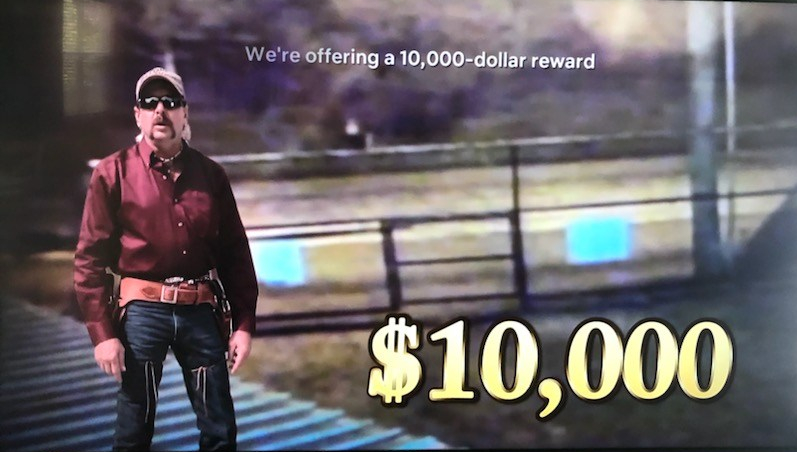
By way of example, consider the reward offer made in Episode 4 of the Tiger King docuseries, when Joe Exotic offers $10,000 for any information leading to the arrest of his rival Carole Baskin for the disappearance of her husband Don Lewis. Is Joe Exotic’s reward offer a legally-enforceable one? My tentative answer is yes–Joe Exotic’s offer is legally enforceable–unless it was made in jest. Now, let’s contrast Joe Exotic’s reward offer in Tiger King with a different reward offer–one that was made by Pepsi Cola in a now infamous TV ad.

In brief, Pepsi once ran a TV ad that offered a Harrier jet to any customer that accumulated seven million Pepsi points. Is that a serious offer, like Joe Exotic’s? While most television viewers may have taken Pepsi’s TV ad in jest, a 21-year-old, John Leonard, took it seriously. He rounded up five investors, and together, they purchased seven million Pepsi points for $700,000 as per the rules of Pepsi’s offer. Leonard’s group then demanded the jet as offered in the Pepsi commercial or its monetary equivalent; they took the cola giant to court when Pepsi refused to perform or pay. Footnote: At the time, a Harrier jet cost $23 million. Given these facts, how would you have ruled in the Pepsi case?

Now that we have said a few words about Property and Contracts, we will proceed to the Law of Torts–and the key choice between Strict Liability and Negligence–in the next day or two.

Joe Exotic Reward Offer

Posted in Uncategorized | 1 Comment

The case of the saucy intruder

Note: This is the second of several blog posts devoted to Module 3 of my business law survey course (Tiger King edition).

In my previous post, I presented an overview of Module 3 of my survey course in business law. Here, I will delve into the details of Module 3, which is devoted to three important areas of the Common Law: Property, Contracts, and Torts. Because I am teaching a survey course, I have (once again) tried my best to reduce the amount of reading materials in Module 3, limiting this module to just three common law cases, Pierson v. Post for the property section, Leonard v. PepsiCo for the contract section, and a cattle trespass case out of Florida (Rockow v. Hendry) for the torts section. In addition to these law cases, this module also contains picture prompts and video clips about several incidents in “Tiger King” that raise important legal issues under the common law, like Joe Exotic’s $10,000 reward offer and the time when one of his employees (Saff) got his arm chewed off by a tiger.

With this basic background in mind, let’s now delve into the Law of Property and discuss the first of our classic common law cases, Pierson v. Post, which is considered by many students of the common law to be the most famous property case in North American legal history. (Also, check out some of the sundry Pierson v. Post merchandise pictured below!) One of the reasons this case is deservedly famous is because it poses a fundamental question: how can something of value be first owned by a human being?

In summary, the facts of Pierson v. Post are as follows: Post was out hunting with his dogs at an uninhabited beach near Southampton in New York State. They were giving chase to a wild fox, but just when Post was about to capture the creature, another man, Pierson, snatched it and carried it off for himself. The rest is legal history. Post was indignant at this breach of local custom and good sportsmanship, so he filed a lawsuit against Pierson claiming that because he and his dogs had already begun pursuing the fox, the property of the fox’s pelt and carcass were rightfully his, not Pierson’s, and the local justice of the peace ruled in favor of Post. Pierson, however, appealed the ruling to the New York Supreme Court of Judicature, who reversed the justice’s decision and ruled in favor of Pierson.

In deciding this case, the majority opinion refers to a wide variety of historical legal treatises, including the Institutes of Justinian from the 5th century A.D. and the writings of Henry de Bracton in the 13th century as well as of Samuel von Pufendorf in the 17th century, and concludes that the time and effort Post spent giving chase to the fox was not sufficient to create a property right. Something more is needed, and that “something more” is actual physical possession. The dissenting judge, by contrast, called Pierson out as a “saucy intruder”, a violator of norms. Simply put, if you were to ask local hunters in Southhampton, N.Y. how they would have decided this case, they would have “regarded hot pursuit as giving rights to take an unimpeded first possession.”

Putting aside the particulars of this property dispute for a moment, this case is important not only for its substantive ruling but also because it illustrates the two main ways judges decide cases. On the one hand, the majority chose to apply a simple bright-line rule to decide the case (the rule of physical possession), while the dissent would have applied a flexible standard (the rule of hot pursuit) based on local customs. Both of these rules have advantages and disadvantages. By way of example, how is the rule of hot pursuit to be applied? Although a bright-line rule is easier to apply than a general standard, it can produce unfair results in murky cases. Pierson v. Post is a case in point! General standards, on the other hand, are more flexible and fair, since they can be tailored to each individual case, but if a standard is too general and flexible, it can produce indeterminate results. How much time and effort, for example, must be expended to create a property right in a wild animal? Does it depend on the type of animal being hunted? Unlike a simple rule like first possession, the rule of hot pursuit can give way to endless disputes and thus invite greater amounts litigation …

So much for property rights and saucy intruders. We will proceed to the Law of Contracts in my next post …

Screen Shot 2020-05-26 at 10.56.50 AM

Posted in Uncategorized | 2 Comments

Overview of Module 3 of Tiger Law

Notes: This is the first of several blog posts devoted to Module 3 of my business law survey course (Tiger King edition). This post was updated on 9/29/20.

If you are new to this blog, we are teaching an online survey course in business law this fall and have assigned our students to watch the surprise hit Netflix show “Tiger King: Murder, Mayhem, and Madness.” In summary, the course consists of six separate modules. Last time, we featured Module 2 on “Sources of Law” (State law, federal law, and international law); this time, I will provide a general overview of Module 3 of the course, which covers three major areas of the Common Law: Property, Torts, and Contracts.

In brief, the Common Law is not only one of the greatest intellectual achievements of the Anglo-American world; the Common Law also permeates almost every aspect of our lives and is probably the single-most important area of law for most business firms. Why? Because without property rights, without contract rules for being able to transfer or rearrange these rights, and without rules of tort liability for intentional and accidental injuries, we could not have markets, and without markets, we would not have business firms. Accordingly, my module on the Common Law is divided into six parts as follows:

  • Theme Song and Playlist of Lectures
  • Property
  • Contracts
  • Torts
  • Bonus Section on “Illegal and Immoral Promises”
  • Assignments

Like the previous module (Module 2), the first five parts of Module 3 contain videos and reading materials, while the last part contains a quiz, a discussion post, and a survey. (The survey question is, Should President Trump pardon Joe Exotic or commute his 22-year sentence?) Moreover, because of my Tiger King theme, every section in this module features problems, questions, and materials involving wild or domesticated animals. By way of example, the Property Law section is devoted to the classic common law case of Pierson v. Post, involving a dispute over the ownership of a wild fox, while the Tort Law section contains a cattle trespass case to illustrate the difference between strict liability and negligence. Even the bonus section contains a book chapter devoted to outlaw contracts with vampires! But I am getting ahead of myself … I will delve into the details of Module 3 in my next few blog posts.

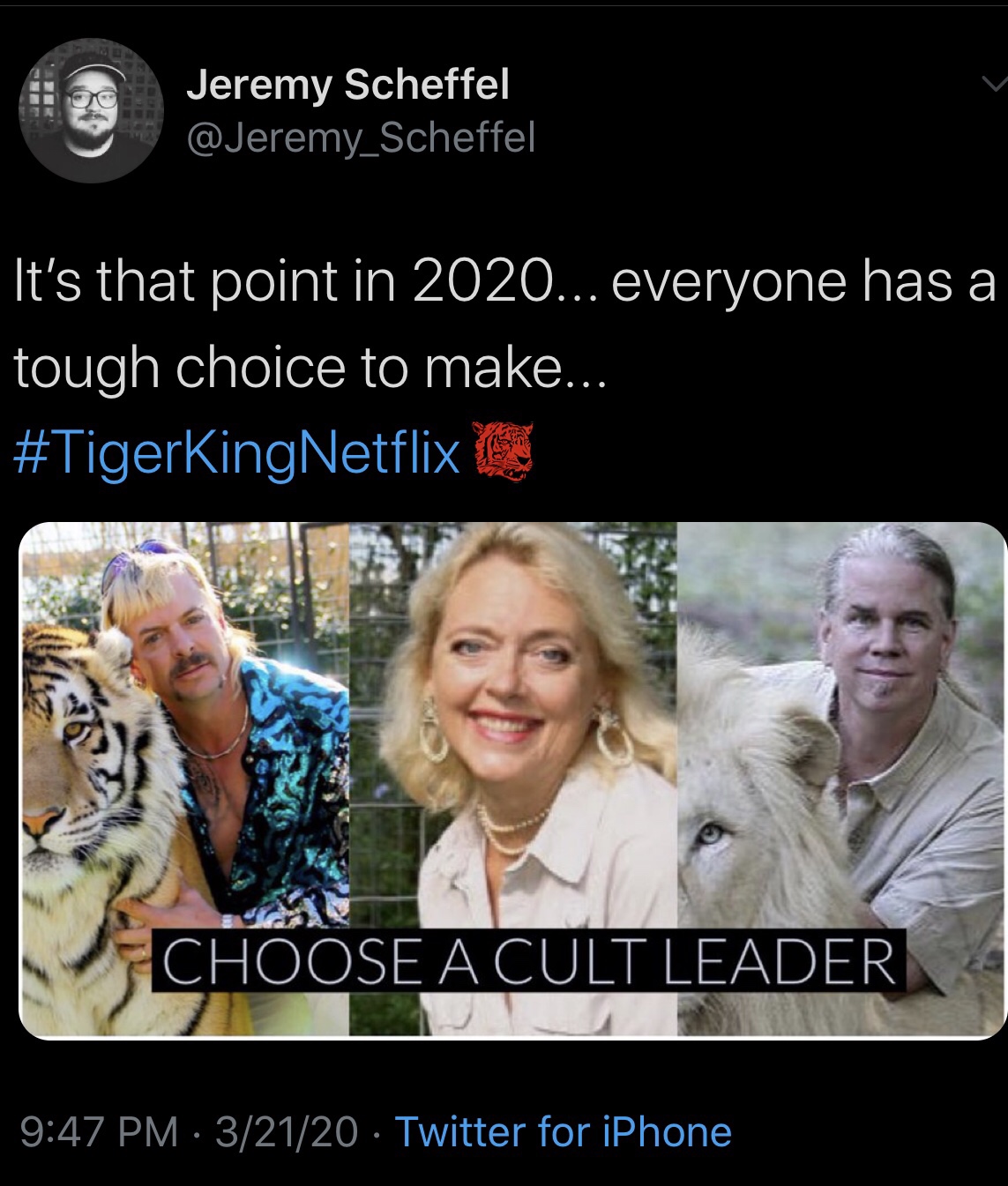
Tiger King Memes That Are Almost As Good As The Documentary

Posted in Uncategorized | 1 Comment

Posted in Uncategorized | Leave a comment

In memoriam

Kindly join me in taking a moment to honor the brave men and women of our armed forces, especially those who have made the ultimate sacrifice for our freedoms.

Flag of the United States - Wikipedia
Posted in Uncategorized | 1 Comment