I am reposting my “final thoughts” on Atlas Shrugged. The only thing I would add to my 2018 review is this modest proposal: leftist academics and politicians of all kinds should add Ayn Rand’s magnum opus to their reading lists.
(a) The Good 🙂: This is by far the most entertaining book we’ve ever read explaining the evils of communism and the hypocrisy of most intellectuals. One can choose to dismiss these “big ideas” as adolescent, simplistic, or naive, but as the histories of various revolutions have shown, radical redistribution schemes make everyone poor–everyone, that is, except for those in power. (As a further aside, if intellectuals truly favored equality, why do so few (if any) of them refuse to accept prizes or literary awards? And why are academic intellectuals responsible for perpetuating the most feudal, archaic, and anti-egalitarian domain of the modern economy? Yes, we are referring to Academia!)
(b) The Bad 😦: Although the story is a compelling one, the bad guys in Atlas are uni-dimensional, mere straw men. As a matter of fact, we would love it if someone were to rewrite Atlas–but from…
As promised, I am re-posting part 3 of my 2018 review of “Atlas Shrugged” here. Also, I will re-post my final thoughts and make a modest proposal soon …
We have been exploring the most original ideas and insights contained in Ayn Rand’s cult-classic Atlas Shrugged, such as the depiction of Robin Hood as an anti-hero and the comparison between trademarks and coats of arms. But to us, the single-most original and surprising idea by far in this epic story occurs on pp. 453-455 (Part Two, Ch. 4) of Atlas Shrugged, during a conversation between two of the leading protagonists of the story, the incorruptible North American industrialist Henry “Hank” Rearden and the mysterious Argentinian copper heir Francisco d’Anconia, who both are in love with the same woman, the heroine Dagny Taggart. (As an aside, check out the different Dagny Taggart visualizations below.) During this dramatic meeting in Francisco d’Anconia’s suite in the Wayne-Falkland Hotel–their second careo or face-to-face encounter in the story–, d’Anconia explains to Rearden the close connection between sex and ethics:
As promised, I am re-posting part 2 of my 2018 review of “Atlas Shrugged.” (Also, I will post part 3 as well as my final thoughts about Ayn Rand’s masterpiece over the weekend.)
So much has been written about Ayn Rand’s magnum opus Atlas Shrugged that we have decided to focus on the three most original insights contained in this monumental novel. (Of course, just because an idea is novel or new does not make it true, but when evaluating a work of art, one can value originality for its own sake.) In our previous post, for example, we revisited Ayn Rand’s original, revisionist critique of Robin Hood. Today, we will explore another original idea in Atlas Shrugged, the idea expressed by one of the main characters in the novel (the Argentinian aristocrat and copper heir Francisco d’Anconia) that brands, corporate logos, and trademarks are the modern equivalent of the such bygone heraldic symbols as family crests and coats of arms. The passage in which Francisco d’Anconia makes this novel comparison appears on page 94 of the 35th anniversary edition of Atlas
While I am “on vacation” working on other projects, I thought I would repost part 1 of my review of “Atlas Shrugged” for my loyal readers. (Coincidentally, I wrote this review exactly two years ago!) Also, I will repost the remainder of my review in the next day or two …
Is Robin Hood a good guy or a bad guy? Our previous post identified three original ideas in Atlas Shrugged. One of these is Ayn Rand’s revisionist critique of Robin Hood, the legendary outlaw who robbed from the rich and gave to the poor. This counter-intuitive critique appears on pp. 532-533 of this monumental tome (all page references are to the 35th anniversary edition of Atlas Shrugged, the one with an Introduction by Leonard Peikoff), or about halfway into the novel, where one of the secondary characters in the novel (the Norwegian pirate Ragnar Danneskjöld) questions the moral ideal of Robin Hood, describing him as “the most immoral and the most contemptible” anti-hero. (By the way, we begin our review of Atlas Shrugged with the Robin Hood passage because the idea expressed in this passage is central to the main thesis of the novel: government regulators are…
Hello. Because this is a one-man blog, and because I will be taking a vacation for the rest of July and for most of August, I will be blogging much more sporadically, if at all, during the next few weeks. Rest assured, however, that I will present my grand synthesis of Oliver Wendell Holmes’s prediction theory of law and H.L.A. Hart’s internal point of view upon my return in late August or early September. Note: I won’t really be “on vacation” per se; instead, I will be using this time to give talks (via Zoom, of course) at several academic conferences and to complete some other scholarly projects, including a book-length treatment of “Goedel’s Loophole.” (If time permits, I may blog about these other projects in the days ahead.)
Because I teach business law, I am interrupting my series of blog posts about H.L.A. Hart’s influential theory of law to share this fascinating map (circa 2018) with the world. Hat tip: u/OttoOnTheFlippside (via Reddit). As an aside, compare the map below with this population map of the USA, also to scale.
We identified three potential problems with H.L.A. Hart’s “rule of recognition” in my previous post. In summary, Problem #1 is that Hart’s rule of recognition is not really a “rule” in any conventional sense; problem #2 is that, regardless of the ontological status of the rule of recognition, it is a totally circular rule; and problem #3 is that the rule of recognition is self-defeating.
We were able to sidestep the first problem by introducing F. A. Hayek’s notion of “spontaneous order” and David Lewis’s work on “social conventions.” In other words, rules or norms can often emerge through a decentralized or invisible-hand process, if the conditions are right. But what about the other two objections to Hart’s theory of positive law? On the one hand, if “law” includes only those rules and norms that judges themselves recognize as law (via Hart’s rule of recognition and internal point of view), then there is something circular in Hart’s definition of law. On the other hand, if “law” is based on the internal acceptance of judges, there could in theory be as many valid legal systems as there are individual legal officials!
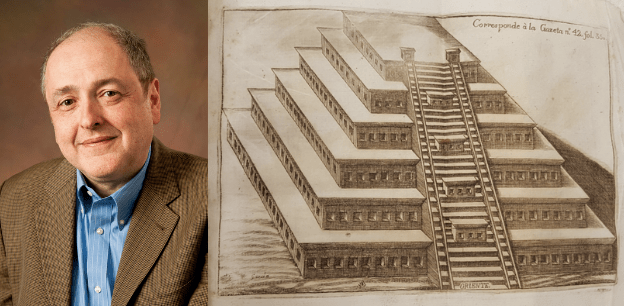
Here is where the work of my colleague and friend Brian Leiter (pictured below, bottom left) deserves special mention. According to Leiter, Hart’s rule of recognition really only comes into play when two conditions are met: “internal acceptance” and “massive agreement” among most lawyers and judges. (As an aside, I blogged about these two key conditions last year.) Although disagreements about the law usually receive the lion’s share of our attention (think, by way of example, of all those highly controversial cases that go up to the U.S. Supreme Court), Professor Leiter has often pointed out that such disagreements are, in fact, relatively rare and uncommon. Most of the time, most lawyers and most judges agree on the content of most primary and secondary rules and also on which rules are valid or not.
To prove his point, Professor Leiter has often compared the universe of all legal questions to a large lopsided pyramid, such as the one pictured below (bottom right). (As an aside, Leiter’s legal pyramid is the image that stood out for me the most from when I attended Professor Leiter’s lectures in Paris last summer.) For Leiter, the base of the pyramid includes all those myriad legal consultations and legal disputes that enter a lawyer’s office. Most such cases are simple and straightforward, or in Leiter’s own words (2009, p. 1227), “most cases that are presented to lawyers never go any further than the lawyer’s office; … most cases that lawyers take do not result in formal litigation; … most cases that result in litigation settle by the end of discovery; … most cases that go to trial and verdict do not get appealed; and … most cases that get appealed do not get appealed to the highest court …” (See Brian Leiter, “Explaining Theoretical Disagreement,” published in The University of Chicago Law Review, Vol. 76 (2009), pp. 1215-1250.)
But as Leiter himself concedes, the “law” becomes more fluid and unstable as we approach the pinnacle of the pyramid, especially the 80 or so cases that the U.S. Supreme Court agrees to review each year out of the billions of possible legal questions at the bottom of the pyramid. In other words, it is only as we approach the very top of Leiter’s legal pyramid that the “rule of recognition” collapses into an “every judge for himself” scenario, and even here, such legal doctrines as stare decisis and res judicata help to mitigate or reduce (at least somewhat) this level of legal uncertainty. For my part, one of the things I like the most about Leiter’s pyramidal lens is that it not only leaves some room open for legal uncertainty or what I like to call “probabilistic law”; this approach also makes possible a synthesis between Oliver Wendell Holmes’s famous prediction theory of law and H.L.A. Hart’s subjective lens or “internal point of view.” Stay tuned. I will present such a synthesis in the next day or two …
Alternative Title: Three Blind Spots with Hart’s Theory of Law
We devoted our previous two blog posts to H.L.A. Hart’s influential theory of positive law. Here, I will identify three blind spots in Hart’s theory of law. The source of all three problems is Hart’s “rule of recognition”–i.e. the secondary rule that tells us what primary rules are part of the legal system or are binding on public officials. Problem #1 is that Hart’s rule of recognition is not really a “rule” in any conventional sense; problem #2 is that, regardless of the ontological status of the rule of recognition, it is a totally circular rule; and problem #3 is that the rule of recognition is self-defeating: there can be as many valid legal systems as there are individual legal officials! Each of these problems or blind spots, individually, is enough to mortally wound Hart’s theory of law. Combined, they utterly obliterate it.
For now, let’s focus on my first objection to H.L.A. Hart’s rule of recognition–that it is not really a legal rule in any conventional sense of the word “rule.” (Alas, I wish I could take credit for this powerful objection, but during my researches for this blog post I stumbled upon this excellent 2007 paper by Julie Dickson, which was published in Volume 27 of the Oxford Journal of Legal Studies.) Why isn’t the rule of recognition really a legal rule or legal norm? Because as we saw in my previous post, the output of this so-called “rule” depends on what Professor Hart himself called “the internal point of view.” In other words, the rule of recognition is not really a rule but rather an internal psychological process.
This objection, by itself, however, is not necessarily fatal to Hart’s theory of law, for as F. A. Hayek (pictured below), Thomas C. Schelling, Elinor Ostrom, and many others have shown (beginning with the great David Hume!), many forms of coordination or spontaneous order or rules of behavior–even complex ones–can arise via an invisible hand or decentralized process. (To learn more about the emergence of informal norms or “conventions” out of an unplanned or decentralized invisible-hand process, David Lewis’s classic work, Convention: A Philosophical Study, is a must-read. See also this helpful entry on “conventions” in the Stanford Encyclopedia of Philosophy.) Also, before proceeding any further, I should also disclose that this is one of the features of Hart’s theory of law that I really admire and appreciate: how Hart’s theory–his rule of recognition, plus the internal point of view–fits into this larger research programme on social conventions and spontaneous orders.
But is Hart’s “union of primary and secondary rules” really the product of a spontaneous order or social convention among public officials? If so, how do we explain such things as “Circuit Splits” (when the courts of two different localities disagree about a particular point of law) or the common practice of “dissenting opinions” (when the judges on a single court disagree about the law)? Stay tuned. We shall explore those particular theoretical puzzles and consider my other two objections–that the rule of recognition is not only circular; it is also self-defeating–in my next blog post …
I introduced H.L.A. Hart’s influential theory of positive law in my previous post. Specifically, we saw that Hart famously defined “law” as the union of primary and secondary rules: the primary rules are “the rules of the game,” i.e. rules of conduct that impose duties or confer powers on people, while the secondary rules are second-order meta rules about the primary rules, or “rules about rules,” including rules of change, rules of dispute-resolution, and rules of recognition. And we concluded our summary of Hart’s theory of law by asking, what is the source of these secondary rules themselves?
Here is where H.L.A. Hart’s theory gets extremely interesting. According to Hart, the ultimate source of all law is the mental attitude or mental disposition of those public officials whose job it is enforce the law (e.g. policemen), change the law (e.g. legislators), or decide disputes about the law (e.g. judges). This is why Hart’s third (and most important) set of secondary rules is often called, in the singular, the “rule of recognition.” In addition Hart famously referred to his psychological or sociological explanation of law as “the internal point of view” because, on Hart’s view, “law” is whatever public officials recognize as law, i.e. as imposing binding duties on them. (See, e.g., Scott J. Shapiro, “What is the internal point of view?,” Fordham Law Review, Vol. 75 (2006), pp. 1157-1170, available here.)
Notice how, in some respects, H.L.A. Hart’s “rule of recognition” looks a lot like Hans Kelsen’s “basic norm.” To begin with, the rule of recognition determines which primary rules are valid and binding on public officials, so this secondary rule plays a pivotal role in Hart’s theory of law, just as the basic norm plays a key role in Kelsen’s theory of law. But here is where any similarity between them ends. Unlike Kelsen’s basic norm, which was entirely fictional and thus untestable, Hart’s rule of recognition is oh so very, very real: it is a “social fact” with psychological and sociological features that can be observed, measured, and tested.
To sum up, Hart’s theory of law is a major achievement in legal theory. For Hart, “law” is neither based on external commands nor grounded in fictional norms; “law” is not a brooding omnipresence in the sky, to borrow Oliver Wendell Holmes’s haunting phrase. Instead, law is a social fact: law is whatever the public officials of a given legal system think law is. As a result, Hart ended once and for all the idea of law as a separate domain of knowledge, for Hart’s theory of law is psychological to the extent we must explore the mental attitudes or mental dispositions of public officials in order to understand what the law is, and his theory is also sociological to the extent these pubic officials form a class of like-minded of individuals who share similar attitudes and dispositions.
Ok, now that we have built up Hart’s highly original, parsimonious, and fruitful theory of law, we will nevertheless do our level best to tear it down in our next few posts before going on vacation for the rest of July …
What is law, and how is law different from morality? Last week, we reviewed John Austin’s “command theory of law” (or Legal Positivism 1.0) and Hans Kelsen’s idea of a “basic norm” (Legal Positivism 2.0). This week, we will introduce the main ideas of H.L.A. Hart and discuss his sociological or “Weberian” theory of positive law (Legal Positivism 3.0), which Professor Hart set forth in his influential book “The Concept of Law,” originally published in 1961.
Before proceeding any further, however, I want to state at the outset that Hart made many significant contributions to many aspects of legal theory–his ideas were so original and powerful that he was a giant in the field of jurisprudence, as the “philosophy of law” is called–and it’s also worth noting that Hart lived a fascinating life before he began teaching law at Oxford and writing about legal philosophy; check out this short biography.) Here, I shall focus on Hart’s contributions to legal positivism, i.e. his answer to the questions posed at the start of this blog post.
For Hart, “law” consists of the union of primary rules and secondary rules. Primary rules are the rules of the game, so to speak–i.e. rules that impose duties or confer powers on people. Secondary rules, by contrast, are rules about rules. Specifically, Hart identified three types of secondary rules:
1. Rules of change. This first set of secondary rules determines how the primary rules of a legal system can be changed, modified, or repealed (and who can do these things).
2. Rules of adjudication. This second set of secondary rules determines which public officials have the authority or power to resolve disputes about the meaning or scope of the primary rules.
3. Rules of recognition. This last set of secondary rules specifies which primary rules and secondary rules are actually valid or binding on the people or officials to whom those rules apply. (Put another way, the rules of recognition tell us what counts as “law”: what rules actually apply to any given situation or dispute and what types of arguments are binding or persuasive.)
But where do these secondary rules, in turn, come from; what is the source of these secondary rules? We shall address these questions in my next blog post. For now, it suffices to say that Hart’s Weberian response to these questions will result in the most powerful and original theory of positive law since Plato’s Republic …