
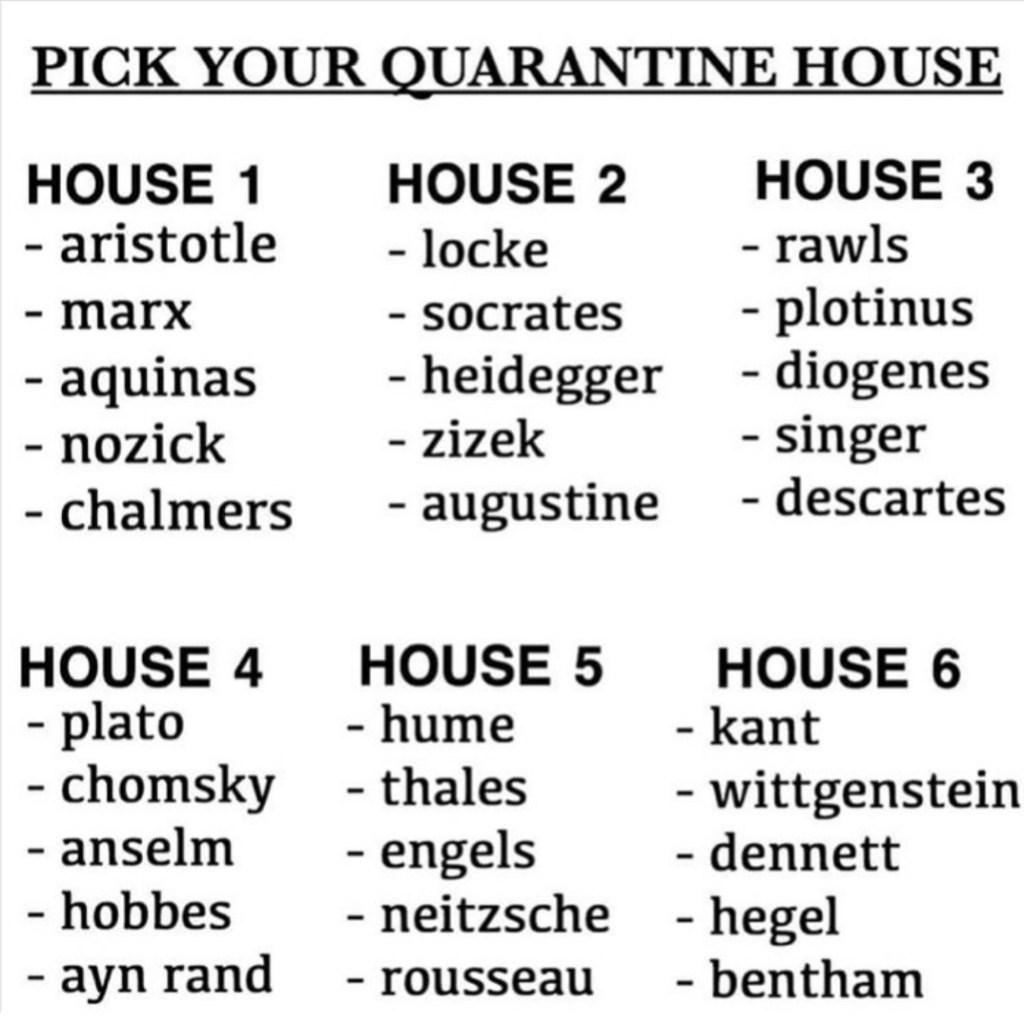
In addition to the six philosophical “houses” pictured below, we recently posted this fun example (involving literary figures) of conflict-prone groups.
hat tip: @Philosophymeme0
In addition to the six philosophical “houses” pictured below, we recently posted this fun example (involving literary figures) of conflict-prone groups.
hat tip: @Philosophymeme0
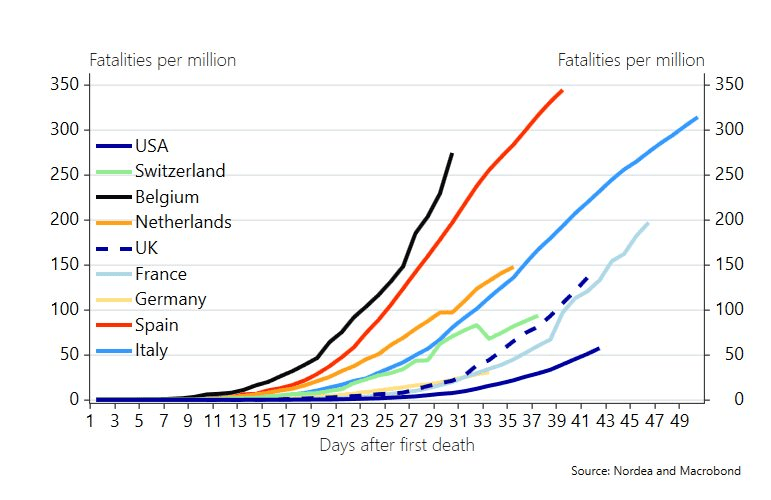
As you may have heard by now, there are more cases of coronavirus in the USA than anywhere else in the world. But with apologies to the late Darrell Huff, most coronavirus tables and charts I have seen thus far tend to focus on the absolute or total number of infections or deaths per country or region, instead of adjusting these dreadful data for population, like the chart below does. Notice how, once we adjust for population size, the USA is not (yet) the most lethal location for this virus.
Finally, a coronavirus chart that adjusts the data for population!
John Conway (pictured below) is one of my mathematical heroes, along with Martin Gardner and John Nash. Among other things, Conway invented a simple zero-player game called “The Game of Life,” for which he will always be remembered by generations of geeks like me. Sadly, Conway died on April 11 from the coronavirus. Here is a beautiful tribute by my colleague and friend Steven Landsburg.

Updated 4/16: Hey, where is my mask? In the mail? If the Mayor of Los Angeles or the Governor of New York is going to make the wearing of masks compulsory (see here and here), then shouldn’t City Hall or Albany be able provide masks to anyone who needs one (like they do in Singapore)?

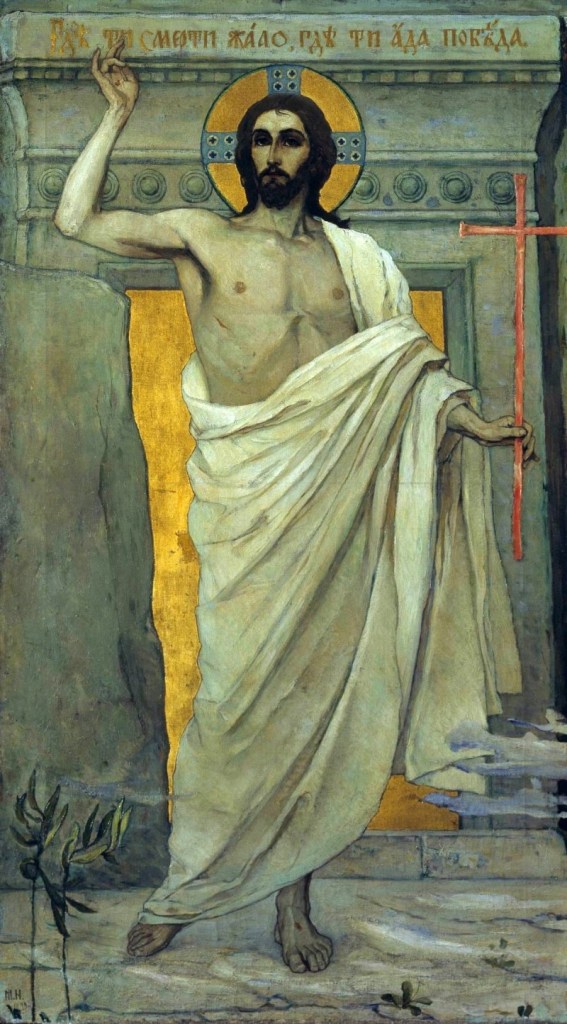
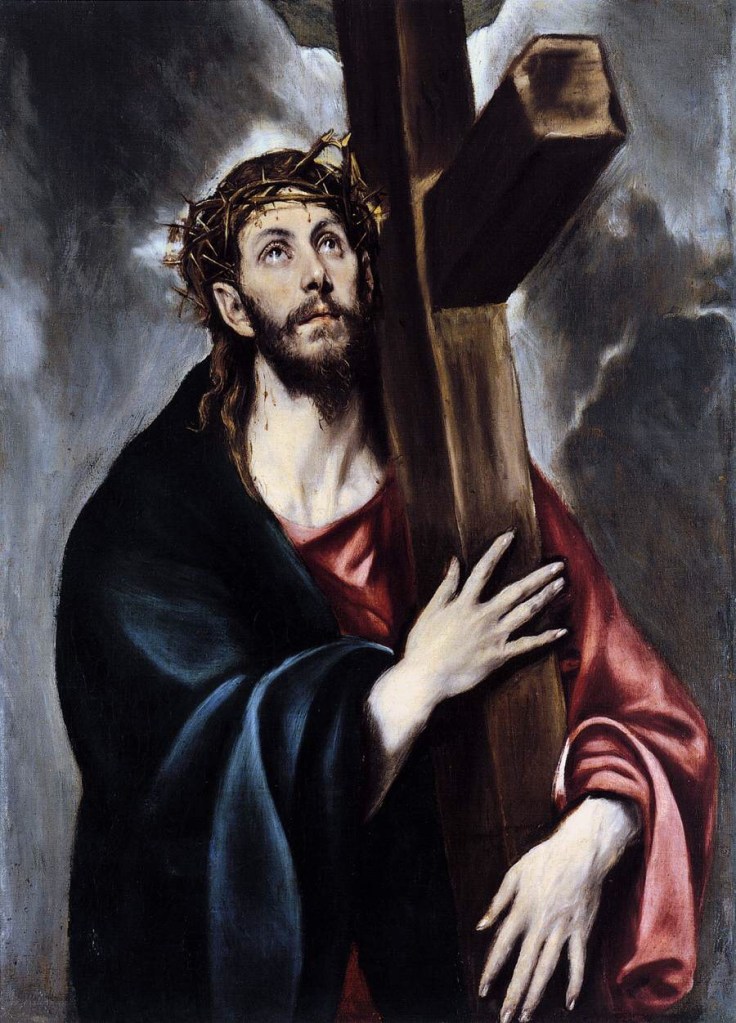
Happy Easter! (Artist: Mikhail Vasilevich Nesterov)
If you are looking for a concise and well-written introduction to Bayesian probability, check out this beautiful essay in the Times Literary Supplement (TLS), which recently appeared in my Twitter feed. (Thank you, Twitter!) This excellent essay was written by Professor David Papineau, who teaches philosophy at King’s College London; here is an excerpt (all spelling and punctuation in the original):
By Bayes’s time, the rudiments of probability had finally been forged. Books such as Abraham de Moivre’s The Doctrine of Chances (1718) explained the basic principles. They showed how to calculate the probability of five heads on a normal coin (it is 1/32) and indeed more complex probabilities like five heads on a coin biased 75 per cent in favour of heads (that would be 243/1024 – about ¼). At last it was possible for gamblers to know which bets are good in which games of chance.
Not that the Reverend Bayes was any kind of gambler. What interested him was not the probability of results given different causes (like the probability of five heads given different kinds of coin). Rather he wanted to know about the “inverse probability” of the causes given the results. When we observe some evidence, what’s the likelihood of its different possible causes? Some commentators have conjectured that Bayes interest in this issue was prompted by David Hume’s sceptical argument in An Enquiry Concerning Human Understanding (1748) that reports of miracles are more likely to stem from inventive witnesses than the actions of a benign deity. Be that as it may, Bayes’s article was the first serious attempt to apply mathematics to the problem of “inverse probabilities”.
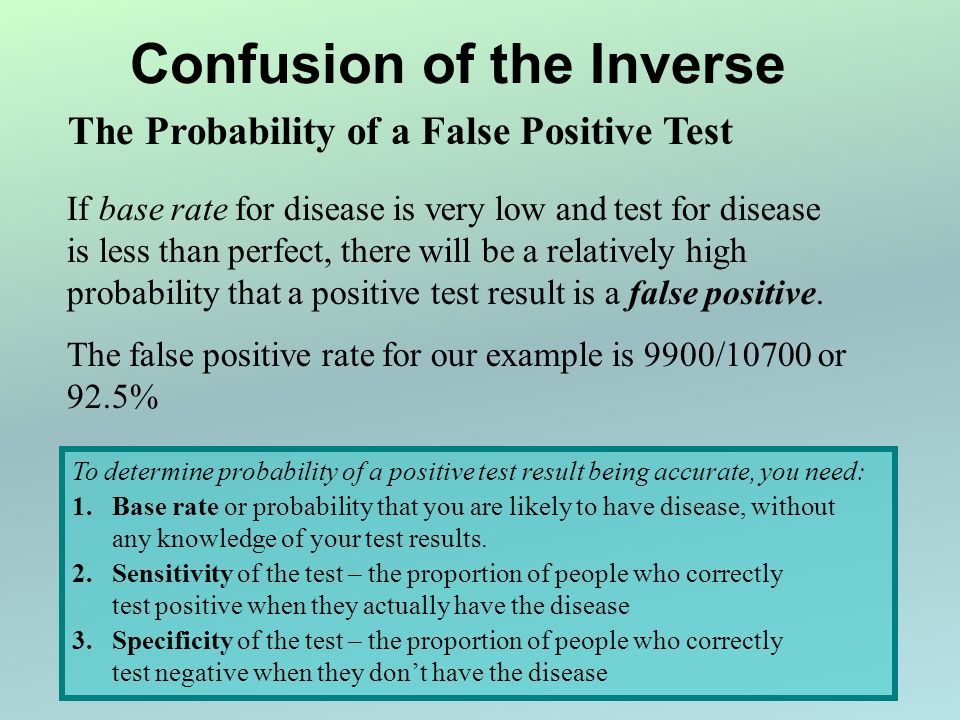
So what? Why are inverse probabilities relevant and worth understanding? It turns out this idea is important for several reasons. Not only does the logic of inverse probability help us unravel many common fallacies in probabilistic thinking (like the infamous Prosecutor’s Fallacy); it might also be relevant to the current coronavirus fiasco. How so? From a Bayesian or “inverse probability” perspective, we need to know at the very least the “base rate” of this crazy pandemic, i.e. what fraction of a random sample of the population have the virus. Without this critical piece of information, we are just shooting in the dark; we have no realistic idea of how serious this pandemic really is.
Credit: Imogen Neal
Sure, why not! Although I am not a big fan of Bill Gates or billionaire philanthropists generally, like a good Bayesian I will update my priors and give credit where credit is due. Like the great Sir Winston Churchill, who warned the world about the threat to freedom posed first by fascism and then by communism–at at time when few politicians took these threats seriously–Bill Gates warned us about the current pandemic situation. See video below:










Welcome to the online home of the IASS
Hopefully It’s Interesting.
In Conversation with Legal and Moral Philosophers
Relitigating Our Favorite Disputes
PhD, Jagiellonian University
Inquiry and opinion
Life is all about being curious, asking questions, and discovering your passion. And it can be fun!
Books, papers, and other jurisprudential things
Ramblings of a retiree in France
BY GRACE THROUGH FAITH
Natalia's space
hoping we know we're living the dream
Lover of math. Bad at drawing.
We hike, bike, and discover Central Florida and beyond
Making it big in business after age 40
Reasoning about reasoning, mathematically.
I don't mean to sound critical, but I am; so that's how it comes across
remember the good old days...
"Let me live, love and say it well in good sentences." - Sylvia Plath
a personal view of the theory of computation
Submitted For Your Perusal is a weblog wherein Matt Thomas shares and writes about things he thinks are interesting.
Logic at Columbia University
Just like the Thesis Whisperer - but with more money
the sky is no longer the limit
Technology, Culture, and Ethics
Just like the horse whisperer - but with more pages
Poetry, Other Words, and Cats

 prior probability