“The revenue of excise would in this case, indeed, suffer a little, and that of the customs a good deal more; but the natural balance of industry, the natural division and distribution of labour, which is always more or less disturbed by such duties, would be more nearly re-established by such a regulation.” (WN, IV.iv.14)
Adam Smith turns his attention to another mercantilist trade policy in Book IV, Chapter 4 of The Wealth of Nations: drawbacks, i.e. targeted tax breaks on exports. In Smith’s day, most exports were subject to the payment of excise taxes. That is, when a merchant wants to export goods abroad, then, in the absence of a drawback, he must pay excise taxes on those goods. With a drawback, however, the merchant gets a partial or full refund on those paid excise taxes. For his part, Smith concludes that drawbacks are “reasonable” but only to the extent they promote foreign trade:
“To allow the merchant to draw back upon exportation, either the whole or a part of whatever excise or inland duty is imposed upon domestic industry, can never occasion the exportation of a greater quantity of goods than what would have been exported had no duty been imposed.” (WN, IV.iv.2)
Nevertheless, Smith also identifies two potential problems with drawbacks. One is fraud: unscrupulous exporters might try to “clandestinely” re-import or otherwise divert their tax-free goods back into the home market. (IV.iv.16) The other is monopoly: when a merchant already enjoys a government monopoly on the export of X goods, providing him a tax break on those goods is just pure payola. (IV.iv.15) In both of these cases, drawbacks reduce the amount of tax revenue the government is able to collect without increasing the overall level of trade:
“The drawback, therefore, may frequently be pure loss to the revenue of excise and customs, without altering the state of the trade, or rendering it in any respect more extensive.” (WN, IV.iv.15)
Do these costs outweigh the benefits? For Smith, the answer is, It depends. More specifically, it depends on whether the net effect of a country’s drawback policy is to increase trade. Although the original purpose or goal of drawbacks was to promote what Smith calls the “carrying trade” — i.e. the business of transporting the goods of one country to another country — drawbacks are good (in the Smithian sense) to the extent they leave the carrying trade free:
“Drawbacks were, perhaps, originally granted for the encouragement of the carrying trade, which, as the freight of the ships is frequently paid by foreigners in money, was supposed to be peculiarly fitted for bringing gold and silver into the country. But though the carrying trade certainly deserves no peculiar encouragement, though the motive of the institution was perhaps abundantly foolish, the institution itself seems reasonable enough. Such drawbacks cannot force into this trade a greater share of the capital of the country than what would have gone to it of its own accord had there been no duties upon importation. They only prevent its being excluded altogether by those duties. The carrying trade, though it deserves no preference, ought not to be precluded, but to be left free like all other trades. It is a necessary resource for those capitals which cannot find employment either in the agriculture or in the manufactures of the country, either in its home trade or in its foreign trade of consumption.” (WN, IV.iv.12)
So, why does Smith defend drawbacks at all? Why not call for getting rid of excise taxes altogether? After all, we wouldn’t even need give exporters tax breaks (i.e. drawbacks) if there were no excise taxes in the first place! For me, the answer is clear: because what this chapter goes to show is that Adam Smith is no ideologue or zealot. He is a pragmatist who is able to judge any given mercantilist policy on its merits, by weighing both the costs and the benefits of the policy. (To be continued …)
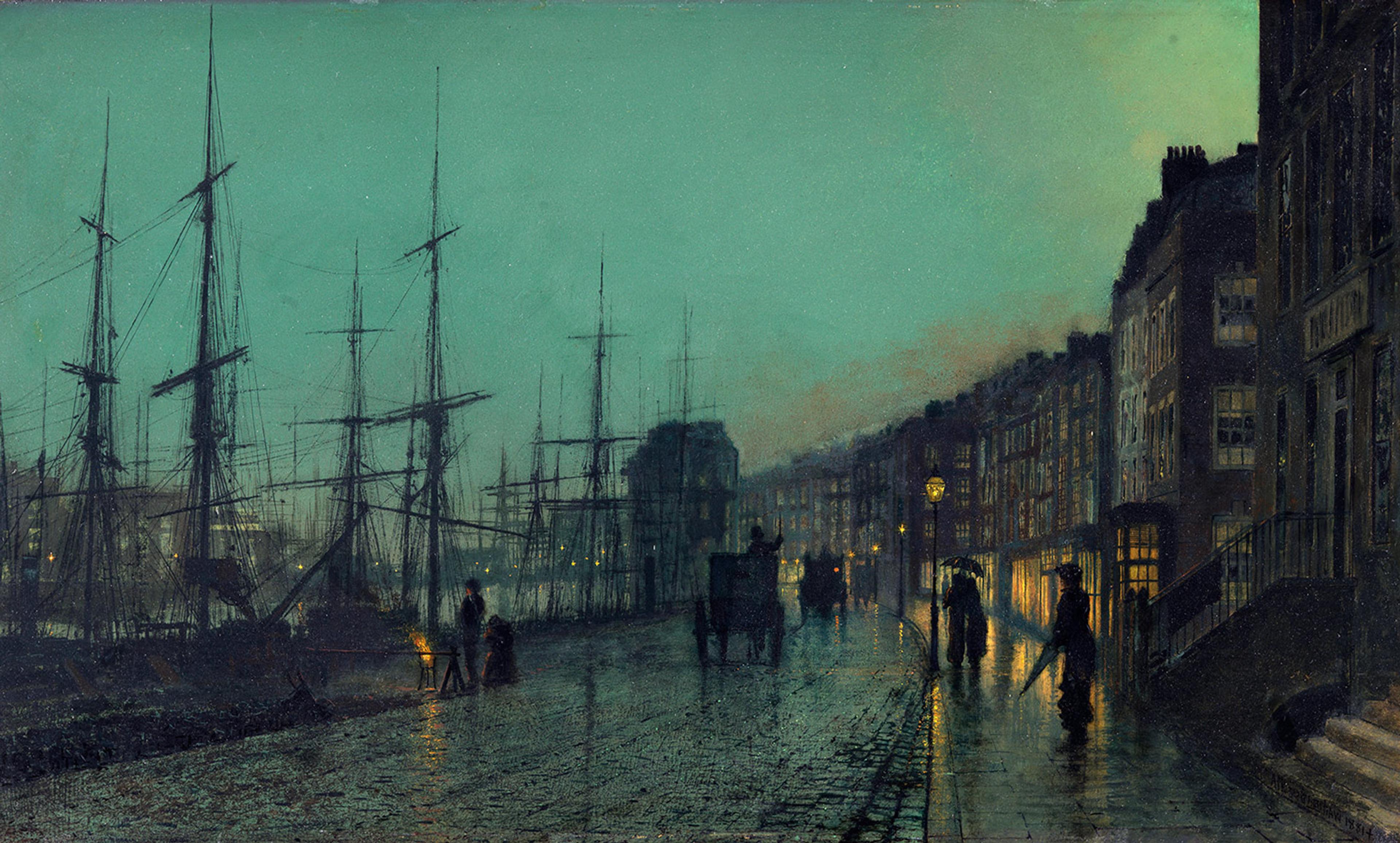
John Atkinson Grimshaw, Shipping on the Clyde, Glasgow (1881); Wikimedia Commons
“There is no commercial country in Europe of which the approaching ruin has not frequently been foretold by the pretended doctors of this system [i.e. mercantilism] from an unfavourable balance of trade. After all the anxiety, however, which they have excited about this, after all the vain attempts of almost all trading nations to turn that balance in their own favour and against their neighbours, it does not appear that any one nation in Europe has been in any respect impoverished by this cause. Every town and country, on the contrary, in proportion as they have opened their ports to all nations, instead of being ruined by this free trade, as the principles of the commercial system would lead us to expect, have been enriched by it.” (WN, IV.iii.c.14; my emphasis)
Adam Smith concludes Chapter 3 of Book IV of The Wealth of Nations with a scathing critique of mercantilism/protectionism: “Nothing, however, can be more absurd than this whole doctrine of the balance of trade, upon which, not only these restraints, but almost all the other regulations of commerce are founded.” (WN, IV.iii.c.2; my emphasis) For Smith, this doctrine is not only motivated by racism, by “the violence of national animosity” (WN, IV.iii.c.13); it is also logically unsound and absurd! Why absurd? Because wealth and money are not the same thing. True wealth consists of goods and services:
“There is another balance, … very different from the balance of trade, and which, according as it happens to be either favourable or unfavourable, necessarily occasions the prosperity or decay of every nation. This is the balance of the annual produce and consumption.” (WN, IV.iii.c.15)
But how does trade increase this alternative balance, i.e. “the balance of annual and produce consumption”? Simply put, how does free trade make a nation more wealthy? According to Smith, when nations open up their markets and freely trade with each other, they can specialize in what they do best. If France, for example, produces cheaper and higher-quality wine than England does, then England would be better off importing French wine instead of trying to produce her own lower-quality higher-cost wine, and this conclusion holds regardless whether England’s importation of wine creates a trade deficit. Why? In a word (two words): opportunity cost. If the owners of capital in England use their capital to produce wine, then that capital cannot be used to produce other goods and services. Capital assets are finite, scarce resources. (See WN, IV.iii.c.2-7.)
Free trade thus allows a country to put her capital assets to their highest-valued, most productive uses. To drive home this point, Smith presents the following memorable analogy:
“It is a losing trade, it is said, which a workman carries on with the alehouse; and the trade which a manufacturing nation would naturally carry on with a wine country may be considered as a trade of the same nature. I answer, that the trade with the alehouse is not necessarily a losing trade. In its own nature it is just as advantageous as any other, though perhaps somewhat more liable to be abused. The employment of a brewer, and even that of a retailer of fermented liquors, are as necessary divisions of labour as any other. It will generally be more advantageous for a workman to buy of the brewer the quantity he has occasion for than to brew it himself, and if he is a poor workman, it will generally be more advantageous for him to buy it by little and little of the retailer than a large quantity of the brewer. He may no doubt buy too much of either, as he may of any other dealers in his neighbourhood, of the butcher, if he is a glutton, or of the draper, if he affects to be a beau among his companions. It is advantageous to the great body of workmen, notwithstanding, that all these trades should be free, though this freedom may be abused in all of them, and is more likely to be so, perhaps, in some than in others. Though individuals, besides, may sometimes ruin their fortunes by an excessive consumption of fermented liquors, there seems to be no risk that a nation should do so.” (WN, IV.iii.c.8; my emphasis)
But if free trade is so good, why does self-defeating Trumpian mercantilism and protectionism still prevail? Smith blames both the owners of capital and labor, i.e. “the sneaking arts of underling tradesmen” (IV.iii.c.8) as well as the “monopolizing spirit” (IV.iii.c.9) and “interested sophistry” (IV.iii.c.10) of “merchants and manufactures”:
That it was the spirit of monopoly which originally both invented and propagated this doctrine cannot be doubted; and they who first taught it were by no means such fools as they who believed it. In every country it always is and must be the interest of the great body of the people to buy whatever they want of those who sell it cheapest. The proposition is so very manifest that it seems ridiculous to take any pains to prove it; nor could it ever have been called in question had not the interested sophistry of merchants and manufacturers confounded the common sense of mankind. Their interest is, in this respect, directly opposite to that of the great body of the people.” (WN, IV.iii.c.10)
Once again, we see a deep tension in Adam Smith’s thought: on the one hand, when markets are free, the owners of capital and labor have an incentive to put their assets to their most productive uses, but when a country is free (in the political sense), these same owners of capital and labor will use their power and clout to try to shut down competition and protect their economic interests at the expense of the public good!
🐎 Happy Lunar New Year! 🐎 Tucked in between Parts 1 and 2 of Chapter 3 of Book IV of The Wealth of Nations is Adam Smith’s “Digression concerning Banks of Deposit, particularly concerning that of Amsterdam” (available here). But why does Smith discuss the inner workings of a foreign bank in a chapter otherwise devoted to trade restrictions based on balance-of-trade arguments? Simply put: because the Bank of Amsterdam is central to Smith’s critique of the balance-of-trade doctrine. To see why, let’s compare and contrast the Bank of England with the Bank of Amsterdam:
In brief, although the Bank of England was created in 1694 by an Act of Parliament and Royal Charter, it was a privately-owned bank, i.e. a joint-stock company (corporation), and its original purpose was to finance the “Nine Years’ War” (1688 to 1697) between France and England. The Bank of Amsterdam (Amsterdamsche Wisselbank), by contrast, was publicly-owned. It was founded in 1609 by Amsterdam’s municipal council and housed in the Town Hall (pictured below).
That is, while the Bank of England was a private for-profit institution created to contribute to a public purpose (fund a war), the Bank of Amsterdam was a publicly-owned entity established to promote private commerce!
In summary, Dutch merchants were often paid in foreign and local trade coins (gold and silver). The problem, however, was that many — if not most — of these coins were “worn, clipt, or otherwise degraded below [their] standard value.” (WN, IV.iii.b.1) The Bank of Amsterdam solved this pesky problem by creating a uniform and standard form of accounting currency called “florins”. That is, the Bank of Amsterdam acted as a central repository where Dutch merchants deposited their foreign and local coins in exchange for “florins”. But here’s the rub: these fictional florins were not a physical currency; florins were merely a unit of account on the bank’s ledgers, and the Bank of Amsterdam charged a fee for converting this bank-account money back into physical coins (Dutch guilders).
So, what incentive did Dutch merchants have for doing business with the Bank of Amsterdam? In a word: security. The city government assumed full and direct liability for all deposits, thus guaranteeing that every “florin” or “guilder” on deposit was fully backed by physical gold or silver bullion kept in the vaults of the bank in City Hall. In other words, as Adam Smith points out in his digression, the Bank of Amsterdam operated as a 100% reserve bank:
“At Amsterdam, … no point of faith is better established than that for every guilder, circulated as bank money, there is a correspondent guilder in gold or silver to be found in the treasure of the bank. The city is guarantee that it should be so.” (WN, IV.iii.b.15)
Smith, however, is skeptical about the true amount of gold and silver reserves being held in the bank’s coffers: “What may be the amount of the treasure in the bank is a question which has long employed speculations of the curious. Nothing but conjecture can be offered concerning it.” (WN, IV.iii.b.16) But for Smith that is precisely the point! Simply put, Amsterdam was a wealthy city not because of the large amounts of reserves in the city’s coffers. She was prosperous because the city-owned bank facilitated commerce by offering safe and secure accounts for Dutch merchants!
This digression thus supports one of Smith’s main insights in Book IV of his magnum opus: the idea that balances of trade don’t really matter. What matters is having a stable and solid currency, which in turn facilitates trade, and that is precisely what the Bank of Amsterdam provided: a stable and solid currency. Nota bene: I will proceed Part 2 of Chapter 3 of Book IV The Wealth of Nations (available here) in my next post.
To my North American readers, 🇺🇸 Happy Presidents’ Day 🇺🇸! Now, let’s pick up where we left off, with Chapter 3 of Book IV of The Wealth of Nations. Recall that Adam Smith launches an all-out, no-holds-barred attack on mercantilism and protectionism in Book IV of his magnum opus. To this end, Smith identifies two types of restraints on trade with foreign nations:
“First, restraints upon the importation of such foreign goods for home consumption as could be produced at home, from whatever country they were imported.
“Secondly, restraints upon the importation of goods of almost all kinds from those particular countries with which the balance of trade was supposed to be disadvantageous.” (WN, IV.i.a.37-38)
Accordingly, Chapter 2 of Book IV reveals the many mercantilist fallacies regarding the first kind of restraint — i.e. economic protectionism or “restraints upon the importation of such foreign goods for home consumption as could be produced at home” — while Chapter 3 (available here), which we explore in this post, exposes the truth about “balance of trade” arguments. [1] As such, both of these Smithian chapters are directed towards Donald Trump and his sundry MAGA followers!
But that said, what is the main difference between these two types of justifications in favor of restraints of trade? Among Adam Smith’s many deep insights in these first three chapters of Book IV — e.g. the absurdity of the doctrine of the balance of trade, the conspiracy of the merchants, the invisible hand of self-interest, etc., etc. — the one that is most surprising to me is Smith’s analysis in Chapter 3 of the cultural politics of the doctrine of the balance of trade. To see why, let’s go back for a moment to Chapter 1 of Book IV. In that chapter, Smith explores the economics of the balance of trade doctrine, and he shows why this protectionist doctrine is bullshit: restrictions on trade retard economic growth and thus make us poorer.
So, what does Smith add to his analysis of the doctrine of the balance of trade in Chapter 3? That is, what does he say in Chapter 3 that hasn’t already been said in the previous two chapters of Book IV of his magnum opus? Simply put, Smith makes an astute political observation in Ch. 3: restraints on free trade based on outright economic protectionism are motivated by “private interest and the spirit of monopoly” (WN, IV.iii.a.1), but restraints on trade based on “balance of trade” arguments are, at bottom, motivated by racism or xenophobia, i.e. “national prejudice and animosity.” (ibid.)
In other words, “balance of trade” arguments are not only economic nonsense; they are morally evil and racist! Here (yet again!) is another reason why Adam Smith is still relevant today. For Smith, if you want to be an effective “anti-racist”, and not just virtue-signal about being so, then the most effective way of fighting racism is by exposing the folly and futility of “balance of trade” arguments, in other words, by supporting free trade!
Free trade does all these things!
[1] That is why Chapter 3 of Book IV of The Wealth of Nations is titled “Of the Extraordinary Restraints upon the Importation of Goods of almost all Kinds from those particular Countries with which the Balance was supposed to be disadvantageous.”
I will resume my series on The Wealth of Nations on Monday. In the meantime, Saint Valentine’s Day is just as good as any to revisit my work on the alleged “lost loves” of Adam Smith, including my blog post on “Adam Smith’s Lost Loves” and my scholarly paper “Adam Smith in Love“. Enjoy!
As I mentioned in my previous two posts, Adam Smith’s famous “invisible hand” appears but once in the entire Wealth of Nations: in Book IV, Chapter 2. Is this magical hand a mere metaphor, a pious acknowledgment of divine benevolence, or just a wisecrack? Or is it something else entirely? Before we proceed to Book IV, Chapter 3 of Smith’s magnum opus, I would like to share some excerpts from my forthcoming book, Beyond Das Adam Smith Problem (with Salim Rashid), where we explore several possible interpretations of Smith’s unseen hand: divine, metaphorical, ironic, and Panglossian. (Footnotes are below the fold.)
1. Background: Three Invisible Hands
According to one Smith scholar (Harrison 2011, p. 33), “Centuries after Smith’s death, we are still struggling to fathom a two-word phrase that stands out in a thousand-page book.” In the words of another, “Few terms in the lexicon are less explanatory than Adam Smith’s ‘invisible hand’.”[1] Really? Although Adam Smith invokes an “invisible hand” only three times in the entire corpus of his works—not just in The Wealth of Nations but also in his Theory of Moral Sentiments and in his posthumously published essay on astronomy—it is no exaggeration to say that this mysterious manus has become the most famous, as well as one of the most contested, ideas in economics, and perhaps in of all the so-called “social sciences.”[2]
But is there a common thread that ties together this troika of invisible hands? Are these three sets of imaginary hands in Smith’s works reconcilable, or does the Scottish philosopher use the same words in different ways?[3] And regardless of the existence or not of a common thread, why does Smith invoke a hidden hand at all? Furthermore, whatever Smith’s motives were, what is the ontological status of this magical forelimb? Is it just a figure of speech, a metaphor standing in for equilibrium end states when competition is allowed and markets are left free?[4] Is it a divine entity, Providence?[5] Or is it a sardonic gag or punchline?[6] One of us (Rashid 1998), for example, subscribes to a rhetorical interpretation of this imaginary hand. In Rashid’s reading, Smith’s invisible hand was a mere rhetorical device, a piece of imagery, perhaps even a casual metaphor—rather than a scientific or systematic analytical tool. In short, is the invisible hand a divine entity, a mere metaphor, or a wisecrack?
2. The Divine Hand
For his part, our Australian colleague Paul Oslington makes a strong case that Smith’s invisible hand refers to the guiding hand of a benevolent God.[7] According to Oslington, the term “invisible hand” was in common use during Smith’s lifetime, and its original meaning refers to the Christian idea of natural harmony through divine providence, i.e. “the possibility of special providential divine action in the economic system to guarantee its stability.”[8]
Alas, Oslington’s deistic reading of Smith’s invisible hand raises more questions than it answers. Do such invisible hand processes as language, markets, and the common law really depend on God’s benevolence or on the goodwill of a magical or godlike being? If so, if God or this divine entity is doing the work of the invisible hand, why does He (or it?) allow imperfections in these institutions, e.g. imperfect translations from one language to another, or market failures in economics, or unjust or poorly-reasoned judicial decisions in law?
3. The Metaphorical Hand
Yet another possible interpretation is that Smith invoked his invisible hand as a short-hand way of describing or standing in for the fundamental theoretical constructs in economics of “efficient markets” or “market equilibrium”, i.e. when prices are established through competition or when the amount of goods or services sought by buyers is equal to the amount of goods or services produced by sellers.[9] On this reading of the invisible hand, Smith’s magical hand is just a metaphor or figure speech, for each individual, in pursuing their own private interests, is led “as if” by an invisible hand to increase the welfare of society overall.[10]
This standard “Econ 101” interpretation, however, has three defects. One problem, as Sarah Skwire points out, is that Smith himself never used the words “as if”![11] Another, even deeper, problem is that the concept of equilibrium in economics is itself a problematic one! Some economists even deny that there is such a thing![12] Yet another problem is the Coasian one that markets are rarely efficient or perfectly competitive. In the real world, markets are full of friction: so-called “transaction costs” can prevent some markets from clearing.[13]
But perhaps the main problem with the standard economics reading of the invisible hand is this: in the one instance in which he uses the term “invisible hand” in The Wealth of Nations, it’s to describe the process of capital accumulation or wealth maximization, not market efficiency or the clearing of markets. One respected economist, Warren Samuels, went as far as to suggest that Smith’s invisible hand should be “erased” from economic textbooks altogether![14]
4. The Ironic Hand
So, which of these first two competing interpretations of the invisible hand—literal or metaphorical—is the correct one? To break this interpretive impasse, Emma Rothschild, an economic historian at Harvard, has proposed an alternative reading: the ironic or sardonic invisible hand.[15] According to Rothschild, Smith “did not particularly esteem the invisible hand and thought of it as an ironic but useful joke.”[16] Although Rothschild concedes that the evidence for her interpretation of the invisible hand is indirect,[17] she makes two important observations: Smith refers to invisible hands three times in all—not just in The Wealth of Nations, but also in his first published book, The Theory of Moral Sentiments, as well as a third time in his posthumously published essay on the history of astronomy—and each time Smith invokes his invisible hand, it is to gently ridicule or poke fun at others.
In The History of Astronomy, for example, Smith refers to “the invisible hand of Jupiter” to describe the pre-scientific theories of primitive peoples during “the first ages of the world” in which “the lowest and most pusillanimous superstition supplied the place of philosophy”:
For it may be observed, that in all Polytheistic religions, among savages, as well as in the early ages of heathen antiquity, it is the irregular events of nature only that are ascribed to the agency and power of the gods. Fire burns, and water refreshes; heavy bodies descend, and lighter substances fly upwards, by the necessity of their own nature; nor was the invisible hand of Jupiter ever apprehended to be employed in those matters. But thunder and lightning, storms and sunshine, those more irregular events, were ascribed to his favour, or his anger.” (HA, 3.2)
In contrast to his invisible hand reference in his astronomy essay, Smith invokes an invisible hand in Book 4 of The Theory of Moral Sentiments to poke fun at the rich. There, Smith invokes a trickle-down invisible hand to explain how the “natural selfishness and rapacity” of “the rich” somehow ultimately redounds to the benefit of the poor.[18] For reference, here is the complete passage:
The rich only select from the heap what is most precious and agreeable. They consume little more than the poor, and in spite of their natural selfishness and rapacity, though they mean only their own conveniency, though the sole end which they propose from the labours of all the thousands whom they employ, be the gratification of their own vain and insatiable desires, they divide with the poor the produce of all their improvements. They are led by an invisible hand to make nearly the same distribution of the necessaries of life, which would have been made, had the earth been divided into equal portions among all its inhabitants, and thus without intending it, without knowing it, advance the interest of the society, and afford means to the multiplication of the species.” (TMS, IV.i.10)
For Rothschild, these invisible hand references are not meant to be taken literally or even metaphorically but rather as a mild and ironic joke, a lighthearted moment of gaiety in his otherwise dense and dignified works.
5. Conclusion: The Panglossian Hand
For our part (Guerra-Pujol & Salim, forthcoming), although we are willing to concede that her “wisecrack” theory is plausible for TMS and HA, Rothschild’s ironic interpretation of the invisible hand is far less plausible for The Wealth of Nations. Accordingly, we wish to propose a fourth possibility: what if Smith’s system of natural liberty and his invocation of an invisible hand are literary bookends, two metaphorical anchors that tie together all the many economic insights and historical digressions in The Wealth of Nations.[19] On this view, Smith invokes an “invisible hand” with the Panglossian intention of reassuring his readers that under his system of natural liberty everything will work out in the end. For reference, here is the famous (or infamous, as the case may be) “invisible hand” passage in The Wealth of Nations:
By preferring the support of domestic to that of foreign industry, he intends only his own security; and by directing that industry in such a manner as its produce may be of the greatest value, he intends only his own gain, and he is in this, as in many other cases, led by an invisible hand to promote an end which was no part of his intention. Nor is it always the worse for the society that it was no part of it. By pursuing his own interest he frequently promotes that of the society more effectually than when he really intends to promote it. (WN, IV.ii.9)
In other words, society overall will be better off when self-interested actors, who intend only their own gain, are free to pursue any trade or occupation and accumulate capital without any unnecessary legal restrictions. Our alternative interpretation of Smith’s invisible hand emphasizes the unintended consequences of individual action, an idea associated with the so-called Austrian School of economics led by Carl Menger (1840-1921), Ludwig von Mises (1881-1973, and Friedrich Hayek (1899-1992). In fact, this Panglossian interpretation can be traced back to Adam Ferguson’s oft-cited insight in his 1767 essay on the history of civil society: “Every step and every movement of the multitude, even in what are termed enlightened ages, are made with equal blindness to the future; and nations stumble upon establishments, which are indeed the result of human action, but not the execution of any human design.”[20]
More simply put, in closing, the Panglossian view of the invisible hand celebrates how our most complex and pro-social human institutions—language, markets, and the common law—have emerged over time through “bottom up” (decentralized) in contrast to “top down” (centralized) processes of self-organization, i.e. from the myriad interactions of individuals pursuing their own goals, not through deliberate design or central planning.[21]
Nota bene: I will proceed to Chapter 3 of Book IV of The Wealth of Nations on Monday, 16 February (Presidents’ Day).
Thus far this week (see here, here, and here), we have surveyed Book IV, Chapter 1 of Adam Smith’s Wealth of Nations. Next up, then, is Chapter 2, which is titled “Of Restraints upon the Importation from Foreign Countries of such Goods as can be produced at Home.” This is the first of five chapters where Smith forcefully — and to any intellectually-honest person, i.e. to any non-politician, persuasively — denounces various forms of protectionist trade policies. It is also the pivotal chapter where Smith’s famous “invisible hand” (IV.ii.9) makes its one and only appearance in Smith’s entire magnum opus. As it happens, I wrote up a detailed paragraph-by-paragraph review of Book IV, Chapter 2 last year after our rabble-rousing demagogic president announced a first round of tariffs on Canada, Mexico, and China on February 1, 2025. In fact, I wrote up 19 entries in all as follows:
In my next post, I will say a few more words about Adam Smith’s invisible hand. For now, however, it suffices to say that if the Battle of Britain was Albion’s “finest hour”, [1] then Book IV, Chapter 2 — Adam Smith’s assault against greedy merchants and cunning politicians — is one of Smith’s finest chapters.
[1] After Germany invaded France (10 May 1940), and after the British Expeditionary Force (BEF) was forced to retreat from Dunkirk (26 May to June 4), and after Paris fell to the Nazis (14 June) — in other words, after all hope was lost that Europe would remain free — Winston Churchill delivered a rousing speech to prepare the British people for the trials and tribulations to come: “If the Empire lasts a thousand years men will say, this was their finest hour.”
Adam Smith concludes Book IV, Chapter 1 of The Wealth of Nations by highlighting two major geographical discoveries that “happened much about the same time”: the discovery of America by Columbus and the discovery of a passage to the East Indies through the Cape of Good Hope by Vasco da Gama. (See WN, IV.i.32-33.) According to Smith, both of these discoveries ended up making Europe more wealthy and prosperous than before. How? By creating an economic chain reaction — the creation of new markets and new trade routes as well as an increase in the volume of trade and in “the productive powers of labour” — a positive cascade that culminated in more wealth and prosperity for all:
“The discovery of America, however, certainly made a most essential one. By opening a new and inexhaustible market to all the commodities of Europe, it gave occasion to new divisions of labour and improvements of art, which in the narrow circle of the ancient commerce, could never have taken place for want of a market to take off the greater part of their produce. The productive powers of labour were improved, and its produce increased in all the different countries of Europe, and together with it the real revenue and wealth of the inhabitants. The commodities of Europe were almost all new to America, and many of those of America were new to Europe. A new set of exchanges, therefore, began to take place which had never been thought of before, and which should naturally have proved as advantageous to the new, as it certainly did to the old continent.” (WN, IV.i.32)
Regarding the East Indies, the Scottish political economist observes how the discovery of new trade routes through the Cape of Good Hope along the coasts of southern Africa “opened perhaps a still more extensive range to foreign commerce than even that of America.” (WN, IV.i.33) Although the nations of Europe that traded with the peoples of the East Indies ended up sending large amounts of their gold and silver abroad in exchange for East Indian goods (e.g. spices, silk, and tea), Smith explains why Europe became more wealthy–not less–in spite of this outward flow of precious metals. According to Smith, these new trade routes through the Cape of Good Hope expanded markets and opportunities for mutually-beneficial trade:
“The trade to the East Indies, by opening a market to the commodities of Europe, or, what comes nearly to the same thing, to the gold and silver which is purchased with those commodities must necessarily tend to increase the annual production of European commodities, and consequently the real wealth and revenue of Europe. That it has hitherto increased them so little is probably owing to the restraints which it everywhere labours under.” (WN, IV.i.33)
But Smith is not blind. He denounces the “savage injustice of the Europeans” who discovered and colonized the Americas: “The savage injustice of the Europeans rendered an event, which ought to have been beneficial to all, ruinous and destructive to several of those unfortunate countries.” (WN, IV.i.32; my emphasis) And he will also have some rather nasty things to say about the British East India Company in Book IV, Chapter 7 (“Of Colonies”) and in Book V, Chapter 1 (“Of the Expenses of the Sovereign”) of his magnum opus, but that is getting ahead of my chapter-by-chapter survey of The Wealth of Nations. I will thus turn my attention Book IV, Chapter 2 (“Of Restraints upon the Importation from foreign Countries of such Goods as can be produced at Home”) in my next post. It is in that chapter where Smith’s famous “invisible hand” makes its one and only appearance in 900-plus pages of The Wealth of Nations. (To be continued …)
I concluded my previous post with a question, Doesn’t the government need to maintain a positive balance of trade as well as a large amount of gold and silver reserves for national security reasons, i.e. to finance naval fleets and raise armies in the event of invasion or war? As it happens, Smith devotes most of the second half of Book IV, Ch. 1 of The Wealth of Nations (see especially paragraphs. 20-30) to this very question, and his answer is an unequivocal NO: “It is not always necessary to accumulate gold and silver in order to enable a country to carry on foreign wars, and to maintain fleets and armies in distant countries.” (WN, IV.i.20) Why not? Because it is a country’s purchasing power (i.e. the amount of goods and services it is able to make or buy), and not its reserves in precious metals, that determines its ability to finance a war:
“Fleets and armies are maintained, not with gold and silver, but with consumable goods. The nation which, from the annual produce of its domestic industry, from the annual revenue arising out of its lands, labour, and consumable stock, has wherewithal to purchase those consumable goods in distant countries, can maintain foreign wars there.” (WN, IV.i.20)
According to Smith, gold and silver can be “accumulated or stored up” in one of three different ways — “first, the circulating money; secondly, the plate of private families; and, last of all, the money which may have been collected by many years’ parsimony, and laid up in the treasury of the prince” (WN, IV.i.22) — but none of these methods of piling up precious metals, standing alone, will ever be enough to pay for a war because wars are expensive. Based on his careful review of the available evidence, Smith concludes: “The funds which maintained [Britain’s] foreign wars of the present century, the most expensive perhaps which history records, seem to have had little dependency upon the … the circulating money, or of the plate of private families, or of the treasure of the prince.” (WN, IV.i.26)
But this observation, in turn, poses a puzzle: if Britain’s wars were expensive, and if they were not financed by taking gold and silver coins out of circulation or by melting down private hoards of precious metals or by shipping gold and silver reserves out of the country, then how were these expensive wars paid for? For Smith, the answer is not gold and silver; it is commerce and commodities. Taking the Seven Years’ Was as his prime example, Smith concludes: “The enormous expense of the late war [i.e. the Seven Years’ War] … must have been chiefly defrayed, not by the exportation of gold and silver, but by that of British commodities of some kind or other.” (WN, IV.i.27) More specifically, Smith tells us that it was “the annual produce of the land and labour of the country” that were “the ultimate resources which enabled us to carry on the [Seven Years’] war.” (WN, IV.i.28)
As an aside, Smith also explains why trade in manufactured goods — more than trade in agricultural goods — is the best way to finance a foreign war:
“The commodities most proper for being transported to distant countries, in order to purchase there either the pay and provisions of an army, or some part of the money of the mercantile republic to be employed in purchasing them, seem to be the finer and more improved manufactures; such as contain a great value in a small bulk, and can, therefore, be exported to a great distance at little expense. A country whose industry produces a great annual surplus of such manufactures, which are usually exported to foreign countries, may carry on for many years a very expensive foreign war without either exporting any considerable quantity of gold and silver, or even having any such quantity to export.” (WN, IV.i.29)
“No foreign war of great expense or duration could conveniently be carried on by the exportation of the rude produce of the soil. The expense of sending such a quantity of it to a foreign country as might purchase the pay and provisions of an army would be too great. Few countries produce much more rude produce than what is sufficient for the subsistence of their own inhabitants. To send abroad any great quantity of it, therefore, would be to send abroad a part of the necessary subsistence of the people. It is otherwise with the exportation of manufactures. The maintenance of the people employed in them is kept at home, and only the surplus part of their work is exported.” (WN, IV.i.30)
Furthermore, free trade not only makes it easier for a country to finance its foreign wars; free trade also promotes economic growth and development in the aggregate:
“The importation of gold and silver is not the principal, much less the sole benefit which a nation derives from its foreign trade…. By opening a more extensive market for whatever part of the produce of their labour may exceed the home consumption, it encourages them to improve its productive powers, and to augment its annual produce to the utmost, and thereby to increase the real revenue and wealth of the society…. To import the gold and silver which may be wanted into the countries which have no mines is, no doubt, a part of the business of foreign commerce. It is, however, a most insignificant part of it. A country which carried on foreign trade merely upon this account could scarce have occasion to freight a ship in a century.” (WN, IV.i.31; my emphasis)
To simplify, the best way to make war is to allow people to make money (not just store money), and the best way to make money is to allow free trade. But if free trade is so great, why is it so maligned in politics and so rare in practice? That is, why does almost every country in the world still engage in futile and self-defeating mercantilist and protectionist politics? (To be continued …)











 prior probability