Finnis’s impossible task (review of II.1)

As promised, we now proceed to Chapter II of “Natural Law and Natural Rights.” Professor Finnis begins this chapter by clearing his throat, so to speak, and announcing that his “present purpose … is not to anticipate later chapters, but to make some preliminary clarifications” (p. 22). The main clarification he makes in the first subsection of Chapter II is to point out a fundamental distinction between natural law and theories of natural law–between “discourse about natural law and discourse about … doctrines of natural law” (p. 23). In summary, natural law proper is timeless and ahistorical (its content is constant and unchanging), while theories of natural law are contingent and historical (the content of these theories can change over time, depending on the time and place in which a given natural law theory was developed).

In addition, Professor Finnis further states: “This is a book about natural law [and not about previous theories of natural law]. It expounds or sets out a theory of natural law, but is not about that theory” (p. 23, emphasis in original). But Prof Finnis’s fundamental distinction between natural law proper and derivative theories of natural law raises a difficult and embarrassing question. If natural law and theories about natural law are two separate subject matters, then how could we ever discover–let alone “test” or falsify–the truth of any particular theory of natural law, including Prof Finnis’s own pet theory? Isn’t such a task an impossible one, or more to the point, are not all theories of natural law (as opposed to natural law proper) tautological? Regardless, we will continue our review of Chapter II in our next post.

Image result for how to test a theory
Posted in Uncategorized | Leave a comment

Review of Finnis: a short interlude

Thus far, we have ripped to pieces the main arguments in Chapter XII of “Natural Law and Natural Rights.” Specifically, we have explained:

  1. Why Professor Finnis’s “practical reasonableness” criterion is indeterminate and idiosyncratic (see our April 23 post);
  2. Why his master-taxonomy of unjust laws is an ad hoc and shaky edifice built on the sands of his indeterminate and idiosyncratic reasonableness criterion (see our April 24 post “Finnis’s hodge-podge“); and
  3. Why his natural law theory is ultimately self-defeating and toothless, since according to Finnis, we still have prudential reasons to comply with unjust laws under his collateral effects doctrine (see our April 25 post “Finnis steps back from the precipice“).

This three-pronged critique of Professor Finnis’s natural law theory has been especially painful for us, as we are not legal positivists. We believe in natural rights and in the existence of a natural or universal law. Genocide, for example, is morally wrong regardless whether there are man-made laws against genocide or whether such laws are enforced or not. So, to avoid ending on a negative note, I want to conclude my review of Chapter XII by remarking on one aspect of this chapter that I really liked: Professor Finnis’s rebuke of such legal positivists as John Austin and H.L.A. Hart and of the idea that law and ethics are two separate domains.

In summary, Prof Finnis provides many powerful reasons why law and ethics are inseparable. At the academic or theoretical level (see, e.g., page 358), any attempt to define or explain of the concept of law requires an analysis of cultural norms and moral values because legal systems (however defined) are always embedded in particular communities and cultures with particular background norms and values. Put another way, what we teach our children about right and wrong is relevant to our understanding of law when we become adults.

Moreover, man-made or “positive” law is infused with morality at many other levels on a day-to-day basis as well (see, e.g., page 362). When legislators make laws, their conceptions of justice and morality will no doubt come into play as they debate bills and vote to enact or repeal legislation. When executive officials enforce laws, they will necessarily have wide discretion and enormous flexibility in deciding which laws to enforce and how to enforce them. And when judges interpret laws and resolve disputes, their judicial decisions are often based on hunches, on their sense of “equity” and fairness. So, when we talk about law at all these levels, how can we not talk about such moral ideas as justice, reciprocity, trust, and virtue?

In short, despite its many serious flaws (see our three-pronged critique above), Professor Finnis’s work is still well worth reading and discussing, and so following the self-recommendation in his first preface, we will proceed to Chapter II of “Natural Law and Natural Right” in our next post …

Image result for right and wrong
Posted in Uncategorized | Leave a comment

Prof Finnis steps back from his natural law precipice (review of XII.3)

Professor Finnis explores one of the most difficult and fascinating moral questions in subsection 3 of Chapter XII: “How does injustice … affect the obligation to obey the law?” Or more simply put, Does one have a duty to obey an unjust law? And in the process of answering these fundamental questions, Finnis demonstrates a high level of philosophical sophistication and scholarly erudition. To begin with, Finnis restates or “reframes” his key question in four different ways: Continue reading

Posted in Uncategorized | Leave a comment

Finnis’s hodge-podge (review of XII.2)

Hey, what’s up? Let’s put on hold our previous objections to John Finnis’s theory of law and proceed with our review of “Natural Law and Natural Rights,” shall we? By my count, Professor Finnis identifies no less than six separate categories of unjust laws in subsection 2 of Chapter XII: Continue reading

Posted in Uncategorized | Leave a comment

Review of Finnis (XII.1)

We begin with Chapter XII of “Natural Law and Natural Rights” because Finnis himself recommends that we do so. This fascinating chapter is divided into four separate subsections (XII.1 through XII.4). In first subsection (XII.1), Finnis makes two important claims. One claim is about the classical natural law maxim lex injusta non est lex (unjust laws are not law). According to Finnis, this famous maxim is, at best, a “subordinate theorem” or “subordinate concern” of natural law theory. Instead,

the principal jurisprudential concern of a theory of natural law is … to identify the principles and limits of the Rule of Law, and to trace the ways in which sound laws, in all their positivity and mutability, are to be derived (not, usually, deduced) from unchanging principles–principles that have their force from their reasonableness, not from any originating acts or circumstances.

In other words, natural law is about distinguishing reasonable laws from unreasonable ones. Say what? Forgive me for raising the alarm and sounding such a skeptical tone at the outset of this review, but let me lay my cards or philosophical priors on the table. Simply put, the criterion of “reasonableness” has to be one of the most amorphous and ambiguous criteria ever devised. Why is “reasonableness” such a useless criterion in practice? Because it is so slippery and subjective, for there is no neutral or impartial standpoint from which to decide how reasonable a law is. That’s why! In short, whether a law is “reasonable” is always going to be in the eye of the beholder.

Finnis makes another important claim in the first section of Chapter XII, a claim about the source of legal authority or political power. According to Finnis, “The ultimate basis of rulers’ authority is the fact that they have the opportunity, and thus the responsibility, of furthering the common good by stipulating solutions to a community’s coordination problems.” For my part, I like Finnis’s original idea of equating the common good (an otherwise vague if not empty concept like “reasonableness”) with a group’s ability to solve co-ordination problems. Why? Because by making an explicit link between co-ordination problems and the common good, we can formulate a fruitful and testable theory of law: laws are good if and only if they are able to solve co-ordination problems.

That said, we can already spot two potential blind spots or gaps in Finnis’s theory of law. One gap is this: how do we define the relevant community? The other blind spot is based on our critique above of Finnis’s slippery “reasonableness” criterion. How do we decide when a solution to a co-ordination problem is “reasonable” or not? Some solutions to co-ordination problems might be effective or efficient, but at the same time such solutions might still be unfair or unjust. (Consider by way of example the quotation by Robert Pirsig below.) If so, we are back to where we started. Nevertheless, we will proceed with our review of Chapter XII in our next post.

Image result for what is reasonable?
Posted in Uncategorized | 2 Comments

Finnis’s prefaces

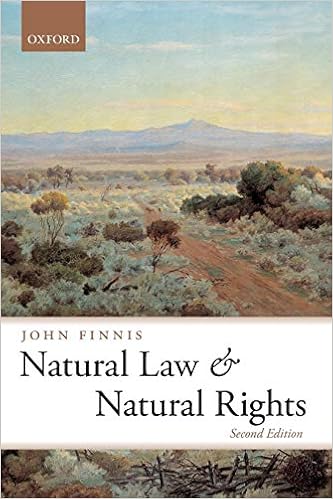
Let’s begin our review of John Finnis’s treatise on “Natural Law and Natural Rights,” and let’s start with the preface. In fact, Finnis wrote two separate prefaces, one for the original edition of the book (published in 1980), and another for the second edition (2011). In the 2011 preface, Finnis identifies the image that appears on the cover of the second edition of his book (pictured below). It is an oil painting called White Saltbush that was painted in 1891 by Edward White. According to Finnis, this painting “depicts results of human purpose and action, to ‘subdue the earth’, in vast areas of marginal land in South Australia that are neither as near-desert as Lake Torrens nor as hospitable and fertile as Adelaide or the Barossa Valley ….” In other words, Finnis is using a work of art to dramatize and visualize his abstract theory of law.

In the preface to the first edition, Professor Finnis reveals two things of note. One is that he wrote most of his book in Africa. Specifically, he states that “the book was mainly written in Africa, in Chancellor College at the University of Malawi, in an environment at once congenial and conducive to contemplation of the problems of justice, law, authority, and rights.” This revelation thus poses an intriguing question: to what extent do Finnis’s travels in Africa influence his theory of law? The other revelation of note is Finnis’s recommendation to some of this readers to turn first to Chapter XII of his book, the chapter devoted to unjust laws: “And those who want to see, in advance, how [Finnis’s theory of law] yields an understanding very different from the accounts of ‘natural law’ in their textbooks of jurisprudence and philosophy might turn first to Chapter XII, and then perhaps to Chapter II.” We shall follow Finnis’s recommendation and proceed directly to Chapter XII in our next post …

Image result for finnis natural law and natural rights
Posted in Uncategorized | Leave a comment

What I’ve been reading …

Happy Easter! I put aside “Infinite Jest” during Holy Week in order to begin reading “Natural Law and Natural Rights,” a classic that I have been meaning to crack open for many years now. (The author of this erudite tome, the Australian legal philosopher John Finnis, is pictured below.) If you are fascinated by such timeless questions as “What is law?” or “What is the relation between law and morality?,” then stay tuned in, for I will restate and review some of the most salient ideas from Professor Finnis’s beautiful (but as we shall see, deeply flawed) book in my next few posts …

Image result for finnis natural law and natural rightsImage result for finnis natural law and natural rights
Posted in Uncategorized | Leave a comment

On break for Holy Week

Happy Easter Triduum!

Posted in Uncategorized | Leave a comment

Long live Bayes

The Rev Thomas Bayes died on this day (17 April) in 1761. His tomb is pictured below. While you’re here, check out this biography of Bayes’s life and his major contributions to probability theory. Hat tip: @mathshistory. What will you be remembered for?

Posted in Uncategorized | Leave a comment

Who spams the spammers?

This guy! Trust us, this hilarious video is worth 9 minutes of your time. (File under “Best TED Talk ever.”)

Posted in Uncategorized | 1 Comment