
For my 51st birthday (25 August), I invite you–family, friends, or students–to take the fun, five-minute Lego train ride posted above; it’s the music video for Anna Meredith’s latest composition “Paramour.” More details here. Hat tip: @kottke.
For my 51st birthday (25 August), I invite you–family, friends, or students–to take the fun, five-minute Lego train ride posted above; it’s the music video for Anna Meredith’s latest composition “Paramour.” More details here. Hat tip: @kottke.
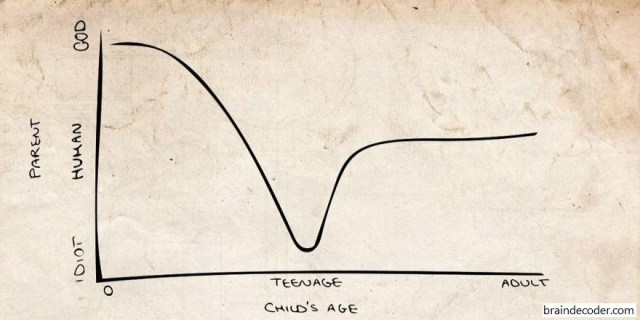
Alternate title: Visualization of a child’s perception of his parents over time (h/t: @pickover)
How do you create a biased coin? With pliers!
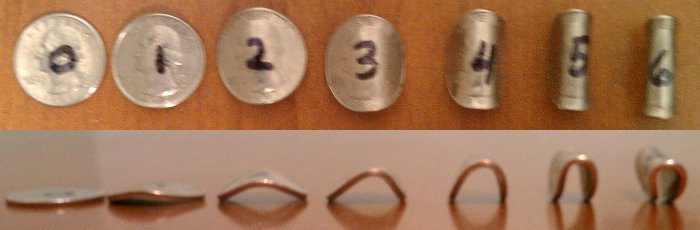
Via Mike Izbicki, who teaches mathematics at Claremont McKenna College (CMC), coin “0” pictured above is unbiased, but coins 1 through 6 were bent to various degrees using a pair of pliers. Professor Izbicki conducted Bernoulli trials on all seven coins, tossing each one 100 times. Below are his raw results:
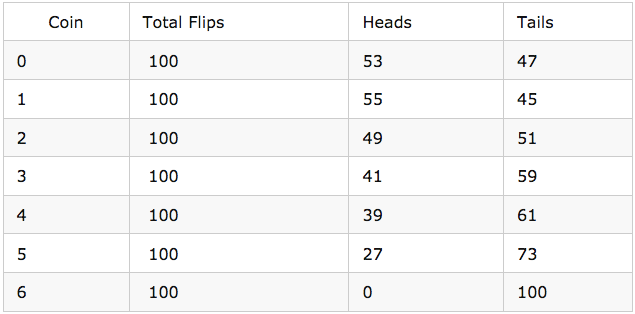
Prof Izbicki wrote up his mathematical analysis of these results here. In brief, his ultimate conclusion is as follows: “Amazingly, it takes some pretty big bends to make a biased coin. It’s not until coin 3, which has an almost 90 degree bend that we can say with any confidence that the coin is biased at all. People might notice if you tried to flip that coin to settle a bet!”
Daniel Pantaleo is the racist police officer who was caught on video using excessive force (an illegal chokehold) against Eric Garner five years ago. Although Pantaleo’s excessive use of force led to Mr Garner’s death, in order to be charged with a felony under New York law one has to be formally indicted by a grand jury, something the Staten Island grand jury in the Eric Garner case unjustly refused to do. Grand jury proceedings are conducted in secret, so we have no way of knowing the real reason why Pantaleo was let off the legal hook. In any case, this analysis begs the question, Why hasn’t Pantaleo faced any federal charges yet?


Source: Congressional Budget Office
The world’s wealthiest family are the third-generation heirs of Sam Walton. Collectively, they own a 50% stake in Walmart. More mind-boggling are these numbers from this recent Bloomberg report: the members of the Walton clan are so wealthy they amass $100 million per day or $4 million per hour or $70,000 per minute! At this astronomical rate, their family fortune will have grown over $20,000 since you began reading this blog post. (A new Walmart employee in the U.S., by contrast, will have made about 6 cents in that time, based on an $11 per hour wage.) We blogged about the significant social benefits of Walmart a week ago, and we also noted that Walmart is the largest US company by revenue and by number of employees, so the great wealth of the “House of Walton” should not be surprising to us. Our only question is: who owns the other 50% of Walmart? Update (8/23): here are some of the projects that some of the third-generation Waltons are investing in.
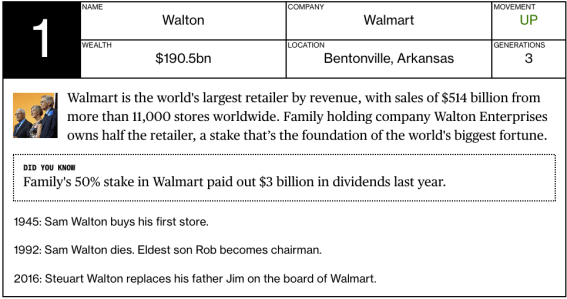
Image credit: Bloomberg
This interactive and zoomable graphic is available here. Hat tip: @kottke.

Check out this survey and interactive report by Sahil Chinoy, a graphics editor for The New York Times. According to Mr Chinoy, how you answer a handful of questions is very likely to determine your political affiliation. Putting aside the unreliability of “self-reports” and social-science surveys generally (people lie!), can you guess what these “handful of questions” are? The visualization of Mr Chinoy’s survey results below should provide some clues:
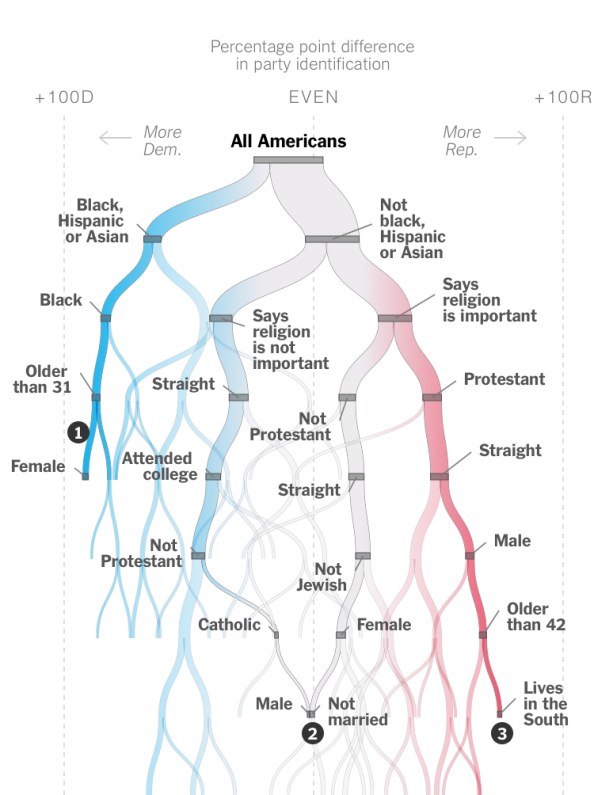
Image credit: N.Y. Times
Lots of people like to complain about partisan gerrymandering. One problem with all these complaints, however, is this–what would a non-gerrymandered voting district look like? Given this problem, here’s our tentative solution: instead of relying on State legislatures to draw up the voting districts in their respective States, why not create such districts based on the area code zones already in use in each State? Consider the State of Texas, by way of example. Currently, there are 27 Congressional districts and 21 area codes in Texas. So, why can’t we just overlay 21 of these districts on the pre-existing area code zones, with the remaining six members of Texas’s House delegation chosen at-large (State-wide)?


Toni Morrison, our national treasure; may she rest in peace. Here is her obituary, and here is a transcript of her 1993 Nobel lecture, or better yet, listen to the audio of her plaintive and poignant narrative via the YouTube clip posted above.





Welcome to the online home of the IASS
Hopefully It’s Interesting.
In Conversation with Legal and Moral Philosophers
PhD, Jagiellonian University
Books, papers, and other jurisprudential things
Ramblings of a retiree in France
BY GRACE THROUGH FAITH
Natalia's space
hoping we know we're living the dream
Lover of math. Bad at drawing.
We hike, bike, and discover Central Florida and beyond
Making it big in business after age 40
Reasoning about reasoning, mathematically.
I don't mean to sound critical, but I am; so that's how it comes across
remember the good old days...
"Let me live, love and say it well in good sentences." - Sylvia Plath
a personal view of the theory of computation
Logic at Columbia University
Just like the Thesis Whisperer - but with more money
the sky is no longer the limit
Technology, Culture, and Ethics
Just like the horse whisperer - but with more pages
Poetry, Other Words, and Cats


