Be like Bayes

In our previous post, we summarized some of the main ideas we stole from Tetlock and Gardner’s fascinating book on “superforecasting.” Their book is really useful because it is a kind of “how to” manual for Bayesian thinking. In fact, it is the first book I’ve read that shows you how to “be like Bayes”–how to apply Bayesian methods to real world decision problems. For the benefit of my loyal followers, I will summarize Tetlock and Gardner’s Bayesian methodology below.

Step 1. Formulate a testable problem. The problem must have an answer, and I will henceforth refer to the answer of the problem as “x” because the answer is unknown until the event occurs.

Step 2. Think probabilistically about x, the answer to the problem. Think of x as a prediction or as a “scorable” guess. Your answer may be correct (or incorrect) with some positive probability between 0 and 1. In plain English, “maybe” is usually the most correct answer as to whether x is true or not, but as Tetlock and Gardner note, there are “many grades of maybe” (p. 141) or “units of doubt” (p. 168), so you should not only make a guess about x, you should also observe how strong or weak your belief in x is.

Step 3. Test your guess. How does one go about testing a guess? We will need to subdivide this step into smaller ones as follows:

  • Step 3a. Figure out the base rate. The base rate is “how common something is within a broader class.” (Tetlock & Gardner, 2015, pp. 117-118.) So, to think probabilistically about a problem (see step 2 above), ask yourself: “How often do things of this sort happen in situations of this sort?” (Ibid., p. 279.) Congratulations! That is your “prior”!
  • Step 3b. Restate the problem in Bayesian terms by asking more questions. In the words of Tetlock & Gardner (p. 111): “What information would allow me to answer the question?” In other words, what evidence do you need to see for x to be true, or how likely is it that x would be true if I saw such-and-such evidence? (I will elaborate on this crucial question-asking procedure in my next post.)
  • Step 3c. Make plausible guesses about the correct answers to these other questions in Step 3b and then revise your guesses whenever you obtain new evidence or information that is relevant to any of these questions.

I will elaborate on and express all these steps in more formal Bayesian parlance in my next post.

Image result for rev bayes

Happy Birthday Sydjia! (Image credit: Tim Cocks)
Posted in Uncategorized | 2 Comments

Beliefs are hypotheses to be tested, not treasures to be guarded

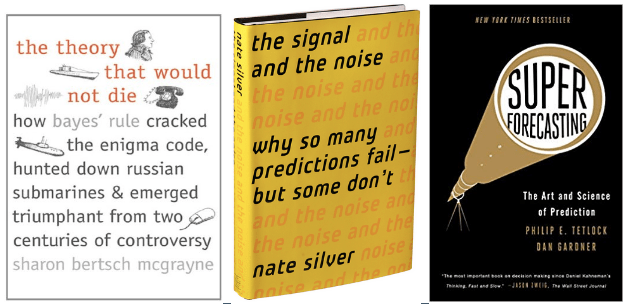
That is my favorite quote from “Superforecasting: the art and science of prediction” by Philip Tetlock and Dan Gardner, which I finally got around to reading during this Christmas holiday. Along with Sharon McGrayne’s 2012 book “The theory that would not die” and Nate Silver’s 2015 book “The signal and the noise,” Philip Tetlock and Dan Gardner’s excellent Superforecasting book are must reads for anyone interested in how to improve hypothesis-testing in science or how to improve decision-making in such fields as business, politics, and law. (This trifecta of Bayesian tomes is pictured below.) Below are some of the main ideas I have stolen from Tetlock and Gardner’s beautiful book:

  1. Science is not about certainty or facts; science is about probability. Or about “testability,” to be more precise: “… in science, the best evidence that a hypothesis is true is often an experiment designed to prove that the hypothesis is false …. Scientists must be able to answer the question: ‘What would convince me I am wrong?’” (p. 38) By contrast, “Fuzzy thinking can never be proven wrong.” (p. 252)
  2. Beliefs should be testable. In the eloquent words of Tetlock and Gardner, “Beliefs are hypotheses to be tested, not treasures to be guarded.” This is why so many legal and political debates are such a supreme waste of time, or in the words of Tetlock and Gardner (p. 268): “These are accomplished people debating pressing issues, but nobody seems to have learned anything beyond how to defend their original position.” In short, beliefs must be tested because even the firmest belief may be wrong.
  3. Bayesian methods can be used to test beliefs. As Tetlock and Gardner show, so-called “superforecasters” are just Bayesians by another name. They test their beliefs by restating those beliefs in the form of predictions and they attach a numerical value to express their degrees of belief in their predictions. These Bayesian ideas are so important and so useful in so many different domains, I will devote my next few posts expounding on the Bayesian ideas in Tetlock and Gardner’s book.
Screen Shot 2018-12-27 at 2.44.44 PM

To my dearest Sydjia: Happy Birthday Eve!

Posted in Uncategorized | 2 Comments

Happy Boxing Day

This video shows how the musician Calvin Harris created his lovely song “Slide”. What will you create in the new year?

Posted in Uncategorized | Leave a comment

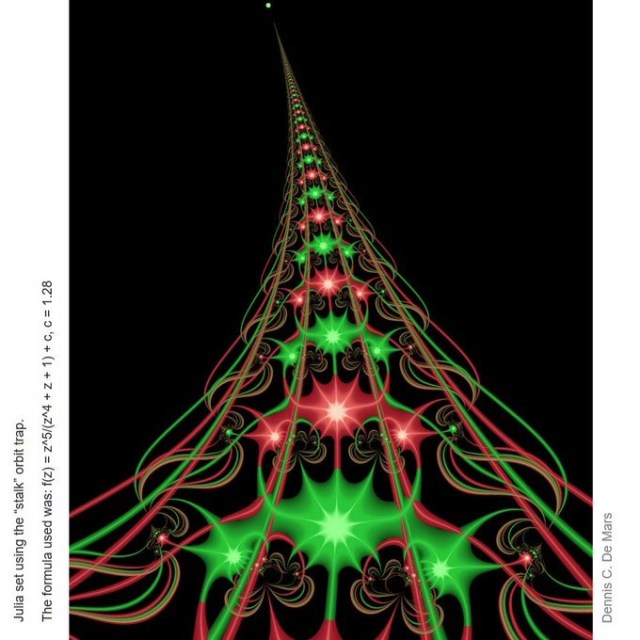
Fractal Christmas Tree

Hat tip: Cliff Pickover (@pickover)

Posted in Uncategorized | Leave a comment

Nochebuena

Latin Americans like to celebrate Christmas Eve (Nochebuena) with their family and closest friends. That’s why 24 December is my favorite holiday tradition and my favorite day of the year.

Posted in Uncategorized | 2 Comments

End of year review: 2018

It’s time to size up what we have been working on during this past year. In addition to my regular teaching duties, I worked on the following research projects:

1. Along with my colleagues Sean Melvin (Elizabethtown College) and David Orozco (Florida State), I contributed 12 chapters to a new textbook on “Business Law and Strategy.” (McGraw Hill Education, in press). Our textbook presents the standard topics of the business law curriculum–such as torts, contracts, corporate governance, etc.–from a strategic and game-theoretic perspective.

2. I attended the 2018 Fall Altheimer Symposium commemorating the 60th anniversary of Cooper v. Aaron, a leading school desegregation case. My talk explored the legality of President Eisenhower’s decision to send troops to Arkansas during the 1957 Little Rock Crisis. The symposium was hosted by the William H. Bowen School of Law of the University of Arkansas on 28 Sept. 2018 and I very much enjoyed my stay in Little Rock, especially my visit to Central High School. After the symposium, I wrote up a paper titled “Domestic Constitutional Violence” (CDV), which will be published in a symposium edition of the UALR Law Review. (I will be blogging more about my CDV paper soon.)

3. Earlier this year, I wrote up a formal review of Randy Kozel’s excellent book Settled Versus Right: A Theory of Precedent (Cambridge University Press, 2017). My review, which is titled “The Problem with Precedent,” will be published overseas in The Vienna Journal on International Constitutional Law. In the meantime, you can read an ungated version of my review here. (I also blogged about Kozel’s thought-provoking book earlier this year.)

4. During the summer months I also wrote up a law review article in which I present a Bayesian or probabilistic theory of stare decisis. Kozel’s book (see item #3 above) and the U.S. Supreme Court’s 5-4 decision in South Dakota v. Wayfair in June of 2018 are what motivated me to write this paper, which is tentatively titled “Bitcoin, the Commerce Clause, and Bayesian Stare Decisis.” The paper will be published in a symposium edition of the Chapman University Law Review next year, and I will present my “Bayesian Stare Decisis” model of judging at the 21st Annual Federalist Society Faculty Conference, which is scheduled to take place on January 3 and 4 in New Orleans.

5. In the summer I was also scheduled to attend the XVIII International Hemingway Conference at the American University in Paris. Although I was unable to attend, in honor of this occasion I drafted a short essay titled “The Bayesian Man and the Sea.” My paper, which applies Bayesian probability to Ernest Hemingway’s novella The Old Man and the Sea, explores the logic of Santiago’s “decision calculus,” his fateful decision to set sail after going 84 days without catching a single fish, from a probabilistic perspective.

6. In honor of what would have been the philosopher Robert Nozick’s birthday 80th birthday on 16 Nov. 2018, I wrote up an extended review of Nozick’s classic book Anarchy, State, and Utopia (ASU). In particular, beginning in November 2017 and extending into the spring and summer of 2018 (with various interruptions), I eventually ended up blogging about every single page of ASU. Type in the word “Nozick” in this blog’s search function if you wish to peruse any of my takes on Nozick’s masterpiece.

7. I also had the opportunity to talk about my 2013 paper “Gödel’s Loophole” with Professor Brian Frye on his scholarly podcast series “Ipse Dixit.” My Gödel paper, which has been downloaded over 5000 times (!), explores the possibility of a logical contradiction in the U.S. Constitution. It is available here (via SSRN), and you can listen to Prof Frye and I retell the story of Kurt Gödel’s discovery of this contradiction here.

Image credit: kinsta.com

Posted in Uncategorized | 1 Comment

Mathematical pudding bowls

Check out these beautiful mathematical pudding bowls. Each bowl contains the proof of a theorem, such as Gauss’s proof by induction. The proof is in the pudding bowls! (You can order a set of four bowls here. Hat tip: Cliff Pickover.)

Posted in Uncategorized | Leave a comment

Musical and legal interpretation

That is the subject of this beautiful paper by Kevin Toh, a philosopher of law at University College London. (The full title of his scholarly paper is “Authenticity, Ontology, and Natural History: Some Reflections on Musical and Legal Interpretation.”) In addition, Michael B. Coenen, a law professor at LSU in Baton Rouge, has written an excellent review of Professor Toh’s work. As Professor Coenen correctly notes, Toh is not the first to explore the relation between musical and legal interpretation; past and present preeminent legal scholars such as Jerome Frank (“Words and music: some remarks on statutory interpretation“), Richard Posner (“Bork and Beethoven“), and Jack Balkin (“Verdi’s High C“), among many others, have commented on the connection between music and law. But Toh’s extensive research draws from a wide variety of scholars, including literary theorists, philosophers of art, social psychologists, evolutionary biologists, as well as legal theorists. Below the fold is an extended excerpt from Prof Coenen’s masterful review: Continue reading

Posted in Uncategorized | Leave a comment

College Graduation Cap Art

ucf-cap-3ucf-grad-4

ucf-cap-9ucf-cap-11

Check out this incredible and creative collection of some of my favorite college graduation caps from this fall’s commencement ceremonies at the University of Central Florida. (All photos by Carly McCarthy, via UCF Today.) #ChargeOn

Posted in Uncategorized | 1 Comment

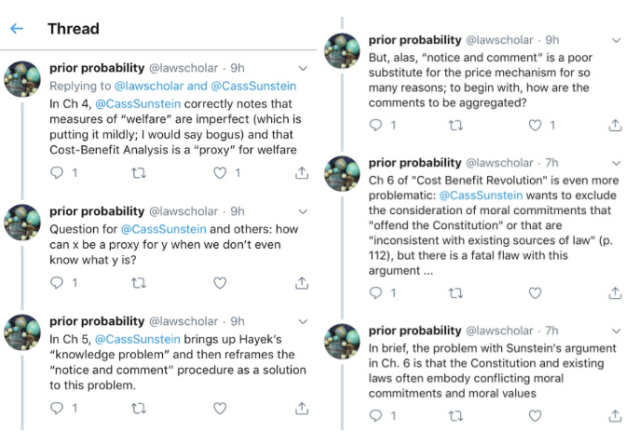
My critique of “The Cost-Benefit Revolution”

Cass Sunstein’s book “The Cost-Benefit Revolution” contains an excellent overview of cost-benefit analysis, so it is a must-read for law students and legal scholars, especially those of us who are interested in the perils and promise of the regulatory state, but without a general theory of harm–i.e. a theory that can tell us which harms should matter in the domains of law and ethics–Professor Sunstein’s cost-benefit approach to regulation is intellectually incoherent.

Screen Shot 2018-12-19 at 1.39.19 AM

Link to my Twitter thread here.

Posted in Uncategorized | Leave a comment