Where is Ms Bingbing?

Update (10/10): Fan Bingbing has reappeared! (See our previous post from 9/10 below.) According to The Guardian (UK), “Fan was detained at a ‘holiday resort’ in Wuxi, under a 2013 legal framework known as ‘residential surveillance at a designated location.’ It is essentially a legalistic euphemism for disappearance and forced detention. ‘In practice it often means someone is held in secret and denied all contact with the outside world,’ says Michael Caster, … [who is the] editor of The Peoples Republic of the Disappeared, a collection of first-hand accounts of victims of such forced detentions. ‘Many of them were subject to one form of torture or another, from prolonged sleep deprivation to physical pain, beatings, stress positions, mental abuse and threatening family members.’ In many cases, the outcome is forced confessions.”

F. E. Guerra-Pujol's avatarprior probability

Via Channel NewsAsia: “China’s highest paid movie star Fan Bingbing … has not been seen in public since July …. The 36-year-old actress has been a household name in China for years and tasted Hollywood success with a role in the 2014 blockbuster ‘X-Men: Days of Future Past’. *** But she has gone quiet in recent months, following allegations of tax evasion.

“In [a] report by Beijing Normal University published earlier this month, 100 Chinese stars including popular actor Jackie Chan and award-winning actress Zhang Ziyi were ranked according to their professional work, charity work, and personal integrity. But with a pass requiring a score of more than 60 per cent, only nine celebrities made the cut, with Chinese actor Xu Zheng topping the list at 78.

“[Ms Bingbing] had a score of zero.” (Hat tip: Tyler Cowen.)

#DueProcess #FanBingbing (Credit: Fergus Ryan)

View original post

Posted in Uncategorized | 2 Comments

The geometry of control panels

Check out this blog devoted to control panels. (Hat tip: kottke.)

Posted in Uncategorized | Leave a comment

Ipse dixit podcast

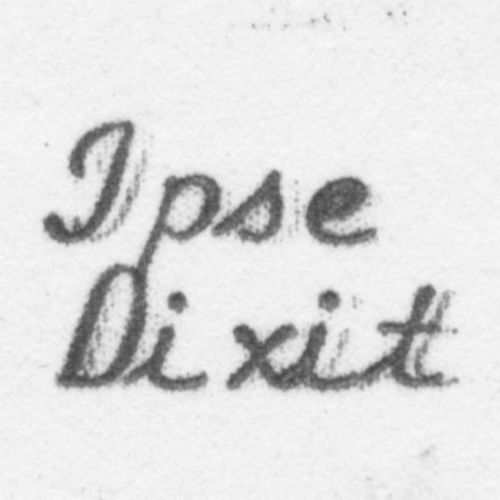
The phrase ipse dixit is Latin for “he said it himself” and refers to an assertion without proof or a dogmatic expression of mere opinion. (Here is the Wikipedia entry for ipse dixit.) This phrase now also refers to a new podcast series hosted by one of our favorite legal scholars Brian O. Frye, who teaches at the University of Kentucky. (FYI: the graceful logo of the podcast is pictured below. We have previously blogged about Professor Frye’s fascinating work on the Zapruder film (see here) and his revisionist history of the facts in Erie v. Tompkins (see here); in addition, here is a master link to his scholarship.) In his podcast Professor Frye interviews sundry legal scholars on a wide variety of topics, so check out the podcast at your leisure. By way of example, Professor Frye has already interviewed Eric Segall on “Originalism as Faith,” which explores the various shades of originalist constitutional interpretation; Valena Beety on “The Overdose/Homicide Epidemic,” which explores the role of coroners in classifying overdoses as homicides; and Ramsi Woodcock on “Efficient Queues,” which explores the theoretical relationship between queues and prices.

Image result for ipse dixit podcast
Posted in Uncategorized | 1 Comment

Idle prohibitions (“keep off grass” edition)

Reddit has an entire thread devoted to “desire paths,” like the one pictured below. (hat tip: @pickover)

Credit: u/Phoenixed

Posted in Uncategorized | 2 Comments

Thought experiment (national borders edition)

What if national borders were redrawn along latitude and longitude lines?

Source: u/Luciantang, via Reddit

Posted in Uncategorized | Leave a comment

Double standards (law professor edition)

A large group of my law professor colleagues (now over 2,400 of them!!!) have signed an “Open Letter” addressed to the U.S. Senate stating their opposition to Judge Brett Kavanaugh (BK). The crux of their sanctimonious argument is that BK lacks the judicial temperament to sit on the U.S. Supreme Court:

… [BK] exhibited a lack of commitment to judicious inquiry. Instead of being open to the necessary search for accuracy, [BK] was repeatedly aggressive with questioners. Even in his prepared remarks, [BK] located the hearing as a partisan question, referring to it as “a calculated and orchestrated political hit,” rather than acknowledging the need for the Senate, faced with new information, to try to understand what had transpired. Instead of trying to sort out with reason and care the allegations that were raised, [BK] responded in an intemperate, inflammatory, and partial manner, as he interrupted and, at times, was discourteous to questioners.

Is this letter right? Does BK lack judicial temperament? This law professor letter is misguided on multiple levels. Specifically, in addition to the counter-arguments made here, I dissent from this letter for the following three reasons:

  1. Double standards. The letter states that BK was “aggressive” as well as “intemperate, inflammatory, and … discourteous” during his 9/27 hearing in the U.S. Senate. The irony, however, is that these very same adjectives can be used to describe the behavior of many judges who are already on the bench, especially appellate judges and supreme court justices. Yes, judges are supposed to be impartial umpires, but even umpires get angry from time to time!
  2. Logical incoherence. The letter claims that BK is not open to the search for accuracy, but this claim is logically incoherent in a domain like law. Why? Because in most appellate and supreme court cases the laws in issue are open to competing and multiple interpretations, and there is no real way of “testing” which of these interpretations is truly the correct one. In short, judges are not Popperian falsifiers. In any case, BK was not presiding over a courtroom. He was at a hearing, accused of heinous behavior and being treated as a “hostile witness” by a group of sanctimonious senators.
  3. Void for vagueness. “Judicial temperament” is a vague and ambiguous standard to begin with. Worse yet, the professors who signed the above letter appear to be applying this standard in an unfair and selective manner. By way of example, let’s recall the words of my favorite justice Sonya Sotomayor, who once said, “I would hope that a wise Latina woman, with the richness of her experiences, would more often than not reach a better conclusion than a white male who hasn’t lived that life.” Is this statement consistent with the open-ended “judicial temperament” standard referred to in the above letter?

Image result for double standards

Posted in Uncategorized | 5 Comments

Who judges the federal judges?

Or: Why are Article III judges above the law? According to Stacy N. Cammarano (via the Washington Post): “Title VII of the Civil Rights Act of 1964 prohibits workplace discrimination on the basis of sex, but it does not apply to the 30,000 employees who work for the federal court system. Though Congress, which originally exempted itself from the law, passed legislation in 1995 that covers congressional employees, it has not done so for the judiciary.”

Image result for above the law

Disclaimer: does not apply to federal judges

Posted in Uncategorized | Leave a comment

The Militia Clauses of the Constitution

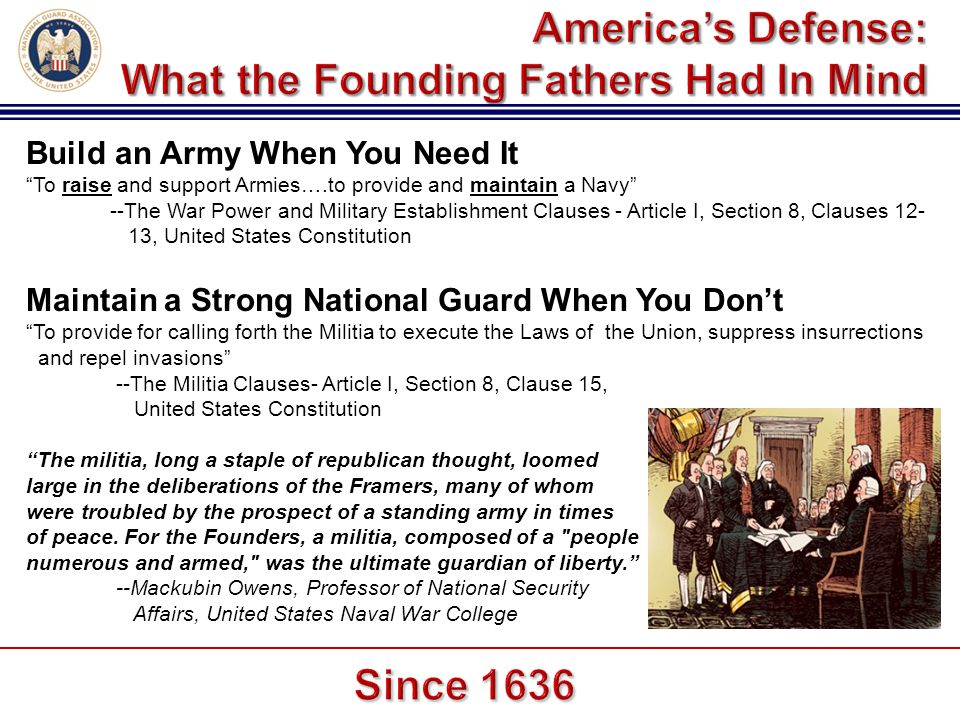
In our previous post, we summarized the main constitutional arguments challenging the legality of Executive Order 10730, the historic decree by which President Dwight D. Eisenhower sent the 101st Airborne Division into Little Rock, Arkansas to restore order in the fall of 1957. To evaluate the merits of these various arguments, we must now ask a different question. We must ask, how much military power can the Congress delegate to the president? It turns out that Congress has the authority to delegate to the president the power to call out State militias under Article I of the Constitution. Specifically, the first of two Militia Clauses (Article I, Section 8, Clause 15) in the Constitution allocates to Congress the power “to provide for calling forth the Militia to execute the Laws of the Union, suppress Insurrections, and repel Invasions….

The first Militia Clause, however, poses a big problem if you favor an “originalist” or “textualist” interpretation of the Constitution, for this clause contains no reference to regular federal troops or the U.S. armed forces! Thus, an originalist or textualist argument can be made that Congress may have exceeded its constitutional authority when it enacted the Insurrection Act of 1807, the Suppression of Rebellion Act of 1861, and the Ku Klux Klan Act of 1871, all of which authorized the president to use regular troops to combat internal insurrections and obstructions of federal law. By contrast, if you favor a “Living Constitution” approach, this omission is no big deal, since the Constitution also allocates to Congress the power “to raise and support armies,” and since the U.S. armed forces have over time grown stronger relative to the State militias. So, which interpretation is the right one? Alas, can there be a “right answer” to this second-order question?

Image result for militia clause of the article I

Credit: Tristian Darrington

Posted in Uncategorized | Leave a comment

The Legality of E.O. 10730

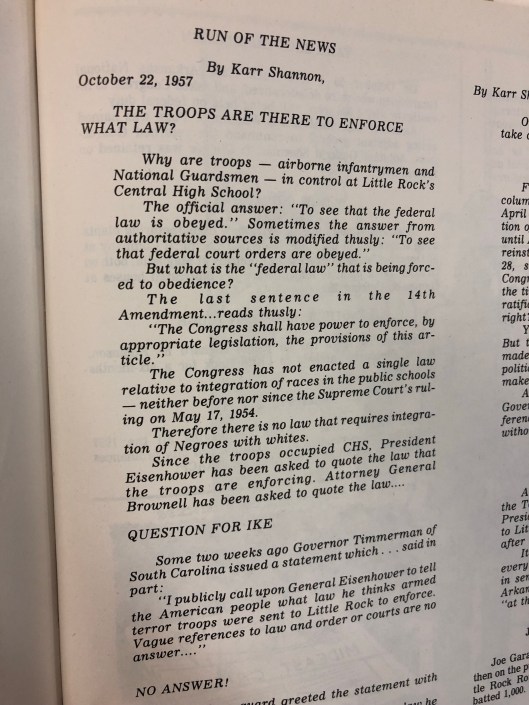
We now return to our analysis of President Eisenhower’s fateful decision to use military force to desegregate Central High School in Little Rock, Arkansas in the fall of 1957. One of the best constitutional arguments against the legality of Executive Order 10730 (and thus against Eisenhower’s use of force in Little Rock) is to focus on the meaning of the word “law.” Although Eisenhower ostensibly sent troops into Little Rock to enforce a federal court order, and although that court order was based on the Supreme Court’s reinterpretation of the 14th Amendment in Brown v. Board I and Brown II, the actual text of the 14th Amendment grants to Congress (not to the federal courts) the power to enact legislation to enforce the provisions of that amendment.

Likewise, one could also argue that the term “law” encompasses only formal enactments of Congress and not the Supreme Court’s interpretation of the Constitution, since all three branches of the federal government have the ability (and perhaps the duty) to interpret the Constitution as they see fit. Nevertheless, even if these arguments are persuasive in a technical or legalistic sense, from a practical perspective neither Congress nor the federal courts have “the power of the sword,” to borrow Alexander Hamilton’s apt phrase in Federalist Paper 78.

So, if the president’s military decisions are for all practical purposes unreviewable by the courts, we must turn our attention to Congress, and as we have noted in one of our previous posts, Congress has delegated limited authority to the president to use military force in the United States. But are those laws themselves constitutional? We shall consider this question in our next post.

Source: Faubus (1980), p. 339

Posted in Uncategorized | 2 Comments

Notice (honor system edition)

We love used bookstores. During our visit to Little Rock, Arkansas this week we patronized “The Bookstore at Library Square.” One of the books we purchased there was published in 1989 and contained the following notice (pictured below) on a loose sheet of paper inside the book: “Your only obligation … is that you agree within a 30-day period to read it and decide whether you want to keep it or not. If you decide to keep the book, you will remit $6.00 to “Books,” 1960 Union National Bank Building, Little Rock, Arkansans 72201. If you elect not to keep the book, then you should pass [it] around in your community as a sharing gift.” Bonus question: is this a valid unilateral contract?

Posted in Uncategorized | 2 Comments