Optimal Auctions and Hamilton

We interrupt our ongoing review of Anarchy, State, and Utopia to ask a simple question: why isn’t there a movie version of the popular Broadway musical “Hamilton” yet? According to this report in The Wall Street Journal (hat tip: kottke), we might just get what we have been wishing for! (As much as my dear wife Sydjia and I would love to see this musical in person, we are not going to pay thousands of dollars for this privilege.) A massive bidding war is apparently going on to bring “Hamilton” to the silver screen, and bids for the legal rights to the musical might exceed $50 million! For more details about auction theory in general, check out this undergraduate course on optimal auctions (via Cheap Talk).

Posted in Uncategorized | Leave a comment

Nozick on hypothetical histories

Nozick devotes the last subsection of Chapter 9 of ASU (pp. 292-294) to the problem of “hypothetical histories.” Here, he poses a crucial question (p. 293): “How should hypothetical histories affect our current judgment of the institutional structure of society?” This hypothetical history question is especially poignant because both John Rawls and Robert Nozick use this device–hypothetical histories–to build their theories of justice by which to evaluate the structure of North American society today: Rawls’s is the original position; Nozick’s, the dominant protection association. Nevertheless, Nozick’s answer to his hypothetical history question is less than satisfying. (See, e.g., David Johnston, The Idea of a Liberal Theory, Princeton U Press (1994), p. 56, n. 36, available here.) In fact, his analysis of the relation between hypothetical and actual histories ends up falling into a vicious circle! Continue reading

Posted in Uncategorized | Leave a comment

The problem with demoktesis

Let’s start wrapping up our review of Chapter 9 of Anarchy, State, and Utopia (ASU) by taking stock of Robert Nozick’s mind-blowing thought experiment in this chapter. In summary, Nozick imagines a collective corporate entity or Great Corporation in which “each person owns exactly one share in each right over every other person, including himself.” (ASU, p. 285.) In other words, each person has an equal say in the lives of all others. Furthermore, Nozick coins a new term to christen this system: demoktesis or “ownership of the people, by the people, and for the people” (p. 290). What is so terrible about this imaginary scheme? It turns out there are two big problems with demoktesis. One is the problem of holdouts. According to Nozick (pp. 289-290), persons who refuse to participate in this scheme would not be allowed to remain in the same territory in which the great corporation operated; nor would they be allowed to create a competing corporation. For my part, my initial response to this argument was to push back against Nozick’s conclusions regarding holdouts. His entire scheme is imaginary, so why can’t we imagine an alternative world consisting of competing human corporate conglomerates? Continue reading

Posted in Uncategorized | 2 Comments

Say it ain’t so …

Update (8/3): We are happy to report that the comments on Marginal Revolution are now back open!

We interrupt our ongoing review of Anarchy, State, and Utopia to bring a matter of marginal significance (in the scheme of things) to the world’s attention. For years, one of our favorite sites on the Internet has been Marginal Revolution (MR), an eclectic economics blog authored by Tyler Cowen and Alex Tabarrok. But one week ago (24 July 2018), the Marginal Revolution blog announced it was going to completely turn off the comments section to MR “for the time being.” Worse yet, aside from a tongue-in-cheek (and easily refutable) justification for this momentous decision, no explanation was provided. (My guess, however, is that the fraction of defectors on MR–i.e. persons who post inane, irrelevant, or profane comments–grew too large relative to the fraction of cooperators, producing an awful cacophony instead of an enlightened discussion on the front end and making moderation of the comments section a tedious chore on the back end.) Nevertheless, I often learned as much from the comments as I did from the MR blog itself, so I hope this “time being” is a short one and that our colleagues Cowen and Tabarrok reopen the comments.

Image result for comments section meme
Posted in Uncategorized | Leave a comment

Nozick’s Lockean digression

As we mentioned at the end of our previous post, smack dab in the middle of one of the most original and mind-blowing thought experiments in the history of political philosophy, Nozick digresses to discuss Locke’s views on parental ownership of children. Although the ostensible reason for this Lockean digression is to figure out whether children are to be included in Nozick’s imaginary “one-shareholder, one vote” scheme, we suspect that the true reason for tucking this digression away in this part of the book might be a more sinister one: to conceal some serious internal contradictions in Locke’s labor theory of property rights. Continue reading

Posted in Uncategorized | 2 Comments

Nozick’s thought experiment

You may have heard the slogan “corporations are people”; but what if people were corporations? The second subsection of Chapter 9 of ASU contains just such a mind-blowing thought experiment. In summary, Nozick borrows the Beckerian concept of “human capital” from the world of economic theory and takes this idea to its logical conclusion. He imagines a society in which each person has the right to incorporate himself as a human corporation, the right to sell off shares of stock in himself, and the right to buy shares in other people. In this imaginary world, it is perfectly legal for people to sell off discrete property rights in themselves, including “the right to decide from which persons they could buy certain services (which they call occupational licensure rights); the right to decide what countries they would buy goods from (import-control rights); … and so on.” (ASU, p. 283, emphasis in original.) Not only is it perfectly legal for people to buy and sell shares of such rights; this practice becomes so widespread and pervasive that, in Nozick’s words (p. 284), “just about everyone sells off rights in themselves, keeping one share in each right as their own, so they can attend stockholders’ meetings if they wish.” Continue reading

Posted in Uncategorized | 4 Comments

Nozick on externalities

Recall from our previous post that Nozick has asked us to keep an open and uncontaminated mind in the opening subsection of Chapter 9. He will need us to keep an open mind because he is going to present an unorthodox thought experiment in the next subsection of this chapter (pp. 280-292), a thought experiment motivated by a special type of “market failure”: the problem of positive externalities.

So, what is an “externality”? In a word (or two words), this is just a fancy term for “side effects.” In particular, a positive or beneficial externality (the subject of Chapter 9 of ASU) refers to the positive side effects that an activity or transaction confers on those parties who are not directly involved in the activity or transaction. Such a side effect can arise either on the production side or on the consumption side. By way of example, a positive production externality includes a beekeeper who keeps bees for their honey. A positive side effect of beekeeping is the pollination of surrounding crops by the bees. (In fact, the value generated by the pollination may be more important than the value of the harvested honey.) Similarly, an example of a positive consumption externality includes an individual who receives a vaccination for a communicable disease, for he not only decreases the likelihood of his own infection, but also decreases the likelihood of others becoming infected through contact with him. Continue reading

Posted in Uncategorized | 2 Comments

Nozick on analogical reasoning

Nozick devotes the first subsection of Chapter 9 (pp. 277-279) to analogical reasoning and to what I like to call “the mental contamination problem.” According to Nozick, one of the problems with reasoning by analogy is our inability to keep an open and uncontaminated mind. Why does this problem occur? Because whenever we are presented with a hypothetical example or with a body of data, we will invariably be tempted to evaluate that example or data through the filter of our theoretical priors, or as Nozick puts it (p. 277, emphasis in original): Continue reading

Posted in Uncategorized | 4 Comments

Overview of Chapter 9 of ASU

Chapter 9 of Anarchy, State, and Utopia (ASU), the penultimate chapter of this classic book, is titled “Demoktesis.” Spoiler alert: according to Wikipedia, demoktesis is a thought-experiment designed to show the incompatibility of democracy (one-man, one-vote) with libertarian theory and with Nozick’s entitlement theory, i.e. Nozick’s defense of the minimal state. So, suffice it to say, we are headed into some real deep waters here! Nozick’s thought-experiment is divided into three subsections as follows:

  • Consistency and parallel examples (pp. 277-279)
  • The more-than-minimal-state derived (pp. 280-292)
  • Hypothetical entities (pp. 292-294)

Nozick begins Chapter 9 by asking, “Is there some way to continue our story of the origin of the (minimal) state from the state of nature to arrive, via only legitimate steps which violate no one’s rights, at something more closely resembling a modern state?” (ASU, p. 276, emphasis in original, citation omitted.) In other words, if Nozick’s minimal state is the only type of state that is morally justified, why does it exist nowhere on earth? We will jump into Chapter 9 in our next blog post.

Image result for the state nozick
Posted in Uncategorized | Leave a comment

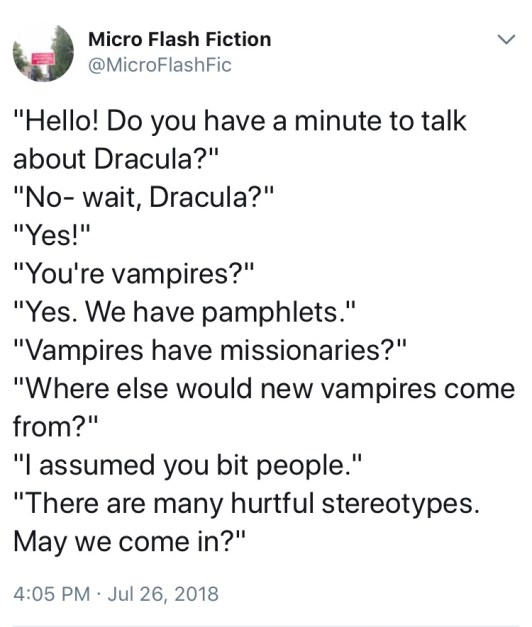
Micro Flash Fiction

During a bout of insomnia, we discovered a new genre of literature and storytelling called micro flash fiction. (Hat tip: @ESYudkowsky.) Below is a sample:

Posted in Uncategorized | 4 Comments