Recommended reading

Here is a small sample of the essays, papers, reports, etc. we’ve learned the most from this week:

  1. Derek Parfit’s last paper (via the Journal of Philosophy & Public Affairs)
  2. The seven deadly sins of AI predictions (Joost Swarte, via MIT Technology Review)
  3. Why fake islands might be a real boon for science (Emma Marris, via Nature)
  4. When the revolution came for Amy Cuddy (Susan Dominus, via NY Times Magazine)
  5. Blade Runner timeline (Jon Miller, via Movie Pilot)

Credit: Felix Tindall (@FT_in_NZ)

Posted in Uncategorized | Leave a comment

Review of Queralt’s defense of economic liberty

It’s been a few days since our last post on the new Routledge Handbook of Libertarianism. (We have already reviewed nine works from this remarkable collection of theoretical and applied essays.) In this post, we will review Jahel Queralt’s excellent essay: “Economic liberties are also the liberties of the poor.” It’s one of the best essays in the entire collection and deserves to be read in its entirety. [Dr Queralt, a law lecturer at Pompeu Fabra University in Barcelona, is the author of Igualdad, suerte y justicia (“Equality, Luck, and Justice”); see book cover below.] In summary, Queralt explains why libertarian theory is so relevant to the lives of working men and women around the world. From a theoretical perspective, she shows how economic liberty–defined broadly as the right to engage in whatever trade or business one wants without governmental interference–is both “autonomy-protecting” as well as “autonomy-enhancing.” Economic liberty protects and enhances individual autonomy because it allows us to decide for ourselves what occupations to engage in, what goods to make, or what services to provide. But more importantly, economic liberty is essential from a practical perspective as well. In the eloquent words of Dr Queralt (the links are hers too): “The poor have a strong interest in having their economic liberties respected. Indeed, in developing countries approximately half of the workforce is self-employed. This includes pushcart vendors, itinerant barbers, shoemakers, and other entrepreneurs that run small businesses against all sorts of government failures—onerous and cumbersome business regulations, bribery, and corruption. Such obstacles not only make it extremely difficult for them to succeed in the market and to earn a livelihood. They also create a division between them and wealthy individuals who can handle regulatory costs and are able to hire legal aid in navigating the maze of red tape. To put it bluntly, infringements of economic liberties can perpetuate poverty and deepen inequalities in the marketplace. When this happens, economic unfreedom harms the poor even more than it harms the rich.” In a nutshell, Queralt’s defense of economic liberty is one of the best we’ve seen in a long time.

Image result for Igualdad, suerte y justicia queralt

Posted in Uncategorized | 1 Comment

Memo to the Royal Swedish Academy

Behavioral economist Richard Thaler was awarded this year’s “Nobel Prize” in economics. But with all due respect, the Swedes got it wrong. If the selection criterion for winning a Nobel in economics these days is going to be original work integrating human psychology into economics (or “how human traits systematically affect individual decisions as well as market outcomes,” to quote the Royal Swedish Academy’s press release), isn’t economist John List far more deserving of this award? True, Thaler may have marginally pushed the pioneering work of Amos Tversky and Danny Kahneman further by actually testing economic theory in laboratory settings, but it was List who figured out creative ways of testing these lab tests themselves! Unlike Thaler and company, who conduct their economic experiments on North American undergrads in artifical environments and for small stakes (coffee mugs and chump change), Prof List has pioneered the use of field experiments in which ordinary people (not just undergrads) play for real stakes. Maybe next year …

Posted in Uncategorized | Leave a comment

Map of lunar landings

Hat tip: @pickover

Posted in Uncategorized | Leave a comment

Crowdsourcing morality?

Is it possible to model such subjective and other-regarding preferences as altruism and fairness? We stumbled upon this fascinating blog post by Dom Galeon on “Crowdsourced Morality.” Among other things, Galeon links to a five-page paper titled “Moral Decision Making Frameworks for Artificial Intelligence” by Vincent Conitzer, Walter Sinnott-Armstrong, Jana Schaich Borg, Yuan Deng, and Max Kramer, computer scientists at Duke University. Previous literature has used insights from game theory to probe problems in ethics, like how to get mutual cooperation or reciprocal altruism off the ground. What’s novel about this paper, however, is that it uses ethics to explore game theory. The paper also introduces the idea of “moral solution concepts.” Here is an excerpt: Continue reading

Posted in Uncategorized | 1 Comment

Review of Blade Runner 2049

The beautiful Blade Runner sequel, Blade Runner 2049, poses many deep  moral dilemmas, psychological puzzles, and other complex conundrums. Yet most of my fellow fans have overlooked a simple but key question: who owns the replicants? From a property rights perspective, the fundamental problem with the dystopian world depicted by movies like Blade Runner 2049 and the original Blade Runner is not that the genetically-engineered androids depicted in these films have limited lifespans or are relegated to degrading or dangerous jobs. After all, the new and improved “Nexus 9” replicants in Blade Runner 2049 now have extended lifespans, and one could easily imagine a reverse-Blade Runner world with the replicants in charge. Rather, the main problem is that the replicants lack self-ownership or property rights in their own minds and bodies! (FYI: here is Wikipedia’s entry for self-ownership.)

If you pay close attention to the sequel, however, you can’t help but notice that all the remaining replicants in the Blade Runner universe are now owned by Niander Wallace (played by Jared Leto), the idealistic industrialist who engineered the new Nexus 9 models. Moreover, according to the new movie’s complicated and convoluted backstory, it was Wallace who bought out the bankrupt Tyrell Corporation in the year 2028 (or nine years after the original movie was set), so he presumably owns the legal rights to all the older Nexus models still in service as well. As Tyrell’s successor firm, the Wallace Corporation is now the only firm engaged in the business of creating and marketing replicants. No wonder, then, that the world depicted in the Blade Runner sequel is so bleak. Put another way, the Wallace Corporation is not a monopoly because it is evil; the Wallace Corporation is evil because it is a monopoly. A competitive and decentralized world of self-ownership, by contrast, would be a completely different world. (We are going to write up a full-length review, tentatively titled “Who owns the replicants?” In the meantime, here is our review of the original Blade Runner.)

Credit for alternative movie poster: @doddlewiggers


Posted in Uncategorized | Leave a comment

Degrees of (paranormal) belief

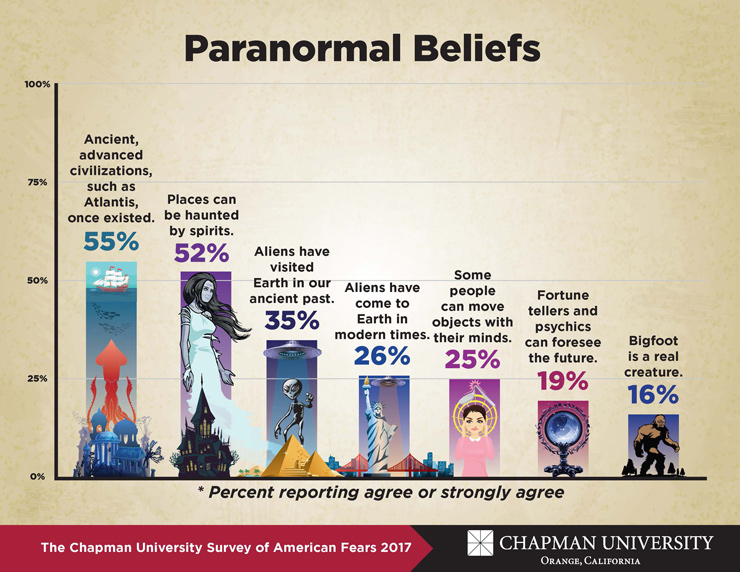
We saw the table pictured below on our Twitter feed (via @MichaelShermer), with the judgmental title: “Paranormal beliefs 2017. Only 25.3% of Americans do not hold any of the 7 beliefs.” (Shermer is a science writer and founder of The Skeptics Society.) But in fairness to the vast majority of people who hold these far-fetched credences, could there be an “optimal level” of paranormal beliefs?

Chapman Fear Survey infographic for Paranormal Beliefs

Hat tip: Michael Shermer

Posted in Uncategorized | Leave a comment

Distribution of colors in a bowl of Fruit Loops cereal

Posted in Uncategorized | 2 Comments

Wallace Corporation T-shirt

We finally saw the movie Blade Runner 2049 and will be writing up a review soon. In the meantime, you can order your very own Wallace Corporation T-shirt (pictured below) here. (In Blade Runner 2049, the Wallace Corporation is the entity that bought out the old Tyrell Corporation–see this fictional corporate timeline here–and manufactures advanced holographic beings like Joi, played by Ana de Armas.)

Image result for wallace corporation t shirt

Posted in Uncategorized | Leave a comment

Review of Muldoon’s defense of tolerance of anti-libertarian views

This post is part of our month-long series of blog posts reviewing select essays published in the new Routledge Handbook of Libertarianism. In this post, we will review Ryan Muldoon’s excellent essay on “Reasons to tolerate.” (Professor Muldoon, a political philosopher at the University of Buffalo, is the author of Social Contract Theory for a Diverse World: Beyond Tolerance; see book cover below.) Although Prof Muldoon restates F. A. Hayek’s powerful critique of social planners as well as Hayek’s slam-dunk arguments for free markets and competition, Muldoon makes a strong case for tolerance of anti-libertarian views.

First off, Muldoon identifies three major moral ideals in the modern world–libertarianism, egalitarianism, and utilitarianism–and then formulates a fundamental syllogism of modern politics. Simply put, people espouse or gravitate toward different moral ideals; therefore, people disagree about a wide array of economic, moral, and political issues. Moreover, this disagreement runs deep; it cannot be resolved through appeals to reason or expensive empirical studies: “Libertarians, egalitarians, and utilitarians (amongst others) don’t merely disagree about what sorts of policies we ought to favor. Their disagreements run far deeper than that. They disagree about what the world is like, and what we should be measuring when we talk about what makes a policy better or worse.” Libertarians, for example, emphasize liberty and freedom from coercion; egalitarians emphasize equality and redistribution of income; and pragmatic utilitarians emphasize social welfare and aggregate wealth. Given this fundamental disagreement, Prof Muldoon argues that such diversity of views should not only be tolerated; this intellectual diversity should also be celebrated and encouraged, or in the eloquent words of Prof Muldoon: “No … theory captures everything that we have reason to care about–the world is far too messy. Instead, we need competition amongst various perspectives, bringing new insights to bear on how we can piece together rules for living together.”

For our part, we wholeheartedly agree with Muldoon’s diversity thesis and defense of tolerance, but nevertheless, there is a huge blind spot in Muldoon’s approach, what philosopher Karl Popper once called “the paradox of tolerance.” Simply put, what about those people who are opposed to tolerance and who are instead committed to oppression and acts of violence in the name of some higher ideal? (Political fanatics like Lenin, Mao, and Fidel, for example, come to mind.) In other words, as Popper once wrote, “unlimited tolerance must lead to the disappearance of tolerance.” How do we untie this Gordian knot? When should anti-libertarian views be met with force instead of reason? We have no idea where to draw this line, but here is what Karl Popper wrote in The Open Society and Its Enemies (1994 edition, p. 581):

If we extend unlimited tolerance even to those who are intolerant, if we are not prepared to defend a tolerant society against the onslaught of the intolerant, then the tolerant will be destroyed, and tolerance with them. In this formulation, I do not imply, for instance, that we should always suppress the utterance of intolerant philosophies; as long as we can counter them by rational argument and keep them in check by public opinion, suppression would certainly be unwise. But we should claim the right to suppress them if necessary even by force; for it may easily turn out that they are not prepared to meet us on the level of rational argument, but begin by denouncing all argument; they may forbid their followers to listen to rational argument, because it is deceptive, and teach them to answer arguments by the use of their fists or pistols. We should therefore claim, in the name of tolerance, the right not to tolerate the intolerant. We should claim that any movement preaching intolerance places itself outside the law, and we should consider incitement to intolerance and persecution as criminal, in the same way as we should consider incitement to murder, or to kidnapping, or to the revival of the slave trade, as criminal.
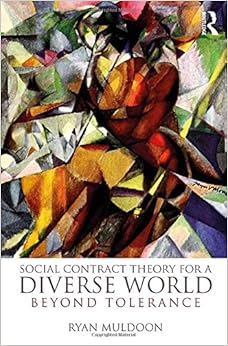
Image result for Social Contract Theory for a Diverse World: Beyond Tolerance
Posted in Uncategorized | 2 Comments