“The nature of their quarrel remains unknown”

Model this.

Posted in Uncategorized | Leave a comment

Mathematics and mathematicians on Twitter

The full list is available here.
Posted in Uncategorized | 4 Comments

Rule evasion (I-95 edition)

My wife and I took turns driving from Orlando, Florida to Savannah, Georgia via various interstate highways earlier today in order to attend the annual meeting of Academy of Legal Studies in Business (#ALSB): I-4 East to I-95 North to I-16 East. There was light traffic most of the way, and I noticed that most (if not all) motorists, including ourselves, were driving at least 10 to 20 miles per hour in excess of the posted speed limits, depending on whether the speed limit was 60 or 70 mph. In other words, rule evasion, far from being some rare occurrence, is the norm, at least when traffic is light! (By the way, doesn’t my contagion model of rule evasion explain this behavior? If driver A sees driver B speeding (and getting away with it), then A should be more likely to speed himself.) So, how common is rule evasion in other domains of life?

Image result for 70 mph speed limit
Posted in Uncategorized | 2 Comments

Tom Brady’s footballs (part 7): some problems with the contagion model

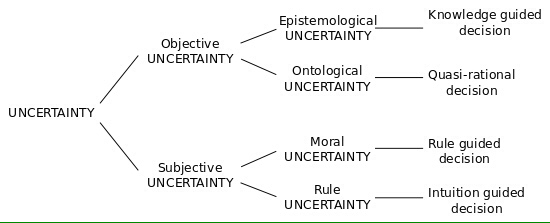
We presented our contagion model of rule evasion in our previous post. Here, however, we shall point out some flaws with our model. To begin with, our model implies that actors are either law-abiding or law-evading, when in reality, actors might adopt a mixed strategy, i.e. complying with probability p and evading with probability 1 – p. Another flaw is that our model does not specifically take into account detection uncertainty or legal uncertainty. In reality, we would expect the levels of such uncertainty to have an effect on the little c and T variables in our model, i.e. on the background rate of compliance and on the transmission rate. In any case, we are not sure why some models distinguish between detection uncertainty and legal uncertainty. So, we need to find a way of incorporating uncertainty in our contagion model, although we would lump both forms of uncertainty together.

Happy birthday Adys Ann!

Posted in Uncategorized | Leave a comment

Tom Brady’s footballs (part 6): a contagion model of rule evasion

In our previous post, we proposed the possibility of a “contagion model” of legal evasion, noting that such a model is plausible given that people tend to copy or imitate what other people are doing. Here, we present the details of our model. We start with a finite population of actors consisting of some number of law evaders and of law abiders as follows:

  • Let n be number of people in a given population.
  • Let et be the number of law evaders in population n at time t.
  • Let net be the number of law abiders at time t.
  • Let C (big C) be the level of contact between people in the population.
  • Let Τ be the contagion or transmission rate; i.e. the likelihood that a law abider will become a law evader.
  • And let c (little c) be the natural or constant level of compliance in the population.

As a result, c × et is the compliance rate; i.e. the rate at which law evaders become law abiders, and n × C is the contact rate; i.e. the rate at which the members of a population meet or come into contact with each other. (Note: the variable big C is what distinguishes our contagion model from information cascade models, which assume that the public behavior and decisions of all actors are common knowledge. In our contagion model, by contrast, each actor meets (and thus observes) a limited number of fellow actors, depending on the value taken by big C.)

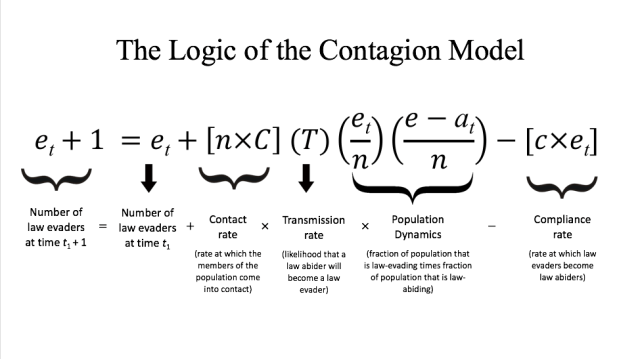
Given these variables and parameters, we now present the logic of our contagion model as follows:

Screen Shot 2017-08-05 at 4.06.20 PMThankfully, our contagion equation above can be simplified through algebraic manipulation as follows:

et + 1 = et + et × {C × T × [(net)/n] – c}

Notice that as the variable et approaches zero, the (net)/n term in the equation above approaches 1, so the model can be further simplified as follows:

et + 1 = et + et × [C × T – c]

As a result, our model tells us that law-evading behavior will spread when C times T > c. In words: when the contact rate times the transmission rate is greater than the rate of compliance, law-evading behavior will spread through the population because the number of law abiders changing their behavior as they come into contact with law evaders is greater than the natural rate of compliance in the population.

But what are the values for C, T, and c? Broadly speaking, we would expect these parameters to vary depending on the actual population of actors we are modelling. By way of example, we would expect big C, the level of contact, to be high in a mobile and modern population and low in a rural or pre-modern population. Moreover, we would expect T, the transmission rate, to vary depending on the ratio of law abiders to law evaders in the population, and we would expect little c, the level of compliance in a population, to depend (endogenously) on the general level of trust in a given population and (exogenously) on the levels of detection uncertainty as well as legal uncertainty. In our next post, we will consider the interaction between both types of uncertainty: detection uncertainty and legal uncertainty.

Posted in Uncategorized | 4 Comments

Tom Brady’s footballs (part 5): the social dimension of evasion

In our previous post, we commented on our colleague Alex Raskolnikov’s simple model of legal uncertainty in his excellent paper titled “Probabilistic Compliance” (Yale Journal on Regulation, 2017). To sum up, we loved his probabilistic model of compliance (in our view, it’s one of the best models of legal uncertainty we’ve studied so far, along with Mark Cronshaw and James Alm’s (Public Finance Quarterly, 1995) game-theoretic model of “two-sided uncertainty,” available here, via Research Gate), but we identified two potential blind spots in Raskolnikov’s elegant model. In brief, his model assumes away “detection uncertainty,” and in addition, like all maximization models, it assumes away the social dimension of compliance and evasion behaviors. Accordingly, I will take a different approach, one that emphasizes “probabilistic evasion” and one that models the social dimension of evasion. Specifically, what if law-evading behavior is more like an infectious disease, one that is capable of spreading across a population? (And just as important, what effect could legal uncertainty have on the rate of transmission?) A contagion model is plausible to the extent some (many?, most?) people tend to copy or imitate what other people are doing. Another advantage of a contagion model is that we don’t have to make any demanding common knowledge assumptions, unlike information cascade models that assume each actor is able to observe the choices and decisions made by all other actors. So fasten your seat belts: we will present our contagion model of evasion in our next blog post.

Image result for contagion nothing spreads like fear

How fast does evasion spread?

Posted in Uncategorized | 1 Comment

Tom Brady’s footballs (part 4): review of Raskolnikov (2017)

Thus far, we have seen that many legal rules consist of general standards and thus generate some level of uncertainty. But is it possible to model this legal uncertainty or rule uncertainty in any formal or mathematical sense? In an excellent forthcoming paper titled “Probabilistic Compliance,” to be published in the Yale Journal on Regulation, Alex Raskolnikov, presents a probabilistic model of compliance. Raskolnikov is a professor of tax law at Columbia University, so he knows what he is talking about, and since his paper is one of the most intriguing works we have read on this subject, we shall summarize it here in some detail.

To begin with, his model has just five fundamental building blocks: x, C, b, F, and G.

  • x is the level of compliance chosen by a regulated actor. In other words, when the law is uncertain, an actor in Raskolnikov’s model must decide how much time and resources to invest in its compliance efforts.
  • C is the cost of figuring out and complying with an uncertain legal standard.
  • b is the benefit from complying with the law, i.e. whatever penalty is avoided by complying with the law.
  • F is the probability of obtaining this benefit. F is probabilistic precisely because the law is uncertain and the amount of compliance, variable. There is no guarantee that x compliance level will actually result in compliance.
  • G is the actor’s expected gain, i.e. expected benefits minus expected costs.

Now, here is Raskolnikov’s model: G(x) = bF(x) minus C(x). What we love about this simple model is that G, F, and C are all a function of x, the actor’s compliance effort. In other words, F is a function of x because the greater an actor’s compliance efforts, the more likely he will be found in compliance. Likewise, C, the cost of compliance, is also a function of x, since stronger compliance positions generally cost more time and resources than weaker compliance positions. And lastly, because compliance is costly and because the level of compliance is variable, the expected gain of compliance is a function of x.

Another thing we love about Raskolnikov’s model is that it makes no reference to “social welfare.” Previous models of legal uncertainty generally assume there is some mythic and socially optimal set of legal rules (or some socially-optimal enforcement regime), but beyond crude guesswork, the social benefits and social costs of most legal rules (especially uncertain ones) are in reality almost always impossible to deduce or infer in any meaningful sense. For his part, Raskolnikov drops the social-optimality assumption altogether. Instead, his model attempts to figure out the optimal amount of compliance from an actor’s private or subjective point of view.

But as much as we love Raskolnikov’s simple model of probabilistic compliance, there are (alas) several serious problems with it. One is that he assumes that “detection and scrutiny are assured” (p. 112). (By the way, this is a problem that plagues previous models of legal uncertainty as well.) This assumption, however, cannot be right, since detection is probabilistic. Why, then, do Raskolnikov and others assume away detection uncertainty?

The other problem with most, if not all, previous models of legal uncertainty (including Raskolnikov’s)–and with previous models of detection uncertainty, for that matter–is that all these models are “maximization” models. That is, these models assume atomistic actors, all of whom are making their maximization calculations individually and in isolation from everyone else. In brief, these maximization models all assume that actors are perfectly interchangeable or perfectly fungible. If the values of each variable in a given maximization model are the same, then an actor will make the same decision, regardless of what other people are doing. But this too cannot be right. In reality, people’s decisions are very much influenced by what other people are doing. (This is why, for example, economists are unable to explain such a simple thing as the act of voting in national elections, which makes absolutely no sense from an economic point of view.)

In sum, we don’t mind it when economists have to posit perfectly rational actors. After all, they have to do this in order to make the mathematics of maximization work. What we do mind is positing perfectly atomistic actors instead of social actors. In the real world, many legal commands are not only uncertain; detection is also uncertain and actors’ compliance efforts are not atomistic but are instead influenced to some degree by the decisions made by other people. Given these truths (or at least axioms), I will present some alternative social models of legal compliance and legal evasion in my next few blog posts.
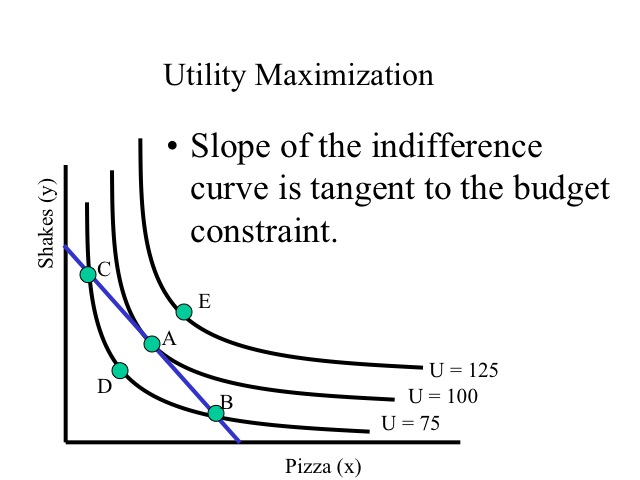
Image result for utility maximization

Does anyone really decide like this?

Posted in Uncategorized | 1 Comment

Tom Brady’s footballs (part 3)

In our previous post, we mentioned the distinction between “detection uncertainty” and “legal uncertainty.” Briefly, detection uncertainty refers to the risk or probability of getting caught and punished; legal uncertainty, by contrast, occurs when there is no bright line separating compliance from noncompliance (cf. Raskolnikov, 2017, p. 104), as is often the case in law.

To provide some context, consider the “rule of reason” test used by courts in antitrust cases or the reasonable man test of tort law. Both legal tests consist of general standards and thus generate some level of legal uncertainty, since there is no clear cut dividing line between reasonable and unreasonable behavior in the domains of antitrust and accidents. (In the alternative, compare the NFL’s Rule 2–the rule Tom Brady was accused of violating, i.e. the rule relating to the amount of air pressure in a football, a clear and precise rule if there ever was one–with Rule 8–the complex and convoluted rule defining what a completed pass or “catch” is. Remember Dez Bryant’s controversial no-catch?) What effect does legal uncertainty have on the levels of compliance, evasion, and enforcement?

Thus, of the two kinds of uncertainty, the latter (legal uncertainty) is the more interesting and puzzling one. After all, one would expect higher levels of evasion the greater the level of detection uncertainty (i.e. the less likely one is of getting caught or punished), and vice versa, all other things being equal. But the ultimate effect of legal uncertainty on the levels of compliance and evasion (and on the level of enforcement for that matter) is less clear. Several scholars (mostly economists and tax lawyers) have attempted to solve this puzzle. We will discuss their work and delve into their formal models of legal uncertainty in our next few blog posts.

Image result for reasonable man test
Posted in Uncategorized | Leave a comment

Tom Brady’s footballs (part 2)

In our previous post, we asked: what is the optimal level of cheating in any given domain, such as business, dating, politics, sports, etc.? It turns out there is a long-standing literature on this problem, going back to such philosophical giants as Thomas Hobbes, Cesare Beccaria, and Jeremy Bentham. Broadly speaking, these great thinkers saw cheating and wrongdoing as a function of the probability of getting caught or punished for one’s misdeeds, so this tradition in political philosophy emphasizes the deterrent effect of law and social norms. In brief, the deterrence approach assumes that people decide whether to obey or evade the law or norms after rationally calculating the gains and consequences of their actions. The late Chicago economist Gary Becker revived this approach in the 1960s and 1970s, and since then, some of the best and brightest economists of our times have thought about this problem (compliance vs. evasion), modelling the decision whether to evade or comply as a form of decision-making under uncertainty. The source of the uncertainty varies in these second-generation models, depending on whether the law itself is unclear (legal uncertainty), or on whether enforcement is uncertain (detection uncertainty). We will discuss the difference between these two types of uncertainty in our next blog post.

Related image

Judit Veszeli

Posted in Uncategorized | 1 Comment

Tom Brady’s footballs: what is the optimal level of cheating?

That is the subject of one of our ongoing research projects. Cheating occurs in many different domains: business, marriage, politics, sports, etc. In the business world, for example, fraud comes in many shapes and sizes, such as the massive manipulation of the London Interbank Offered Rate (the Libor scandal), the eggregious Volkswagen emission scandal, and the transnational FIFA corruption case. Are these business scandals rare outliers,  isolated incidents, or the tip of the iceberg? Stay tuned. We will be blogging about this question in the days ahead.

Image result for business scandals

Jason Lundell

Posted in Uncategorized | 1 Comment