
I will resume my survey of Book IV of The Wealth of Nations in my next post; in the meantime, here is a remix of “1st of tha month”:
Creative Commons
Blogs I Follow






I will resume my survey of Book IV of The Wealth of Nations in my next post; in the meantime, here is a remix of “1st of tha month”:
Translation: The Adam Smith Colonial Problem (I respectfully beg the indulgence of my loyal readers for the Germanic title of this particular blog post. It is an intentional reference to the original so-called “Das Adam Smith Problem” — if you know, you know! Footnotes are below the fold.)
“NO TAXATION WITHOUT REPRESENTATION” was the chief rally cry of the North American rebels calling for independence in 1776 — the year The Wealth of Nations was published — but what if King George III of Great Britain had granted his North American (and West Indian) colonies representation in the British Parliament? Towards the middle of Part 3 of Chapter 7 of Book IV of his magnum opus (available here; scroll down to “Part Third”), Adam Smith drops the following bombshell:
“The Parliament of Great Britain insists upon taxing the colonies; and they [the colonies] refuse to be taxed by a Parliament in which they are not represented. If to each colony, which should detach itself from the general confederacy, Great Britain should allow such a number of representatives as suited the proportion of what is contributed to the public revenue of the empire, in consequence of its being subjected to the same taxes, and in compensation admitted to the same freedom of trade with its fellow-subjects at home; the number of its representatives to be augmented as the proportion of its contribution might afterwards augment; a new method of acquiring importance, a new and more dazzling object of ambition would be presented to the leading men of each colony.” (WN, IV.vii.c.75)
Wait, what?! Is Smith proposing giving the North American colonies full representation in Parliament? Is he really presenting a political solution to the brewing rebellion in North America? Yes, he is, and to follow up on my previous post, it is my Number One “Top Adam Smith Play” in this chapter. But was Smith being serious when made this bold proposal, or was he being ironic? One of my colleagues, Dan Klein (2023), has made a strong case that Smith did not mean this radical political proposal to be taken seriously. Other Smith scholars, by contrast, have taken Smith’s proposed constitutional union at face value.[1] Who’s right?
On the one hand, Klein (2021) has shown how certain passages in some of Smith’s essays, lectures, and other works lend themselves to an esoteric reading, one in which we cannot take what Smith is saying at face value but must read between the lines to arrive at Smith’s true meaning.[2] For Klein (2023), Smith’s radical proposal should also be read this same esoteric way. Among other things, Klein emphasizes just how impractical such a constitutional union would have been given the time-consuming nature of travel across the Atlantic Ocean at the time.
But on the other hand, we have Smith’s own eloquent words: “There is not the least probability that the British constitution would be hurt by the union of Great Britain with her colonies.” (WN, IV.vii.c.77) That statement, taken at face value, sure sounds like a full-throated endorsement of a grand constitutional union between Britain and her North American colonies. Also, for what it’s worth, after Smith mentions in passing that “[t]here is not the least probability that the British constitution would be hurt by the union of Great Britain with her colonies,” he adds:
“That constitution [i.e. the grand union between North American and Great Britain], on the contrary, would be completed by it, and seems to be imperfect without it. The assembly which deliberates and decides concerning the affairs of every part of the empire, in order to be properly informed, ought certainly to have representatives from every part of it.” (WN, IV.ii.c.77)
Smith further suggests that the North American colonies might become even more prosperous than Great Britain and that the “seat of the empire” might move overseas from London to North America: “… in the course of little more than a century, perhaps, the produce of America might exceed that of [Great Britain’s]. The seat of the empire would then naturally remove itself to that part of the empire which contributed most to the general defence and support of the whole.” (WN, IV.ii.c.79) Are these prophetic passages in The Wealth of Nations mere rhetorical hyperbole? At that time (1776), the three largest cities in British North America by population were Boston (around 16,000 souls), New York City (25,000), and Philadelphia (30,000 to 38,000).[3] By way of comparison, the population of London at that same time was several orders of magnitude larger: around 750,000 souls.[4] For what it’s worth, the 20th-century Smith scholar W. R. Scott reports:
“… after the publication of The Wealth of Nations, [Adam Smith] was consulted in 1778 by Alexander Wedderburn, Solicitor-General in Lord North’s administration, and he replied in a Memorandum endorsed ‘Smith’s Thoughts on the Contest with America Feby. 1778’ in which he, ‘as a solitary philosopher’ recommends a constitutional union with America with ‘the most perfect equality’ between both parts of the Empire ‘enjoying the same freedom of trade and sharing in their proper proportions both in the burden of taxation and in the benefit of representation…. The leading men of America, being either members of the general legislature of the Empire, or electors of those members would have the same interest to support the general government of the Empire which the members of the British legislature and their electors have to support the particular government of Great Britain.'” (Scott 1935, p. 84, footnote omitted)
So, was Smith serious? If so, why didn’t he also propose a constitutional union between one or both of her two most recently-acquired colonial prizes, Bengal and Quebec?[5] Why not unify Britain and Ireland, for that matter?[6] Either way, I will conclude on this note: a political association between Britain and North America was not as far-fetched as my colleague and friend Dan Klein would have us believe, for there was a recent historical precedent for such a bold political union: the two “Acts of Union” of 1707 — one ratified by the Parliament of Scotland in March 1707, the other by the Parliament of England shortly thereafter — putting into effect the Treaty of Union signed on 22 July 1706, the treaty that formally united the Kingdom of England and the Kingdom of Scotland into a single Kingdom of Great Britain.
Nota bene: I will conclude my review Part 3 of Chapter 7 of Book IV of The Wealth of Nations on Monday.

DaDaDa! DaDaDa! This is Smith Center! Part 3 of Chapter 7 of Book IV of The Wealth of Nations — available here; scroll down to “Part Third” — is yet another must-read, for the great Adam Smith concludes his chapter on colonialism with a number of significant and still-relevant observations. To get us started, below is my personal highlight reel of Adam Smith’s “top ten plays” (so to speak), the ten most timeless Smithian insights of this lengthy chapter:
#10. The formal title of Part 3 of Chapter 7 is “Of the Advantages which Europe has derived from the Discovery of America, and from that of a Passage to the East Indies by the Cape of Good Hope” (WN, IV.vii.c), but Smith doesn’t get around to these major discoveries until almost the very end of this lengthy chapter (Paragraph 80). But it’s what Smith has to say in the first 79 paragraphs that will really take your breath away!
#9. Smith begins Part 3 on a promising note: after recapping the previous part of this chapter — “Such are the advantages which the colonies of America have derived from the policy of Europe” (WN, IV.vii.c.1) — Smith then asks, “What are those which Europe has derived from the discovery and colonization of America?” (WN, IV.vii.c.2)
#8. In answering the above question, Smith uses the phrase “dead weight” for the first time. Indeed, his full answer is so direct and brutal that it deserves to be quoted in full:
“The exclusive trade of the mother countries tends to diminish, or, at least, to keep down below what they would otherwise rise to, both the enjoyments and industry of all those nations in general, and of the American colonies in particular. It is a dead weight upon the action of one of the great springs which puts into motion a great part of the business of man-kind. By rendering the colony produce dearer in all other countries, it lessens its consumption, and thereby cramps the industry of the colonies, and both the enjoyments and the industry of all other countries, which both enjoy less when they pay more for what they enjoy, and produce less when they get less for what they produce. By rendering the produce of all other countries dearer in the colonies, it cramps, in the same manner the industry of all other countries, and both the enjoyments and the industry of the colonies. It is a clog which, for the supposed benefit of some particular countries, embarrasses the pleasures and encumbers the industry of all other countries; but of the colonies more than of any other. It not only excludes, as much as possible, all other countries from one particular market; but it confines, as much as Possible, the colonies to one particular market; and the difference is very great between being excluded from one particular market, when all others are open, and being confined to one particular market, when all others are shut up. The surplus produce of the colonies, however, is the original source of all that increase of enjoyments and industry which Europe derives from the discovery and colonization of America; and the exclusive trade of the mother countries tends to render this source much less abundant than it otherwise would be.” (WN, IV.vii.c.9; my emphasis)
#7. Colonies generate negative returns: “Such colonies [those of Spain, Portugal, and England], therefore, have been a source of expense and not of revenue to their respective mother countries.” (WN, IV.vii.c.13)
#6. In developing his timeless critique of exclusive trade monopolies (WN, IV.vii.c.14-44), which Smith denounces as an “invidious and malignant project” (WN, IV.vii.c.18), Smith uses the term “absolute advantage” for the first time. (See WN, IV.vii.c.16 & IV.vii.c.18.)
#5. Smith draws a connection between trade monopolies and the legal environment of business. More specifically, Smith compares and contrasts the “irregular and partial administration of justice” in Spain and Portugal, “which often protects the rich and powerful debtor from the pursuit of his injured creditor, and which makes the industrious part of the nation afraid to prepare goods for the consumption of those haughty and great men to whom they dare not refuse to sell upon credit, and from they are altogether uncertain of repayment” (WN, IV.vii.c.53), with the “equal and impartial administration of justice” in Britain, “which renders the rights of the meanest British subject respectable to the greatest, and which, by securing to every man the fruits of his own industry, gives the greatest and most effectual encouragement to every sort of industry.” (WN, IV.vii.c.54)
#4. Smith explains why “the monopoly of the colony trade” is “like all the other mean and malignant expedients of the mercantile system ….” (WN, IV.vii.c.56) Simply put, trade monopolies benefit small groups of merchants at the expense of everyone else: “It is thus that the single advantage which the monopoly procures to a single order of men is in many different ways hurtful to the general interest of the country.”
#3. Smith hurls the memorable insult “a nation of shopkeepers” to describe this particular brand of crony capitalism, to take British merchants to task for using their money and influence to procure counter-productive trade monopolies:
“To found a great empire for the sole purpose of raising up a people of customers may at first sight appear a project fit only for a nation of shopkeepers. It is, however, a project altogether unfit for a nation of shopkeepers; but extremely fit for a nation whose government is influenced by shopkeepers.” (WN, IV.vii.c.63)
#2. So, what is to be done? Smith, ever the pragmatist, has no idea:
“To open the colony trade all at once to all nations might not only occasion some transitory inconveniency, but a great permanent loss to the greater part of those whose industry or capital is at present engaged in it. The sudden loss of the employment even of the ships which import the eighty-two thousand hogsheads of tobacco, which are over and above the consumption of Great Britain, might alone be felt very sensibly. Such are the unfortunate effects of all the regulations of the mercantile system! They not only introduce very dangerous disorders into the state of the body politic, but disorders which it is often difficult to remedy, without occasioning for a time at least, still greater disorders. In what manner, therefore, the colony trade ought gradually to be opened; what are the restraints which ought first, and what are those which ought last to be taken away; or in what manner the natural system of perfect liberty and justice ought gradually to be restored, we must leave to the wisdom of future statesmen and legislators to determine.” (WN, IV.vii.c.44; my emphasis)
#1. So, what is Number One? I will reveal what I consider to be the Top Play or Smithian highlight from Chapter 7 in my next post!
“Folly and injustice seem to have been the principles which presided over and directed the first project of establishing those colonies; the folly of hunting after gold and silver mines, and the injustice of coveting the possession of a country whose harmless natives, far from having ever injured the people of Europe, had received the first adventurers with every mark of kindness and hospitality.” (WN, IV.vii.59)
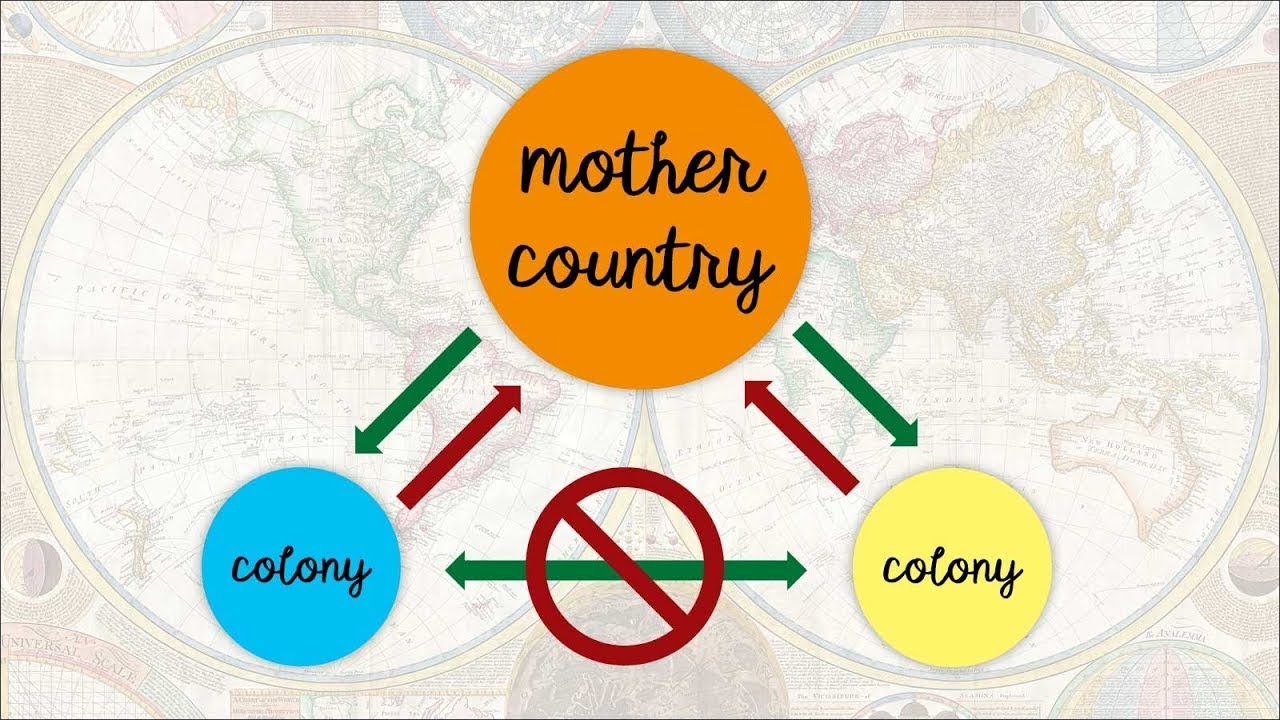
Adam Smith continues his attack on colonialism in Part 2 of Chapter 7 of Book IV of The Wealth of Nations (available here). Although Part 2 of this chapter is titled “Causes of Prosperity of New Colonies”, a better title would be “Causes of Poverty of the Colonies”, for Smith exposes the truth about greedy merchants in the mother countries: he explains how their mercantilist monopolies have hindered the economic growth and development of Europe’s newly-acquired colonies in the Americas. (Nota bene: Smith has a lot to say in this chapter, so no mere summary or synopsis can do it justice. I will therefore fast-forward to the very end of Part 2 of Chapter 7 (Paragraphs 57 to 64), where Smith recaps his scathing critique of European colonialism.)
To begin, what motivated so many Europeans to colonize the Americas in the first place? Smith explains that European colonialism was not the result of some wise policy or preordained plan. These colonizers were willing to cross the dangerous waters of the Atlantic only because things were so bad at home:
“The English Puritans, restrained at home, fled for freedom to America, and established there the four governments of New England. The English Catholics, treated with much greater injustice, established that of Maryland; the Quakers, that of Pennsylvania. The Portuguese Jews, persecuted by the Inquisition, stripped of their fortunes, and banished to Brazil, introduced by their example some sort of order and industry among the transported felons and strumpets by whom that colony was originally peopled, and taught them the culture of the sugar-cane. Upon all these different occasions it was not the wisdom and policy, but the disorder and injustice of the European governments which peopled and cultivated America.” (WN, IV.vii.61; my emphasis)
Worse yet, according to Smith, the settlement and expansion of Spain’s colonies was even more haphazard and entrepreneurial:
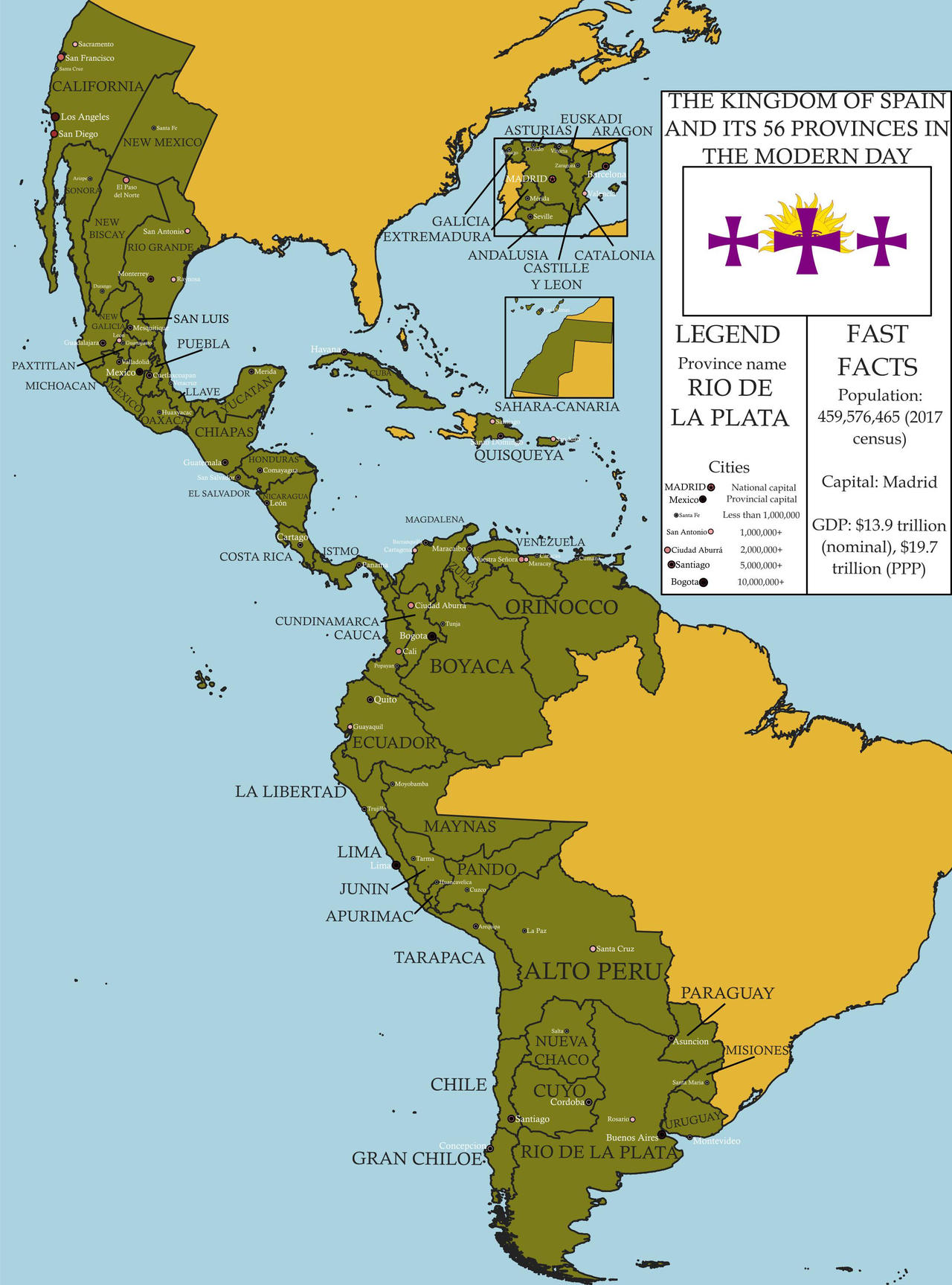
“The conquest of Mexico was the project, not of the council of Spain, but of a governor of Cuba …. The conquerors of … almost all the other Spanish settlements upon the continent of America, carried out with them no other public encouragement, but a general permission to make settlements and conquests in the name of the king of Spain. Those adventures were all at the private risk and expense of the adventurers.” (WN, IV.vii.62; my emphasis)
In both cases, British North American and Spanish South America, the governments of the mother countries provided little support: “The government of Spain contributed scarce anything to any of them [the Spanish adventurers in search of gold and silver mines]. That of England contributed as little towards effectuating the establishment of some of its most important colonies in North America.” (WN, IV.vii.62) The mother countries took notice of their new colonies only after the fact:
“When those [new colonies] … had become so considerable as to attract the attention of the mother country, the first regulations which she made with regard to them had always in view to secure to herself the monopoly of their commerce; to confine their market, and to enlarge her own at their expense, and, consequently, rather to damp and discourage than to quicken and forward the course of their prosperity. In the different ways in which this monopoly has been exercised consists one of the most essential differences in the policy of the different European nations with regard to their colonies. The best of them all, that of England, is only somewhat less illiberal and oppressive than that of any of the rest.” (WN, IV.vii.63; my emphasis)
In other words, as soon as the colonists became prosperous, the mother countries began to economically rape and pillage them by establishing lucrative trade monopolies — and in the case of Spain, through the outright theft of raw materials. Smith further shows how these predatory mercantilist policies benefit a cabal of powerful and well-connected merchants in the mother countries at the expense of everyone else. (To be continued …)
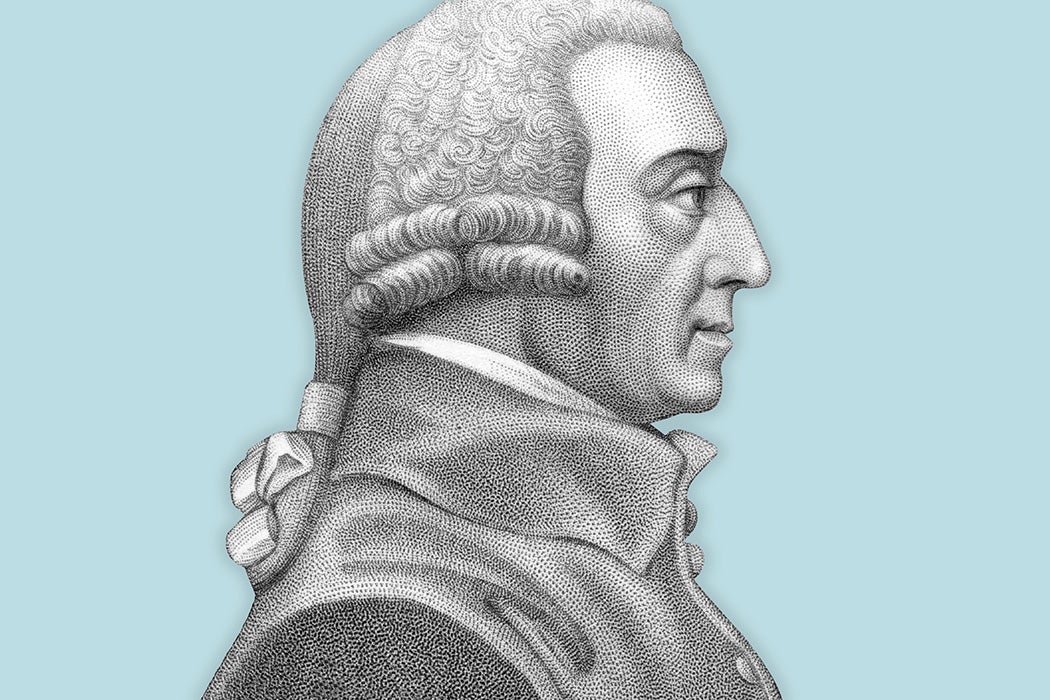
“In consequence of the representations of Columbus, the council of Castile determined to take possession of countries of which the inhabitants were plainly incapable of defending themselves. The pious purpose of converting them to Christianity sanctified the injustice of the project.” (WN, IV.vii.a.15)
Adam Smith explores the economics of colonialism in Book IV, Chapter 7 of The Wealth of Nations. In summary, Smith divides this chapter into three distinct and separate subsections as follows:
Let’s begin with Part 1. Here, Smith surveys the history of colonialism — beginning with ancient Greece and Rome up to the “discovery” of the Americas by Christopher Columbus — and concludes that “[t]he interest which occasioned the first settlement of the different European colonies in America and the West Indies was not altogether so plain and distinct as that which directed the establishment of those of ancient Greece and Rome.” (WN, IV.vii.a.1) So, what is this common motive or common thread? According to Smith, it is one of two motives: an “irresistible necessity” or a “clear and evident utility.” (WN, IV.vii.a.3)
More specifically, it was population growth that drove many small Greek city states to establish colonies overseas: “All the different states of ancient Greece possessed, each of them, but a very small territory, and when the people in any one of them multiplied beyond what that territory could easily maintain, a part of them were sent in quest of a new habitation in some remote and distant part of the world.” (WN, IV.vii.a.2) In the case of ancient Rome, by contrast, the main motive for the establishment of new colonies was land scarcity: “The people became clamorous to get land, and the rich and the great, we may believe, were perfectly determined not to give them any part of theirs. To satisfy them in some measure therefore, they frequently proposed to send out a new colony.” (WN, IV.vii.a.3) But in the case of the Americas, it was greed — plain and simple — that motivated the Spanish colonial system:
“It was the sacred thirst of gold that carried Oieda, Nicuessa, and Vasco Nugnes de Balboa, to the Isthmus of Darien, that carried Cortez to Mexico, and Almagro and Pizzarro to Chili and Peru. When those adventurers arrived upon any unknown coast, their first inquiry was always if there was any gold to be found there; and according to the information which they received concerning this particular, they determined either to quit the country or to settle in it.” (WN, IV.vii.a.17)
More importantly, as Smith goes on to show, it was the theft of these riches that ultimately led to Spain’s economic decline and downfall! For starters, from a “micro” or individual perspective, this greedy quest, this “sacred thirst of gold”, bankrupted most of the Spanish adventurers who went to the Americas in search of gold and silver:
“Of all those expensive and uncertain projects, however, which bring bankruptcy upon the greater part of the people who engage in them, there is none perhaps more ruinous than the search after new silver and gold mines. It is perhaps the most disadvantageous lottery in the world, or the one in which the gain of those who draw the prizes bears the least proportion to the loss of those who draw the blanks: for though the prizes are few and the blanks many, the common price of a ticket is the whole fortune of a very rich man.” (WN, IV.vii.a.18)
More importantly, from a “macro” or global perspective, this avaracious and unholy quest also ended up bankrupting the entire kingdom of Spain! Or in the immortal words of Adam Smith:
“The same passion which has suggested to so many people the absurd idea of the philosopher’s stone, has suggested to others the equally absurd one of immense rich mines of gold and silver. They [the Spanish colonizers] did not consider that the value of those metals has, in all ages and nations, arisen chiefly from their scarcity ….” (WN, IV.vii.a.19)
Thus far, Smith’s main focus has been on his fellow European colonizers. What about the colonized? (To be continued …)
Adam Smith concludes his chapter on bilateral trade treaties — Chapter 6 of Book IV of The Wealth of Nations — with a detour on the practice of “seigniorage”. In summary, seignorage refers to the portion of metal retained by a sovereign (the government mint authorized to produce coins) when minting bullion into coins, i.e. the difference between the face value of these coins and their production cost. (As an aside, no less a figure than Sir Isaac Newton was appointed Master of the Royal Mint in 1699, a lucrative post he held for almost 30 years! See, for example, this fascinating 2022 paper by Alice Marples on “The science of money: Isaac Newton’s mastering of the Mint.”)
But Smith’s true target in this chapter is “that most insignificant object of modern policy” and “this silly notion”, the balance of trade. (WN, IV.vi.13 & 14) Why is the doctrine of the balance of trade so silly and insignificant in substance for Smith? The Scottish philosopher gives two reasons for this conclusion. One is that even if a country does end up importing more gold and silver coins from foreign countries than she exports abroad, some fraction of those coins will end up being melted down and exported abroad anyways. (WN, IV.vi.18) The other reason is that “no precaution of government could prevent it [i.e. the melting down of coins].” (ibid.)
But what does Smith’s critique of the balance of trade doctrine have to do with seignorage? The connection is this: Smith concedes that “a seignorage is the most effectual preventative of the melting down of the coin” (WN, IV.vi.21) He therefore devotes the last part of this chapter to the following question: how high or low should this seignorage be? That is, what is the optimal level of seignorage? If the seignorage is too low, it will not stop enterprising arbitrageurs from melting down minted coins and exporting them abroad, but if the seignorage is too high, the face value of such minted coins will not reflect their true value. In the end, Smith concludes that the seignorage of his day is a futile and ineffectual practice:
“If there was a reasonable seignorage, while at the same time the coin contained its full standard weight, as it has done very nearly since the last recoinage, whatever the bank might lose by the seignorage, they would gain upon the price of the bullion; and whatever they might gain upon the price of the bullion, they would lose by the seignorage. They would neither lose nor gain, therefore, upon the whole transaction, and they would in this, as in all the foregoing cases, be exactly in the same situation as if there was no seignorage.” (WN, IV.vi.26)
Is Smith’s survey of seigniorage still relevant today? Although the mechanics of 18th-century coin production have changed (the United States, for example, abandoned the gold standard in the 20th century), I suspect that Smith’s survey — and his analysis of money in Book I of his magnum opus — might shed some light on the mysterious economics of cryptocurrency.
N.B.: To commemorate the 250th anniversary of the publication of The Wealth of Nations (9 March 1776), I will be posting my chapter-by-chapter reflections on Adam Smith’s timeless magnum opus on my blog.
What’s better: bilateral or multilateral trade agreements? Adam Smith scrutinizes bilateral trade treaties in the first half of Chapter 6 of Book IV of The Wealth of Nations. More specifically, he singles out the Methuen Commercial Treaty of 1703 between the kingdoms of England and Portugal in which England agreed to reduce its duties (taxes) on wines from Portugal in exchange for Portugal opening up its market to English textiles. (For more information about this historic treaty, see here and here.) Although mercantilists celebrated this treaty “as a masterpiece of the commercial policy of England” (WN, IV.vi.8), Smith the skeptic pushes back. But his argument in this chapter is a subtle one: it’s not that these types of treaties are “bad” in some absolute sense. Instead, Smith’s critique is that a country that negotiates selective or bilateral trade treaties ends up leaving money on the table, so to speak:
“Such treaties, however, though they may be advantageous to the merchants and manufacturers of the favoured, are necessarily disadvantageous to those of the favouring country. A monopoly is thus granted against them to a foreign nation; and they must frequently buy the foreign goods they have occasion for dearer than if the free competition of other nations was admitted. That part of its own produce with which such a nation purchases foreign goods must consequently be sold cheaper, because when two things are exchanged for one another, the cheapness of the one is a necessary consequence, or rather the same thing with the dearness of the other. The exchangeable value of its annual produce, therefore, is likely to be diminished by every such treaty…. Even the favouring country, therefore, may still gain by the trade, though less than if there was a free competition.” (WN, IV.vi.6)
In other words, although he concedes that English textile companies are able to sell more textiles to Portugal than they would have in the absence of the treaty, his larger point is that England as a country would have been even more better off overall if she had opened her markets to all foreign countries instead of negotiating selective or bilateral trade treaties. The gains to consumers from free trade outweigh the gains from English textile companies under the 1703 Methuen Treaty. As such, the end result of this treaty was to line the pockets of English wine merchants and English textile manufactures at the expense of the general public.
Although Chapter 6 of Book IV of Smith’s magnum opus is titled “Of Treaties of Commerce”, the Scottish philosopher changes gears (so to speak) in the second half of this chapter (Paragraphs 16-32). There, he takes direct aim (yet again!) at his true target: the “silly” doctrine of the balance of trade. (To be continued …)


I will resume my grand series on The Wealth of Nations in my next post; in the meantime, shout out to my daughter Adys Ann for introducing me the music of Laufey!
“The laws concerning corn may everywhere be compared to the laws concerning religion. The people feel themselves so much interested in what relates either of their subsistence in this life, or to their happiness in a life to come, that government must yield to their prejudices, and, in order to preserve the public tranquillity, establish that system which they approve of. It is upon this account, perhaps, that we so seldom find a reasonable system established with regard to either of those two capital objects.” (WN, IV.v.b.40)
Adam Smith concludes Book IV, Chapter 5 of The Wealth of Nations with his famous “Digression concerning the Corn Trade and Corn Laws.” Don’t be fooled by the word “digression” in this subtitle, however. Here, Smith makes three points that are timeless: (1) he defends the role of middlemen in the grain trade; (2) he explores the economics of famines; and (3) he explains the wealth of nations, i.e. why some countries are poor, while others are wealthy. In short, if I could read only one section of Smith’s magnum opus, this “digression” might be it!
1. Smith’s solution to the middleman paradox. Smith begins his digression with a paradox: “The interest of the inland dealer, and that of the great body of the people, how opposite soever they may at first sight appear, are, even in years of the greatest scarcity, exactly the same.” (WN, IV.v.b.3) But how can this paradox be true? How can the private interest of middlemen, who want to obtain the highest possible price for their products, be aligned with the public interest of consumers, who want to pay the lowest possible price? Smith’s solution to this paradox is as elegant as it is surprising and is therefore worth quoting in full:
“Without intending the interest of the people, he [the middleman] is necessarily led, by a regard to his own interest, to treat them, even in years of scarcity, pretty much in the same manner as the prudent master of a vessel is sometimes obliged to treat his crew. When he foresees that provisions are likely to run short, he puts them upon short allowance. Though from excess of caution he should sometimes do this without any real necessity, yet all the inconveniences which his crew can thereby suffer are inconsiderable in comparison of the danger, misery, and ruin to which they might sometimes be exposed by a less provident conduct. Though from excess of avarice, in the same manner, the inland corn merchant should sometimes raise the price of his corn somewhat higher than the scarcity of the season requires, yet all the inconveniences which the people can suffer from this conduct, which effectually secures them from a famine in the end of the season, are inconsiderable in comparison of what they might have been exposed to by a more liberal way of dealing in the beginning of it. The corn merchant himself is likely to suffer the most by this excess of avarice; not only from the indignation which it generally excites against him, but, though he should escape the effects of this indignation, from the quantity of corn which it necessarily leaves upon his hands in the end of the season, and which, if the next season happens to prove favourable, he must always sell for a much lower price than he might otherwise have had.” (WN, IV.v.b.3; my emphasis)
In other words, middlemen perform a crucial economic function: they set prices, and they have a powerful and self-regulating economic incentive — the profit motive — to set their prices based on how plentiful or scarce the supply of grain is at any given time relative to consumer demand. How so? Because in order to maximize their profits, middlemen must ensure that the supply of grain lasts the entire season: if they set the price of grain too low, their supplies of grain will be wiped out too soon, resulting in a famine. If they set the price too high, however, supply will exceed demand and they will eventually have to sell at a loss because grain is a semi-perishable commodity.
2. The economics of famine. Next, Smith presents another paradox: he shows how well-intentioned government policies designed to prevent or ameliorate famines always end up making matters worse. How so? According to Smith, price controls are counterproductive because they interfere with the freedom of middlemen to set prices, and forcing prices to stay low can turn a localized shortage into a full-blown famine by discouraging middlemen from bringing food to market in the first place:
“When the government, in order to remedy the inconveniences of a dearth, orders all the dealers to sell their corn at what it supposes a reasonable price, it either hinders them from bringing it to market, which may sometimes produce a famine even in the beginning of the season; or if they bring it thither, it enables the people, and thereby encourages them to consume it so fast as must necessarily produce a famine before the end of the season. The unlimited, unrestrained freedom of the corn trade, as it is the only effectual preventative of the miseries of a famine, so it is the best palliative of the inconveniences of a dearth; for the inconveniences of a real scarcity cannot be remedied, they can only be palliated. No trade deserves more the full protection of the law, and no trade requires it so much, because no trade is so much exposed to popular odium.” (WN, IV.v.b.7; my emphasis)
3. The wealth and dearth of nations. Smith concludes his digression with a ringing defense of property rights (“security”) and natural liberty (“freedom”):
“The improvement and prosperity of Great Britain, which has been so often ascribed to those laws [regulating grain trade], may very easily be accounted for by other causes. That security which the laws in Great Britain give to every man that he shall enjoy the fruits of his own labour is alone sufficient to make any country flourish, notwithstanding these and twenty other absurd regulations of commerce …. The natural effort of every individual to better his own condition, when suffered to exert itself with freedom and security is so powerful a principle that it is alone, and without any assistance, not only capable of carrying on the society to wealth and prosperity, but of surmounting a hundred impertinent obstructions with which the folly of human laws too often incumbers its operations; though the effect of these obstructions is always more or less either to encroach upon its freedom, or to diminish its security. In Great Britain industry is perfectly secure; and though it is far from being perfectly free, it is as free or freer than in any other part of Europe.” (WN, IV.v.b.43; my emphasis)
Simply put, countries like Britain are wealthy not because of their mercantilist and protectionist policies, but because people are allowed to enjoy the “fruits of their own labour.” (WN, IV.v.b.43) That is, Britain is prosperous in spite of its mercantilist and protectionist policies! Again, how so? Because our innate or built-in desire to “better [our] own condition” is so strong that we are able to figure out a way around these laws and regulations! This observation, however, presents yet another paradox: what is the optimal amount of law? On the one hand, some laws are necessary in order to protect property rights and freedom, but at the same time, laws can also do more harm than good. (To be continued …)
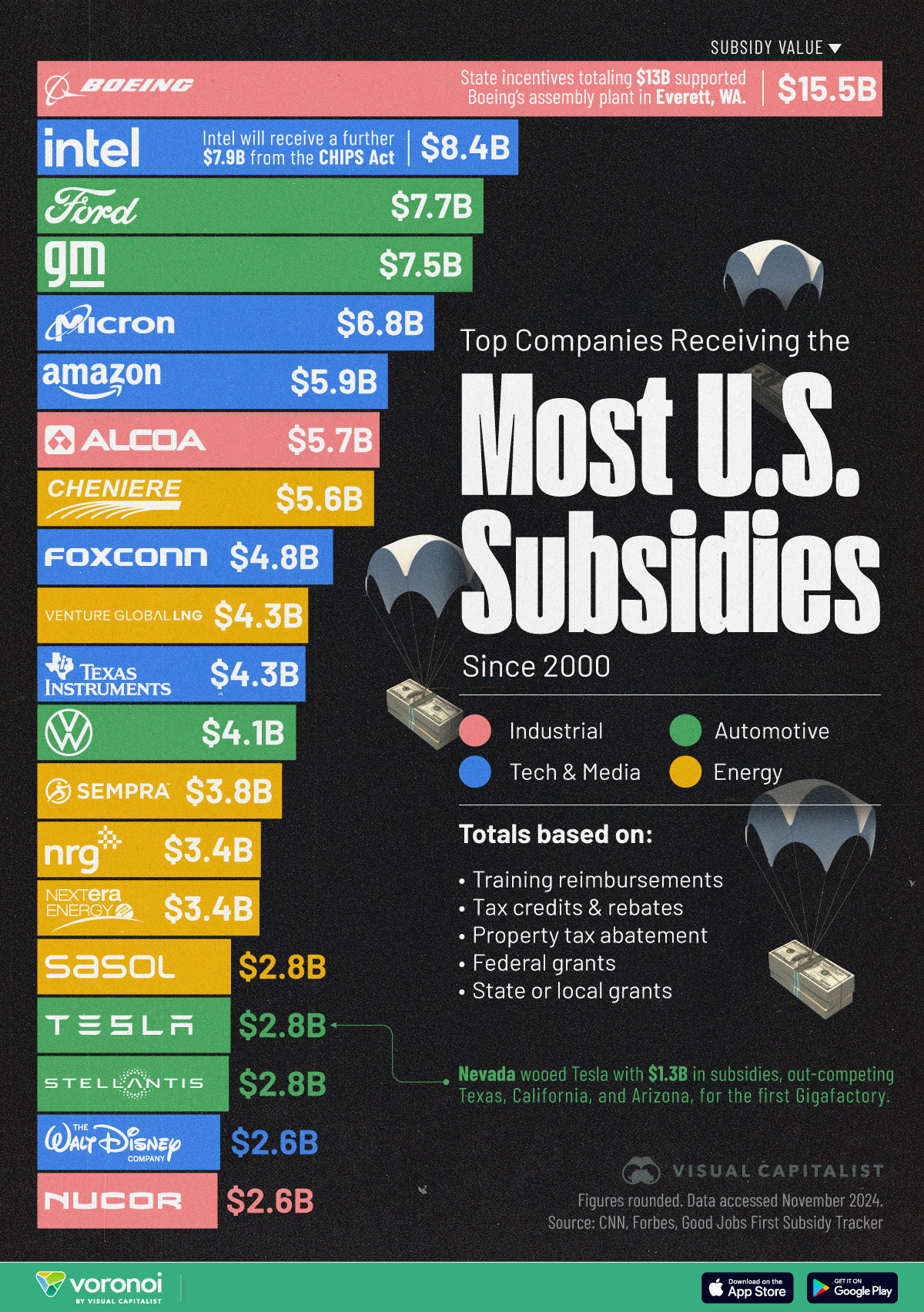
[Alternative title: “The Dearth of Nations: How Government Subsidies Make Us Poorer”]
Adam Smith takes dead aim at yet another mercantilist policy in Chapter 5 of Book IV of The Wealth of Nations, a foolish and futile scheme that continues up to this day (see, for example, the infographic pictured below): crony capitalism in the form of “bounties upon exportation”, i.e. government subsidies that are paid directly to potent and powerful and well-connected producers in certain strategic industries like (in Smith’s day) grain. Smith tells us right off the bat what the mercantilist rationale of such bounties upon exportation is — to promote exports in certain industries in order to obtain a favorable balance of trade:
“Bounties upon exportation are, in Great Britain, frequently petitioned for, and sometimes granted to the produce of particular branches of domestic industry. By means of them our merchants and manufacturers, it is pretended, will be enabled to sell their goods as cheap, or cheaper than their rivals in the foreign market. A greater quantity, it is said, will thus be exported, and the balance of trade consequently turned more in favour of our own country.” (WN, IV.v.a.1)
But as the Scottish philosopher-economist explains in the first half of Chapter 5 (see especially Para. 24), bounties upon exportation are almost always injurious to a country’s overall economic health. Although Smith makes a limited exception for “bounties upon the exportation of British-made sail-cloth, and British-made gun-powder,” two goods that Smith says are necessary for national defense (WN, IV.v.a.36), such government subsidies are otherwise counterproductive. More specifically, bounties upon exportation make nations poorer in three ways: they misallocate capital, impose a double-burden on taxpayers, and distort prices:
1. Misallocation of capital. To begin, Smith observes how government subsidies divert the flow of capital. Simply put, bounties prop up business firms and entire industries that would not otherwise survive:
“Those trades only require bounties in which the merchant is obliged to sell his goods for a price which does not replace to him his capital, together with the ordinary profit; or in which he is obliged to sell them for less than it really costs him to send them to market.” (WN, IV.v.a.2)
In other words, bounties subsidize trades and industries where the cost of production exceeds the value of returns. As a result, the aggregate effect of government subsidies is to inhibit economic growth and development. Why? Because bounties cause capital assets to be misallocated into unproductive industries instead of being put to better or more productive uses, or in the immortal words of Adam Smith, “The effect of bounties, like that of all the other expedients of the mercantile system, can only be to force the trade of a country into a channel much less advantageous than that in which it would naturally run of its own accord.” (WN, IV.v.a.3)
2. Double-taxation. Next, Smith turns to the example of the corn bounty to show more generally how bounties and subsidies are a form of double taxation, i.e. a massive redistribution of income from the public to the beneficiaries of these mercantilist policies. Taxpayers must not only fund the cost of the government subsidy program itself; the public at large will end up paying higher prices overall for the goods being subsidized:
“The corn bounty, it is to be observed, as well as every other bounty upon exportation, imposes two different taxes upon the people; first, the tax which they are obliged to contribute in order to pay the bounty; and secondly, the tax which arises from the advanced price of the commodity in the home market, and which, as the whole body of the people are purchasers of corn, must, in this particular commodity, be paid by the whole body of the people. In this particular commodity, therefore, this second tax is by much the heavier of the two.” (WN, IV.v.a.8)
3. Distortion of the price signal. As the last sentence in the passage quoted above indicates, bounties (especially bounties upon exportation) distort prices. How so? When bounties are tied to exports of certain goods (such as grain or corn), such bounties end up reducing the supply of those goods at home and thus increasing their price:
“The extraordinary exportation of corn, therefore, occasioned by the bounty, not only, in every particular year, diminishes the home, just as much as it extends the foreign, market and consumption, but, by restraining the population and industry of the country, its final tendency is to stunt and restrain the gradual extension of the home market; and thereby, in the long run, rather to diminish, than to augment, the whole market and consumption of corn.” (WN, IV.v.a.8)
As it happens, Smith has much more to say about the grain market: the second half of Chapter 5 of Book IV of his magnum opus contains a “Digression concerning the Corn Trade and Corn Laws”. (WN, IV.v.b) Why does Smith devote so much attention to the grain trade? By some accounts, this trade represented a large chunk (if not the largest share) of the total trade of the British Isles. (See, e.g., Dennis Baker, “The Marketing of Corn in the First Half of the Eighteenth Century: North-East Kent”, Agricultural History Review, Vol. 18, No. 2 (1970), pp. 126-150, available here.) Suffice it to say, then, we will take a closer look at Smith’s digression in my next post.


Welcome to the online home of the IASS
Hopefully It’s Interesting.
In Conversation with Legal and Moral Philosophers
Relitigating Our Favorite Disputes
PhD, Jagiellonian University
Inquiry and opinion
Life is all about being curious, asking questions, and discovering your passion. And it can be fun!
Books, papers, and other jurisprudential things
Ramblings of a retiree in France
BY GRACE THROUGH FAITH
Natalia's space
hoping we know we're living the dream
Lover of math. Bad at drawing.
We hike, bike, and discover Central Florida and beyond
Making it big in business after age 40
Reasoning about reasoning, mathematically.
I don't mean to sound critical, but I am; so that's how it comes across
remember the good old days...
"Let me live, love and say it well in good sentences." - Sylvia Plath
a personal view of the theory of computation
Submitted For Your Perusal is a weblog wherein Matt Thomas shares and writes about things he thinks are interesting.
Logic at Columbia University
Just like the Thesis Whisperer - but with more money
the sky is no longer the limit
Technology, Culture, and Ethics
Just like the horse whisperer - but with more pages
Poetry, Other Words, and Cats

 prior probability