
You can read more about the Pan American Highway here.

Source: brilliantmaps.com
You can read more about the Pan American Highway here.
Source: brilliantmaps.com
Although modern probability theory dates to the 1600s, our ancestors have been playing games of chance for a very long time. Via the amazing Cliff Pickover, for example, check out this ancient die (circa 2500 B.C.) from the Indus Valley Civilization. (Photo Credit: Lahore Museum in Lahore, Pakistan.)

The Lucky Five?
Have you ever downloaded copyrighted content from the Internet or shared your Netflix password with a friend? We sure have! In our next class, we will debate the law and ethics of copyright infringement and discuss how the law attempts to balance “fair use” (or sharing) with property rights in the domain of copyrights. In particular, we will focus on two cases: The Sony Betamax Case (decided in the mid-1980s) as well as Metallica v. Napster (decided in the early 2000s). In summary, before Sean Parker discovered Facebook, he had co-founded a company called Napster in 1999, a peer-to-peer file-sharing website that allowed users to share MP3 music files with each other. Napster became an instant success; according to Wikipedia, “verified Napster use peaked with 26.4 million users worldwide in February 2001.” The rock group Metallica, however, wasted no time in filing a federal lawsuit for copyright infringement against Napster, and the courts eventually issued an injunction shutting down the website … But did the court make the correct decision, and on what legal grounds did the court issue this draconian remedy, i.e. the injunction shutting down Napster?
Have you seen fugitive war criminal George W. Bush’s collection of oil paintings of veterans? (See fragment below.) These remarkable portraits are assembled in his new book Portraits of Courage: A Commander in Chief’s Tribute to America’s Warriors. This series of portraits got me thinking … Just as the Library of Congress appoints a United States Poet Laureate, who serves as the nation’s official poet for a designated term, why don’t we also create a space for an Artist Laureate, a Movie Director Laureate, or even a Blogger Laureate as well?

Matt Thomas just brought this beautiful TV ad to our attention via his blog. The ad in question is composed of a series of movie scenes featuring the iconic Rolex watch. (In several of these classic scenes, the actors actually refer to the brand by name!) Some marketing scholars, however, claim that product placement is an unethical business practice and should be regulated by law. (See here, for example.) We totally disagree with this claim. Whether product placement is ethical or not (i.e. a form of deception), regulating this practice would probably do more harm than good. After all, how could a director shoot a motion picture without placing any products in his film?
As we approach the end of the winter season, what are the chances of finding two identical snowflakes? According to physicist Jon Nelson (via Popular Mechanics), the chances are “essentially zero.” Or, to be more mathematically precise, the chances are one divided by 1,000,000,000,000,000,000,000,000,000,000,000,000,000,000,000,000,000,000,000,000,000, 000,000,000,000,000,000,000,000,000,000,000,000,000,000,000,000,000,000,000,000,000,000, 000,000,000,000,000,000,000,000,000,000,000,000,000,000,000,000,000,000,000,000,000, 000,000,000,000,000,000,000,000,000,000,000,000,000,000,000,000,000,000,000,000,000, 000,000,000,000,000,000,000,000,000,000,000,000,000,000,000,000,000,000,000,000,000, 000,000,000,000,000,000,000,000,000,000,000,000,000,000,000,000,000,000,000,000,000, 000,000,000,000,000,000,000,000,000,000,000,000,000,000,000,000,000,000,000,000,000, 000,000,000,000,000,000,000,000,000,000,000,000,000,000,000,000,000,000,000,000,000, 000,000,000,000,000,000,000,000,000,000,000,000,000,000,000,000,000,000,000,000,000, 000,000,000,000,000,000,000,000,000,000,000,000,000,000,000,000,000,000,000,000,000, 000,000,000,000,000,000,000,000,000,000,000,000,000,000,000,000,000,000,000,000,000, 000,000,000,000,000,000,000,000,000,000,000,000,000,000,000,000,000,000,000,000,000, 000,000,000. (The enormous denominator in this fraction is the number of possible snowflake shapes there are: one followed by 768 zeros.) By the way, the image below, via Rian Dundon, is a reproduction of one of the first photographs of a snowflake:

Credit: Wilson Bentley
Our friend and colleague Tyler Cowen has just published a new book with a catchy title: The Complacent Class. At the risk of over generalization (pun intended), Professor Cowen’s book claims that North Americans are becoming intellectually lazy and spiritually complacent–more willing to settle for small or marginal improvements in existing methods and things and less willing to test risky and revolutionary large-scale ideas and projects. (Really? Sorry Elon Musk!) Professor Cowen is also producing a series of short and engaging lectures on video explaining the main ideas from his book. Although we disagree with Professor Cowen’s gloom and doom thesis, his videos are worth watching. (Self-recommending, as he likes to say!) Here is the first installment:
Was this situation a false positive or a false negative?

Getty Images
Thus far this semester, we have studied sources of law as well as three major areas of private law: contracts, torts, and property. In our next class, by contrast, we will focus on the extralegal domains of ethics and morality: how should we decide between right and wrong? To this normative end, we will consider the following three major theories of moral philosophy, i.e. three competing theories for deciding between right and wrong: (1) consequentialism, an instrumental theory of ethics originating with the great British essayist David Hume, (2) universal moral duties, an influential theory of morality developed by the great German philosopher Immanuel Kant, and (3) the highly original contractarian theory of justice proposed by Hungarian-American economist John Harsanyi as further developed by Harvard professor John Rawls. In addition, we will debate whether the fictional Mark Zuckerberg (as portrayed by the actor Jesse Eisenberg in the movie “The Social Network”) flouted Harvard College’s Honor Code in his dealings with the Winklevoss twins. Also, beyond the narrow walls of the Ivory Tower–i.e. in the broader world of commerce and markets–what does a motto like “don’t be evil” mean?

Define “evil”!
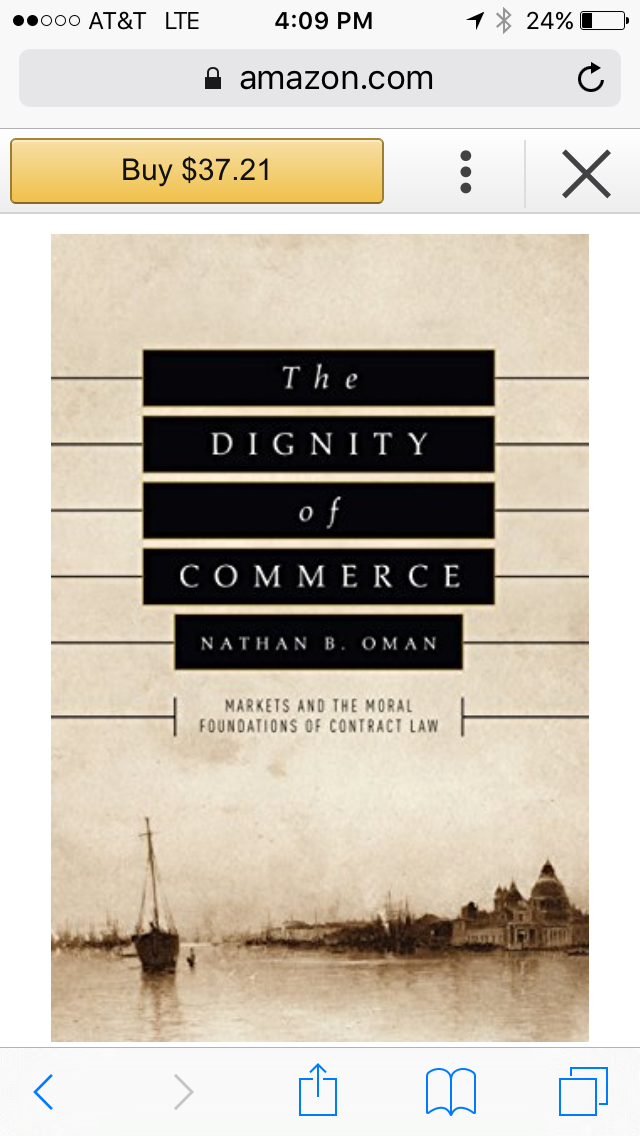
We have been attending the 12th Annual International Conference on Contracts (KCON XII) at Southwestern Law School in downtown Los Angeles this weekend (fun!). One of our favorite talks at the conference was by Nathan Oman, a law professor at the College of William & Mary, who presented his new book The Dignity of Commerce: Markets and the Moral Foundations of Contract Law (U Chicago Press, 2017). In summary, Professor Oman argues that the main purpose of the law of contracts is to promote commerce and well-functioning markets. Moreover, he claims that markets are morally desirable in and of themselves. Why? Because markets not only promote economic efficiency (i.e. the allocation of assets to their highest valued uses); markets also facilitate social cooperation and communal harmony. Specifically, markets enable people to serve the needs of others and cooperate in mutually beneficial ways even in the absence of political, religious, or ideological agreement. (This last point–the ability of markets to meet human needs and bring diverse and self-interested actors together–deserves more attention in the legal academy.)





Welcome to the online home of the IASS
Hopefully It’s Interesting.
In Conversation with Legal and Moral Philosophers
PhD, Jagiellonian University
Books, papers, and other jurisprudential things
Ramblings of a retiree in France
BY GRACE THROUGH FAITH
Natalia's space
hoping we know we're living the dream
Lover of math. Bad at drawing.
We hike, bike, and discover Central Florida and beyond
Making it big in business after age 40
Reasoning about reasoning, mathematically.
I don't mean to sound critical, but I am; so that's how it comes across
remember the good old days...
"Let me live, love and say it well in good sentences." - Sylvia Plath
a personal view of the theory of computation
Logic at Columbia University
Just like the Thesis Whisperer - but with more money
the sky is no longer the limit
Technology, Culture, and Ethics
Just like the horse whisperer - but with more pages
Poetry, Other Words, and Cats


