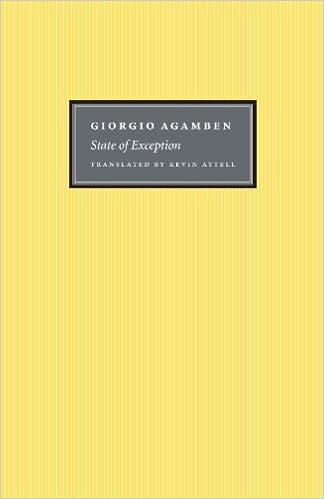
In our previous post, we compared and contrasted the standard version of the Trolley Problem with Lon Fuller’s “Case of Speluncean Explorers.” Another possible commonality between both hypotheticals is the legal theory of necessity. Since both cases involve thought experiments that present life-and-death scenarios in which one life must be sacrificed in order to save four or five lives, why can’t the defense of necessity apply to the facts of either scenario? This critical question, in turn, raises a new set of technical and definitional questions. What is necessity? Is it an excuse or justification? And how broadly or narrowly should we define this legal concept (i.e. where do we draw the proverbial line)? In this post, we shall take a different approach to these questions. Specifically, building on the work of jurist Giorgio Agamben (whose beautiful book “State of Exception” is pictured below), we shall present three different pictures or theories of the concept of necessity. In brief, we can view necessity narrowly as an ex post exception to violations of law, or in the alternative, we can view necessity broadly as an ex ante independent source of law. Thirdly, we can take an intermediary position and view necessity as an all-around utility player or legal gap filler, i.e. a concept that applies only when our sources of positive law (the law on the books) are silent, conflicting, or otherwise vague and ambiguous. Stay tuned … We will elaborate on all three theories of necessity in our next few blog posts.
The Law of the Trolley Problem
We recently rediscovered and reread Lon Fuller’s classic “Case of the Speluncean Explorers” (via Peter Suber), and in the process of writing up our own response to Fuller, we noticed a possible parallel between this hypothetical case and the famous “Trolley Problem” in the field of moral philosophy. (There are several variants of the problem (see below); we will refer to the standard version in this post.) By way of background, we summarized the facts of Fuller’s fictional case in a previous post; alternatively, here is a simplified account of the cave case (via Wikipedia):
The case involves five explorers who are caved in following a landslide. They learn via intermittent radio contact that, without food, they are likely to starve to death before they can be rescued. They decide that someone should be killed and eaten so that the others may survive. They decide who should be killed by throwing a pair of dice. After the four [remaining] survivors are rescued, they are charged and found guilty of the murder of the fifth explorer.
By comparison, the trolley problem is a moral dilemma that involves a similar numerical calculus, but instead of five explorers trapped in a cave, there are six hapless workmen (five on one track and one on another) and an innocent bystander standing next to a switch or lever where the track divides into two. We restated the standard version of this moral dilemma in a previous paper; here too is the standard set up of the trolley problem (again, via Wikipedia):
There is a runaway trolley barreling down the railway tracks. Ahead, on the tracks, there are five people tied up and unable to move. The trolley is headed straight for them. You are standing some distance off in the train yard, next to a lever. If you pull this lever, the trolley will switch to a different set of tracks. However, you notice there is one person on the side track. You have two options: (1) Do nothing, and the trolley kills the five people on the main track. (2) Pull the lever, diverting the trolley onto the side track where it will kill one person. Which is the correct choice?
The question we have is this: are the factual differences in both the cave and trolley scenarios morally or legally relevant? In both cases there is an imminent threat or mortal danger to five human lives, and both cases involve sacrifices, but the relevant decision makers are different in each case. In one case, the persons whose own lives are in danger are able to deliberate and ponder their collective fate. Moreover, they initially agree to sacrifice one member of their party through a random mechanism. In the other case, by contrast, someone external to the danger (the person standing next to the lever) has no time to deliberate. He must make a snap decision and that decision (including the decision to do nothing) will result in the loss of either one or five lives.
In short, is the trolley problem relevant to our legal or moral analysis of the case of the explorers? By way of illustration, let’s transpose the trolley problem to Fuller’s fictional land of Newgarth. (Recall the language of the relevant murder statute in Newgarth: “Whoever shall willfully take the life of another shall be punished by death.”) Putting the ethics of the trolley problem aside (assuming it is even possible to separate morality from law), would the person at the switch in the trolley problem be guilty of murder under this statute if he were to divert the trolley onto the side track? Further, does our answer to this question apply or control the result in the case of the explorers?
Trolley problems …
Lon Fuller’s Speluncean Explorers
In our previous post, we mentioned Peter Suber’s beautiful book on Lon Fuller’s fictional “Case of the Speluncean Explorers.” By way of background, this hypothetical case occurs in the year 4300 A.D. in the Commonwealth of Newgarth. The relevant facts and the applicable statute are as follows:
I. The Facts
The relevant facts of this fictional case are undisputed: After a massive landslide, five explorers are trapped in a remote cave with limited rations. Via radio, they learn that a massive rescue effort is underway, but as their food and water supplies dwindle, one of the explorers (Roger Whetmore), who happens to have a pair a dice with him, proposes to the others that they draw lots (by throwing the dice) to randomly determine who should be sacrificed so that the other four might live until they are rescued. After much discussion, the men apparently assign numbers to themselves and agree to roll the dice. (We say “apparently” because Fuller does not disclose any facts regarding the details of the dice throw.) But Whetmore later has second thoughts and decides to back out of the plan. The other men, however, proceed to roll the dice, and as it happens, Whetmore’s number comes up, and “he was then put to death and eaten by his companions.” (Fuller, p. 9, in Suber, 1998.)
II. The Law
The applicable laws of the Commonwealth of Newgarth simply state: “Whoever shall willfully take the life of another shall be punished by death.” The text of the law makes no mention of self-defense or the defense of necessity.
III. Issue (Question Presented)
On these facts and statutory language, are Whetmore’s companions guilty of committing murder?
IV. Preliminary Analysis
Given these facts and given the statute, this should be an easy case to decide, right? Wrong! It turns out that one can generate any legal outcome (guilty or not guilty) depending on the theoretical or philosophical framework one applies to the facts and law of this case. Worse yet, in law there is no way of testing or deciding which outcome is the “correct” one. In a future post, building on the previous work of Lon Fuller (pictured below), Peter Suber, and others, we will enter the theoretical fray and write up our own legal analysis of this famous hypothetical case.

Credit: Estate of Lon Fuller
In praise of Peter Suber
We first discovered the work of Peter Suber, formerly a legal philosopher at Earlham College and now a senior researcher at Harvard’s Berkman Klein Center for Internet & Society, sometime in 2011 or 2012, while we researching and writing up our paper “Gödel’s Loophole.” (In that paper, we revisit the legend of Kurt Gödel’s alleged discovery of a logical contradiction in the U.S. Constitution; at the time, after carefully reading Suber’s excellent book on “The paradox of self-amendment” and after considering the 1933 Enabling Act that legalized Hitler’s dictatorship, we offered the following Gödelian conjecture regarding one possible constitutional contradiction: specifically, we reasoned that the logical flaw in the Constitution is that the amendment procedures set forth in Article V of the Constitution self-apply to the amendment rules in Article V themselves.) Then, a few months ago, one of our loyal readers (shout out to Craig Collins; check out page one of his thoughtful blog “100 billionth person” here) brought to our attention Douglas Hofstadter’s engaging review of a strange game called Nomic, a complex self-amendment game created by none other than Peter Suber himself. (The rules for Nomic also appear in an appendix to Suber’s paradox book.) Among other things, Nomic provides further evidence in support of our Gödelian conjecture, for this strange game contains a set of both mutable and immutable rules, and the players can eventually transform all the rules of the game over time, even the immutable ones!
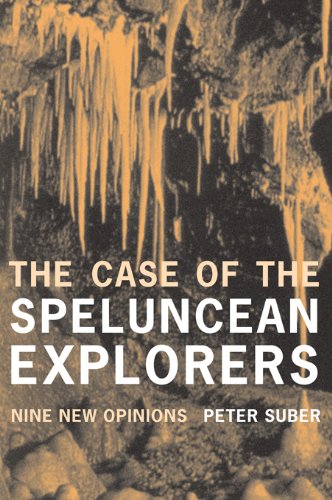
But wait, there’s more … A couple of weeks ago, we serendipitously stumbled upon a used copy of another of Suber’s beautiful books, “The Case of the Speluncean Explorers: Nine New Opinions” (pictured below), and finished reading it earlier this week. In brief, Suber takes a famous hypothetical example from law, a hypothetical developed by the late great Lon Fuller–the so-called “Case of the Speluncean Explorers”–and Suber presents new ways of looking at that old hypothetical case. Suber’s book, along with Fuller’s original statement of the problem, provides a deep and engaging introduction to legal theory and the philosophy of law, so we will be blogging in greater detail about Fuller and Suber’s “Speluncean Explorers” in the days ahead. (We will then return to Kenny Easwaran’s important 2015 paper on Bayesian reasoning.)
Two questions about degrees of belief
Previously, we saw how the Bayesian notion of “degrees of belief” offers a possible solution to the preface paradox. Here, we shall consider some philosophical or epistemic objections to this idea of “degrees of belief.” In his thought-provoking and beautiful 2015 Nous paper, for example, Kenny Easwaran poses a number of open questions regarding the nature of degrees of belief, all of which (we think) boil down to the two following queries:
Question 1: What is the difference between an old-fashioned and plain and simple “belief” and a highfalutin Bayesian “degree of belief”? In particular, is there some threshold or cut-off point (say, .9 or .95 or .99) above which a degree of belief acts like a full-fledged belief? (A related question we have is this: do we even need the notion of degrees of belief? After all, isn’t a regular or ordinary belief just as subjective and susceptible to Bayesian updating as a degree of belief is?)
Question 2: In actual human reasoning and daily practice, are degrees of belief “infinitely precise real numbers” (e.g., exact numerical values ranging from 0 to 1) or “something less precise” (e.g., high, medium, and low)? In other words, can a degree of belief really be expressed in precise numerical terms, and if so, how? Aren’t we just plucking numbers out of thin air?
This second question is especially delicate. If it turns out that for whatever reason we cannot assign a precise numerical value to a degree of belief, then we won’t be able to transpose the axioms of probability into the Bayesian framework, and the Bayesian view of probability collapses like a house of cards. In any case, thus far it has taken us three separate blog posts to summarize the first three pages of Easwaran’s 38-page paper. We hope to discuss the rest of his paper in future posts (most likely after the Labor Day holiday).

Credit: Zoubin Ghahramani, via SlideShare
The Bayesian solution to the preface paradox
In our previous post, we presented Kenny Easwaran’s vivid description of the paradox of the preface. Briefly, the paradox is this: when a scholar writes up an academic paper, he would like to believe that every claim or proposition in his paper is true. But at the same, that same scholar may add a statement or disclaimer (usually in the acknowledgements section of his paper) accepting responsibility for any error or errors that may appear in the body of the paper. Hence the paradox: if all the claims and propositions in the paper are true, the statement in the preface or acknowledgements section is false; but if the preface/acknowledgements section is true, then there must a claim or proposition in the body of the paper that is false.
In the next part of his beautiful paper, Easwaran presents the standard Bayesian solution to this paradox: the ingenious idea of “degrees of belief.” Simply put, a scholar’s belief in the truth of a claim or proposition is not binary, is not all or nothing; instead, his belief in the truth of claim x or proposition y may range anywhere from 0 to 1; in other words, our beliefs may vary in degrees of strength or weakness; our beliefs may come in shades of grey. So, how does the Bayesian notion of “degrees of belief” solve the paradox? Through the axioms of probability. By way of example, let’s say a scholar has written a paper containing two claims or propositions (Claim A and Claim B)–a very short paper indeed!–and further assume that the scholar’s degree of belief in each claim/proposition is only 0.51 (i.e., the scholar believes that it is only more likely than not that each proposition or claim is true). If the truth of the first claim (Claim A) is independent of the truth of the second claim (Claim B), this strange state of affairs means that there is a high probability that at least one of the claims or propositions might, in fact, be false. (Why? Because when two probabilistic events are independent, the probability of both occurring is P(A and B) = P(A) times P(B).) This ingenious device (degrees of belief) thus solves the paradox of the preface: it is consistent for the scholar to believe in the truth of his claims and to believe that one of those claims might turn out to be false. In our next post, however, we will consider some objections to the Bayesian solution.
The Paradox of the Preface
Kenny Easwaran, a philosopher at Texas A&M, recently published in the journal Nous this beautiful paper on Bayesian probabilities (hat tip: Brian Leiter). Among other things, Easwaran’s paper contains the best and most succinct explanation of the “paradox of the preface” we’ve ever read. Here it is (edited by us for clarity):
Dr. Truthlove … has just written an extensively researched book, and she believes every claim in the body of the book. However, she is also aware of the history of other books on the same subject, and knows that every single one of them has turned out to contain some false claims, despite the best efforts of their authors. Thus, one of the claims she makes, in the preface of the book, is to the effect that the body of this book too, like all the others, surely contains at least one false claim. She believes that too. She notices a problem. At least one of her beliefs is false. Either some claim from the body of the book (all of which she believes) is false, or else the claim from the preface (which she also believes) is. So she knows that she’s doing something that she hates–believing a false claim. At the same time, she notices a benefit. At least one of her beliefs is true! Either the claim from the preface is true, or all of the claims in the body of the book are true.
We shall have more things to say about this original paper in the days ahead …
Visualization of the argument for free trade/open borders

Hat tip: Landon Schnabel, via Twitter.
Facebook 101
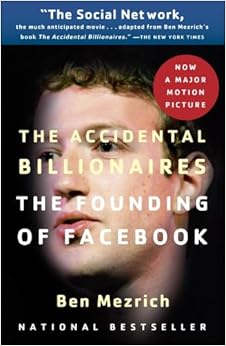
This fall, we are teaching a large undergraduate survey course (n > 800) on “the legal and ethical environment of business.” Instead of trying to cover everything, we will focus instead on the founding and subsequent explosive growth of Facebook–as depicted in the bestseller “The Accidental Billionaires” by Ben Mezrich (pictured below) and the movie “The Social Network”–in order to explore various areas of the legal and ethical environments of business, including such areas as the law of contracts (think of Facebook’s “terms of use”), intellectual property (think of Facebook’s logos, brand, and “Like” symbols), choice of business entity (think of Facebook’s evolution from a two-man partnership into a Florida limited liability company before incorporating in the State of Delaware), and many other relevant legal and ethical topics, such as the ethics of Facebook’s privacy policies. Although the Professor is not a big fan of Facebook, we think our focus on the founding of Facebook makes good sense for several reasons. First of all, our target audience consists of undergraduates, most of whom use some form of social media to connect with the wider world, and furthermore, it was a motley crew of college students who ended up creating one of the most successful Internet platforms in the world today. Mark Zuckerberg literally changed the world, so why not learn from his successes … and from some of his mistakes?