That is the title of this paper by Ryan Calo. Here is an excerpt from the abstract of the paper: “This article closely examines a half century of case law involving robots … Most of the cases involving robots have never found their way into legal scholarship. And yet, taken collectively, these cases reveal much about the assumptions and limitations of our legal system. Robots blur the line between people and instrument, for instance, and faulty notions about robots lead jurists to questionable or contradictory results. *** The article concludes that jurists on the whole possess poor, increasingly outdated views about robots and hence will not be well positioned to address the novel challenges they continue to pose.” We can’t wait to read the full article, and we will report back soon. For now, however, we pose a simple question: what happens when artificial intelligence is applied to fields like law and to legal reasoning generally?
Coffee cup art

“thefacebook LLC” and first-movers (Lessons 11 & 12)
“Tyler … knew all about the business concept of ‘first-mover advantage’ … For certain industries, it wasn’t about the quality of product or even corporate strategy. It was about who got there first.”
–Ben Mezrich, Accidental Billionaires (Ch. 20)
In our next two lectures (10/20 & 10/25), we will explore two important business law questions: one specific; the other general. First, we will focus on Facebook’s formal legal structure as a company. Specifically, why did Facebook become a “Limited Liability Company” or LLC in April of 2004? (See Lesson 11 of our Case Study for a copy of Facebook’s original “Articles of Organization.”)
Secondly, we will study the general strategic concept of “first-mover advantage” and apply this important idea to business litigation. Generally speaking, is there a first-mover advantage in business litigation? (If you have time, check out this article by Fernando Suarez and Gianvitto Lanzolla in the Harvard Business Review explaining the idea of first-mover advantage in business. See also Lesson 12 of our Case Study for a copy of the original complaint in ConnectU v. Facebook.)
Lastly, since we are using the founding and growth of Facebook as an in-depth case study to explore the legal and ethical environments of business, we will also re-enact a crucial scene from the movie “The Social Network” on Tuesday, Oct. 25th. This particular scene occurs overseas in the beautiful village of Henley-on-Thames in England (see image below) and involves many characters, including a member of Monaco’s Royal Family (Prince Albert), so we will need at least 6 volunteers for our next class.
Promises, promises (Epilogue)
We wrote up a four-part series on the problem of promises (specifically, why is it morally wrong to break a promise?), using a recent episode from the world of politics to explore the moral foundations of promises. In particular, we saw how Marco Rubio, Ted Cruz, and John Kasich offered radically different reasons–ranging from Rubio’s consequentialism (“we must defeat Hillary Clinton“) to Cruz’s virtue ethics (“I gave my word“) to Kasich’s Kantian reciprocity (“you want to respect the people that you’re in the arena with“)–explaining their individual pledges to support the eventual nominee of their party, even if the nominee were Donald Trump. But, so what? What’s the point of exploring the moral foundations of promises? To answer this question, we’ve decided to write this epilogue, and we’ve decided to pose a new question: which candidate is least likely to break his pledge to support Trump if he (Trump) were to win the nomination?
Let’s start with Senator Rubio. Since his promise is based on consequential reasoning, there is no guarantee that he won’t simply change his mind down the road about Trump being the “lesser evil” than either Clinton or Sanders. So much for Rubio. What about Senator Cruz, who gave his solemn word to support the eventual nominee? Well, what happens when one minor promise conflicts with another more major promise? After all, Cruz has also given his word to support the true conservative cause, so we could easily see Cruz renouncing his promise to support Trump if that promise conflicts with his previous promise to defend the conservative cause. Now, let’s conclude with Governor Kasich. We may be wrong about this, but in our view, because his promise to support Trump is grounded in Kantian reciprocity and respect, Kasich is the least likely man to break his pledge, for he would not only be harming the promissee or recipient of his promise if he were to go back on his word; he would also be harming himself.
Promises, promises (part 4 of 4)
Note: this is the last post of this four-part series.
Our previous posts in this series have explored the moral foundations of promissory obligations. Furthermore, instead of investigating this important philosophical puzzle in the abstract, we have turned our attention to the rough-and-tumble world of politics, since all three of Donald Trump’s remaining Republican rivals (Marco Rubio, Ted Cruz, and John Kasich) recently reiterated their solemn pledge to support Trump if he (Trump) were to win their party’s nomination. Thus far in this series, we compared and contrasted the competing reasons offered by Senators Marco Rubio (consequentialism) and Ted Cruz (natural law theory) for keeping their promise to Trump. Today, we will focus on Governor John Kasich, who offered this powerful Kantian argument in defense of keeping his pledge:
“And, yeah, look, when you’re in the arena, and we’re in the arena, … we’re traveling, we’re working, we spend time away from our family, when you’re in the arena, you enter a special circle. And you want to respect the people that you’re in the arena with. So if he ends up as the nominee — sometimes, he makes it a little bit hard — but, you know, I will support whoever is the Republican nominee for president.”
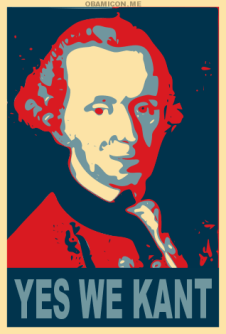
In other words, Governor Kasich’s promise-keeping rationale is based on Kantian or rational ethics. According to the great German philosopher Immanuel Kant, it is immoral to use another person merely as a means to an end; people must be treated as ends in themselves. Governor Kasich’s elegant and humorous answer to the Trump question affirms this Kantian sentiment.
But what does it mean to treat people as ends? In brief, Kant argued that moral duties–duties like telling the truth and keeping one’s promises–are based on universal rules or “the categorical imperative.” Specifically, moral duties must at a minimum meet two fundamental conditions: consistency (i.e. the rule must treat like cases alike) and reversibility (one must abide by the same rules one uses to judge the morality of other persons’ conduct).
Both of these fundamental conditions not only apply to the general moral duty of keeping one’s promises; they also appear to apply to the specific political pledge made by the Republican presidential candidates to support their party’s eventual nominee. In short, if Trump’s rivals want Trump to support the eventual nominee, then they too have to be willing to support Trump if he wins the nomination this summer.
Promises, promises (part 3 of 4)
Note: this is the third post in a four-part series.
In our previous blog posts, we saw how Donald Trump’s remaining Republican rivals (Rubio, Cruz, and Kasich) have all pledged to support the eventual nominee of their party, even if the dreaded Trump were to win the nomination. We also focused on Rubio’s pragmatic rationale for making his promise–e.g. Trump is better than his most likely rival Hillary Clinton–and we offered two criticisms of Rubio’s reasoning. Today, let’s focus on Senator Cruz’s rationale for promising to support his party’s eventual nominee.
To begin with, here is the exact question Fox News reporter Brett Baier posed to Ted Cruz: “Senator Cruz, yes or no, will you support Donald Trump if he’s the nomimee?,” and here is Cruz’s concise and eloquent response: “Yes, because I gave my word that I would, and what I have endeavored to do every day in the Senate is do what I said I would do.”
Unlike Senator Rubio’s pragmatic reasoning, Senator Cruz’s competing reason for keeping his promises is grounded in the natural law or “virtue ethics” tradition. According to this traditional theory, when we voluntarily make a promise, we are duty-bound to keep our word. This “voluntary duty argument” makes intuitive sense, but there is a logical weakness with this argument when we examine it closely. In a word, the problem with the duty argument is that it is circular. That is, Cruz is essentially saying that he will keep his promise to Trump because he (Cruz) promised to do so!
Furthermore, in the words of one philosopher (Allen Habib), “The idea that we simply manufacture promissory obligations by speaking them, like an incantation, is decidedly mysterious.” In fact, this critique goes back to our favorite philosopher and intellectual hero David Hume, who wrote (emphasis in original):
“… since every new promise imposes a new obligation of morality on the person who promises, and since this new obligation arises from [the promissor’s] will, it is one of the most mysterious and incomprehensible operations that can possibly be imagined, and may even be compared to transubstantiation of holy orders, where a certain form of words, along with a certain intention, changes entirely the nature of an external object, and even of a human creature.”
In our view, no one has provided a persuasive reply to Hume’s devastating critique of the traditional natural law theory of promises, except maybe the great Immanuel Kant, so in our next post, we will conclude this series with John Kasich’s Kantian reasoning in support of keeping his promise …
Promises, promises (part 2 of 4)
Note: this is the second post of a four-part series.
In our previous blog post, we mentioned how Marco Rubio, Ted Cruz, and John Kasich recently reiterated their solemn pledge to support the eventual nominee of their party, even if the nominee were Donald Trump. In addition, we saw how Trump’s three remaining rivals offered radically different moral reasons in support of their promise. In this post, we will focus on Senator Rubio’s consequentialist or utilitarian reasoning in particular. To begin with, here is Rubio’s reasoning in his own words:
“I’ll support Donald if he’s the Republican nominee, and let me tell you why. Because the Democrats have two people left in the race. One of them is a socialist. America doesn’t want to be a socialist country. If you want to be a socialist country, then move to a socialist country. The other one is under FBI investigation, and not only is she under FBI investigation, she lied to the families of the victims of Benghazi, and anyone who lies to the families of victims who lost their lives in the service of our country can never be the commander-in-chief of the United States.”
In other words, Rubio’s promise to support Trump is a pragmatic one: however despicable Trump might actually be (a “con man” and a “liar” according to Rubio himself), once we consider and weigh the even worse Democratic alternatives to Trump, then we should support Trump because he is still preferable to Senator Sanders or Secretary Clinton. Okay, now that we have restated Rubio’s reasoning, we must ask, is it sound? Unfortunately for Rubio, we don’t think so.
In brief, there are two fundamental flaws with Rubio’s pragmatic and consequentialist reasoning. (1) One problem with pragmatism is that it is totally unprincipled, like most utilitarian reasoning generally. For instance, if one could somehow persuade Senator Rubio that either Sanders or Clinton were, in reality, preferable to Trump, Rubio would then be morally justified in breaking his solemn promise to support his party’s nominee. (2) The other problem with pragmatism or consequentialism is the problem of measurement. In this particular case, for example, how do we really know whether Sanders or Clinton would be worse than Trump? The relative merits of these candidates is not only a matter of subjective opinion; we will never really know who the “best” man (or woman!) for office is because only one of them can win come November!

Image credit: Sahar Shehata
Promises, promises
Note: This is the first post of a four-part series on the theme of promissory obligations.
During the summer of 2015, all the main Republican presidential candidates took a solemn pledge to support the eventual nominee of their party. Although such a political pledge does not appear to be legally binding, most people would agree that it is morally wrongful to not keep one’s promises. But why? Now, let’s fast forward to the most recent Republican debate–here is an anotated transcript via the Washington Post–which took place in Detroit on March 3, 2016. At the end of this debate, Fox News anchorman Brett Baier asked Donald Trump’s three remaining challengers (Marco Rubio, Ted Cruz, and John Kasich) this question:
“Gentlemen, this is the last question of the night. It has been a long time since our first debate, seven months ago in Cleveland. A lot has transpired since then, obviously, including an RNC pledge that all of you signed agreeing to support the party’s nominee and not to launch an independent run. Tonight, in 30 seconds, can you definitively say you will support the Republican nominee, even if that nominee is Donald J. Trump?”
All three candidates promised to honor their promise—to support Mr Trump if he were to win the nomination next summer—but interestingly, they offered radically different moral reasons in support of their pledge, including consequentialism (Rubio), virtue ethics (Cruz), and Kantian reciprocity (Kasich).
- Senator Rubio, for starters, said he would support Donald Trump in the end because Trump, even with all his faults, was still a better choice than the two remaining Democratic choices, Senator Bernie Sanders and Secretary of State Hillary Clinton. In other words, Rubio offered a consequentialist or utilitarian reason for keeping his promise: Trump is less bad than the other alternatives.
- In contrast to Rubio’s consequentialist claim, Senator Cruz offered an aretaic or virtue-ethics rationale for keeping his promise to support the nominee. Specifically, Cruz said he would support Trump if he won because “I gave my word that I would.” In other words, a virtuous man is one who keeps his word.
- For his part, Governor Kasich offered a deontological or duty-based reason for keeping his promise. He said, “when you’re in the [political] arena, you enter a special circle, and you want to respect the people that you’re in the arena with.” This statement is consistent with Kantian ethics, which requires one to treat one’s rivals with equal dignity–as ends and not as means.
“Spotlight”
Here is our review:
Although this film is ostensibly about a team of journalists at the Boston Globe who exposed corruption at the highest levels of Boston’s Catholic Church, it’s also about the law and about lawyers. Interestingly, lawyers are both the villains and the heroes of this remarkable story: (i) the villains who defended scores of corrupt priests and helped cover up their evil misdeeds by negotiating secret out-of-court settlements with victims; (ii) the heroes who represented the victims and fought on their behalf in open court, refusing to negotiate secret back-room deals with the Church.
Moreover, one of the most momentous turns in this story does not occur in a press room; it occurs in a courtroom, when lawyers for the Globe present a motion requesting the release of sealed documents that would expose to the world the Church’s immoral cover-up. The judge who rules for the press and unseals the documents is Constance Sweeney. Without her ruling or the persistence of some of the lawyers for the victims, there would probably be no front-page story. As such, we wish to echo film critic Richard Brody’s sentiments. He wrote last fall, “As I watched the movie, I was utterly frustrated—I wanted the camera to be a fly on the wall in Judge Sweeney’s chambers as she discussed the case with her law clerk, or perhaps with a colleague, so that her reasoning would become part of the film. No such luck; the ruling is delivered, and the journalists get back to work.”

Give the lawyers some credit (and blame) too …