In the movie version of the bestselling book The Accidental Billionaires: The Founding of Facebook, Eduardo Saverin threatens to sue his friend Mark Zuckerberg when he finally discovers that his original 30% equity stake in Facebook–the social network business he cofounded with Mark and Dustin Moscovitz–has been diluted all the way down to “point zero three percent.” Eduardo confronts Mark: “You better lawyer-up, asshole, ’cause I’m not coming back for my 30 percent, I’m coming back for everything!” In other words, Eduardo threatens to sue for significant monetary damages … But given everything we’ve studied thus far (i.e. Lessons 1 through 9), under what legal theories could Eduardo sue Mark for, and what type of court (State or federal) would have jurisdiction to decide Eduardo’s legal claims? By the way, in real life, Mark actually sued Eduardo first! Why?
Moving movie posters
The Mathematics of Bookmaking
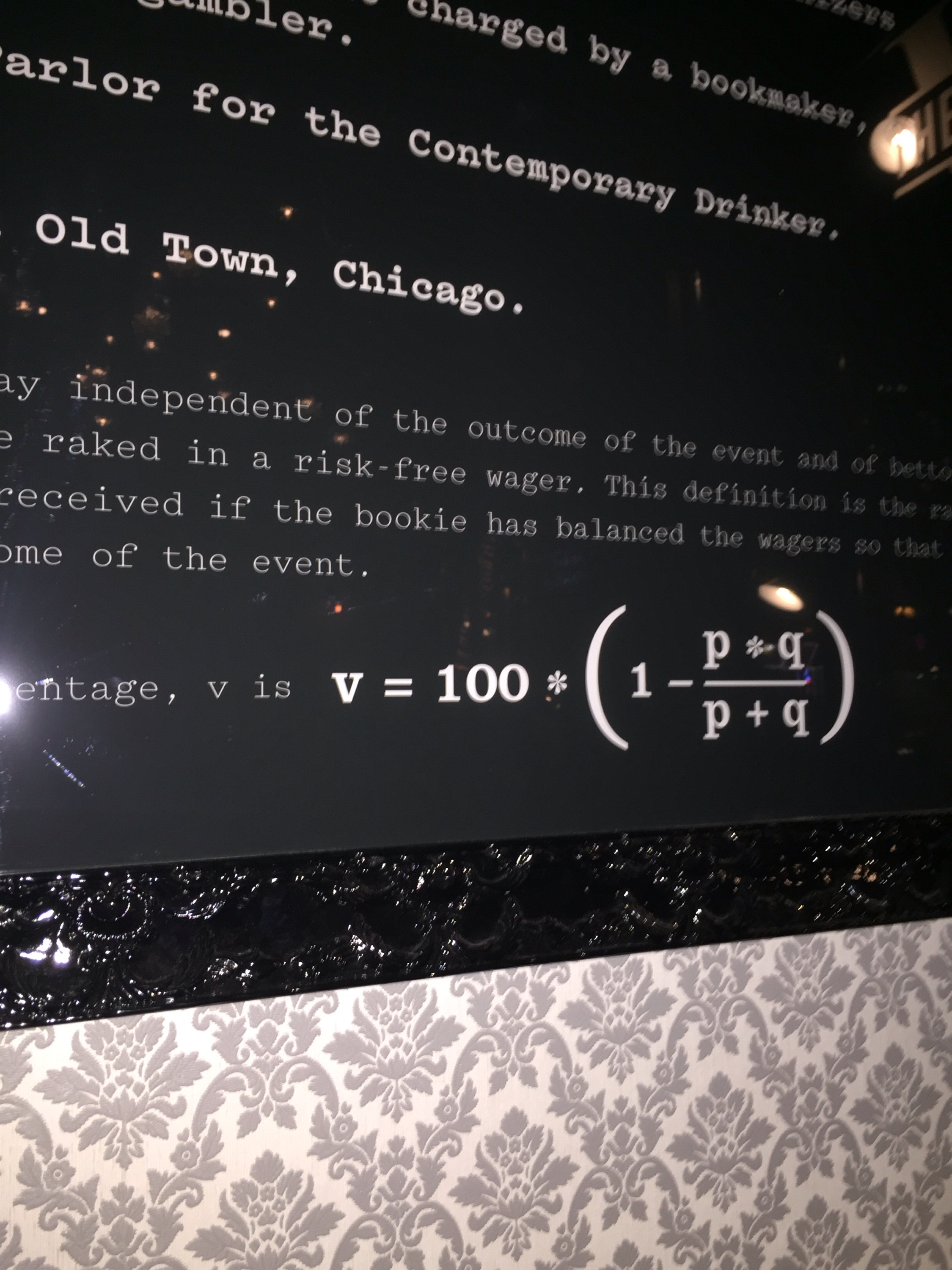
In the gambling world, vigorish refers to the amount charged by a bookmaker, or bookie, for taking a bet from a gambler. We found the following formal definition of vigorish on the walls of a tavern in the Old Town section of Chicago: “Vigorish percentage can be defined in a way independent of the outcome of the event [being bet on] and of the bettors’ behavior by defining it as a percentage raked in a risk-free wager. This definition is the rake of the bookie as a percentage of total bets received if the bookie has balanced the wagers so that he makes equal profit regardless of the outcome of the event.” (The formula above applies to a two-outcome event.)
Are smartphone videos “speech” or “conduct”?
This is an important legal question, since “speech” is generally protected under the First Amendment, while “conduct” can be prohibited and punished. At this year’s Loyola constitutional law colloquium in Chicago, professor Alan K. Chen explained why digital photographs and videos should be classified as speech acts under the First Amendment. (See his forthcoming paper “Free Speech and Democracy in the Video Age,” co-authored with Justin Marceau.) Given the ubiquity of digital photography and videos in our daily lives (think of all the police brutality videos and undercover videos of abortion “doctors” in the news lately), we consider this paper the most important one of the entire colloquium. By the way, if courts were to define digital photographs and videos as speech, wouldn’t corporations try to assert a right to privacy (the “Citizens United gambit”) in order to trump the speech rights of the public and of their employees?
What does it mean to “interpret” the Constitution?
This is one of the penetrating questions Richard Posner posed at the Sixth Annual Constitutional Law Colloquium at Loyola University in Chicago. According to Judge Posner, judges resort to various ad hoc theories of interpretation to decide cases when the text of the Constitution itself does not provide any obvious or sensible answer to the issue presented in the cases before them. Take “the right to free speech,” for example. The text of the First Amendment clearly states that the Congress shall not “abridge” the right to free speech, yet despite the explicit existence of this textual right, many forms of speech–threats, false statements, copyright infringement, etc., etc.–are abridged via legislation as a matter of course. For Posner, then, “interpretation” is just a fancy word for judicial problem-solving (i.e. deciding disputes) in those cases in which the text of the Constitution is of no help. Returning to Posner’s preferred example (free speech), courts must often decide what legislative limits to free speech are consistent with the Constitution, but the Constitution itself does not provide any definitive answer to this question. Judges must figure out this problem for themselves.
Image Credit: Concurring Opinions.“The Coasian Constitution”
That is the title of our most recent work-in-progress in which we suggest replacing judicial review with some form of “constitutional arbitration.” We will present our work during the Sixth Annual Constitutional Law Colloquium sponsored by the Loyola School of Law in Chicago. Our panel is scheduled for this Friday, Nov. 5th, at 1:15 pm in Room 1102 of Loyola (25 E Pearson Street). Feel free to see us speak if you are in Chicago. Below the fold is an outline of our presentation: Continue reading
Television Markets in the Continental U.S.
Why not use this map of broadcast TV markets to create a new system of congressional voting districts and thus solve the gerrymandering problem in politics? Hat tip: elliotd303 (via reddit).
The Economics of Internet Platforms
Question: What do all of these Internet platforms have in common? In the case of Uber, Alibaba, and Airbnb, these platforms create new markets by bringing together sellers and buyers … But what type of market is Facebook creating? (Hat tip: Tushar Goyal, via LinkedIn.)
“Breaking Bad and the Natural Law Tradition”
Update (2 Feb. 2016): Our paper has a new title: “So Long Suckers: Bargaining and Betrayal in Breaking Bad.” We’ve posted a complete draft of our working paper on SSRN, and we’ve posted our new abstract here.
That is the tentative title of our work-in-progress in which we evaluate the fateful actions of meth-kingpin Walter White (alias Heisenberg) and DEA agent Hank Schrader–the two lead characters in the popular crime-drama “Breaking Bad“–from a natural law perspective. (We have written a series of papers over the years exploring the intersection between popular culture and law. See here, for example, if you are into vampires. Our “breaking bad” paper, which we expect to complete by early 2016, is our most recent contribution to this series.) In the meantime, here is the abstract of our “breaking bad” paper: Continue reading