Civil Liability for Research Fraud?

We explore this novel legal question in our most recent work-in-progress titled “The Law & Economics of Research Fraud,” which is available on the Social Science Research Network (SSRN) here. Our paper sets the stage by reviewing three recent examples of alleged research fraud in the social sciences: James Hunton’s various research projects on accounting fraud, Michael LaCour’s fake gay-marriage survey published in the journal Science (and later retracted), and Alice Goffman’s dubious study of fugitive life in her best-selling book On the run. Next, we delve into the law and assess the potential civil liability of lead authors and co-authors in cases involving fabricated data under various common law theories of liability (tort and contract). We also assess the potential civil liability of research institutions and “predatory publishers” under various theories of vicarious liability. (By the way, we will write about the possibility of criminal liability in a future paper.) There is, however, a larger question that we leave to others for now: would the imposition of legal liability have a “chilling effect” on research? Maybe, maybe not, but here is another question to think about: why should academics be held to a lower legal standard than, say, businessmen are?

Posted in Uncategorized | 1 Comment

A life in economics (Angus Deaton edition)

The “Nobel Prize” in economics–or the Sveriges Riksbank Prize in Economic Sciences in Memory of Alfred Nobel 2015–is perhaps the most prestigious award in all of the social sciences. Previous winners include our intellectual heroes Thomas Schelling, Ronald Coase, and John Nash. This year’s Nobel in economics was awarded to one Angus Deaton “for his analysis of consumption, poverty, and welfare.” Check out Professor Deaton’s beautiful autobiographical essay “Puzzles and paradoxes: a life in applied economics.” Here is an excerpt:

It has been a good time to spend a life in economics. Compared with many others, the profession is remarkably open to talent, and remarkably free of the nepotism and patronage that is common in professions in which jobs are scarce. It is also a profession that, deservedly on undeservedly, is very well- rewarded. The best gifts of a profession are the people it brings, to talk to, to work with, to be mentored by, and to make friends with. I have been truly fortunate in this respect. * * * Many of my oldest and best friends, many of them also mentors, have come to me through economics. Through economics too, I met my wife, Anne Case, and our personal and professional lives are almost entirely integrated; Anne is my critic, my colleague and coauthor, and my friend. * * *

Posted in Uncategorized | Leave a comment

Bat flips and moral philosophy?

Revised on Oct. 19. When Toronto slugger Jose Bautista crushed a monster “homerun” off the hapless Texas Rangers’ reliever Sam Dyson, Mr Bautista arrogantly chucked his bat to the side before rounding the bases. (The T-shirt pictured below breaks down Bautista’s epic bat flip.) So, what’s wrong with some brashness in baseball? Andrew Keh’s eloquent essay “Baseball reaches a flipping point” sums up the debate this way:

To some, the [bat flip] maneuver symbolizes a break from the gentlemanly principles that have supposedly steered the game across generations. * * * To others, bat flips represent a breath of fresh air in a stuffy sport and reflect the game’s increasingly diverse clubhouses, which feature more and more players from the Latin America and Asia, where such celebrations tend to be more common. * * *

Notice that “reciprocity” or the Golden Rule doesn’t solve this debate at all, since a norm of reciprocity could go either way in this case. Likewise, an argument based on “tradition” doesn’t really carry very much weight either, since we still have to decide which traditions are good and worth keeping and which are bad and worthy of elimination. Lastly, could John Rawls be helpful here? That is, what “bat flip” rule would most people favor from behind a veil of ignorance? (Or, is your guess as good as mine? Yeah, that’s what we thought!) In other words, is there a principled way of solving this debate, or is it just a matter of your personal preference, like so many rules of ethics, law, and morality?

Posted in Philosophy, Sports | Leave a comment

The Law & Ethics of Napster

Before Sean Parker discovered Facebook, he had co-founded a company called Napster, a peer-to-peer file-sharing website that allowed users to share MP3 music files with each other (see image below, courtesy of the website “How Stuff Works“). At the time, Napster was huge. According to Wikipedia, for example, “verified Napster use peaked with 26.4 million users worldwide in February 2001.” The Recording Industry Association of America wasted no time in filing a federal lawsuit against Napster–the file-sharing website was launched in June 1999; the lawsuit was brought in December 1999–and the record industry eventually persuaded a court to issue an injunction or court order shutting down the website … But did the court make the correct decision, and on what legal grounds did the court issue this draconian remedy (i.e. the injunction shutting down Napster)? Let’s say, by way of example, that you have paid for and downloaded onto your computer your favorite movie or your favorite record album. Is it illegal or unethical for you to then send that file to a friend … or to a member of your immediate family? What about your Netflix password? Is it illegal or unethical to share the password to your Netflix account with a friend or a family member?

Posted in Uncategorized | Leave a comment

An Aviation Thought Experiment (Public Choice Edition)

Hola! We have been invited to speak about a federal law known as “the Jones Act” during today’s “fiscal crisis” panel of the Encuentro Nacional de la Diaspora Puertorriquena. (The “Encuentro Nacional” will take place at El Centro Borinqueno, which is located on 1865 N. Econolockhatchee Trail in Orlando, Florida, and our panel is scheduled to begin at 10:40 am and conclude at 12:20 pm.) If you are unable to attend, here is what we will be talking about: imagine if the Congress were to enact legislation–under the pretext of “national security,” of course–requiring all goods and passengers transported by air between airports within the United States be carried only on U.S.-flag aircraft built in the United States. In other words, imagine a federal law that not only prohibited all non-U.S. airlines from transporting cargo and passengers within the United States but that also prohibited all aircraft manufactured by Airbus and other foreign manufacturers from flying within the U.S. Well, guess what? We already have a federal law like this on the books. It’s called the Jones Act. The only difference is that the Jones Act applies to the shipping industry, not to aviation. By the way, the Congress is not the only legislature guilty of engaging in such a blatant form of economic protectionism. The Puerto Rico Legislature, which has enacted many misguided protectionist laws over the years, is a “repeat offender” in this regard. Maybe Puerto Rico’s politicians should consider getting their own house in order, since unfortunately the Congress is unlikely to repeal or amend the Jones Act any time soon, if ever.

How much is this going to cost us?
Posted in Economics, Law | Leave a comment

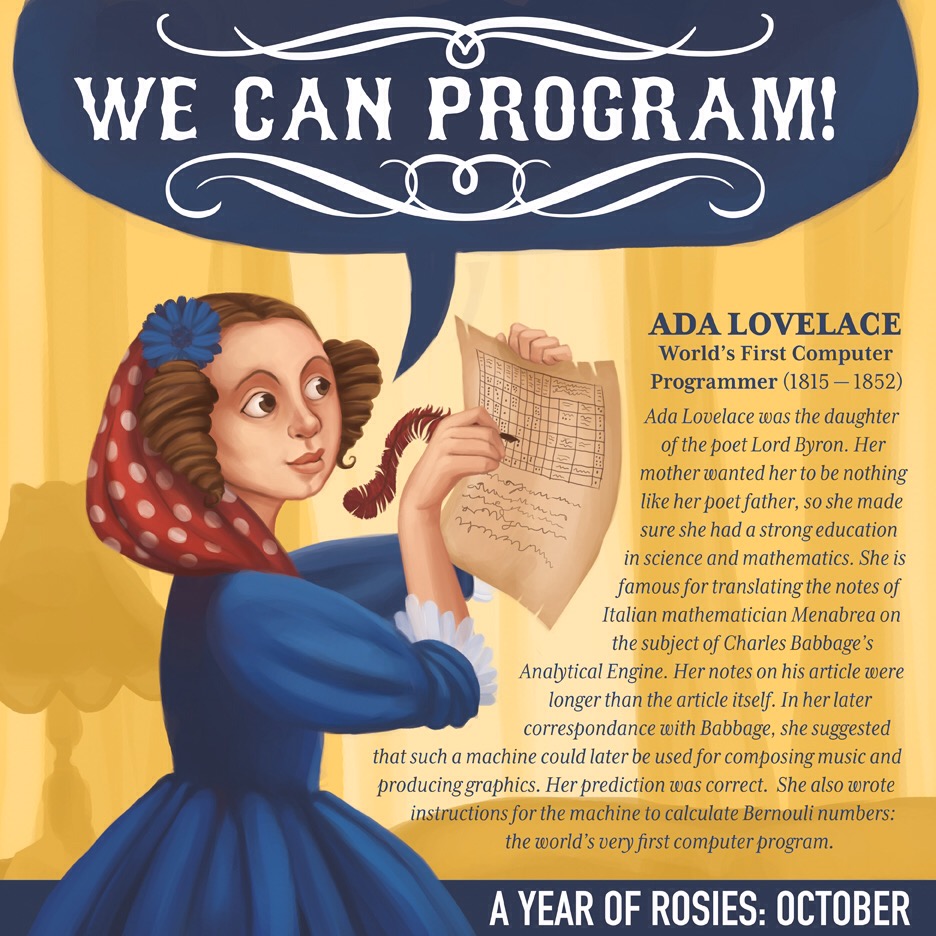
Happy Ada Lovelace Day!

Posted in Culture, Science, Web/Tech | Leave a comment

Why won’t Richard Epstein update his priors?

In our previous two posts (part 1 and part 2), we summarized Professor Richard Epstein’s critique of the great F. A. Hayek. It is now time to assess Epstein’s criticisms of Hayek–to critique the critique, so to speak. It pains us to say this, but either Epstein is not a very good reader or he is not a good Bayesian. On page 136 of “The Constitution of Liberty,” Hayek specifically anticipates Epstein’s monopoly problem and concedes that “a monopolist could exercise true coercion … if he were, say, the owner of a spring in an oasis.” In addition, Hayek writes (ibid.):

It is worth pointing out … that whenever there is a danger of a monopolist’s acquiring coercive power, the most expedient and effective method of preventing this is probably to require him to treat all customers alike, i.e., to insist that his prices be the same for all and to prohibit all discrimination on his part.

In other words, Hayek’s solution to the monopoly problem anticipates the exact same argument that Professor Epstein makes in his critique of Hayek. We not only suspect, however, that Professor Epstein is a careless reader; we also suspect that his inability to give Hayek credit where credit is due might be the result of Epstein’s general skepticism about philosophy’s ability to contribute to our understanding of the law. Simply put, Professor Epstein has a particular view of the world. Fine, we all do. In Epstein’s case, his view is that modern philosophy has little to offer legal theory. (See, for example, his thoughtful 1999 Dunbar Lecture published in volume 68 the Mississippi Law Review under the title “Life Boats, Desert Islands, and the Poverty of Modern Jurisprudence.“) Given these priors about philosophy, Epstein must have reasoned thus: Since Hayek, at bottom, is really a philosopher, then Hayek must have little to offer legal theory. But had Epstein read Hayek more carefully, he would not have been so quick to dismiss Hayek’s contributions to law.

Posted in Uncategorized | Leave a comment

Epstein’s Critique of Hayek (Part 2)

In our previous post, we identified (via the loquacious Professor Richard Epstein) a potential contradiction in Hayek’s influential theory of “spontaneous order.” Briefly, decentralized markets are a good example of a spontaneous order, but markets require a set of rules or a legal framework in which contracts and property rights are enforced, and this framework itself is often (though not always) the product of human design. (See also Regis Servant’s thoughtful comment in our previous post.) But aside from this mismatch, Epstein identifies another major blind spot in Hayek’s work. Specifically, Epstein asks, what happens when there is a breakdown of spontaneous order? Continue reading

Posted in Economics, Law, Philosophy | 4 Comments

Epstein’s Critique of Hayek (Part 1)

We recently attended Richard Epstein’s lecture at George Mason University on “The Continuing Relevance of Hayek’s The Constitution of Liberty.” (Disclosure: we are big fans of Epstein’s book “Simple Rules for a Complex World.”) In his lecture, Epstein delivered several devastating blows against Hayek’s body of work. Among other things, Epstein spotted an internal inconsistency in Hayek’s thinking. Let’s start with Hayek’s greatest contribution to the field of political economy: his counter-intuitive notion of “spontaneous order.” In his famous paper on “The Use of Knowledge in Society,” for example, Hayek explains why decentralized markets produce greater levels of peace and prosperity than centralized “command-and-control” systems do. Simply put, when people are free to decide for themselves what things to buy and sell, their choices spontaneously generate high levels of social coordination without any intentional design or central planning. In Hayek’s own words: “The continuous flow of goods and services is maintained by constant deliberate adjustments, by new dispositions made every day in the light of circumstances not known the day before, by B stepping in at once when A fails to deliver.” (Hayek, 1945, p. 522.) Hayek’s main point is that all these “deliberate adjustments” and “new dispositions” are made voluntarily by millions of individuals and firms acting independently of each other, and yet, in spite of the lack of centralized control, this chaotic process produces a wide array of complex goods and services that people want to buy. So, where’s the inconsistency? Continue reading

Posted in Economics, Law, Philosophy | 7 Comments

Oyez! Oyez! Oyez! 

  
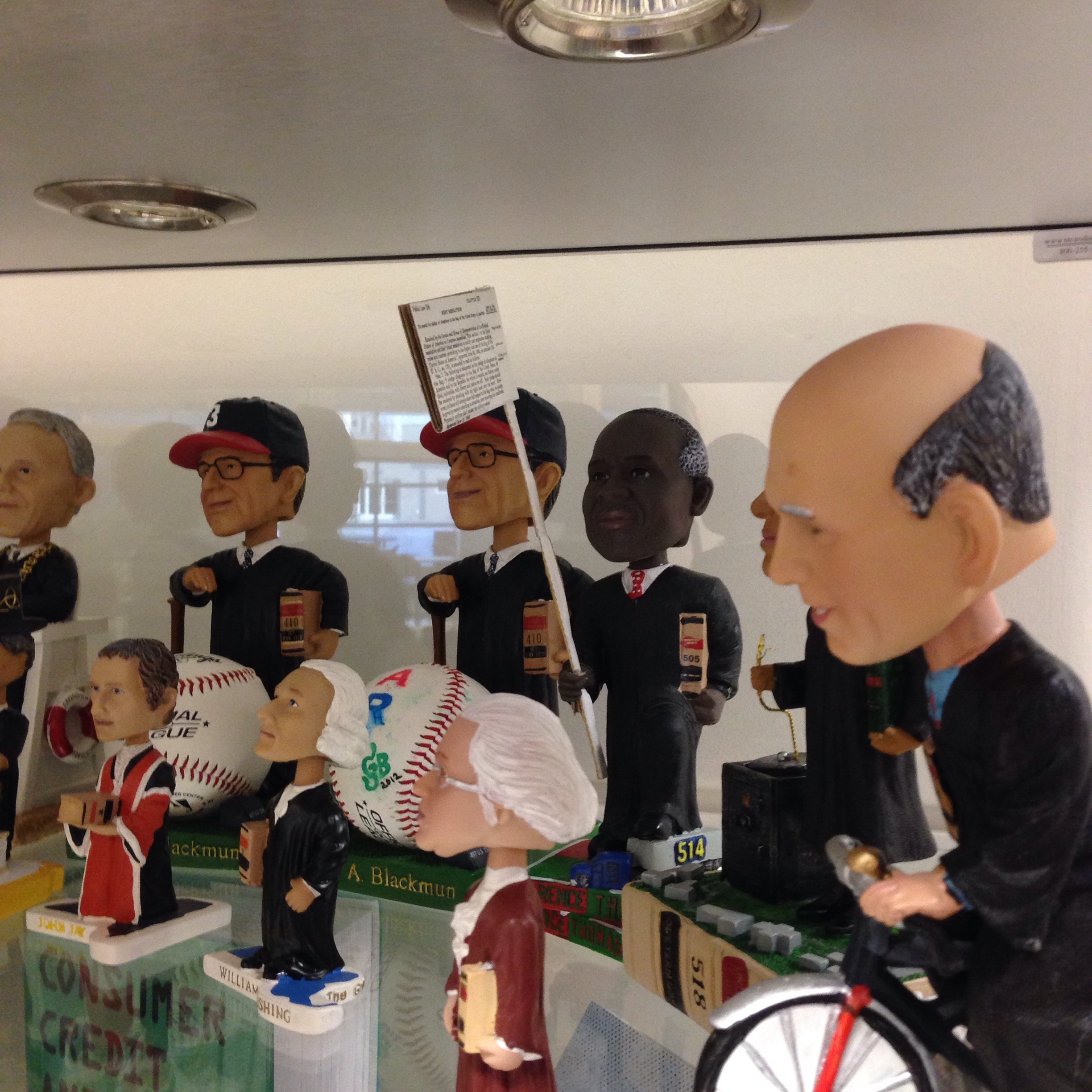
The law library of George Mason University has a wonderful collection of bobblehead dolls of our Supreme Court Justices and other historical jurists.

Posted in Culture, Law | Leave a comment